Volcano club

<a href=showthread.php?s=&postid=12964599#post12964599 target=_blank>Originally posted</a> by pdelcast
Dude -- I'm afraid you have a few things wrong...

DC motors work by converting the DC to AC either by using brushes or by using a synchronous controller. So there isn't any real difference between DC and AC motors. No rotary motors use pure DC as a power source. (well, actually homopolar motors use pure DC, but they are extremely rare, and very very poor efficiency.)

RMS wattage is real wattage. It is essentially the integral of the power function over the time domain. VA is NOT the real wattage -- you have them backwards. VA (when talking about AC wattage) is a generalized mean (OR peak power -- which isn't the same as watts, which is a measurement of energy usage)- - less accurate than a true RMS measurement. RMS wattage works with sinusoidal, square, multiphase ... you name it. VA only works with DC or Sinusoidal currents. A lot of people use simplified RMS calculations -- and get VA instead (which is incorrect) -- the proper RMS calculations return TRUE average power by a varying load.

The most efficient widely available current motor designs are DC Permanent magnet brushless (where the controller converts DC to three phase AC synchronously with motor rotation.) Efficiencies on those types of motor typically exceed 90% -- BUT, copper rotor induction motors are very close (85-87%), and don't have the AC-DC conversion efficiency losses.

Real Wattage/VA = RMS wattage / Power Factor

Power Factor = direct term in calculating efficiency of a motor, so a motor with a PF of .4 will be no more than 40% efficient. DC motors dont have a power factor and the VA = RMS.

VA only works with DC or Sinusoidal currents? Well, AC is sinusoidal, no?

I really dont care to go into integrals and such here, but for all practical purposes, I dont see what you say is wrong here. I realize that most DC motors rely on some method of conversion back to AC for polarity, but this is what also allows them to vary their speed according to voltage, and they still keep their efficiency much better than an AC motor which has its power factor at .4-.5 or something (what many AC pumps are at when used as needlewheels). Maybe rather than 'REAL' power, I should have used the term 'apparent power'. Because of the conversion from AC to DC though, the power needed for a DC motor ends up much higher than the regular AC motor's RMS wattage, and not just due to power losses at the conversion.

A simple google search explains it all I suppose:
http://www.geocities.com/vijayakumar777/powerfactor/powerfactor.html
 
Would there be anyway or benefit in just making an extension to the existing Dart volute? I have also noticed with playing with my dart NW that when I bush the input to about 5/8" that it seems to have a better water to air ratio. I got 89watts and 58-60scfh when it was ran like this on the Orca reeflo skimmer. I undid the mod as I was unsure if this would hurt the motor due to the power factor in these motors are around 140. I did like how less turbulent the air coming out of the bubble chamber was. Any thoughts or recommendation would be helpful since it seems we have all the skimmer big wigs here? Have you experienced this with any of your smaller Volcanoes spazz? Do you restrict the input on your pumps at all?
 
<a href=showthread.php?s=&postid=12965395#post12965395 target=_blank>Originally posted</a> by hahnmeister
Real Wattage/VA = RMS wattage / Power Factor

Power Factor = direct term in calculating efficiency of a motor, so a motor with a PF of .4 will be no more than 40% efficient. DC motors dont have a power factor and the VA = RMS.

VA only works with DC or Sinusoidal currents? Well, AC is sinusoidal, no?

I really dont care to go into integrals and such here, but for all practical purposes, I dont see what you say is wrong here. I realize that most DC motors rely on some method of conversion back to AC for polarity, but this is what also allows them to vary their speed according to voltage, and they still keep their efficiency much better than an AC motor which has its power factor at .4-.5 or something (what many AC pumps are at when used as needlewheels). Maybe rather than 'REAL' power, I should have used the term 'apparent power'. Because of the conversion from AC to DC though, the power needed for a DC motor ends up much higher than the regular AC motor's RMS wattage, and not just due to power losses at the conversion.

A simple google search explains it all I suppose:
http://www.geocities.com/vijayakumar777/powerfactor/powerfactor.html


RMS already takes power factor into account --

Power factor is non-sinusoidal current draw -- it is a term which describes how far off the current draw waveform is from the voltage sinusoid. -- hence the term "power factor." Resistors have a power factor of 100 -- they draw current at equal to incoming voltage. Inductive (motor) and capacitive (power supply) currents are not typically sinusoidal. Power factor is already included in RMS calculations, because RMS calculations use the integral of the current function over the time domain for calculation.

Yes, Power factor is required to convert VA to true watts -- that is because VA doesn't include power factor in the calculation for VA. RMS calculations DO include power factor already, so they are already TRUE WATTS.

I was just trying to explain that I think you got VA and RMS backwards -- when things are rated in VA, the manufacturer is trying to "boost" the ratings -- because VA is often expressed in "peak" rather than average. RMS is always TRUE watts, and can't be "perverted" for a boost in ratings.


Look this up -- it should explain:

http://en.wikipedia.org/wiki/Root_mean_square

http://en.wikipedia.org/wiki/Volt-ampere
 
Last edited:
OR I can look in any one of my EE texts (I kept them around). lol.

VA/RMS=PF tells the pump's efficiency in a big way. If the PF is low, the pump will run hotter than if the PF was higher. Many pumps run at .8 to .9 as regular motors, but as needlewheels they can drop to .5 or .4, sometimes even worse. Lets say you take a 40 watt AC pump with a PF of .5. Chances are to get the same performance from a DC pump, you would be looking at about 80 watts (the VA of the AC). That was really the whole point.
 
I'm now officially in the club! Yesterday I picked up my skimmer from Spazz and I am hooking it up today. I got the 4 ft tall model. I plan to gravity feed it from my 420g display (900 gallon system).

I would like some advice from other Volcano users. How much water would you recommend running through the skimmer? Right now I have around 1200gph going through the drains. Scott thought something closer to 1800 gph would be better. Is anyone running one of these with less than 1500 gph? What should I look for to determine the right flow? Is it mainly an issue of turbulence?


Here are a couple of pics. Click my red house to see my build thread.

Being water tested at Scott's shop.
IMG_8147.jpg


Being loaded up.
IMG_2715.jpg


Sitting in my living room.
IMG_9839.jpg


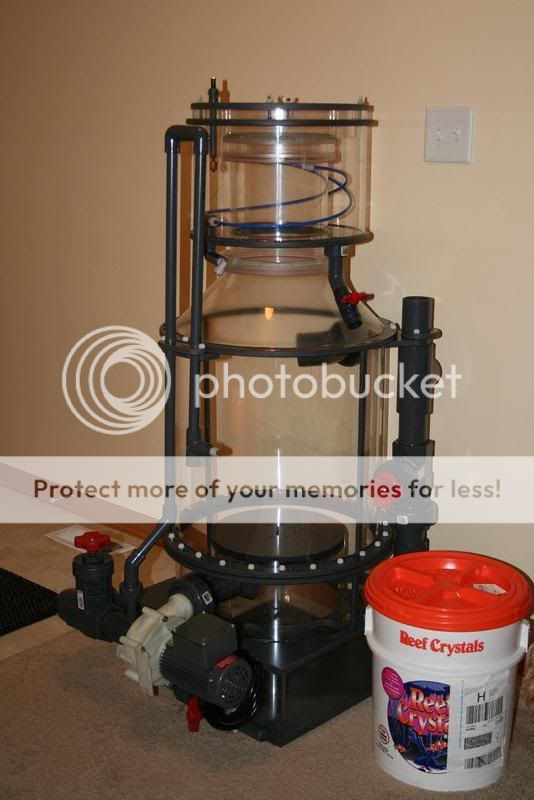
The workmanship on my skimmer is excellent. I knew to expect a very high quality skimmer, as my buddy Double-J has the 6ft model, and is very happy with it. I can't wait to get this thing up and running. My tank has been skimmerless since I set it up 7 months ago.


Brad
 
It looks great! Let's see it up and running. BTW I'm hoping that's my 1850 in the background of your picture in Scott's shop.
 
figured I would share as well. I can say first hand that the construction of these skimmers is top notch. As is the construction of the calcium reactors.... And the tanks if you can talk him into building one. I just recieved my skimmer today, but I also own a carx by aquatic acrylics, and my tank was made there. I guess you could say I have an aquatic acrylics house :)


On with the pics! (sorry, I couldn't resize them :( )
skimmer:
DSC_5800-1.jpg


CArx:
DSC_5801-1.jpg

DSC_5802-1.jpg


Tank:
DSC_5804.jpg
 
Back
Top