Wanted: Reefsafe glue/epoxy/cement

TampaSnooker

Active member
The catch is that I need to use a LOT of it in a tank full of livestock.

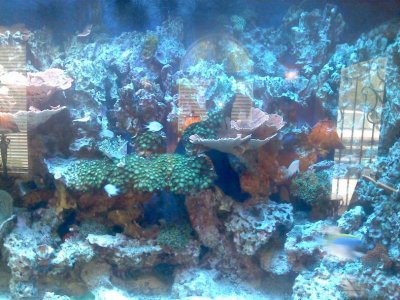
I have an 800 gal reef in my care that has had some rockwork shift about 2/3 of the way down. Tank dimensions are 8' x 2' x 4'H. The way I see it, I have 2 options for repair: 1. Find a nontoxic material with the consistency of wet cement or cyanoacryllate gel and just slather it in all the gaps I can to harden - or 2. Drain the tank 2/3 of the way to the area in trouble and try to re-stack and re-cement.

Given that there is a good amount of fish and coral growth in this tank, I need something that is nontoxic when curing and something that doesn't require as much flushing as cement. Anything that requires more than a few hours of curing time or flushing will require the dismantling of the tank to remove fish and corals, which I'm trying hard to avoid. Also, it is located in a busy Dr's office so we're trying to keep downtime and disruption to a minimum.
 

Attachments

  • 0501121002.jpg
    0501121002.jpg
    103.2 KB · Views: 11
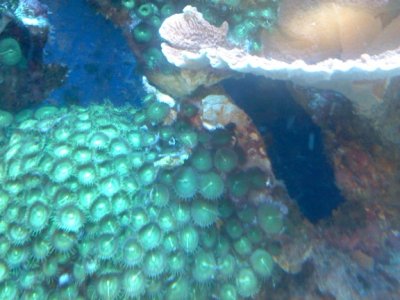
The area in question is the right hand side of the ledge full of green palys. The left hand side is solid, but the right is supported by a very small pinnacle beneath and the counter balance of the rock above and left. I thought about aquamend/2 part epoxy beneath it but that requires a very small person to be able to get in the tank to apply it. Frankly, I just don't trust the kids... What I"m hoping to find is a material that is gel-like and can be pumped or squeezed in via a caulk gun or a hand pump with a hose like is used for motor oil/fluids. Cyanoacryllate always seems to fail over time.
 

Attachments

  • 0501120958.jpg
    0501120958.jpg
    87.7 KB · Views: 11
After a few conversations today, the winner so far is EPO putty. That will still require dismantling 1/4 of the tank to fix the paly ledge due to lack of support on the right. Thanks to Mr.Wilson for the recommendation. Does anyone know of something that has the consistency of thich cyanoacryllate but that dries hard AND stays adhesive over time? Every cyanoacryllate I've used lets go after being under water for a while.
 
Don't use cyanoacrylate for this application, it will not work. You can use underwater epoxy (I use "water-weld" from lowes/home depot) which will cure underwater just fine but large quantities would be expensive and I don't think you could apply it using a calk-gun (too thick).

Several manufacturers make reef-safe "mortar" that you can buy in bulk and will bond live rock permanently.

Something like:

http://www.marcorocks.com/bondingmortar.aspx

I think the problem would be getting it to flow/stay where you want under water... usually you mix it with a set volume of liquid until it's a thick paste and apply to "dry" rock. Underwater it might not set properly.
 
We're going with EPO putty. It's reputation seems to be better than other epoxy/putties both in adhesion and long term durability. The rockwork was originally set up with a reef safe cement, but they all fail in time. The marco rocks site even recommends that it only be used up to 55 gal tanks for light duty. This is 2.5-3' down in an 800 gal tank - we need heavy duty. Neither cyanoacryllate nor common aquarium putties stick to frag plugs, so they're definitely out for this job.
Today we are taking measurements for bracing and trying to figure out which or us gets to try to squeeze through the top of the tank around lighting and plumbing to apply the bracing and putty - a tough reach for 2 short, stocky guys... I did have a good idea to purchase a sheet of plexi glass to protect the viewing pane in case of further adjustments while we're working. I think that we will be able to secure the largest rock to the pinnacle it came to rest on with an XL cable tie to give the putty repair some extra strength.
 
http://www.epoputtyusa.com/ There are several distributers. I used Jim and the shipment was prompt.

Went by the client's office today and found that the rocks had shifted again. I think they are being held up by the Grace of God at this point. A 30" ledge has one corner tucked under a large rock above it and the rock above that is suspended in mid water - held in place by a Monti cap. I was able to build a brace out of PVC to support so if it shifts again, it can't tumble forward into the acryllic. We weren't able to schedule the repair until Thursday evening - and that took some convincing with the Dr and staff.
The good side to that is it removed any doubt as to how we have to procede. The plan is to drain out 2-300 gal into barrels and keep the corals covered - there's lots but nothing fancy at the top - big candy cane, several orange monti caps and asst zoas. I think we'll have a few hours to work if we keep the corals covered in a wet towel. Some plumbing will have to come out, but that's no biggie. We discovered that we can just barely reach the failing ledge, so we'll just remove 1-200# of rock, brace it and restack with putty. Never thought I'd be working on a mature 800 gal tank with internal scaffolding...
I just wish I knew of a good cement with fibers in it - similar to fiberglass. It would be nice if I had a way to incorporate the same idea in cement to coat all the repairwork. This tank is about 5 years old and the cement is failing all over because there is nothing to hold the cement together. I think that biological activity helped to weaken it. In a way, it's a blessing that we have to reassess the structures now before the viewing panel got scratched. We'll have enough Monti cap to cover up all the ugly spots when we're done and will use that as a natural adhesive as it grows.
I'm in this far - I'll post more on Thursday after the repair - hopefully with pics.
 
http://www.epoputtyusa.com/ There are several distributers. I used Jim and the shipment was prompt.

Went by the client's office today and found that the rocks had shifted again. I think they are being held up by the Grace of God at this point. A 30" ledge has one corner tucked under a large rock above it and the rock above that is suspended in mid water - held in place by a Monti cap. I was able to build a brace out of PVC to support so if it shifts again, it can't tumble forward into the acryllic. We weren't able to schedule the repair until Thursday evening - and that took some convincing with the Dr and staff.
The good side to that is it removed any doubt as to how we have to procede. The plan is to drain out 2-300 gal into barrels and keep the corals covered - there's lots but nothing fancy at the top - big candy cane, several orange monti caps and asst zoas. I think we'll have a few hours to work if we keep the corals covered in a wet towel. Some plumbing will have to come out, but that's no biggie. We discovered that we can just barely reach the failing ledge, so we'll just remove 1-200# of rock, brace it and restack with putty. Never thought I'd be working on a mature 800 gal tank with internal scaffolding...
I just wish I knew of a good cement with fibers in it - similar to fiberglass. It would be nice if I had a way to incorporate the same idea in cement to coat all the repairwork. This tank is about 5 years old and the cement is failing all over because there is nothing to hold the cement together. I think that biological activity helped to weaken it. In a way, it's a blessing that we have to reassess the structures now before the viewing panel got scratched. We'll have enough Monti cap to cover up all the ugly spots when we're done and will use that as a natural adhesive as it grows.
I'm in this far - I'll post more on Thursday after the repair - hopefully with pics.
 
Back
Top