
You are using an out of date browser. It may not display this or other websites correctly.
You should upgrade or use an alternative browser.
You should upgrade or use an alternative browser.
What DI resin should I be using?
- Thread starter kevin_e
- Start date

mcgyvr
New member
Do you have sufficient details on your water quality/system setup that would be needed for us to answer that question?
Input TDS? Water quality/contaminate report? Single or dual DI stages? and more ,etc....
Are you having any specific problems with what you are currently using?
Input TDS? Water quality/contaminate report? Single or dual DI stages? and more ,etc....
Are you having any specific problems with what you are currently using?
I am using a 4 stage system. Sediment filter, carbon block, membrane and single canister DI. I wouldn't say I have any problems per se. My TDS is high, but that's because I need a new membrane. My DI resin became depleted quickly.Do you have sufficient details on your water quality/system setup that would be needed for us to answer that question?
Input TDS? Water quality/contaminate report? Single or dual DI stages? and more ,etc....
Are you having any specific problems with what you are currently using?
I'm just shopping for DI replacement (and membrane) and noticed that there are a freshman products to house from and I want to make sure I get the best for my setup.
I want to replace my sediment filter and carbon block too. What's the benefits of a 5 micron vs 1, or vice versa?
Sent from my XT1080 using Tapatalk

Opus123
Member
This is the way to think of your RO setup. The RO membrane is the most important part. You want to protect it. This is where the sediment and carbon blocks come in. The sediment block filters out small particles that could quickly clog up the membrane. The carbon block then takes care of any chemicals that could harm the membrane. As for microns, there are different theories. I personally go by the philosophy that the sediment filter should be smaller or the same size as the carbon block. If the carbon block is smaller it could become clogged up quicker than the sediment filter and stop working efficiently. I personally have a .2 micron sediment filter and a 1 micron carbon block. You should also check your cities water report (assuming you are on city water) and make sure they are not putting chlormines in the water. If they are, then you want a carbon block that specifically removes this. You should also get a RO membrane with a 98% rejection rate or you can spend the extra like me and get the 99% membrane. My tap water is over 400 tds and my tds after the RO membrane is 4. I personally just order my DI from amazon. Unless you are needing the DI to do something special then the mixed is fine.
With a tds of 4, I should get around 1100 gallons of 0 TDS water out of my DI catridge.
If you don't already have one, you should invest in a handheld tds meter.
With a tds of 4, I should get around 1100 gallons of 0 TDS water out of my DI catridge.
If you don't already have one, you should invest in a handheld tds meter.
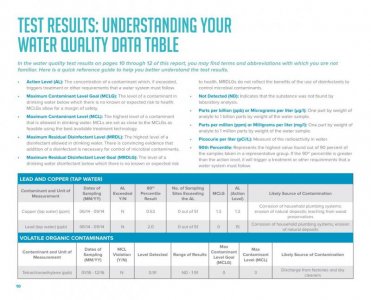
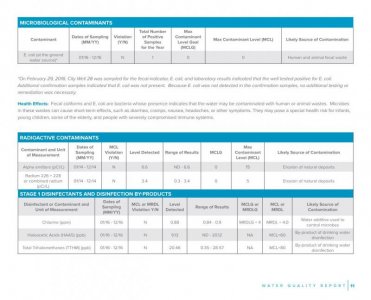
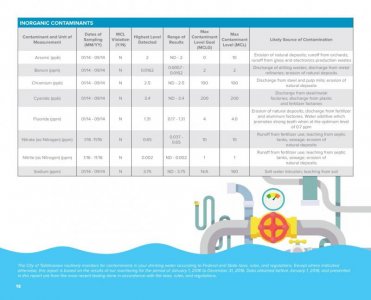
Thanks. It looks like chlorine is added. Here is out city's report:This is the way to think of your RO setup. The RO membrane is the most important part. You want to protect it. This is where the sediment and carbon blocks come in. The sediment block filters out small particles that could quickly clog up the membrane. The carbon block then takes care of any chemicals that could harm the membrane. As for microns, there are different theories. I personally go by the philosophy that the sediment filter should be smaller or the same size as the carbon block. If the carbon block is smaller it could become clogged up quicker than the sediment filter and stop working efficiently. I personally have a .2 micron sediment filter and a 1 micron carbon block. You should also check your cities water report (assuming you are on city water) and make sure they are not putting chlormines in the water. If they are, then you want a carbon block that specifically removes this. You should also get a RO membrane with a 98% rejection rate or you can spend the extra like me and get the 99% membrane. My tap water is over 400 tds and my tds after the RO membrane is 4. I personally just order my DI from amazon. Unless you are needing the DI to do something special then the mixed is fine.
With a tds of 4, I should get around 1100 gallons of 0 TDS water out of my DI catridge.
If you don't already have one, you should invest in a handheld tds meter.
My post mebrane TDS is 35ish, so I need to replace it. So 1 micron carbon block and sediment filter should be good together.
Sent from my XT1080 using Tapatalk
Attachments

josephxsxn
Member
If your only running 1 DI canister I would run a mixed bed of both resins. It will depend on your water if its more anion or cations. Personally in the city I reside in I almost never use cation up and use anion like its candy. I run 3 canisters (cation, anion, mixed)
With BRS iirc the non-Pro Mixed Bed color changing is Anion, and the Pro is Cation.
Cation is for Calcium, Mag, and Metals
Anion is for Phospahte and nitrates, etc
And +1 to what Opus123 said, protect your RO Membrane... Its what will give you the best life out of the DI Resins.
With BRS iirc the non-Pro Mixed Bed color changing is Anion, and the Pro is Cation.
Cation is for Calcium, Mag, and Metals
Anion is for Phospahte and nitrates, etc
And +1 to what Opus123 said, protect your RO Membrane... Its what will give you the best life out of the DI Resins.
Yes, 1 micron should be fine. At 35 tds, you will only get around 125 gallons of 0 tds out of a cartridge of DI.
Thanks. Well I need to replace my membrane, no question. I need to be lower than 35 tds.
If your only running 1 DI canister I would run a mixed bed of both resins. It will depend on your water if its more anion or cations. Personally in the city I reside in I almost never use cation up and use anion like its candy. I run 3 canisters (cation, anion, mixed)
With BRS iirc the non-Pro Mixed Bed color changing is Anion, and the Pro is Cation.
Cation is for Calcium, Mag, and Metals
Anion is for Phospahte and nitrates, etc
And +1 to what Opus123 said, protect your RO Membrane... Its what will give you the best life out of the DI Resins.
Do you think I should add a second canister, or even a 3rd to my system? Is there much of a benefit to running an anion, cation and mixed bed versus th extra cost? It would be about 80-120 to set up an additional 1 or 2 canisters and then $12-$24 extra for each DI resin swap. Would I see much of a benefit versus just running a mixed bed?
Last edited:
josephxsxn
Member
Here is a really good vid from BRS talking about how water comes out with multiple stages.
https://youtu.be/NVlS_1-ljX8?t=14m12s
For me the reason I use multiple stages is I will use about 3+ canisters of anion before I use 1 canister of cation. So when I used to use a single DI mixed bed cartridge I would be wasting lots of cation resin that had not gotten used up yet. With 3 stages I typically only ever change my anion cartridge, and the final mixed cartridge is just in case, this lets me use all of my anion cartridge without worrying that it will leak because the final mixed will stop anything else before going to the holding tank.
I run RO -> Cation -> Anion -> Mixed -> Holding Tank..
PS - my RO water is 4 TDS, and typically its 3 after the Cation and 0 after the Anion..
https://youtu.be/NVlS_1-ljX8?t=14m12s
For me the reason I use multiple stages is I will use about 3+ canisters of anion before I use 1 canister of cation. So when I used to use a single DI mixed bed cartridge I would be wasting lots of cation resin that had not gotten used up yet. With 3 stages I typically only ever change my anion cartridge, and the final mixed cartridge is just in case, this lets me use all of my anion cartridge without worrying that it will leak because the final mixed will stop anything else before going to the holding tank.
I run RO -> Cation -> Anion -> Mixed -> Holding Tank..
PS - my RO water is 4 TDS, and typically its 3 after the Cation and 0 after the Anion..
Ok. So I have a 4 stage RODI. 1 micron sediment filter 1 micron carbon block, membrane and mixed bed resin.
BRS sells a 3 stage upgrade kit which includes anion, cation and mixed bed, a triple TDS meter. This price is $5 more than the 2 stage upgrade kit. With that said, it makes more sense to get the 3 stage.
However, what would.i do with the additional 7th stage? I'm guessing I would need to replumb and make one of the first 3 stages an additional carbon or sediment filter?
Is there any point going through that effort? And getting the 3 stage or just pay the same price for the 2 stage and prevent having to replumb.
I guess what I'm asking is, would the additional sediment or carbon block provide any better protection to my membrane?
Sent from my XT1080 using Tapatalk
BRS sells a 3 stage upgrade kit which includes anion, cation and mixed bed, a triple TDS meter. This price is $5 more than the 2 stage upgrade kit. With that said, it makes more sense to get the 3 stage.
However, what would.i do with the additional 7th stage? I'm guessing I would need to replumb and make one of the first 3 stages an additional carbon or sediment filter?
Is there any point going through that effort? And getting the 3 stage or just pay the same price for the 2 stage and prevent having to replumb.
I guess what I'm asking is, would the additional sediment or carbon block provide any better protection to my membrane?
Sent from my XT1080 using Tapatalk

Tap is 132. Post membrane is 3-5. Keep in mind that I just replaced membrane, sediment filter and carbon block today.Maybe I missed it somewhere, what is the TDS of your tap water? You should expect at least a 95% reduction of TDS post RO.
And, just by the filters, No need to by new canisters and the brackets that hold them. You may need a refillable cartridge for the DI resin.
Sent from my XT1080 using Tapatalk
Heck of a system there. Do u find that you go through less resin with the 3 stage resin setup?I just added the brs 3 stage DI to my spectrapure maxcap system. When I added it I did replying so now the system goes.
5 micron sediment
1 micron sediment
1 micron carbon for chloimines
1 micron general use carbon
Dual RO membranes
Anion
Canion
mixed bed
Sent from my XT1080 using Tapatalk

DesertReefT4r
New member
I use this kit from BRS when I replace my filters and DI. https://www.bulkreefsupply.com/brs-4-stage-value-replacement-filter-kit.html
I have a Spectrapure 3 stage 90gpd that is very basic and old (1997), I have used this membrane in the past with 98% rejection. http://spectrapure.com/FILTERS-MEMB...-SpectraSelect-Plus-Tested-90-GPD-RO-Membrane
However I messed up and bought their standard membrane http://spectrapure.com/FILTERS-MEMB...-FLOW-RESTRICTORS/Standard-90-GPD-RO-Membrane
And it has been performaning at 98% rejection as well and it saved me money! My source water is really crappy, 450 ppm and I get 8 ppm after the membrane. I want to add on 2 more stages and maybe a second ro to reduce waste water.
I have a Spectrapure 3 stage 90gpd that is very basic and old (1997), I have used this membrane in the past with 98% rejection. http://spectrapure.com/FILTERS-MEMB...-SpectraSelect-Plus-Tested-90-GPD-RO-Membrane
However I messed up and bought their standard membrane http://spectrapure.com/FILTERS-MEMB...-FLOW-RESTRICTORS/Standard-90-GPD-RO-Membrane
And it has been performaning at 98% rejection as well and it saved me money! My source water is really crappy, 450 ppm and I get 8 ppm after the membrane. I want to add on 2 more stages and maybe a second ro to reduce waste water.
AFAIK from my limited knowledge of RO systems, a second RO membrane would not reduce your waste water. your waste water is determined by the flow restrictor on the waste out. you could block the waste out totally and you would have 0 waste water, you'd just go through membranes realllllly fast.

fishyguy7
New member
AFAIK from my limited knowledge of RO systems, a second RO membrane would not reduce your waste water. your waste water is determined by the flow restrictor on the waste out. you could block the waste out totally and you would have 0 waste water, you'd just go through membranes realllllly fast.
Adding a second membrane to the waste out of first membrane basically doubles the output of clean water. There is a slight increase in tds but it's minimal
Similar threads

- Replies
- 5
- Views
- 114


- Replies
- 19
- Views
- 2K


- Replies
- 34
- Views
- 3K

- Replies
- 7
- Views
- 896
