Which test kits?

bacon5

Member
So I really would like to get into the dosing aspect of reef keeping. Therefore I would like to be able to keep track of the different parameters that I would need to watch when doing so. I would like recommendations on the following parameters:

nitrate
phosphate (I have heard good things about the Hanna PO4 egg checker)
calcium
magnesium
Ammonia(is this a test that is necessary after cycling)
Nitrite(Same as above)
Any other params I missed?

Thank you all in advance!
 
Alk, Mg, Ca: Red Sea
Phosphate: Hanna
Ammonia, Nirite, Nirate: API (may not be as accurate, but works for this simple test)

I test for Ammonia about once a month or if I add any new live rock and/or stir-up any sand during water change.
 
There's lots of options and opinions out there but except for a few I've found most all hobby grade test kits more then accurate enough.

I've done a few threads on several test kit comparisons

Nitrate Test Kit Shoot out: NYOS Salifert RedSea API
http://www.reefcentral.com/forums/showthread.php?t=2538789

PO4 Phosphate Test Kit Shoot out: NYOS Elos Pro Salifert Hanna Checkers Seachem
http://www.reefcentral.com/forums/showthread.php?t=2540702

API and Salifert Calcium and Alk Tests
http://www.reefcentral.com/forums/showthread.php?t=1927189

Triton vs. Aquamedic AWT vs. Hobbyist kits API Salifert Elos RedSea Hanna etc
http://www.reefcentral.com/forums/showthread.php?t=2541190

Hobbyist vs. Triton testing
http://reefcentral.com/forums/showthread.php?t=2537234

Me Personally, I like and use:
Salinity: Veegee Refractometer is my favorite. But also use a pinpoint probe, apex probe, and a Milwaukee digital

pH: my hanna handheld I've had for years is my favorite. I also use 2 apex probes

Temp: my hanna handheld. And also have 3 apex temp probes and a Ranco.

ORP: my hanna handheld and also tracking with an apex probe.

Alk: API as it's so easy, cheap, and has been very consistent

Calcium: API also same as above

Mg: Salifert as it's been the most consistent for me and made for aquarium saltwater. Red Sea Mg has been the worse test kit I've ever used.

Phosphate: Hach but its expensive so I use and get consistent results with my Hanna ULR phosphorus egg. Elos PO4 Pro is a good option as well.

Nitrate: API has been good enough for me but changing to Salifert so I don't have to shake the snot out of bottle 2 anymore. If I ever cared to get into ULNS I'd go Red Sea Pro Nitrate.

For everything else I don't care to much about but to test for once or twice a year Triton

 
You are missing a BIG one. Alkalinity!

Lol how could I??? Thanks for the reminder!

Thank you all for the responses and especially Jason for all of the information! I really enjoyed your write-ups on your experiments especially when compared with the "professional" testing services of Triton.

Tbh I was kind of surprised to see you recommend any of the API tests:eek2: But reading you comparisons and the rationale of only needing a general idea of the range for many of the value I think I may go with them for the Alk and Calcium. However I have been using the nitrate api test and I have to say I really dislike it due to the colors being hard to differentiate for me. However the Salifert nitrate test looks good to me. So I think my list is going to look like this:

nitrate - Salifert ($20)
phosphate - Hanna ULR 736 ($50)
calcium - API ($10)
magnesium - Salifert ($17)
Alk (Kh/Gh is this the same thing?) - API ($6)

Also two additional questions what is ORP? Also which pH Hanna meter are you using since I saw a few with varying prices? Thanks again Jason and everyone else's input!
 
Phosphate: Hach but its expensive so I use and get consistent results with my Hanna ULR phosphorus egg. Elos PO4 Pro is a good option as well.

Quick question on the Hanna. I am planning on buying a used one, but I noticed that you can buy a calibration kit but I have not seen it being used in the tutorials I have seen. Is this calibration needed, and if so how often do they need to be calibrated. Thanks!
 
You can't calibrate Hannas. (not including the ph probe) You can only check the accuracy of yours to a known sample. So then you'd have to take into account the difference when performing tests. I use Saliferts for Calcium, Magnesium, and Nitrate. I use Hannas for Phosphate and Alkalinity. Ammonia isn't so much of a concern after your tank has cycled unless fish start dying for no reason.
 
Last edited:
If you're dosing 2 part and Magnesium you need kits for Ca, Alk, and Mag. Saliferts work fine for any of those. I didn't have a kit for Magnesium for the longest time because a bag of Reef Crystals claims it's high in Mag but I found that the stuff I have was really low in Mag. Good thing I started checking it!

Shoot sorry I should have read more of the thread. Didn't see where you already had your kits picked out.
 
Last edited:
Quick question on the Hanna. I am planning on buying a used one, but I noticed that you can buy a calibration kit but I have not seen it being used in the tutorials I have seen. Is this calibration needed, and if so how often do they need to be calibrated. Thanks!

I really wish they didn't call it a calibration kit. It is and should be called a Reference kit. You can not calibrate the checkers yourself. You can use the reference kit to check to make sure your checker is accurate enough. If not you can call Hanna and if still under warranty may replace it.

Both the 736 ULR and 713 Low Range "calibration" kits come with two filled vials BUT the 713 Low range checker is not fully ready to go. You have to uncap, not easy, one of the vials and mix in some reagent first. Which lends it to some interference reducing it's accuracy. The 736 "calibration" kit comes already mixed and ready to go. I would recommend a lint free cloth and never touching the vials with your finger and take care not to scratch or blemish them in any way.

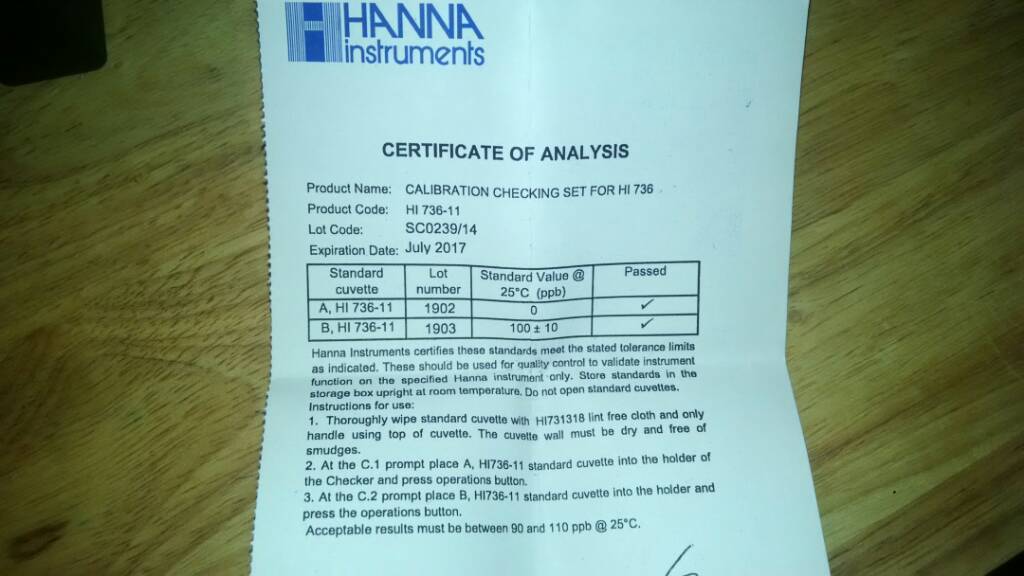
The 736 ULR instructions
1e28ce788215f0036b520d1455aa1164.jpg


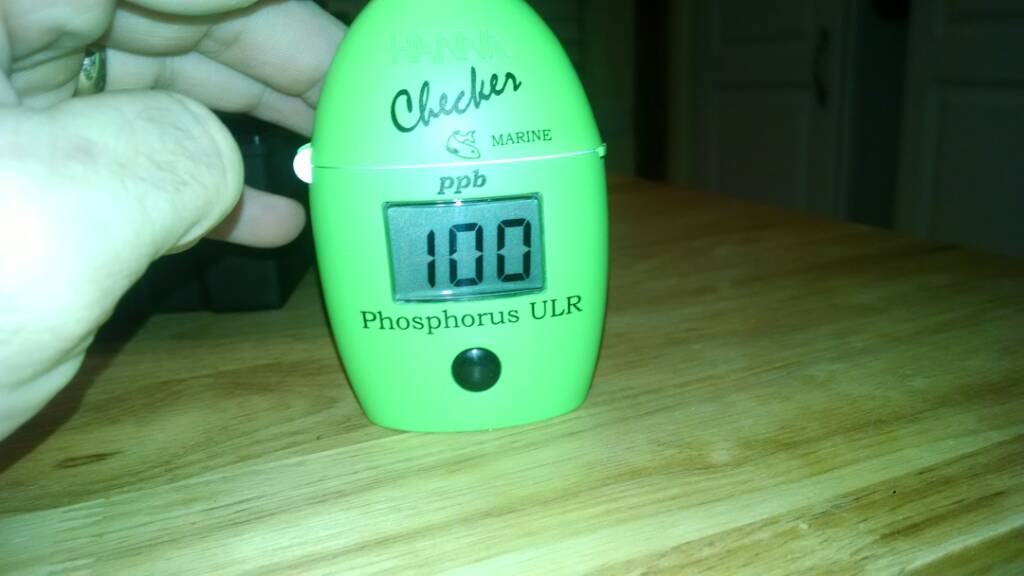
and with mine I usually get around 98-100 which is pretty much perfect.
dafbc8bf2261c82804220e73f856e5c4.jpg


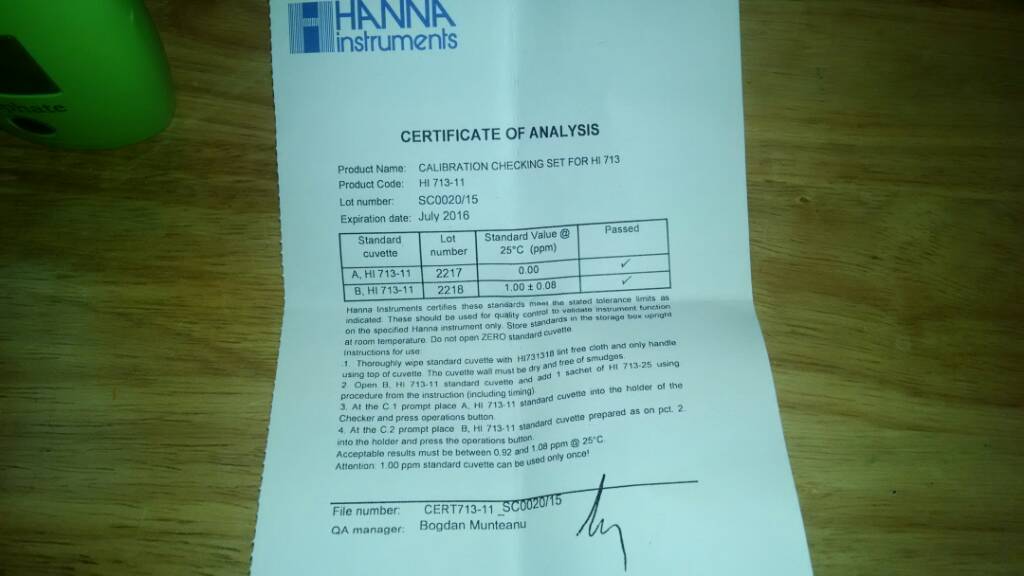
The 713 Low Range
df87445c4a193d37a68aa4c2bd3318f8.jpg


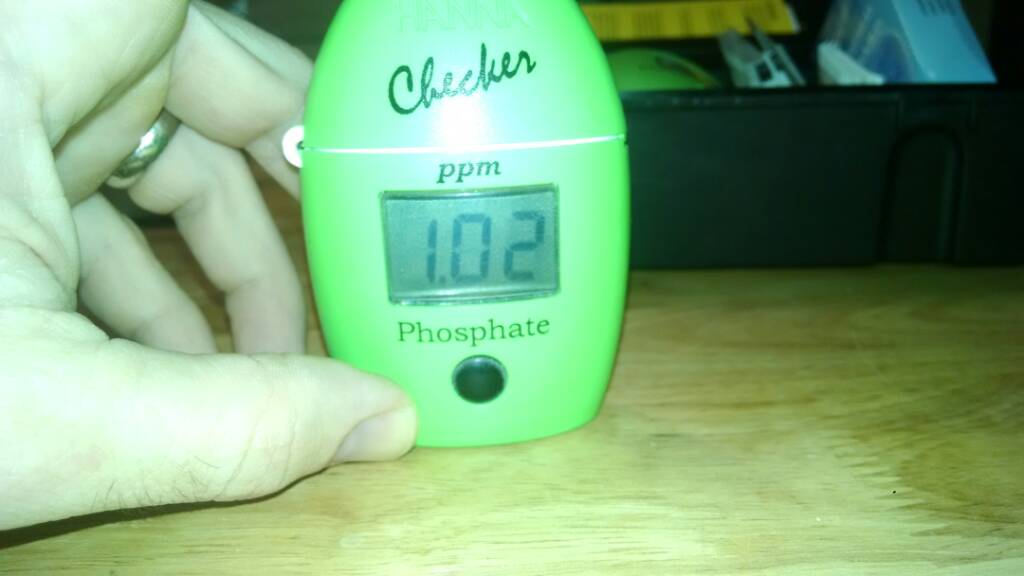
and it's accurate enough
56bea504274aae16a1d0ebd43ad6d55a.jpg


That's from my PO4 shoot out thread.
http://reefcentral.com/forums/showthread.php?t=2540702
 
I wouldn't recommend Api for nitrate as I just went though some craziness with mine reading 80 forever when I had my lfs test with salifert it was 25ish, he also used his Api which read 40ish so I would get salifert as recommended by others.
 
I really wish they didn't call it a calibration kit. It is and should be called a Reference kit. You can not calibrate the checkers yourself. You can use the reference kit to check to make sure your checker is accurate enough. If not you can call Hanna and if still under warranty may replace it.

Both the 736 ULR and 713 Low Range "calibration" kits come with two filled vials BUT the 713 Low range checker is not fully ready to go. You have to uncap, not easy, one of the vials and mix in some reagent first. Which lends it to some interference reducing it's accuracy. The 736 "calibration" kit comes already mixed and ready to go. I would recommend a lint free cloth and never touching the vials with your finger and take care not to scratch or blemish them in any way.

The 736 ULR instructions
1e28ce788215f0036b520d1455aa1164.jpg


and with mine I usually get around 98-100 which is pretty much perfect.
dafbc8bf2261c82804220e73f856e5c4.jpg


The 713 Low Range
df87445c4a193d37a68aa4c2bd3318f8.jpg


and it's accurate enough
56bea504274aae16a1d0ebd43ad6d55a.jpg


That's from my PO4 shoot out thread.
http://reefcentral.com/forums/showthread.php?t=2540702

I've had 3 different hanna checkers and the cuvettes that came with all of them have had very light straches if you look at them in a light. Have you noticed this with yours?
 
I wouldn't recommend Api for nitrate as I just went though some craziness with mine reading 80 forever when I had my lfs test with salifert it was 25ish, he also used his Api which read 40ish so I would get salifert as recommended by others.

if your nitrate levels are high, which to me is anything over 10 and I target under 5 personally, API kits are susceptible to a lot more interference from other nitrogen based elements like nitrite other then the nitrate-nitrogen that we are trying to measure here. Even ammonium-nitrate could be an issue at the high levels.

Salifert is supposed to be much more accurate in reading purely the nitrate-nitrogen and not get the interference that some other kits like API are susceptible too.

But in the end, if your nitrates are high regardless of how high they are the plan to improve your nutrient exports should be the same. For many, Nitrates are much easier to get control of compared to Phosphates. Tip, water changes alone are not a good stand alone method unless it's a nano tank.

To get the best results out of API nitrate kit you should shake both bottle before use. Make sure bottles are vertical when dripping and not tipped at all. AND then shake, bang, whack, smack, shake, and repeat many times until your hand goes numb bottle #2 before using it.

Which is why I'm switching to Salifert. Both tell me I'm under my target which is 5ppm just fine. Salifert wont give me carpal tunnel though.
 
I've had 3 different hanna checkers and the cuvettes that came with all of them have had very light straches if you look at them in a light. Have you noticed this with yours?


I haven't which that may or may not interfere as long as it's the same position you put the vial in for both C1 and C2 after adding the reagent which should help. I always make sure that the 10ML is facing me when putting in the vials.
 
Yeah, I'd say mine repeat very well despite the fine scratches. I've read where some people buy the calibration samples to replaces scratched cuvettes because it's cheaper than just buying 2 cuvettes but then they complain that even those are scratched. If you look at the tolerance for the calibration vial for the 713 the tolerance is huge. I don't see how that could be useful.
 
Yes I know my nitrates are high which I why started a thread to help me find and fix my problem.

Sorry this is off the op topic.
 
Yeah, I'd say mine repeat very well despite the fine scratches. I've read where some people buy the calibration samples to replaces scratched cuvettes because it's cheaper than just buying 2 cuvettes but then they complain that even those are scratched. If you look at the tolerance for the calibration vial for the 713 the tolerance is huge. I don't see how that could be useful.

It is a pretty big swing both ways but the 713 wasn't really meant for our application it was just the first to come out before the 736 was released that did get into the range we're looking for under .09. The 736 ULR was meant for us and even says Marine on it.
 
Back
Top