Why do I need / want a Refugium?

Patrick, can you get some pictures of his tanks? I'd really be interested to see what kind of corals he's keeping with those kind of Nitrates.

Also, just to note, I've seen 3 different LFS's using MH, T5 and VHO. All three have very successful coral systems. Many different styles work. I personally have a very minimalistic setup that does quite well.

Yes I will. I went over there today and intended to take some video but the room that contains his best displays was blocked off for some work being done so I could not really get in there. But I will go back. His tanks look very healthy to me (although I am definintely a newbie) and he seems very serious about his method of caring for fish and corals. He showed me his whole backroom setup for his tanks that hold the corals and fish that he sells and he has a huge container of bio-balls that all of the water passes through and is then pumped back into the various tanks. For my tank he recommended a wet/dry filter with an external pump. Anyway, I will try to get over there again soom.

Pat
 
Thanks all for input. Can someone tell me how long refugiums have been in favor for reef aquariums and what was used before refugiums were "invented?" It is my understanding, but I could be wrong, that refugiums are "relatively" new to reef aquariums.

They've been around since before I was in the hobby. They were touched upon in TRA, vol. 1, which was from 1994, so they're at least that old.
 
Not only would I want to see pictures of the tanks but proof that he has 400+ nitrates. Sounds like a guy that is just not with the times when it comes down to good reef keeping.
 
It would be helpful to me if these questions could be addressed...


1. Why are bioballs a "nitrate factory?"


2. Without bioballs, how do you oxygenate your water?


3. Do most refugiums have good water circulation through them or does the water stagnate?


Thanks!
 
1. they convert ammonia to nitrate but they don't have the bacteria or whatever it is to convert the nitrate to nitrogen so your nitrate just keeps building up. because live rock is completly submerged it can get the bacteria that converts nitrates to nitrogen gas.

2. skimmer is a big one. also having ripples on the top of the water will create the O2 exchange. if you have an overflow box then the water flowing to the sump will also create it.

3. usually the refugium will have good water flow through it it helps keep the macro algae turning and help it grow better. usually 3-5 times tunover is what you shoot for for flow.
 
The important thing to know is that with live rock we have a better more complete nitrogen cycle and there is no need for bioballs. Bacteria living on bioballs will convert ammonia to nitrite and then to nitrate. The nitrate to nitrogen part of the cycle requires low oxygen, low flow environments like inside the live rock. When nitrates are created in the live rock, that cycle tends to work. When nitrates are created by the bio balls, those nitrates don't end up getting inside the rock to break down.

So bio balls are nitrate factories. They are not only unnecessary in tanks with live rock, they detract from the ability of the live rock to keep the tank low in nitrates.
 
The important thing to know is that with live rock we have a better more complete nitrogen cycle and there is no need for bioballs. Bacteria living on bioballs will convert ammonia to nitrite and then to nitrate. The nitrate to nitrogen part of the cycle requires low oxygen, low flow environments like inside the live rock. When nitrates are created in the live rock, that cycle tends to work. When nitrates are created by the bio balls, those nitrates don't end up getting inside the rock to break down.

So bio balls are nitrate factories. They are not only unnecessary in tanks with live rock, they detract from the ability of the live rock to keep the tank low in nitrates.

So are saying that som low flow areas are desirable? One of my concerns about a sump has been stagnating water.
 
Low flow inside a rock that is full of working bacteria is different than a low flow area in a sump. These are two completely different things. Low flow in a rock is also a low oxygen area that allows the nitrate conversion. I would think a sump would have enough mixing that you wouldn't see stagnant water.
 
So are saying that som low flow areas are desirable? One of my concerns about a sump has been stagnating water.

Low flow and stagnation are not the same thing. Low flow can be desirable, for a variety of reasons.

I think shifty really nailed the answers for all three questions.
 
We don't trust him based on the advice he's giving you, not based on what his tanks look like.
x2
I'd like to point out that he has employees to do his water changes for him. Whoknows how often that's needing to happen? Comparing a home tank to one in a LFS can be apples to oranges. Also who knows how often he changes out the corals?
 
okay i read thorugh this thread and here is why i personally have a sump/fuge combo NITRATES ARE BAD!!!!!!! MOST corals dont like NITRATES at all and i know of none that like 400 thats rediculous. bioballs are nitrate factorys if not kept clean as stated before. anyways back to what im saying

i keep my fuge in my 30 gallon long sump it takes up about 12 gallons of this. it has a 8" DSB and is filled with LR pieces and macro algae fern and grape calupra or however its spelled. the macro takes up some excess nitrates and when it grows alot u harvest it (either throw it away or offer to another hobbiest in the are) and that takes it back out of the "system" also this allows for a great spot for all kinds of lil bugs to grow without being eaten if u just dump them in ur display they are going to be eaten as quick as u pour them in IMO. when u give them a place to breed yo will have a constant supply to your tank. also this is a low flow area which gives the LR and DSB more contact time with your water. also im planning on adding some mandarins to the tank is another reason i want to give the bugs a good place to populate and grow

thats just my opinion though ill never own a tank without one.


heres what mine looks like
swgg0.jpg
 
Last edited:
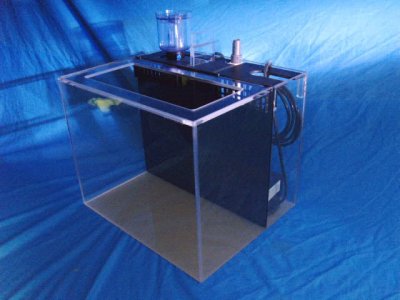
Well, my original plan was to add a sump/fuge to my existing system and then I started questioning that decision after I engaged this LFS owner to take care of my tank while I am on vacation. (Because of the comments I have laid out here.) I actually have a sump / fuge on order from Lifereef but my build has not yet started so I was considering changing direction with it. Now after all of this discussion, I feel like I need to continue on the path I was on and stick with the sump/fuge, sans bio-balls. ;)

While I believe that he believes in his methods and his tanks seem to support them, I can't ignore the overwhelming consensus here.

So, thanks all for your input! :thumbsup:

I will post some video after the first of the year when I install my new sump.

Pat
 
are you saying your gonna run a sump/fuge along with bioballs? why run the bioballs? if you have enough LR the bio balls are a waste. you may still run into nitrate problems as the LR may not be able to keep up with removing the nitrate that the bio balls produce.
 
are you saying your gonna run a sump/fuge along with bioballs? why run the bioballs? if you have enough LR the bio balls are a waste. you may still run into nitrate problems as the LR may not be able to keep up with removing the nitrate that the bio balls produce.

No, sorry. Sump with Fuge, no bio balls, just like everyone is recommending. ("Sans" Bio Balls = "Without" Bio Balls in French. :cool: ).

Here is what it will look like.

Thanks!
 

Attachments

  • Lifereef Sump 3.jpg
    Lifereef Sump 3.jpg
    84.1 KB · Views: 20
Last edited:
ohhhhh ok lol thats much better. I can almost guarentee you will be much happier this way than with bio balls.

good luck
 
Back
Top