Wiring leds

pastelball

New member
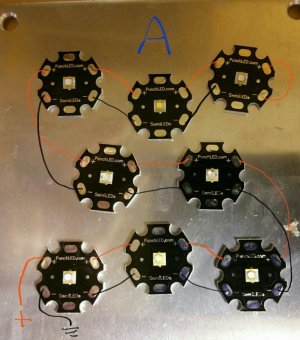
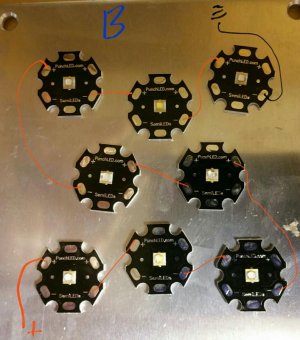
I am going to wire my leds and looking to see a or b on soldering.
 

Attachments

  • 20150613_181626-1-1-2.jpg
    20150613_181626-1-1-2.jpg
    74.6 KB · Views: 2
  • 20150613_181626-1-2-1.jpg
    20150613_181626-1-2-1.jpg
    73.4 KB · Views: 6
I think some of the more expensive ones don't run them parallel or daisy chained but a pos and neg individually run to each LED.
 
Both would work in theory, but work very differently. B is wiring them in series which is the normal way of doing it and has all LEDs wired in series on one string. A has them all wired in parallel and therefore whatever current you drive them with will be shared across the LEDs (probably not what you want, but depends what you're trying to do!).

Tim
 
What driver are you going to use? That will determine what you need to do. For a C, you could wire your leds like B, but where the 4th and 5th one connect don't connect them and run the 2 positives together and 2 negatives together (from the now 2 strings) and it will make it series and parrallel therefore cutting the amount of voltage it would take to power them in half but also cut their mA (intensity) half also.

Basically it will boil down to what driver and what size/depth tank you are putting them over for the best way to wire them IMO
If it's a small tank you could get away with a 12v 1000mA ac/DC adapter if you don't care about dimmability (I think I made a word) and it would run all 8 leds at 500mA wired as C
 
You must take B.If you take a the Leds are paralell.The Problem is,if one Led is not working,the rest Leds become to much Power and blown away!
 
I am going to wire b. I tested my nano driver the output goes from 2v straight to 36v with just a turn of the dimmer there is no other voltage to choose. Does there have to be a load on the driver?
 
pulse frequency/duration changes not voltage

think of it like this
If an LED is at 50% dimming then, it is ON 50% of the cycles that occur 40,000 times a second, so its on every second cycle kind of thing

Not a perfect explanation but might help
 
I am going to wire b. I tested my nano driver the output goes from 2v straight to 36v with just a turn of the dimmer there is no other voltage to choose. Does there have to be a load on the driver?

The driver will increase the voltage till the amp set point is reached or in the case of an "open" circuit, till max voltage is reached. so yes you need a load.. ;)

In case it didn't occur to you "if" you hot plug the LED string in and "if" the driver doesn't respond fast enough (drop voltage) you will blow your LED's.. So, as a matter of caution do not hook the LEd's to a "on" driver..
always hook the LED string to the driver before turning it on.......

dimmer doesn't apply really..since you are just "chopping" voltage.. regardless of what your meter may be averaging it is always the same voltage no matter where you set dim .ONLY thing that changes is on/off period..
Say you have it set at 50% and the driver increases the voltage till it "senses" 1A draw is 12V.. You get 12V at 50% of "on" time.. A VOM may average that to show 6V BUT it is still 12V when "on" 0 volts when "off"....
AT least this holds for most current driver topology..some do change current.. but that is not the "best" way (arguable of course for those that can see flicker)

Last thing is the "signal" is not the output. In other words you may have 0-10V dimming "signal" but what the LED "see"s is a chopped voltage 0(well off which may not be zero volts as you saw) to MAX voltage at the point of amp draw, which will be whatever voltage your string needs to "draw" the amp set point.
 
Last edited:
Back
Top