Would this be enough to go skimmerless?

knight2255

New member
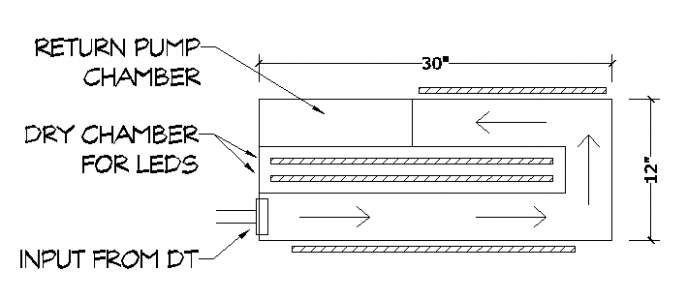
I'm in the planning stages of a 135g mixed reef. I just found out about algae scrubbers and thought it such a waste to just throw away all the green hair algae. I would like to feed a regal angel and 2 tangs fresh gracilaria out of the fuge as well as grow pods for other critters. Would making a U-shaped flow channel in a regular fuge work to be both a nutrient sink for the DT, food for the fish, and pod creator like this?

1819vc.gif
 

Attachments

  • MACRO FUGE.png
    MACRO FUGE.png
    11.2 KB · Views: 25
Last edited:
I'm not convinced that an algae scrubber changes the desirability of a skimmer.

Algae take up inorganic nutrients and typically release organics.

Skimmers export organics but do not do much for inorganic nutrients. :)
 
interesting idea in dead...i like really but as randy said I would add a skimmer just to be on the safe side. also looks like a heck of alot of algae scrubbing....:) maybe over kill??
more is not always better. have you read the revised formula for ATS?
 
I'm not convinced that an algae scrubber changes the desirability of a skimmer.

Algae take up inorganic nutrients and typically release organics.

Skimmers export organics but do not do much for inorganic nutrients. :)

Agreed, skimmers basically remove "food" before it decays in the tank. I believe I read a study that showed skimmers are only about 20% effective at doing that. Where as algae scrubbers use the decay from the "food" as its made available. This keeps the food you feed in the water column longer... Now of course no real study has ever been done for the aquarium scrubbers we build but one can reduce that it's effectiveness is far higher, something in the range of 95%. Also as you said, algae releases amino acids, oxygen and organic carbon back into the water.

I don't do it myself but I believe a skimmer and a scrubber could have a nice ying yang effect.

As we get closer and closer to fine tuning sizing, flow, lighting etc things can only get better. Due to the phosphate article you wrote I really had an awaking about how much PO4 is in the food we feed. Additionally algae uses N and P about 15:1 so its a challenge for scrubber only tanks not to become nitrate limited over time. I am looking for ways to counter that by actually providing nitrate. I have been told one could possibly dose calcium-nitrate, going to be testing that soon...
 
I'm in the planning stages of a 135g mixed reef. I just found out about algae scrubbers and thought it such a waste to just throw away all the green hair algae. I would like to feed a regal angel and 2 tangs fresh gracilaria out of the fuge as well as grow pods for other critters. Would making a U-shaped flow channel in a regular fuge work to be both a nutrient sink for the DT, food for the fish, and pod creator like this?

1819vc.gif

Feeding the algae that is grown directly counter acts the harvest process, reintroducing the wastes back into the water column. Without monitoring wastes could build up to dangerous levels. The idea of an algae scrubber is to keep N and P to undectable levels, almost removing the need to test for these all together.
 
. . . I believe I read a study that showed skimmers are only about 20% effective at doing that. . .

Research by Dr. Ken Feldman showed at best a protein skimmer only removes 30% of the DOC in a system. Other research by him showed skimming also reduces bacterial count in a reef system to 10% of what is found in nature.

Delbeek and Sprung in thier "Reef Aquarium" series discuss methodologies not using filters or pumps. Here's a video of a system I've maintained for over 4 years: http://www.youtube.com/watch?v=9Eckf4Jne40
 
Research by Dr. Ken Feldman showed at best a protein skimmer only removes 30% of the DOC in a system.
http://www.youtube.com/watch?v=9Eckf4Jne40

FWIW, I contend that the data supporting that conclusion is weak. Not the data itself, which is fine for what it actually tests, but the interpretations that follow from it that many have expounded around the internet.

Copied from another thread:


In the ocean, many organic molecules are added and reasonably quickly removed again from the water, by lots of different processes. Over time, what has largely resulted is a set of organic materials that are largely refractory to these removal processes, and they are only very slowly removed, some maybe only over centuries or longer.

So at any given instant, they may be the predominate organics present in seawater, but they are not necessarily those that are driving many biological processes, such as the carbon and nitrogen and phosphorus cycles that involve organic materials. The more easily metabolized organics are added and just as quickly removed. In this context, it might be a mistake to say that removing all of the total organics would be necessary to nearly completely shut down the biological processes involving organic materials. In fact, a reduction of only 10% in total organics might remove all of those rapidly turning over organic materials, and perhaps coincidently, those might be the ones that are most involved in at least some of the concerns of hobbyists with organics.

So in the context of these experiments, I wonder if the results would be substantially different if one started with tank water that was from an unskimmed system? Not just that the levels would be inherently higher and so might be more readily reduced, but that the actual types of organics may be quite different, and in some ways more reflective of the total organics dumped into the water column. In essence, skimming an aquarium may continuously remove those compounds that are more easily removed, and so leave behind those that are much harder to remove. Just as in the ocean then, we may have compounds building up that are resistant to skimming, and those may be a big portion of the TOC in a skimmed system. In that case then, it may not be surprising that when a study looks at how well a skimmer can remove them, you are looking at what is a refractory set of materials to start with.

I know the article made no such claims, but many folks may extrapolate the 10 or 20% removal fractions that were shown to say that only 10 or 20% of organics entering the water will be skimmed, and that might not be the case.

 
Research by Dr. Ken Feldman showed at best a protein skimmer only removes 30% of the DOC in a system. Other research by him showed skimming also reduces bacterial count in a reef system to 10% of what is found in nature.

Delbeek and Sprung in thier "Reef Aquarium" series discuss methodologies not using filters or pumps. Here's a video of a system I've maintained for over 4 years: http://www.youtube.com/watch?v=9Eckf4Jne40

Thank you for finding that for me, and for sharing that book. Looking to get a copy now, thanks again
 
Last edited:
Research by Dr. Ken Feldman showed at best a protein skimmer only removes 30% of the DOC in a system.

Makes sense to me. Recently I tried curing some live rock in a 75g tank with a ETSS 800 skimmer, completely oversized skimmer to the system. Water still went yucky yellow with the nitrate/phosphate going through the roof.

I thought the skimmer would have done a better job keeping up with the load on the system, no such luck.
 
FWIW, I contend that the data supporting that conclusion is weak. Not the data itself, which is fine for what it actually tests, but the interpretations that follow from it that many have expounded around the internet.

Copied from another thread:


In the ocean, many organic molecules are added and reasonably quickly removed again from the water, by lots of different processes. Over time, what has largely resulted is a set of organic materials that are largely refractory to these removal processes, and they are only very slowly removed, some maybe only over centuries or longer.

So at any given instant, they may be the predominate organics present in seawater, but they are not necessarily those that are driving many biological processes, such as the carbon and nitrogen and phosphorus cycles that involve organic materials. The more easily metabolized organics are added and just as quickly removed. In this context, it might be a mistake to say that removing all of the total organics would be necessary to nearly completely shut down the biological processes involving organic materials. In fact, a reduction of only 10% in total organics might remove all of those rapidly turning over organic materials, and perhaps coincidently, those might be the ones that are most involved in at least some of the concerns of hobbyists with organics.

So in the context of these experiments, I wonder if the results would be substantially different if one started with tank water that was from an unskimmed system? Not just that the levels would be inherently higher and so might be more readily reduced, but that the actual types of organics may be quite different, and in some ways more reflective of the total organics dumped into the water column. In essence, skimming an aquarium may continuously remove those compounds that are more easily removed, and so leave behind those that are much harder to remove. Just as in the ocean then, we may have compounds building up that are resistant to skimming, and those may be a big portion of the TOC in a skimmed system. In that case then, it may not be surprising that when a study looks at how well a skimmer can remove them, you are looking at what is a refractory set of materials to start with.

I know the article made no such claims, but many folks may extrapolate the 10 or 20% removal fractions that were shown to say that only 10 or 20% of organics entering the water will be skimmed, and that might not be the case.

+1

in my personal opinion, skimmer is absolutely necessery. You can put some algae to complete and work together, but skimmer must be kept taking out waste.
 
. . . skimmer is absolutely necessery . . .

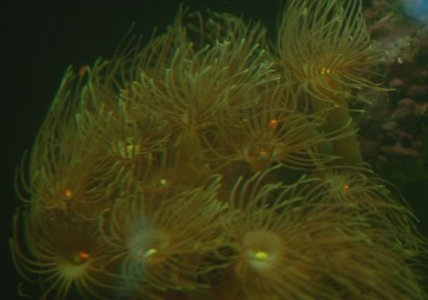
Sorry Luis but I have to disagree. I have run systems for as long as 15 years without the use of protein skimmers and I doubt I would have had this successful clam reproduction in a display tank if I had. Additionally, while the effect a PS would have had on these polyps spawning could be argued it certainly was not necessary for them to spawn.

Knight2255, FYI niether of the two systems had refugiums as you are proposing. I want to emphasize I don't have any objection to your proposed setup, anything to increase the biodiversity of an ecosystem is a good thing. The clams system just has an empty sump and the polyps system is a wet/dry.
 

Attachments

  • Yellow Zooanthid Spawning.jpg
    Yellow Zooanthid Spawning.jpg
    27.8 KB · Views: 25
Last edited:
Timfish

It´s very interesting view, I liked your position, but how do you compare/see your systems if you had a skimmer? What kind of negative impact would it do?

If your clams need some nutrients, you could adjust skimmer to keep a constant nutrient level.
 
Luis, good questions. From a pragmatic point of view if I can maintain a beautiful system for a decade or more without a PS why use it? In the case of this system with the clams I saved an estimated 65 - 70 hours labor. This is without taking into consideration the additional heat (biggest killer of corals in my experience) and electricity associated with a skimmer. These factors make the initial cost and replacement cost of a PS a moot argument but I'll add that savings in as well. As far as the clams are concerned I seriously doubt the larval would have survived being run repeatedly through a skimmer until they settled out, even if I used a low turnover like the public aquariums of 1/2 to 1 turnover an hour. So unless someone can demonstrate clam larval surviving and settling out in a system with protein skimming I'm pretty sure it would not have happened if I had even a small skimmer on this system.

As far as maintaining the correct level of nutrients I'm not sure that's the correct way to view this issue. Unlike corals and Tridacna sp. clams which will remove ammonia and nitrates directly from the water to feed their zooxanthellae these clams are arguably strictly filter feeders. What I have to consider is what is their food source? Especially since there's a good chance it's some kind of zooplankton. I know protozoans are included in zooplankton but I'm not sure if all peleagic marine microbial sp. are but here is a quote from one of Dr. Feldman's articles "Aquaria subjected to active filtration via skimming present water column bacteria populations that are approximately 1/10 of those observed on natural reefs. The consequences of this disparity on the long-term health of the tank's livestock are not known. How do reef tank organisms adapt to such a bacteria-deficient environment? Is the whole food web in an aquarium perturbed, or are there compensatory mechanisms that maintain an appropriate energy transduction through all of the trophic levels? Is "old tank syndrome" related to possible nutritional deficiencies stemming from this bacteria "gap"? Alternatively, could "old tank syndrome" be symptomatic of a gradual decrease of bacterial diversity as a consequence of selective skimmer-based removal of only bubble-susceptible bacteria? At present, it is not possible to go beyond speculation on these points - further research is needed." http://www.advancedaquarist.com/2011/3/aafeature I can test the water for dissolved nutrients and I suppose I could get a microscope and start doing bacterial counts but I still need to figure out the species and if my clams are specifically feeding on certain species or have a cosmopolitan diet and maybe the species isn't one affected by skimming but now it seems to me I should be working on a thesis and have gotten beyond what's practical for me or most aquarists.

Taking into account the axiom "The greater the biodiversity of an ecosystem the better it's stability", Dr. Feldman's research (albeit limited and generating more questions than answers) showing greatly reduced microbial populations when protein skimming is used and my own successes without using skimmers I will argue protein skimming is uneccessary. Considering how much more research is needed to answer the questions Dr. Feldman poses it would be foolish and bellicose of me to go beyond that.
 
Last edited:
I know protozoans are included in zooplankton but I'm not sure if all peleagic marine microbial sp. are but here is a quote from one of Dr. Feldman's articles "Aquaria subjected to active filtration via skimming present water column bacteria populations that are approximately 1/10 of those observed on natural reefs. The consequences of this disparity on the long-term health of the tank's livestock are not known. How do reef tank organisms adapt to such a bacteria-deficient environment? Is the whole food web in an aquarium perturbed, or are there compensatory mechanisms that maintain an appropriate energy transduction through all of the trophic levels? Is "old tank syndrome" related to possible nutritional deficiencies stemming from this bacteria "gap"? Alternatively, could "old tank syndrome" be symptomatic of a gradual decrease of bacterial diversity as a consequence of selective skimmer-based removal of only bubble-susceptible bacteria? At present, it is not possible to go beyond speculation on these points - further research is needed."

FWIW, I think that one should be wary of extrapolating that data to other tanks.

In my tank with a pretty decent skimmer (an ETS 800 gemini run by an Iwaki 55RLT), dosing large amounts of vinegar resulted in the water continually hazy with bacteria. So the skimmer alone absolutely did not cause it to have levels of bacteria only 10% of natural reefs. :)
 
May I mention one Randy´s (perfect) article? Randy, excuse me :)

Tim, you centered onto nutrients and clam larval problems, right?

What about undesireble chemistry? Such phosphates. How do you export/remove them?

http://www.advancedaquarist.com/2002/9/chemistry

If you don´t remove, there´s a good possibility of somewhere in time you´ll have an algae explodion or any other crash.

If you simply don´t use a skimmer for larval purposes, you need other stuff to help you keeping a minimum water quality level.

What do you do for healthy system? Refugium?
 
Randy would a good comparison for ATS and skimmers be that:

Skimmers are like heterotrophic bacteria, they remove the organic compound (disregard what heteros produce :D)

whereas...

ATS are like autotrophic bacteria, they use up the product of the waste (nitrogen and phosphate).

I know it disregards a lot of things but thats how I've always thought of the two in relation to their jobs.
 
As long as you removed the heterotrophs from the system, yes, that's a reasonable way to think of things. Heterotrophs likely directly remove nitrate and phosphate, however, while a skimmer won't.
 
Dr. Farley-Holmes, I wanted to apologize for taking so long to respond. I wanted to reread some stuff and I had to look up a couple of words too :reading:

FWIW, I contend that the data supporting that conclusion is weak. Not the data itself, which is fine for what it actually tests, but the interpretations that follow from it that many have expounded around the internet.

In the ocean, many organic molecules are added and reasonably quickly removed again from the water, by lots of different processes. Over time, what has largely resulted is a set of organic materials that are largely refractory to these removal processes, and they are only very slowly removed, some maybe only over centuries or longer.

So at any given instant, they may be the predominate organics present in seawater, but they are not necessarily those that are driving many biological processes, such as the carbon and nitrogen and phosphorus cycles that involve organic materials. The more easily metabolized organics are added and just as quickly removed. In this context, it might be a mistake to say that removing all of the total organics would be necessary to nearly completely shut down the biological processes involving organic materials. In fact, a reduction of only 10% in total organics might remove all of those rapidly turning over organic materials, and perhaps coincidently, those might be the ones that are most involved in at least some of the concerns of hobbyists with organics.

So in the context of these experiments, I wonder if the results would be substantially different if one started with tank water that was from an unskimmed system? Not just that the levels would be inherently higher and so might be more readily reduced, but that the actual types of organics may be quite different, and in some ways more reflective of the total organics dumped into the water column. In essence, skimming an aquarium may continuously remove those compounds that are more easily removed, and so leave behind those that are much harder to remove. Just as in the ocean then, we may have compounds building up that are resistant to skimming, and those may be a big portion of the TOC in a skimmed system. In that case then, it may not be surprising that when a study looks at how well a skimmer can remove them, you are looking at what is a refractory set of materials to start with.

I know the article made no such claims, but many folks may extrapolate the 10 or 20% removal fractions that were shown to say that only 10 or 20% of organics entering the water will be skimmed, and that might not be the case.

This issue with refractory organics is another fascinating aspect of what is going on in reef systems. (One question that immediately comes to mind is whether this is happening faster or slower in our aquariums than in nature.) I would be very interested in seeing any references or research showing these refractory organics are primarily or exclusively hydrophilic or that these refractory organics compounds make up a significant percentage of the TOC either in aquariums or on reefs. Because I don't understand how this fit's into this discussion if these refractory organics can be divided into subgroups that will be removed by skimming and will not be removed by skimming.

I am also very curious to see how further research on this will fit in with Feldmans study showing the majority of skimmate was inorganic compounds http://www.advancedaquarist.com/2010/2/aafeature

Adding my own speculations as well, considering the long history of reef aquariums being maintained without skimming as well as with skimming I would not be surprised at all if research eventually shows the long term health and success is not dependant at all whether skimming is or is not used. Rather that if skimming is used one set of issues is more likely to be predominate and if skimming is not used a different set of issues is more likely to occur. Also taking into consideration the literally thousands of species we are keeping and adding to that the variants being developed and the multitude we are still trying to figure out how to maintain it strikes me as unreasonable any one approach to filtration methodology will work across the board. What seems far more reasonable to me is eventually there will be a range of protocals depending on the animals being kept. Time will tell and if I'm lucky I'll still be alive :D


FWIW, I think that one should be wary of extrapolating that data to other tanks. . .

I had to laugh as I've said much the same thing in numerous discussions with other aquarist. :lol:

Actually Dr. Feldman's research has had a negligible impact on how I maintain my aquariums. My introduction to reef systems was the skimmerless approaches in Raymond Hunziker's articles in July, November and December 1986 issues of Tropical Fish Hobbyest and Merril Cohen's experiences with importing live rock and having corals reproduce using Lee Chin Eng's approach in the '60s in an article in the the January 1988 issue of Marine Fish Monthly. Although not specifically about reef aquariums Martin Moe's first edition of 'Marine Aquarium Handboook" where he discussed breeding and raising clownfish in tanks with undergravel filters certainly supported my belief success was not dependant on fancy equipment. Julian Sprung's endorsement for protien skimming in his article "Captive Reefs" in October 1988 issue of TFH endorsement certainly carried some wieght in favor of skimming. However the article he coauthored with Charles Delbeek, "New Trends In reef Keeping" Fresh and Marine Aquarium, December 1990, in which they described Dr Stuber's Berlin System, Alf Nilsen approach in Norway and Dr. Jaubert's very simple pumpless, filterless and skimmerless system reinforced one pragmatic question. "Why use all that equipment when it's not necessary?" When I actually started keeping reef systems in the early and mid 90's and I started connecting with other aquarists and started working for a local aquarium maintenance company what I came to see was methodology and equipment did not figure into a successfull reef system. The key to success is consistent maintenance and correctly choosing animals. One interesting description of the use of simple natural systems is Robert Perrin's description of the systems his aquaculture company Tropicorum used in the June/July 2005 issue of "Coral". Tropicorum discontinued the use of pumps, protien skimmers, kalkwasser and calcium reactors and goes on to say "We have not added any calcium chloride recently". (I will point out elsewhere in the article he states they add Caribsea's Aragamight daily.)


. . . In my tank with a pretty decent skimmer (an ETS 800 gemini run by an Iwaki 55RLT), dosing large amounts of vinegar resulted in the water continually hazy with bacteria. So the skimmer alone absolutely did not cause it to have levels of bacteria only 10% of natural reefs.

I have always taken large bacterial poplulations as one possible cause of cloudy water but you didn't say how you determened this was indicative of microbial populations comprable to a reef in the open ocean. What role does size of the microbe play? Is there an easy, reliable method to determin microbial density? Because one frustration I have with Feldman's work is there is no practicle way I can determine microbial species or populations in my systems to evaluate them.


May I mention one Randy´s (perfect) article? Randy, excuse me

Tim, you centered onto nutrients and clam larval problems, right?

What about undesireble chemistry? Such phosphates. How do you export/remove them?

http://www.advancedaquarist.com/2002/9/chemistry

If you don´t remove, there´s a good possibility of somewhere in time you´ll have an algae explodion or any other crash.

If you simply don´t use a skimmer for larval purposes, you need other stuff to help you keeping a minimum water quality level.

What do you do for healthy system? Refugium?

Actually Louis, you brought up the questions about nutrients. This system has been running since 1997. Presumably the clams showed up in 1999 when everything was moved from a 100 gallon tank into a 200 gallon tank and some new live rock was added as they were first seen a few months later. As to what the readings are I don't know, I don't think I've tested the water in 4 or 5 years. This system gets a 15 gallon water change weekly (7-8%), that's all. The sump is unlit and has primarily featherdusters growing in it with some other worms and the usual volunteer sponges.
 
Back
Top