240 Inwall Construction (Image Intense)

I'm wondering would you guys know the effects of the air bubbles on things such as sponges and tunicates? It's not direct exposure, but I'm not sure if it's the same. Do you have any sponges or tunicates to know?

I know that neither should ever be exposed to air directly (removed from the water) as air is easily trapped inside the channels, which will kill that part of the animal, hence my concern.
 
<a href=showthread.php?s=&postid=12315702#post12315702 target=_blank>Originally posted</a> by chrismunn


marc, let us know when you run out of breath ;)

Wow, no one slammed me with that much-too-easy-set up? :lol:
 
Ralph: I'm sorry but I don't know what kind it is and there isn't any writing aside from a W on it. It came second hand to me so I have no clue.

chris wright: I don't know how the air injection will affect sponges and the like but I will say that I do still have the typical sponges about my tank and they continue to thrive. Keep in mind that, at least in my tank, the bubbles size is extremely small. Not unlike what you would find in a quality skimmer. I don't have any purchased sponges so I can't comment on this regularly available type.

Joseph.
 
Tagging along for the interesting "air injection" talk..

Air injection is the new trend folks!! Nothing more natural for an SPS reef.

Good on you guys for breaking the unwriten rules of reefkeeping:)

To think that Ive read on this forum before that air bubbles are bad for corals??? Who ever said that probably hasnt been on a natural reef crest where SPS thrive:)
 
ive already heard a few people say thier going to try the air injection system after having read this thread. this is going to catch on quik isnt it? it should be interseting to see peoples methods and success, or lack there of?

way to go joseph! not only are you golden with a bad memory, but your a trend setter as well ;)
 
I will definitely be trying the air injection after seeing the effects on this system. However i wont be doing it through closed loops etc. Im just doing a simple air pump through the return and powerheads. Once again, Great Idea!
 
Thanks for getting back to me Joesph. I too have the sponges that grew on the live rock, and I had a sponge I purchased. I had a return from a canister filter that blew bubbles at it when I did water changes, but I can't say for sure whether this led to it's decline. I still have the sponges that are growing on the live rock though.

I like the idea of the air injection, but didn't want to loose my sponges and tunicates, so I'm thinking of trying this method on my next set-up. Thanks again.

Chris.
 
Just to chime in... I've also had no problems at all with the air injection and sponges. As is obvious, sponges are pretty effective at holding in water and keeping the air out.
 
My concern was that considering the volume of water that the sponge filters, that by the odd chance it got air trapped, it wouldn't get out. Probably more so with collected species that could be subject to removal from the water more so than what they are exposed to in the water.

The sponges I have left are hitchhikers, so I should assume they are more resistant to air than other sponges, but I like to know other peoples experiences, before taking chances.
 
I would like to make a few statements before this whole air injection craze gets too out of control. ;)

First, I do feel air can be an issue with SPS (and LPS/softies too) corals if flow within the tank is not great enough to dislodge any air trapped under a given coral. So... be sure that if you try this technique, you have plenty of flow, so much so that after the injection cycle ends, you cannot see any "standing", accumulated air anywhere. In addition, this heavy flow will aide in dislodging coral mucus so it can be skimmed and processed out of the tank system.

Second, I definitely would NOT attribute the SPS coral growth in my tank to the air injection system only. There are many other contributers, I feel, such as proper lighting (quantity and spectrum), water chemistry (calcium, alk, mag., etc.), filtration (efficient skimmer) and flow (also for waste export) to name a few of the more critical aspects.

So... please do not see air injection as the magic bullet as there are many other variables and most of which are not always simple to execute. While I do feel it aides in the overall health of a tank, there is no simple, easy route. Keeping corals healthy and growing takes perseverance and dedication to providing an optimum environment in which they can flourish.

With all this said, I would still recommend trying it on your system should you feel so inclined. That's all I wanted to say. Carry on. ;)

Joseph.
 
<a href=showthread.php?s=&postid=12323698#post12323698 target=_blank>Originally posted</a> by weatherson
I would like to make a few statements before this whole air injection craze gets too out of control. ;)

First, I do feel air can be an issue with SPS (and LPS/softies too) corals if flow within the tank is not great enough to dislodge any air trapped under a given coral. So... be sure that if you try this technique, you have plenty of flow, so much so that after the injection cycle ends, you cannot see any "standing", accumulated air anywhere. In addition, this heavy flow will aide in dislodging coral mucus so it can be skimmed and processed out of the tank system.

Second, I definitely would NOT attribute the SPS coral growth in my tank to the air injection system only. There are many other contributers, I feel, such as proper lighting (quantity and spectrum), water chemistry (calcium, alk, mag., etc.), filtration (efficient skimmer) and flow (also for waste export) to name a few of the more critical aspects.

So... please do not see air injection as the magic bullet as there are many other variables and most of which are not always simple to execute. While I do feel it aides in the overall health of a tank, there is no simple, easy route. Keeping corals healthy and growing takes perseverance and dedication to providing an optimum environment in which they can flourish.

With all this said, I would still recommend trying it on your system should you feel so inclined. That's all I wanted to say. Carry on. ;)

Joseph.

Great post!

Your tank is one of my all time favorites bro for sure.. ;)
 
Joseph,

That is one nice tank and serious operation you have going on there.

I notice you have a Heniochus in your tank. Some report coral nipping with the H. Accuminatus, but not the H. Diphreutes. Has yours sampled your corals at all? Do you know which kind yours is, and were you able to determine that yourself, or did you get it from a source that could tell the difference?

I really like the banner fish, but most places I see them have no clue whether its Accuminatus or Diphreutes. I've seen descriptions on how to tell them apart, but they are too close for my novice eye.

I've also heard that Hawaiian Henis are Diphreutes and ones from farther west are Acuminatus, but I don't know that from a reliable source.

Thanks for any input you can give me. Again, that is a really nice tank.

- Jason
 
Jason: Thanks for the kind words. I wish I could be more help but unfortunately, when I've searched the web or the fish books I have available, I've not been able to determine which version I have of Heniochus. Perhaps someone more knowledgeable will pipe in. I acquired this fish "used" from a local, fellow reef keeper. I can say though that it has been a model citizen when it comes to other fish and corals alike. Never have I witnessed it nipping at any of my corals. But... it does have a liking for snails. Primarily just if they are stuck upside-down though and extremely vulnerable. Hope that helps some and good luck.

Joseph.
 
<a href=showthread.php?s=&postid=12360000#post12360000 target=_blank>Originally posted</a> by JMaxwell
I've also heard that Hawaiian Henis are Diphreutes and ones from farther west are Acuminatus, but I don't know that from a reliable source.

This is true. "Shore Fishes of Hawaii" by Randall states that H. diphreutes is from Hawaii and that H. acuminatus is not found in Hawaii.
 
Thanks Joseph & Spleen (!)

I'd guess Joseph has H. diphreutes as most say H. accuminatus will decimate zoas and such.
 
Well... here's a tank-event induced update. Yesterday, at about noon, I did my monthly, 50-gallon water change. This went as usual and was quick and relatively easy. I'd been mixing the new salt water for a day and a half so it was well oxygenated and temperature equalized to the tank. So... all is good there.

I have a good friend who works at a local hospital and we regularly discuss the events there and more specifically to their emergency room and how this relates to the lunar solstice. In fact, they do see more activity during the full moon phase. Just thought I'd throw this in here and you may already see where this is going. ;) And guess what tomorrow is? Yep... you guessed it, the full moon for this month. Hmm.

So last night, at about 11:00PM, with all the tank lights off except for the moon lights, the air injection system came on for one of its scheduled times. I noticed it was making an odd sound and different from the usual. It's amazing how many times sound, and not something visual, has alerted me to tank oddities. Anyway, I look at the tank and notice that the moonlights weren't illuminating the tank as they should during the full moon phase. When I got up to look closer, I realized I couldn't see the back of the tank for how cloudy the water was. My first thought, before putting it all together, was that there was a Kalkwasser incident which was the culprit. But the alarm should be going off due to a pH spike and it wasn't. So then, it dawned on me that the tank was experiencing another spawning event. Sure enough, the skimmer was going nuts and there was... um... coral... um... spawn scum in the filter sock and floating in the sump. Here' a shot of the fishnet I used to pull out that which was floating...
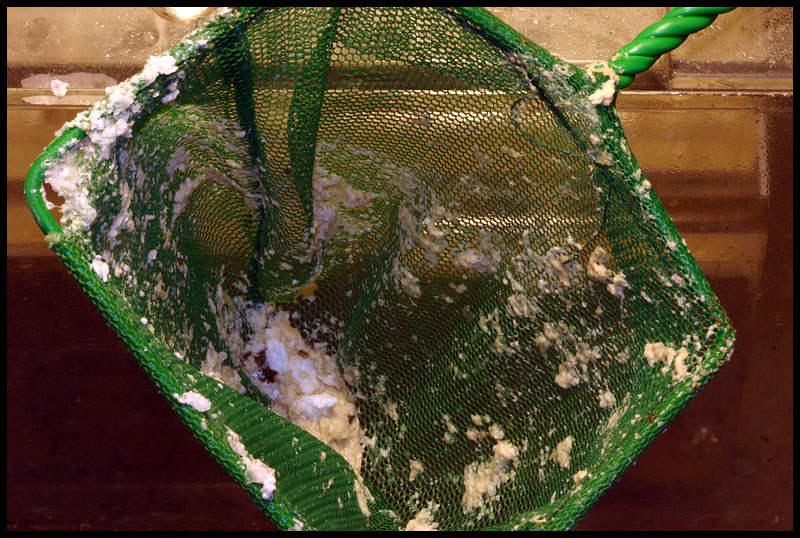
881_spawn_scum.jpg


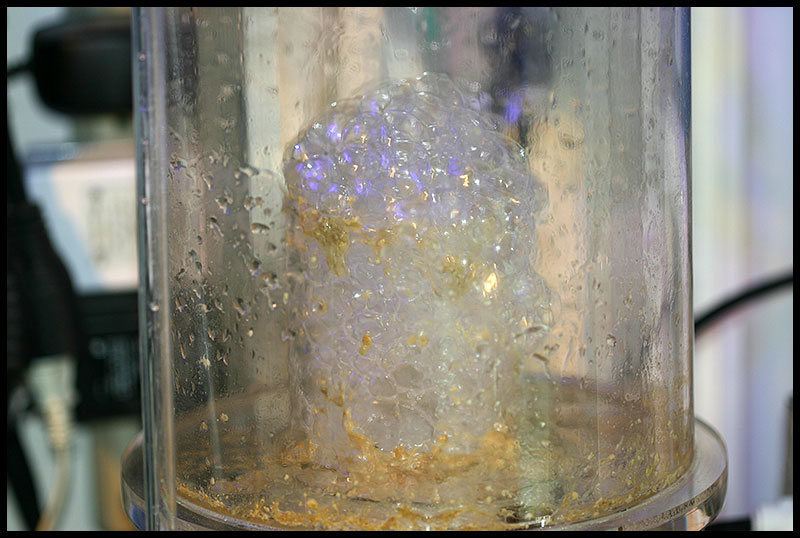
I know that this event was coral and not clam as was the case of the last spawn or something else as the smell was very intense and definitely of the SPS coral kind. Unfortunately, I was too late to be able to get any shots of the corals spreading their procreation excretions. There... I just coined a new phrase. ;) Anyway... as mentioned, the skimmer was going nuts and pulling out a ton of "procreation excretion" (PE) matter. Here's a shot taken after one of the many skimmer cleanings I did to keep it producing as efficiently as possible...

880_spawn_skim.jpg


In addition to cleaning the skimmer multiple times, I also replaced my filter sock with clean ones at least six times and removed the prefilter box screens so that surface skimming within the tank was uninhibited. I also ran the air injection system manually several times which seemed to help greatly in removing as much PE as possible. After a couple hours of this, the tank was starting to clear and this morning, it's as if nothing had happened. Everything looks well. The skimmer still isn't foaming like normal but it's slowly getting there. There's apparently still some PE in the water but not enough to be visual.

So there you have it... a mass coral spawning event. While this may sound like an exciting event, it's quite unnerving, to say the least. Having this happen in a closed system is very stressful. For the tank and me. ;)

Joseph.
 
I can see how that would be very stressfully! But I have to admit that it is fascinating!
 
Back
Top