kbriers
New member
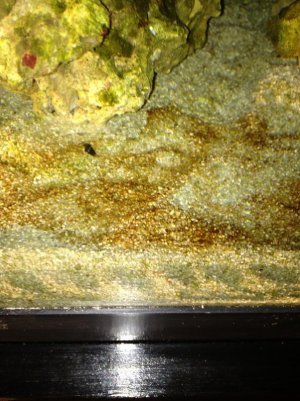
So I did the 3 day blackout on my 40 gallon breeder tank because I'm getting tired of having cyano on my sand bed. Well it went away for about a week and now its back in full force. To be honest, I'm not 100% sure it is cyano. It is a dark brown/red almost rust color. When it gets thick enough, it will siphon off in "sheets" so I'm assuming it is in fact cyano. Sorry this is going to be a long post but, I'm trying to give a play-by-play of how I do things so maybe someone can come up with an answer. Tank has been up a little more than a year or so.
My water chemistry values are...
S.G.- 1.025 via refractometer
pH- Between 8.1-8.3 via Apex
Temp- 77-79 via Apex
Ammonia- 0 via API
Nitrite- 0 via API
Nitrate- 0 via API
Phos- 0 via API and Hanna
Calcium 430-450 via API and Salifert
DKH-8 via API and Salifert
Mg- 1400 via API and Salifert
I've only ever used RO/DI water from my Spectrapure MaxCap MPDI system OR distilled water from wally-world for mixing salt/topoff. The TDS meter on my clean water line reads 0 when making water. My topoff container is a plastic trashcan from home depot. Could this be the problem? I've never actually thought about testing the water coming from my ATO so maybe?
For salt, I use plain ol IO. I let the water come up to temp, add salt and let mix for at least 24 hours before doing water change. I mix the salt in a big rubbermaid container so could that be leeching phosphates? (I've tested newly mixed saltwater and phos/trates read 0) For waterchanges I do 10 gallons every 3 weeks or so.
I use BRS GFO in a reactor and have used it for 6 months? or so. I'm guessing between the tank/sump/rocks and sand I have roughly 40 gallons of water so I use 10 Tablespoons of GFO. I replace every 3 weeks or so when I do a waterchange. (Even if discharge line from reactor reads 0 with Hanna)
Lighting wise, I have 2 kessil a150's (The 15K one, forgot actual name) I have the left light turning on at 9am and off at 4pm. The right light comes on at 10am and off at 5pm.
For flow, I have 2 hydor evo 750's and my return line (mag 9 throttled back) One on each side of the tank pointing up some. They switch between them turning off and on every 5 minutes in "anti-sync" I have them turn completely off at 6pm and turn back on at 7am.
I feed rod's food every other day about a "dime-size" amount to a clown, goby, blenny, basslet, cleaner shrimp, some LPS and a monti cap. When I remember, I will put a few drops of Selcon on the food too.
I have roughly a 2 inch sandbed using tropic eden reef flakes and I used pukani dry rock when I started. CUC wise I have 5 or so nass. snails, dwarf ceriths, 1 hermit and a fighting conch.
What I don't understand is that it only gets on my sand bed and on the back glass. Nowhere else in the tank. I have never had any other algea problem at all.
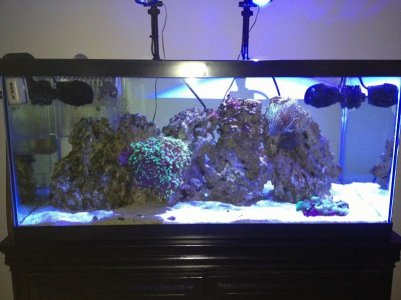
Sorry for the bad pics but it will at least give you an idea of powerhead/light placement. The second pic is what it starts looking like before it "mats" up.
Any help/ideas/questions/whatever would be most appreciated. I'm beggining to get frustrated to the point where it is losing its "fun factor"
Thanks so much
My water chemistry values are...
S.G.- 1.025 via refractometer
pH- Between 8.1-8.3 via Apex
Temp- 77-79 via Apex
Ammonia- 0 via API
Nitrite- 0 via API
Nitrate- 0 via API
Phos- 0 via API and Hanna
Calcium 430-450 via API and Salifert
DKH-8 via API and Salifert
Mg- 1400 via API and Salifert
I've only ever used RO/DI water from my Spectrapure MaxCap MPDI system OR distilled water from wally-world for mixing salt/topoff. The TDS meter on my clean water line reads 0 when making water. My topoff container is a plastic trashcan from home depot. Could this be the problem? I've never actually thought about testing the water coming from my ATO so maybe?
For salt, I use plain ol IO. I let the water come up to temp, add salt and let mix for at least 24 hours before doing water change. I mix the salt in a big rubbermaid container so could that be leeching phosphates? (I've tested newly mixed saltwater and phos/trates read 0) For waterchanges I do 10 gallons every 3 weeks or so.
I use BRS GFO in a reactor and have used it for 6 months? or so. I'm guessing between the tank/sump/rocks and sand I have roughly 40 gallons of water so I use 10 Tablespoons of GFO. I replace every 3 weeks or so when I do a waterchange. (Even if discharge line from reactor reads 0 with Hanna)
Lighting wise, I have 2 kessil a150's (The 15K one, forgot actual name) I have the left light turning on at 9am and off at 4pm. The right light comes on at 10am and off at 5pm.
For flow, I have 2 hydor evo 750's and my return line (mag 9 throttled back) One on each side of the tank pointing up some. They switch between them turning off and on every 5 minutes in "anti-sync" I have them turn completely off at 6pm and turn back on at 7am.
I feed rod's food every other day about a "dime-size" amount to a clown, goby, blenny, basslet, cleaner shrimp, some LPS and a monti cap. When I remember, I will put a few drops of Selcon on the food too.
I have roughly a 2 inch sandbed using tropic eden reef flakes and I used pukani dry rock when I started. CUC wise I have 5 or so nass. snails, dwarf ceriths, 1 hermit and a fighting conch.
What I don't understand is that it only gets on my sand bed and on the back glass. Nowhere else in the tank. I have never had any other algea problem at all.
Sorry for the bad pics but it will at least give you an idea of powerhead/light placement. The second pic is what it starts looking like before it "mats" up.
Any help/ideas/questions/whatever would be most appreciated. I'm beggining to get frustrated to the point where it is losing its "fun factor"
Thanks so much