
3 tanks, 1 potentially big problem

mpderksen

New member
I have a healthy, happy 75g. No problems there.
I have a 20g QT that got new arrivals just this Wednesday from LA. Everyone is already eating and also happy.
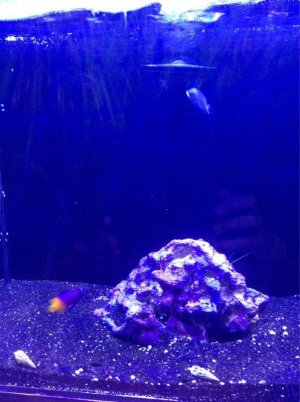
Then I have my 25g nano on my desk. Not so happy.
The only inhabitants are a snowflake clown and a royal gramma, with a cleaner shrimp (just molted 2 days ago for the 3rd time since November, so he's fine). Last night, during the last feeding, I noticed the dreaded white spots all over the Royal. Really, really tiny, and his behavior is fine (ate well etc.). Obviously I immediately suspect Ich. Pretty difficult to see a white spot on a white clown, so I'm not sure there. Nothing at all new has gone in the tank since December. That's what the new guys in QT are for.
IF I now have Ich, I have a few solutions, but none of them make me happy, so I thought I'd ask for some advice.
1. Remove both fish from the nano to join the others in QT, and extend the wait to 10 weeks to let the tank go fallow. Treat everyone in there. The downside is now I'm combining sick fish with healthy.
2. Set up an emergency 10g hospital tank for these 2 only, and still wait the 10 weeks before anything goes in. Maintain a 4th tank!?!?
3. Remove the 3 fish from QT that are going into the 75g, and risk introducing whatever THEY may be carrying into my primary tank, and put the 2 sick with the remaining 2 that are in QT, treat there and wait.
None of these are attractive options. The 25g is obviously going to have to be fallow, so I guess it's a question of whether I want to expose the new ones to a sick fish (and the stress of copper treatment) or deal with another tank.
What would you do?
 
Before you freak out, made sure you really have ich. Are the fish flashing? You can wait a couple of days and observe to be sure.

Keep things separate. Your fish in QT could possibly have something worse than ich. I hope not, but its a possibility. Yes, set up a 4th tank. I am a believer in tank transfer method for ich. But, it does require even more equipment.


Best of luck.
 
2. Set up an emergency 10g hospital tank for these 2 only, and still wait the 10 weeks before anything goes in. Maintain a 4th tank!?!?

None of these are attractive options. The 25g is obviously going to have to be fallow, so I guess it's a question of whether I want to expose the new ones to a sick fish (and the stress of copper treatment) or deal with another tank.
What would you do?

I would deal with another tank, why expose, dose, and create more undue stress on the newbies.
 
I would go with scenario #2, personally. While it's definitely more work to maintain 4 tanks, scenario #1 could actually be more difficult if the newly acquired fish are carrying some other pathogen (e.g. brooklynella). Best to treat the known without adding the unknown.

Scenario #3 should not even be considered a viable option, IMO.

On the positive side, ich doesn't kill quickly, so you have plenty of time to get the HT set up before being in a desperate situation.
 
Before you freak out, made sure you really have ich. Are the fish flashing? You can wait a couple of days and observe to be sure.

Keep things separate. Your fish in QT could possibly have something worse than ich. I hope not, but its a possibility. Yes, set up a 4th tank. I am a believer in tank transfer method for ich. But, it does require even more equipment.


Best of luck.


fish flashing?
what's that?
 
Indeed, I really didn't consider #3 either. Not Risking 7 long term healthy fish to the unknown is why I QT in the first place.
If by "flashing" you mean swimming quickly past something, like he's trying to scratch an itch? Yes, there was a little of that. Some on the back glass, and twice against a rock. This morning the lights aren't on yet, but it's near a window, so I tried to get a look. Can't see anything on him at this point, so maybe I'm paranoid?
Further observation is a good idea for sure before I get more equipment. It would be nice if the $1/gal sale was on, but a 10g is pretty cheap. And I can always use a new heater.
 
Going a bit off topic, (but it's my post anyway, lol) should I be using PraziPro on the new arrivals, just in case? Or wait to see if it's needed?
In the hospital tank, assuming I end up needing that, I just run low SG and copper?
 
Going a bit off topic, (but it's my post anyway, lol) should I be using PraziPro on the new arrivals, just in case? Or wait to see if it's needed?
In the hospital tank, assuming I end up needing that, I just run low SG and copper?

I always proctively treat for flukes using Prazipro (and ich, for that matter, using TTM). Low SG isn't really needed, unless you are going to do full hyposalinity (1.009). If you do full hypo, don't use copper. In fact, I'm not a fan of copper in general, as it is hard on the fish and difficult to dose. It has a very narrow range of effectiveness (0.35 - 0.5mg/L for Cupramine), and the test kits are very difficult to read IMO. Too low, and you won't kill the parasite; too high and you start to put the fish's health in jeopardy.
 
Read a few stickies, and have a plan.
First, I'll wait for another week to add PraziPro to the QT to let them settle in. I plan to observe until end of April (~6 weeks total).
If the Royal really does break out and I determine he really does have Ich, then I'll pick up a small 10g and use the Hyposalinity method, since this seems to be the best for the fish. At that point, I start the clock on the nano for 10 full weeks for the fallow period.
Once I have 4 weeks of no symptoms in the hospital tank, which is likely the same time the QT will be over, I will introduce the 3 from QT to the 75g. The 2 remaining in QT will be joined by the now healthy royal and clown in the QT until the fallow period is over, and all 4 can go into the nano together.
This seems to be the safest way to insure everyone gets what they deserve. Sound good?
 
Read a few stickies, and have a plan.
First, I'll wait for another week to add PraziPro to the QT to let them settle in. I plan to observe until end of April (~6 weeks total).
If the Royal really does break out and I determine he really does have Ich, then I'll pick up a small 10g and use the Hyposalinity method, since this seems to be the best for the fish. At that point, I start the clock on the nano for 10 full weeks for the fallow period.
Once I have 4 weeks of no symptoms in the hospital tank, which is likely the same time the QT will be over, I will introduce the 3 from QT to the 75g. The 2 remaining in QT will be joined by the now healthy royal and clown in the QT until the fallow period is over, and all 4 can go into the nano together.
This seems to be the safest way to insure everyone gets what they deserve. Sound good?

Sounds like a good plan.
 
Flashing is rubbing, like they are trying to scratch. When my tank got ich, I noticed that my fish were flashing, but more so that they were "twitchy" best way I can describe it. I knew from their behavior that something was wrong.
Wally World has cheap 10 gallon tanks.
 
Flashing is rubbing, like they are trying to scratch. When my tank got ich, I noticed that my fish were flashing, but more so that they were "twitchy" best way I can describe it. I knew from their behavior that something was wrong.
Wally World has cheap 10 gallon tanks.


I wonder if this flashing behavior is a sensitive and specific sign to ID ich early on.
 
3 tanks, 1 potentially big problem

would it be safe to say a no flashing fish is ich free at the moment?
just wondering because my clownfish just swims slowly around
still eats and not lethargic, but just not as active or hyper as my other clownfish. definitely not flashing too.
 
Could be. I'm no expert or I would be answering questions instead of asking them #SelfDeprication. No sign of ANY spots today. And I looked REALLY closely multiple times. The spots were noticed right after a water change. Maybe false alarm. My sand is black, so unlikely it was that.
ImageUploadedByTapatalk1426384598.385529.jpg
 
Back
Top