A Different Beckett Housing Design

Lunchbucket: $50 each? I guess you are unfamiliar with my hourly rate. :D Thinner acrylic wouldn't be that much less and would take away what makes them look so "puurrty". ;)

marm64: Be proud of your equipment and take it out of the closet!... I mean sump. ;) Thanks and if you decide to use the 3/4" stock, you will need to trim some threads off the top PVC piece or extend the acrylic cylinder to adjust for the protrusion. Thanks for the kind words.

williamrandel: Exactly and well said. Thanks.

Joseph
 
platapus: Thanks and yes, if this didn't work out, they would make some pretty cool mini ash trays. ;) The screws are 1/4 - 20 by 2" Stainless Steel button head-allen with SS flat washers. I polished these to a chrome look while I was at it.

r3tic: Thanks. I'm glad you like them.

Joseph
 
I'm going to dust the cob webs from this thread as I completed the skimmer that the Beckett housings were made for. Following are photos with brief descriptions of the parts and finally, a photo of the skimmer complete. Here we go... First, a few shots of the Jasper circle cutting tool used for most pieces. A 1/8th inch hole is drilled in the stock for the pin that becomes the pivot point.

223_centering_pin.jpg


The bottom side of the jig showing the 1/16" incremental holes for indexing the circle size.

224_jasper_cirle_cutter.jpg


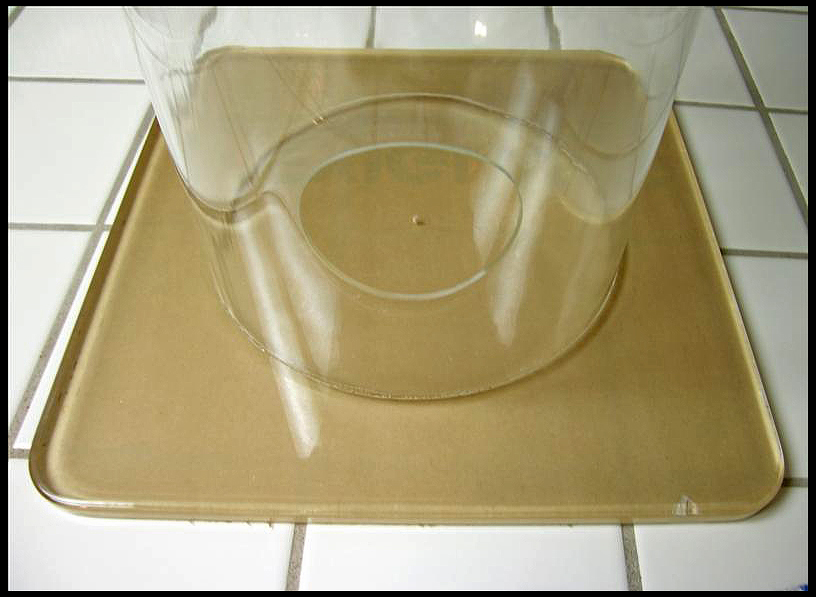
And finally, a shot of the dado cut in the bottom plate that receives the 10" diameter acrylic cylinder that is the bottom of the skimmer.

225_dado_cut.jpg
 
Last edited by a moderator:
Up next is a shot of the threading of holes in the lower chamber's top flange. I used half inch stock for all the flat pieces.

227_flange_hole_threading.jpg


Here's a shot of the finished flange after polishing and flaming all the edges.
228_top_flange.jpg
 
Last edited by a moderator:
Next is a shot of the collection cup's bottom flange and the chambers bottom. Note that I did a rabbit joint at the inside cut out on the flange shown on the left. This accepts the lower cylinder. There's also a similar dado joint on the bottom piece shown on the right. The final tube has a similar, but smaller dado on the oposite side of this flange. It's slightly offset from the one beneath it. There's also a threaded drain hole and another dado joint cut at the outside diameter that accepts the overall cylinder that is the outside walls of the collection cup.

229_collection_bottom-middle.jpg


Next is a shot of the three tubes of the collection cup. Note the angle top cut of the last and smallest tube for foam directivity. This makes the foam ffall to one side. The ends of the middle sized tube were trimmed as the thickness of this piece was slightly larger.

230_collection_tubes.jpg


And finally, a shot of the upper-most top pieces. Note that no gasket is needed when using half inch stock. ;)

231_collection_top.jpg
 
Last edited by a moderator:
Here's a couple shots of the finished collection cup. The first without a flash and the second with.

232_collection_no_flash.jpg


233_collection_flash.jpg
 
Last edited by a moderator:
It was time to return to the main body after having finished the bottom plate and glued the 10" cylinder to it. I then carefully drilled holes for the output, a 2" sized plumbing, and the 1 1/4" holes for the injector inputs. I also added a separate hole for a drain and for a level indicating tube. I heated slowly teh area imediately around the holes and then quickly inserted the bulkheads without gasket and tightened it down. This ceated the flat area needed for a watertight seal. First, the output hole.
234_bulkhead_hole.jpg


Next, the bulkhead in place.
235_bulkhead.jpg


And last, a shot of the side holes for the injector outputs.

236_side_holes.jpg
 
Last edited by a moderator:
Next, I neede to support the output plumbing as it's 2" size makes it very heavy and I didn't want undue stress on this bulkhead. I made this bracket that allows for removal of the held plumbing.

237_plumbing_support.jpg


And a shot of the strap clamp while guing it in place on the 10" cylinder.

238_support_assembly.jpg
 
Last edited by a moderator:
Unfortunately, while concentrating on the final assembly of the skimmer, I didn't shoot more photos. So, at this point , we will jump to a shot of the skimmer as it looked after completion. Note that the extension tube at the middle I had built previously for my then current skimmer. I did this to get by with that skimmer until I built this one. In case you are not familiar, I upgraded my old 65-gallon to my current 240-gallon tank. Here's the shot;

239_skimmer.jpg


Here's a link to a much larger version of the above shot for a more detailed view. Dial-up beware as this image is BIG.
BIG image link.
 
Last edited by a moderator:
Last of all, a shot with descriptions and water flow diagrams I created for a request on my other thread of my tank. You can click HERE to go to this thread. There is a little more detailed info there. Here's the shot;

241_skimmer_diagram.jpg
 
Last edited by a moderator:
So there you have it. My new skimmer creation for my fairly new tank. ;) It'ss been running for about a day now and is still breaking in. I should mention that I also upgraded my skimmer pump from an Iwaki 55 to a new Iwaki 100. I'll post a working photo as soon as possible.

Joseph
 
As with the Beckett housing, nice work. Looks pretty heavy especially with the 1/2" stock acrylic. How tall is the entire skimmer? What size pump do you plan on running? Are you planning on upgrading the current tank to something that can handle that size skimmer?

Good Job:thumbsup:
 
That is one of the most beautiful skimmers I have seen - It's approaching art!

Very nice job, and great craftsmanship!

How is it performing?

J
 
Back
Top