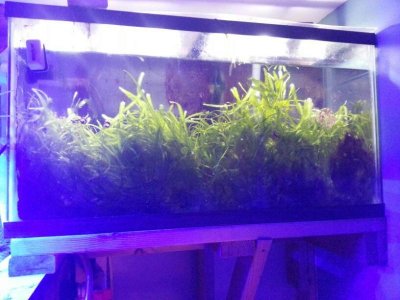
About caulerpa...a warning

Sk8r

Staff member
RC Mod
Caulerpa comes in a LOT of forms. Google the word and look at the pix. For that matter, read the Wikipedia article.

It's toxic. It's insanely prolific. It got loose in the Mediterranean Sea and is an ecological disaster there. California has banned it...fearing what might happen to its marine ecology if it began to proliferate along that coast.

It's also sold as refugium weed, and frequently comes tangled in bundles of cheatomorpha---if you spot it, I'd advise rejecting the cheato. Just toss it.

Very few fish will eat it---rabbitfish will, some tangs will---but rabbits and tangs grow to 10 inches really fast, and even the smaller are not comfortable really in any tank under 100 gallons. Both species of fish can start killing tankmates if in too small a tank.

This means if caulerpa gets into the system of a tank that cannot support a fullgrown tang or rabbit---you have a vegetable plague on your hands.


It reproduces like an alien plague---from bits, pieces, roots, spores in the water [so it can get from sump to dt], or runners. It roots into the rock and a piece of rock that has been all but dead can let those roots sprout. It will grow until it completely fills a tank. And it's too toxic for snails and crabs.

So save yourself future grief. Don't let this stuff get started, not one sprig of it.
 
just to add to the list of the fish that eat caulerpa my flame angel eats my Caulerpa Brachypus when i transfer it over from the sump to the DT. i will take huge bundles of it and place it in the DT and the 2 tangs and flame angel all mow it down. but unfortunely my tank is not large enough for a full grown yellow tang so i will soon have to rehome him.

seeing how it grows in my sump i can attest to it being an extreme nuisance to those who arent equipt to handle what it will become. its roots go in all directions literally attaching to any and everything including the glass and even a spec of root left in place will start the colony all over again. its quite an evasive species of macro algae.

and the flame angel eating it is not a normality just a weird fish's eating habbits.
 
I have some in my tank right now. It came in on a piece of rock I added. I had looked it over but it must have been rooted deep for me to not see it.

I have been manually removing but will most likely do a peroxide dose this weekend on it. It might take a few dosings considering it roots deeply but I will give it a try. Otherwise goodbye rock and I will simply replace with another piece of rock...
 
Just a note, but not all Caulerpa is bad. Caulerpa prolifera is a very "nice" macroalgae. Typically, it does not latch onto rocks, preferring the sandbed. It also rarely goes sexual. As long as you contain the macroalgae, everything will be fine. C.racemosa, C. mexicana, and C. taxifolia, are the ones to watch out for. They spread to rocks, and easily go sexual.

C. prolifera, and any one of the other "bladed" Caulerpa species, can also look wonderful in a tank. Seahorse tanks in particular, as the Caulerpa provides hitching posts, as well as hiding places for pods, and suck up some of the nutrients that seahorses produce. And since it's relatively hard for some to get seagrass species, C. prolifera can make a great surrogate, especially for fish that come from seagrass habitats (Banggai cardinalfish, seahorses, etc.)

To add to the Caulerpa eating species, there is a nudibranch that will eat C. prolifera, I think it's the Lettuce Sea Slug.
 
Soulpatch, even high doses of peroxide added directly to refugium didn't do much damage to caulpera. I was treating for dyno\cyano outbreak in the fuge that was smothering the caulpera.

I do have to say that it is very effective at absorbing nutrients and I think in my case it stopped growing due to lack of nitrates. There is no way to remove it once it take hold in the fuge.
 
You were dosing peroxide to the water whereas I am looking to do a dip which is much more concentrated. Even in water I can do a peroxide paste to ensure the peroxide hits the caulerpa and sits there vs. being "watered" down throughout the tank.

I had to do the same with bryopsis I had in the tank as general dosing did not impact it.
 
Just a note, but not all Caulerpa is bad. Caulerpa prolifera is a very "nice" macroalgae. Typically, it does not latch onto rocks, preferring the sandbed. It also rarely goes sexual. As long as you contain the macroalgae, everything will be fine. C.racemosa, C. mexicana, and C. taxifolia, are the ones to watch out for. They spread to rocks, and easily go sexual.

C. prolifera, and any one of the other "bladed" Caulerpa species, can also look wonderful in a tank. Seahorse tanks in particular, as the Caulerpa provides hitching posts, as well as hiding places for pods, and suck up some of the nutrients that seahorses produce. And since it's relatively hard for some to get seagrass species, C. prolifera can make a great surrogate, especially for fish that come from seagrass habitats (Banggai cardinalfish, seahorses, etc.)

To add to the Caulerpa eating species, there is a nudibranch that will eat C. prolifera, I think it's the Lettuce Sea Slug.

i have tons of this in my sump. I also feed it to the Tangs . they love it.Just do not feed them the stems as they either will not eat it or have trouble digesting it...
 
Well I nuked some rock with it tonight and took one heavily infested rock out. I did not think it was that bad till I pulled the rock to peroxide dip it and realized the extent of the roots throughout the rock. So that rock is now gone.

I can't wait for my new tank to get here and start over with TBS rock. I seem to have gotten Bryopsis and caulpera in this tank and both are a pain in the rear to eradicate. At least with the next tank I will have the size for some of the cleaner fish if needed.

Now to plan out moving corals and not the algae into the next tank. Guessing the next tank will need a UV unit to help keep everything at bay...
 
How is C. sertularioides?

This grows wild in Hawaii, so I can pick it up easily from tide pools around the area. In the tide pools, it grows pretty sparsely and not wild like I've seen in some people's pictures. C. sertularioides looks similar to taxifolia, but has slight variations in the rhizome and leaves.

Does this species grow aggressively like the taxifolia?
 
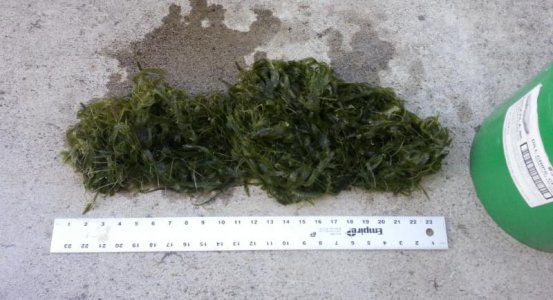
I love the stuff. My tangs do too especially my vlamingii (550g display). I grow it in a 38g fuge and when I gather the motivation I will pull a bunch out and throw some in the display and some in the trash. I used to try to give it away but it's easier to throw it away. I recently had gotten lazy and when I finally got around to it tossed this much

uploadfromtaptalk1436346900337.jpg

uploadfromtaptalk1436346913109.jpg
 
Thanks for all the info guys! I'll have to watch out for it on my incoming batch of chaeto.
 
I had a blade type leafy version of it. It gets huge in a hurry and scared me so I took the rubble from the fuge and dried it out. I have the rock back in there now with no signs of it anywhere. To bad though I wish I had some, it did a great job keeping nitrates low. Gotta be careful though.
 
fighting this stuff for over a year now, and I was winning for a while. My biggest issue was fighting it in a 29g where I can't really house a tang/surgeonfish of any kind. However, I got desparate and bought a Rabbitfish 6 months ago and he was killin it for a while!

NOW the fish is NOT eating it and I don't know what to do. He eats the brine shrimp and frozen food I feed the other fish, and the brown algae growing on my back wall, but ignores the caulerpa prolifera! I think its angry now ... Any suggestions??
 
Oh, additional fact-ish thing:

When I had C. prolifera growing in the DT, a nasty film algae problem that I had growing on some of my (very beautiful) red Gracilaria, went away. Then the Gracilaria went away. I've never had cyanobacteria in my display tank (or at least, very tiny amounts) when I've had Caulerpa growing. Algae problems are usually minimized when I have this macroalgae in the tank.
 
Well I had a small piece of sertularioides in a bucket with some water from my DT and a small powerhead for some flow. I tried leaving it under a light to see how it did. It died....

Now I'm not too sure how well sertularioides does in aquariums.
 
Back
Top