
All about what "Onyx" Perculas look like!

Dlckwood

Premium Member
How much black does a Percula need to be an onyx?

Well, that is a very complicated question. The truth is there is no real concencious on what an onyx clown needs to look like. There are however two common clasifications. To me, they both constitute great looking onyx clowns.

For both discriptions of onyx, one thing is very clear, they both state that the first bar and the last bar will be connected by black. The most common classification of onyx is the whole body is not covered in black but the first and last bar are connected.
Below are some examples of the first.
AMPHIPRIONpercula.jpg

(Pic by lightningstrike)
006.jpg

(Pic by ReefBum)
007.jpg


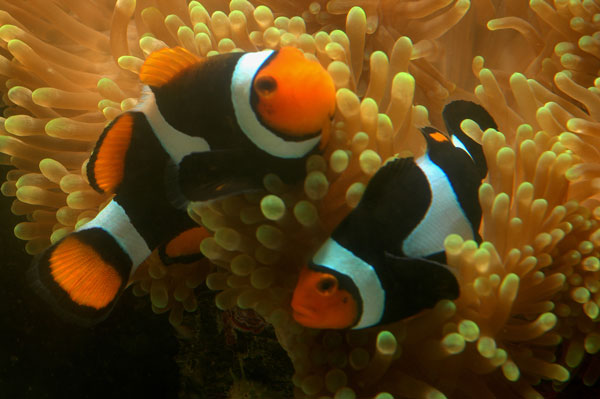
Now the other less used classification on a Percula that some people only call onyx is like the clown in the lower right below.
post-57-1113395473.jpg

Do you notice how much more of the clown is covered in black? Both fins are as well as the top spine. Now in my experiance the only people that say only these clowns are onyx are the ones that own them.
These ones also fit into this classification.
(Pic by CatDoc)
002.jpg

(Pic by CaveManNOhio)
004.jpg


Just to finish this off, these A. Perculas would also be considered Onyx.
(Pic by CatDoc)
003.jpg

(Pic by intekhab)
005.jpg


So, if your clown doesnt look like one of these clowns then it most likely is not an Onyx percula.
David
 
you finally made it:) good job Dave!

hopefully there will be NO more people asking if they have an Onyx perc:D

Mods...can this please be made into a sticky?
 
Still is my opinion it is not a true onyx unless you can trace them back to the origional pair that came from c-quest..

Dave
 
Curious questions, how long does it take (ball park) for the full color development of an "onyx" to take place?

Also, the common markings are a opinion of some owners of these percula? Or documented by a place such as c-quest? Whom I understand from Dave are the first to name this coloring.
 
I would imagine the coloring could take some time (i.e., 6 months to a year), since perculas take the longest to mature. A high quality diet, rich in vitamins and HUFAs, may also contribute to how fast they color up, based on their genetics.

I have a pair of black ocellaris from ORA and it has taken the female quite some time to lose the orange on her head and chin. The process will take me well into a year for them to become completely black, if they ever.
 
TippyToeX said:
Curious questions, how long does it take (ball park) for the full color development of an "onyx" to take place?
A long, long time! I'm going on 8 months and my babies have mostly not even got their full second stripe!:(

No wonder none of the commercial guys concentrate on true percs!:)
 
thanks dickwood, great synopsis of an onyx. i agree as long as a perc has black between its strips its an onyx. but there are variations that i personally and seek.

the more black the better. :)
 
C-quest used the word onyx to differentiate them from their normally colored percs. They did not develop the color variety, it occurs naturally. I believe Dave considers Onyx to be a brand name. Most of us seem to consider onyx a descriptive term.
In my opinion, it is a little like arguing whether or not a plastic adhesive bandage can be called a band-aid, if it is not made by Johnson and Johnson.
 
phender said:
C-quest used the word onyx to differentiate them from their normally colored percs. They did not develop the color variety, it occurs naturally. I believe Dave considers Onyx to be a brand name. Most of us seem to consider onyx a descriptive term.
In my opinion, it is a little like arguing whether or not a plastic adhesive bandage can be called a band-aid, if it is not made by Johnson and Johnson.


Are you positive?

I do believe you are right about people using the name to describe a color pattern but I think it is wrong to do that.

From everything I have read and heard it was a bred trait. I have heard it is a recessive gene, what ever that means, plus a few other things.. But everything points to it being a bred trait..
Did you know c-quest was a fish hatchery..

Matter of fact inland aquatics lists the onyx and the Solomon island clowns differently.. The Solomon Island clowns are the same ones I believe live aquaria is sellingââ"šÂ¬Ã‚¦ Even the faq on rc lists the two different alsoââ"šÂ¬Ã‚¦


By the way anyone know where the black A. ocellaris started from? I have never seen any in books or in picks in the wild is this a bred traight? I have looked and have found no info? I think i will start a new thread on this subject..

Dave
 
shred5 said:
Still is my opinion it is not a true onyx unless you can trace them back to the original pair that came from c-quest..

Dave

That is a great point which I forgot to mention. I don't believe it is a bred trait that only they came up with but I believe they were the first ones to breed SI percs that were completely black between the bars and they coined the phrase ONYX. The reason they differentiated between SI percs and onyx is because it doesn't matter where the perc comes from but the black pattern it has. Therefor onyx can come from SI, PNG, and where ever else they can be collected. Now, I'm not positive about what there thinking was but this is how I perceive it.
David
 
Dlckwood said:
That is a great point which I forgot to mention. I don't believe it is a bred trait that only they came up with but I believe they were the first ones to breed SI percs that were completely black between the bars and they coined the phrase ONYX. The reason they differentiated between SI percs and onyx is because it doesn't matter where the perc comes from but the black pattern it has. Therefor onyx can come from SI, PNG, and where ever else they can be collected. Now, I'm not positive about what there thinking was but this is how I perceive it.
David

maybe we would not be having this discussion if they called them c-quest onyx clowns, kind of like tyree does with Tyree LE...

But I really would like to know for sure.. someone has to know... C-quest has been sold, does anyone have a contact there?

Dave
 
Edgar is from C-Quest and would likely have the info.

But my understanding is that they came from WC with the black pattern and that they where able to breed "true" with their breeding program.

And yes it does breed true in other's like the ones that come out of PNG.
 
shred5 said:
Are you positive?
About them not creating the trait in their breeding program? Yes. Wild caught individuals with the same color pattern come in all the time.

From everything I have read and heard it was a bred trait. I have heard it is a recessive gene, what ever that means, plus a few other things.. But everything points to it being a bred trait..
It is probably more than one gene that causes the color variation. We are not talking about delta tail guppies here. If there was never a C-quest, we would still have fish with the same color pattern because it occurs naturally. If you had a pair of C-quest onyx and a pair of wild caught onyx, I would expect that the C-quest pair would produce a higher percentage of onyx babies. Inbreeding over many generations tends to eliminate genetic diversity.

Did you know c-quest was a fish hatchery.. Reeeeally? (that was sarcasm)

Matter of fact inland aquatics lists the onyx and the Solomon island clowns differently.. The Solomon Island clowns are the same ones I believe live aquaria is sellingââ"šÂ¬Ã‚¦
Obviously, you haven't talked to Inland Aquatics. I have. Their "normal" percs have only black around the stripes. Their SI percs have more black, that may connect the stripes in front but not the back. Their onyx clowns have both stripes connected by black.

I respect your opinion. I understand your opinion. But the meaning of the word onyx is based on its actual usage, not on whether it is proper or not. Onyx has become the standard way to describe the amount of black on a percula clown. For you to tell someone that is new to clowns that the fish in the above pictures are not "true" onyx clowns is very misleading in my opinion.
 
Back
Top