All coral dies or loses color

No really. I think I might be able to move the reactor to the center chamber right before the skimmer and I can throw the Apex probes in there too. The only thing that really worries me is the Macro going asexual. After you brought that up, I starting doing some research and it looks pretty scary.

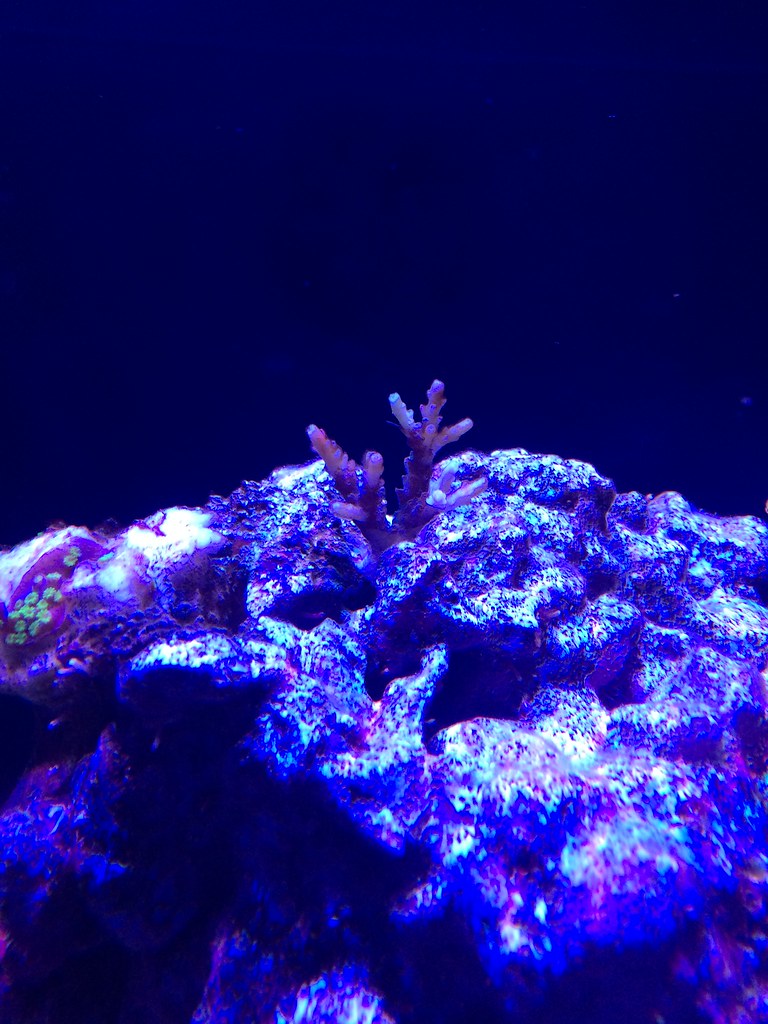
I moved up the Verde Acropora to about half way up the tank yesterday. I'm not sure if there is something wrong with it or not, but the tips get long stringy white things on them when I feed the tank. I'm not sure what that's all about.

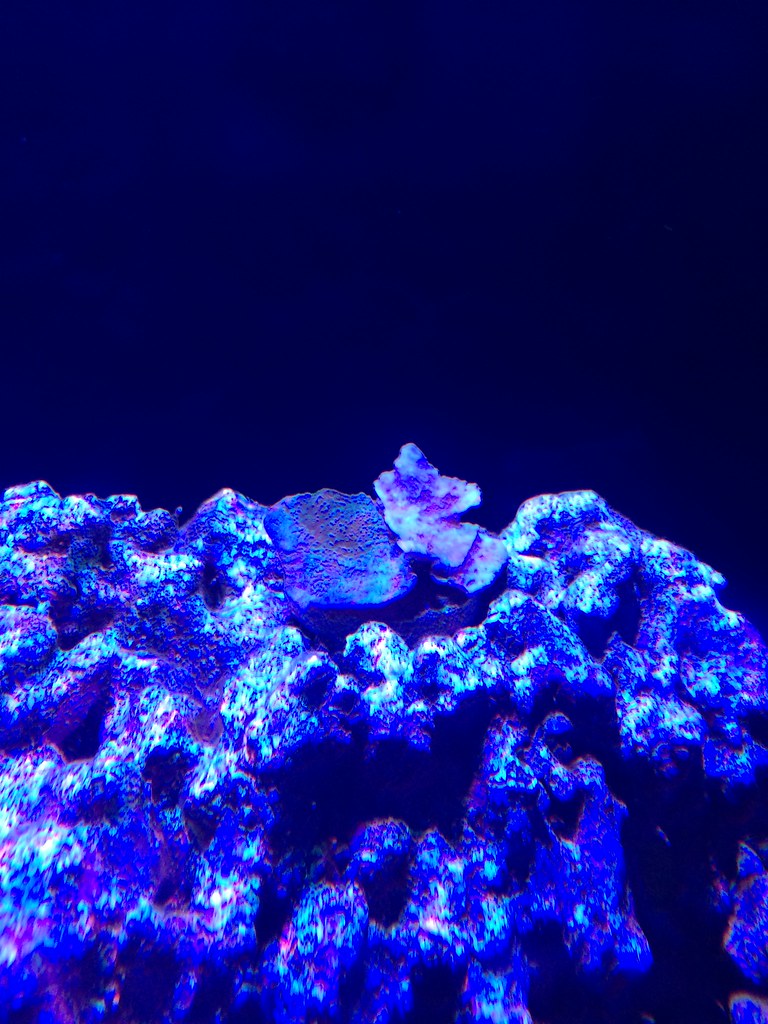
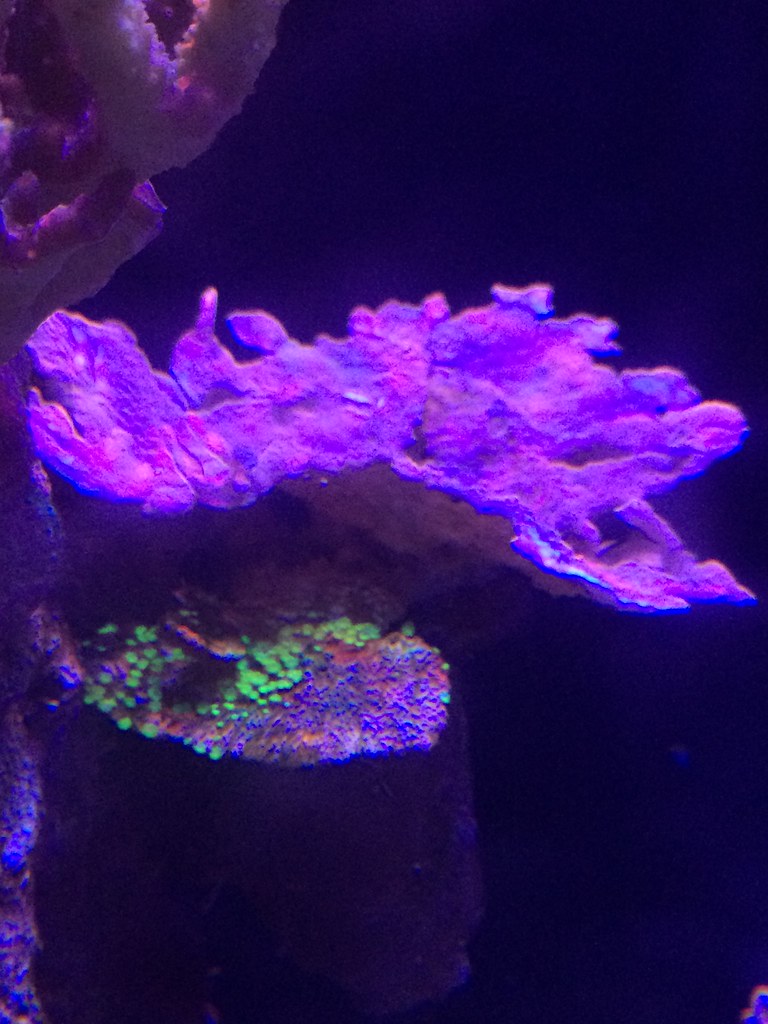
The new Montipora is still on the sand, because I have no idea where to put it. I'm thinking I might pull the old Montipora off the rock (provided I can remove it) and put it there. The part that is supposed to be purple, has a few polyps, but it isn't purple anymore. The orange part is really drab in color and nothing like it was before. I'm not sure if it has a chance or not.

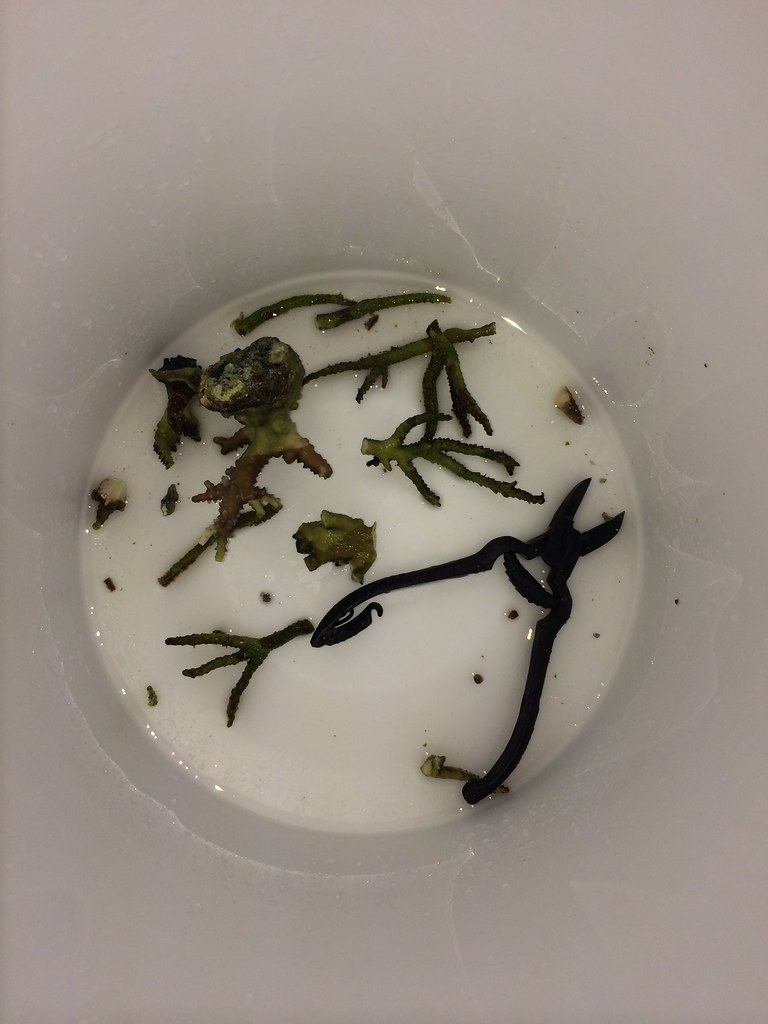
Would you leave it in or take it out? I pulled the Bennet Tort out the other day and was heartbroken. Its flesh kept falling off. I have to cut off some of the others too and see if can salvage a tip or something. This is so disheartening.....

14426996443_0bcc30f976_b.jpg
 
No really. I think I might be able to move the reactor to the center chamber right before the skimmer and I can throw the Apex probes in there too. The only thing that really worries me is the Macro going asexual. After you brought that up, I starting doing some research and it looks pretty scary.

I moved up the Verde Acropora to about half way up the tank yesterday. I'm not sure if there is something wrong with it or not, but the tips get long stringy white things on them when I feed the tank. I'm not sure what that's all about.

The new Montipora is still on the sand, because I have no idea where to put it. I'm thinking I might pull the old Montipora off the rock (provided I can remove it) and put it there. The part that is supposed to be purple, has a few polyps, but it isn't purple anymore. The orange part is really drab in color and nothing like it was before. I'm not sure if it has a chance or not.

Would you leave it in or take it out? I pulled the Bennet Tort out the other day and was heartbroken. Its flesh kept falling off. I have to cut off some of the others too and see if can salvage a tip or something. This is so disheartening.....

whereas the asexual is a risk, a couple things to consider - (1) as long as you keep a light over it, it is extremely rare and (2) there are indicators that it is about to, such as turning white, giving you enough time to rip it out if necessary. I have had Caulerpa for almost 4 years now and haven't had it happen. not saying it couldn't happen or won't eventually happen, but so far the lighting trick has gone well. you could also do chaeto, which does not have that risk.

For what its worth with Montipora, back when I was having the same issues as you i had thought all of my Monti had died (purple and orange). But once I got things moving along, they came back nicely and are growing out of control now. That said, won't hurt to leave it in there.

Not sure what the "long stringy white things" might be. Does it look slimy? could it be a vermatid snail tube?

have you backed down your carbon usage yet?

also curious, how much skim production do you get? is it thick/dirty or thin/wet?
 
whereas the asexual is a risk, a couple things to consider - (1) as long as you keep a light over it, it is extremely rare and (2) there are indicators that it is about to, such as turning white, giving you enough time to rip it out if necessary. I have had Caulerpa for almost 4 years now and haven't had it happen. not saying it couldn't happen or won't eventually happen, but so far the lighting trick has gone well. you could also do chaeto, which does not have that risk.

Maybe I'll go with Chaeto. Is there a benefit to using one or the other?

For what its worth with Montipora, back when I was having the same issues as you i had thought all of my Monti had died (purple and orange). But once I got things moving along, they came back nicely and are growing out of control now. That said, won't hurt to leave it in there.

Sounds like a plan. I need to frag off the top of my Pink Lemonade so maybe I'll put it where that is at right now. The rest of the Pink Lemonade has lost all its tissue like everything else, but maybe I can save a small piece. :sad2:

Not sure what the "long stringy white things" might be. Does it look slimy? could it be a vermatid snail tube?

Definitely not a Vermetid snail. I have a bunch of them in the tank and know what they look like. It looks slimy almost like a coral when its irritated after being dipped. Not sure why it does that after I feed the tank though.

have you backed down your carbon usage yet?

also curious, how much skim production do you get? is it thick/dirty or thin/wet?

I actually shut my reactor off completely about a week ago.

The skimmate is relatively thin and doesn't have much of a smell. When things weren't dying, my skimmate was darker and really smelly. Since things started going downhill, its become more clear and doesn't have much of a smell.
 
im still thinking this is a starving issue. can you describe your feeding habits (sorry if a repeat, i scanned back up but didn't see anything)? quantities/frequencies as well.

i mean, there is no harm in just doubling up your food until you start seeing nitrates form. this is what you need to strive for at this point in diagnosis. get them up above 5ppm. and then you can start backing down until you keep nitrates stable at a good level. watch your ammonia levels though just in case.

do you have anything else running right now, like PO4-removers (GFO) or Bio Pellets? just skimmer?

not sure the differences in chaeto vs caulerpa, but regardless, if you can get either growing quick that means you are keeping PO4 & NO3 up nicely. really should be a correlation between macro growth and tank health, to some extent anyway. maybe start with chaeto and then decide later if you switch over to caulerpa.
 
im still thinking this is a starving issue. can you describe your feeding habits (sorry if a repeat, i scanned back up but didn't see anything)? quantities/frequencies as well.

I feed the fish mostly Larry's Reef Frenzy every day in the evening. The coral gets Oyster Feast and Phyto Feast a few times a week They aren't really on a set schedule. I also give the LPS some pellets every once in awhile and they get Black Worms when I make a trip to the LFS.

i mean, there is no harm in just doubling up your food until you start seeing nitrates form. this is what you need to strive for at this point in diagnosis. get them up above 5ppm. and then you can start backing down until you keep nitrates stable at a good level. watch your ammonia levels though just in case.

The last Nitrate test was 2ppm and Phosphate was 0.04ppm.

do you have anything else running right now, like PO4-removers (GFO) or Bio Pellets? just skimmer?

Just a skimmer.

The Montipora I bought is beginning to lose its color and it's only been a week. It was nice to have a little color in the tank, even though it was only for a week. :sad2:
 
Easy solution to that... buy one! :)

But seriously... with the amount of grief and $$ loss you're looking at in trying to track this down, wouldn't it make sense to buy a PAR meter to see if it's lighting? You're testing water parameters in a lab (granted, you can do it for free!) but yet just eyeballing light intensity?

$155 at Apogee for the sensor head. Wire it to a multimeter that you probably already have. Multiply mV reading by 5 and you have PAR.

Is the SQ-120 the sensor that I would need? It says the SQ-120 is for Electric lights and the SQ-110 is for sunlight.

Would you recommend buying the sensor wand they sell, or just hold it by hand?

Would the multimeter I have work with that sensor? What would be the best way to attach the sensor to the multimeter?
 
Have you taken any PAR readings to determine what your actual light intensity is? Have you had any success with soft corals?

Ladies and Gentlemen, I think we have a winner. :celeb3:

Here is what I think happened:

1. The coral bleached because of low nutrient (Phosphate and Nitrate), but still grew
2. Lights were swapped for LEDs thinking that would solve the problem after other options were explored.
3. Corals were cooked because the lights were placed directly on the tank at 40%.
4. Lights were hung and intensity was dropped to 35% not allowing the corals to recover and killing the ones that weren't cooked from the initial LED installation.

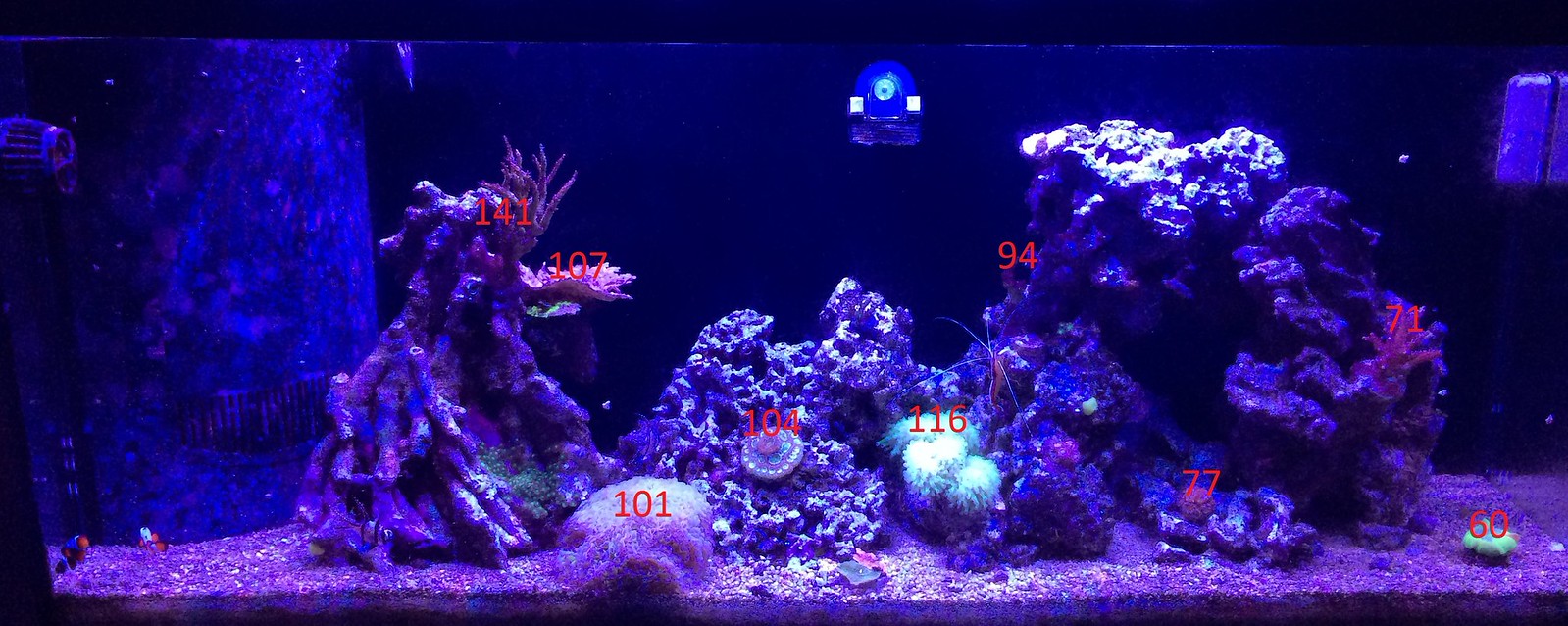
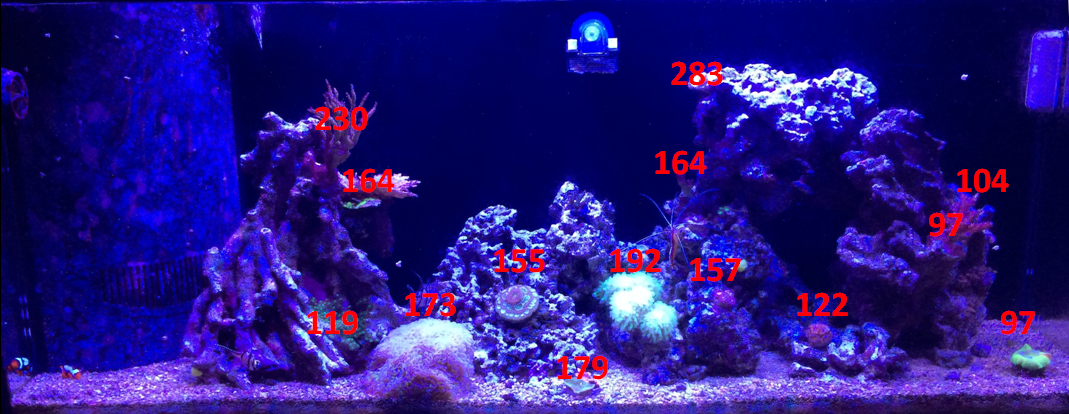
You won't believe this, but the highest PAR reading in my tank is 141. :eek2:

Corals and corresponding PAR values.

  • Plating Montipora - 107
  • Hammer Coral - 100
  • Acro Valida - 141
  • Frogspawn - 116
  • Ora Red Planet - 90
  • Orange Crush Acans - 104
  • Bleeding Apple Scoly - 60
  • Misc Acropora - 71
  • Red Acans - 77

14489229591_03169683fd_h.jpg
 
oh man, ya 141 isn't good! well, glad you found what is hopefully 'the culprit'.

so whats your plan? switching to MH or T5's?

i started with LED's and once I did a PAR test quickly realized better lighting was necessary, just as you did. I am using MH now. Radium 20K bulbs with magnetic ballast - 4x 250w bulbs.
 
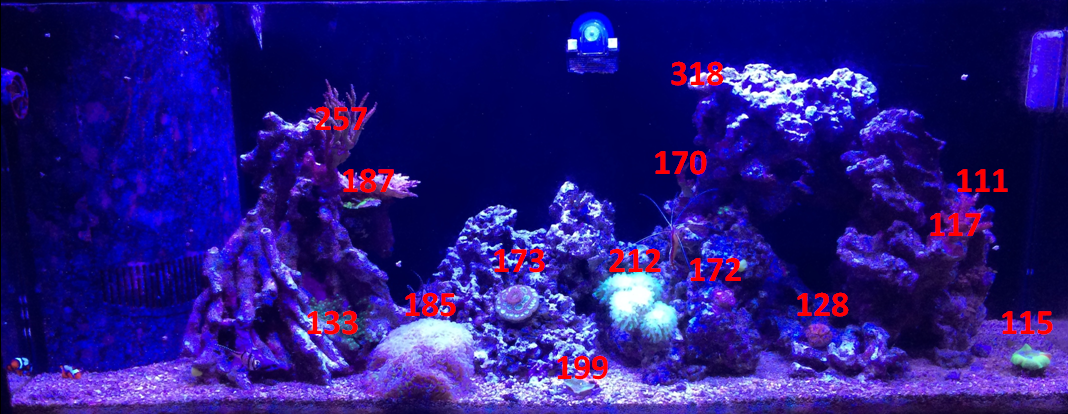
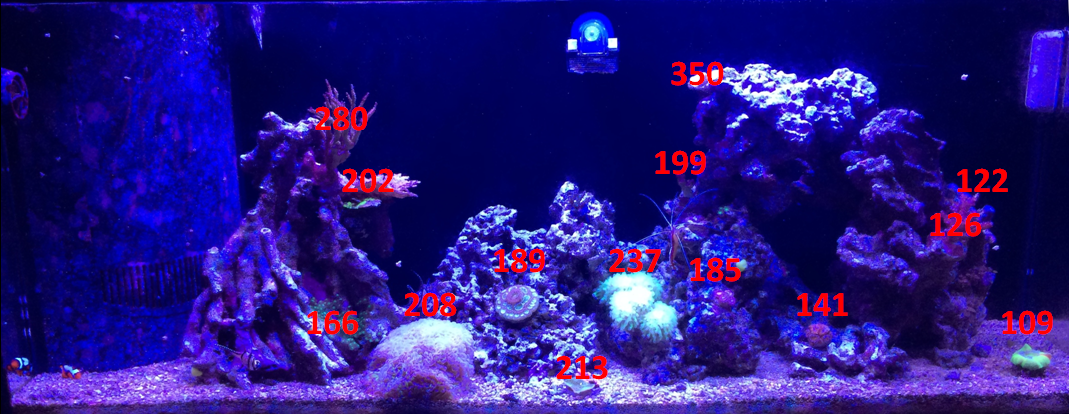
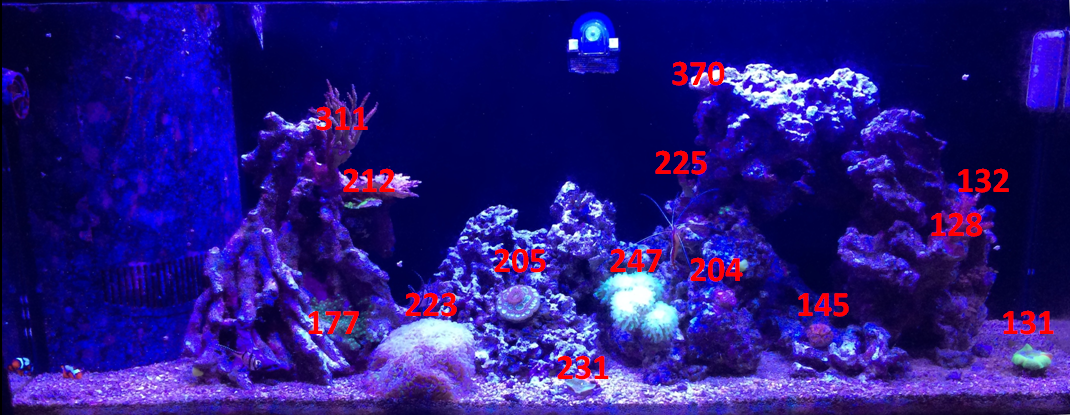
My old T5 fixture is still in the basement. I might throw that on just to do some PAR readings. That way I can compare them with what I got with the LEDs. My LEDs are about 8.5" off the surface of the water and even at 100%, the highest coral position in my tank only hits 370.

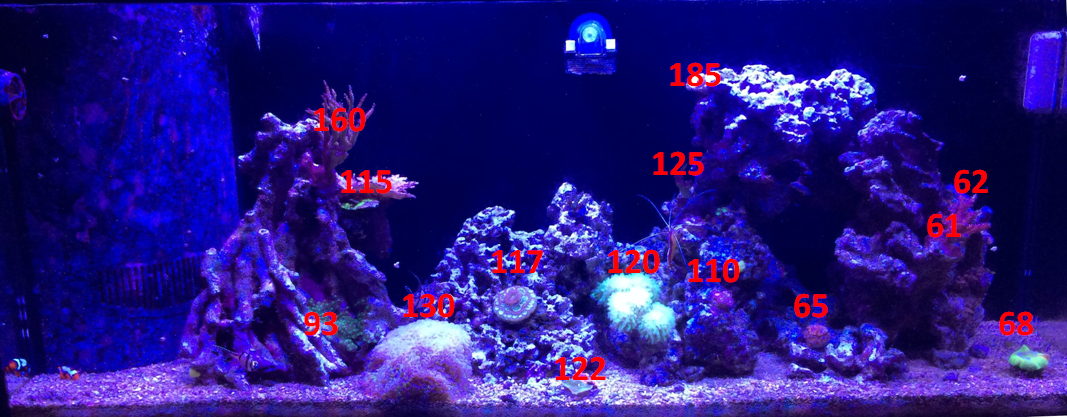
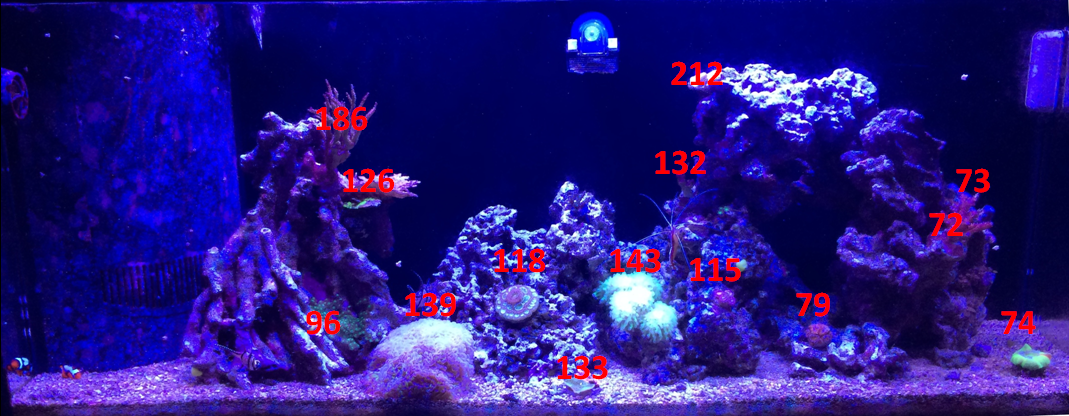
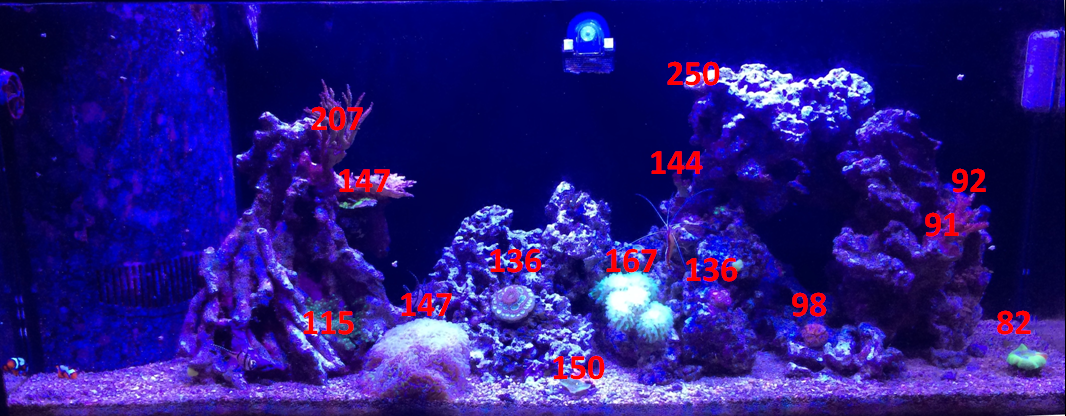
I bumped up the fixture to 45% and am going to lower the fixture on a regular basis until I get around 500 at the top position. Getting spread in the corners is going to be tough because these LEDs seem to be very "spotty".

Here are the readings from today. Keep in mind that the sensor was held by hand, while holding the meter and attempting to dictate to my iPhone for later use. I really need to get a wand. :D

Anyone have any input? :bounce2:

45%

14308004400_e1f642241b_o.png


50%

14514765533_cb1ed46a19_o.png


60%

14514765453_e8ac0dcf8c_o.png


70%

14493446602_c61612fefd_o.png


80%

14308050628_f9a653101b_o.png


90%

14308187507_9d55ca7237_o.png


100%


14491267541_dc51436ef7_o.png
 
I've heard par meter slightly underrate LEDs, but I want to say by only about 10% pending on spectrum.

Your numbers a 100% look good to me. I really want to know what my par numbers are on my DIY led fixture.
 
Is the SQ-120 the sensor that I would need? It says the SQ-120 is for Electric lights and the SQ-110 is for sunlight.

Would you recommend buying the sensor wand they sell, or just hold it by hand?

Would the multimeter I have work with that sensor? What would be the best way to attach the sensor to the multimeter?

Sorry I didn't see this earlier... but it sounds like you have the PAR meter issue taken care of.

I didn't buy the wand, but just made one out of some PVC pipe and elbows. I didn't glue the elbows on the end where the sensor mounts so I could pivot it around to keep the sensor at the right angle. I think to get good readings you really need a wand so that your arm isn't blocking any of the light.

LPS seem happy in my tank with readings in the low to mid 100s, but yeah... acros up high in the tank should be getting quite a bit more!

Also, regarding the correction factor for LEDs, look on Apogee's website and they have a correction chart for the type of lighting. Off the top of my head, Risin's 10% number sounds about right. Think it's higher for the blue spectrum down in the mid 400nm range.
 
I'm no expert but are you SURE you don't have Montipora Eating Nudibranchs and AEFW? I lost my Montipora almost overnight and didn't realize that they were so very small and hard to see.
 
I don't see any pests and since both Montipora and Acropora have different pests, I don't think that is the problem.

I ripped out more dead coral last night and my two test pieces aren't doing well. The Montipora has lost almost all of its color and the Acropora is starting to lose tissue. :sad2:

14378597570_4e7aafa96f_b.jpg
 
I took your advice 100%hydrophylic and picked up two cheap frags last night and am acclimating them to my lighting. They are sitting on the sand. I'll move them up and they will be the test pieces. I was just going to get an Acro, but I lost my Montipora (it was my favorite) so I got another one to replace it.

Here they are. It's pretty cool having some color in the tank. Sorry for the terrible Acro shot, but my iPhone isn't a fan of the lighting. Especially at night when it's predominantly blue.


The test piece idea didn't go well, unfortunately. The Verde is dead and has been disposed of in the trash. All of the flesh fell off and algae began to take over the skeleton. The Red & Green Montipora is almost dead and has lost all of its color. :sad2:


14727692353_885e2e0635_b.jpg


14521169779_b90b3e035d_b.jpg


I'm going to start offering a reward to whoever can diagnose my problem. :(
 
After reading through I am lead down two paths, Lighting and Alk
first the easy one, take a Alk reading everyday for awhile.

Now for your lights you have a very nice light that is very adjustable, you said you had it at 40% and then down to 33% but you don't state the channel levels or what program you are using.

There is a Hyperion section on the forum with some great info, you not only need to get them turned to a good spectrum but also the right intensity and photo period I know plenty of guys now running their white channels for only 3 to 4 hours a day and blues for 8 hours and for extended viewing run low power blue or moon.

Light acclamation should be months not days or weeks.

So my suggestion would be get some acclamation settings from the Hyperion section of the forum http://www.reefcentral.com/forums/forumdisplay.php?f=680
and set like you just got the light and go through a complete light acclamation program and get your spectrum dialed in.

and test and record your Alk everyday for awhile.
 
Now for your lights you have a very nice light that is very adjustable, you said you had it at 40% and then down to 33% but you don't state the channel levels or what program you are using.

When I initially installed the lamp I mounted it on the tank using the Pacific Sun spider mount and set it to 40% as per the manufacturer. Unfortunately, it burnt all the coral that was in the top 1/3 of the tank. I then dropped it down to 33% and hung the lamp. I slowly increased the power to 45% where it sat for a month or so while the coral continued to die.

Once I purchased a PAR meter, I found out how "spotty" these lamps are and how inconsistent their light output is in relation to the panel. Move the PAR meter an inch to the right or left and the PAR can go from 200 to 270. :fun5:

Over the last month or so, I have slowly increased to where it is now (62%) and dropped the Red channel to 60% and the Amber to 55%.

The PAR still isn't very high even at the surface.

There is a Hyperion section on the forum with some great info, you not only need to get them turned to a good spectrum but also the right intensity and photo period I know plenty of guys now running their white channels for only 3 to 4 hours a day and blues for 8 hours and for extended viewing run low power blue or moon.

The Hyperion S doesn't have any white channels. My photoperiod is a total of 10 hours, with a 3 hour sunrise, 4 hours of daylight and a 3 hour sunset. This was also the recommended configuration when I purchased the lamp and spoke to the vendor.

I've given up on the vendor sponsored forum and haven't had much luck making any progress asking them for help.

Light acclamation should be months not days or weeks.

and test and record your Alk everyday for awhile.

That's easy enough. :)
 
try these settings as you max settings
UV channels ramp to 80%
RB channels ramp to 50%
Blue channel ramp to 40%
Cyan channel ramp to 30%
Green channel ramp to 30%
amber channel ramp to 30%
Red channel ramp to 15%
 
I'm a little hesitant to make such a drastic change to the lighting. Over the last 2 weeks, some of my LPS has begun to regain a little of its color. For the first time in almost 2 years, my Orange Crush Acan actually has some Orange and my Red Acans Echinatas are starting to get their green strips back and the red is getting deeper. Most everything is still pale, but I can see some very minor changes.

I can also see small orange dots appearing on when I thought was a dead Montipora (a different one than in the picture above). These dots are only visible when the tank is at the end of sunset and things are very blue, but they weren't there a few weeks ago.

Unfortunately, the SPS has all died, but perhaps things are starting to turn around....

Its my first glimmer of hope and I'm afraid to breath around the tank.

I just changed salt mixes about 2 water changes so I'm going to ride out the salt change and lighting increase for a month or two before I do anything drastic. I think your idea of monitoring Alkalinity daily is a good one, especially since I switched from Red Sea (8.0dKh) to Instant Ocean (~10dKh).
 
Back
Top