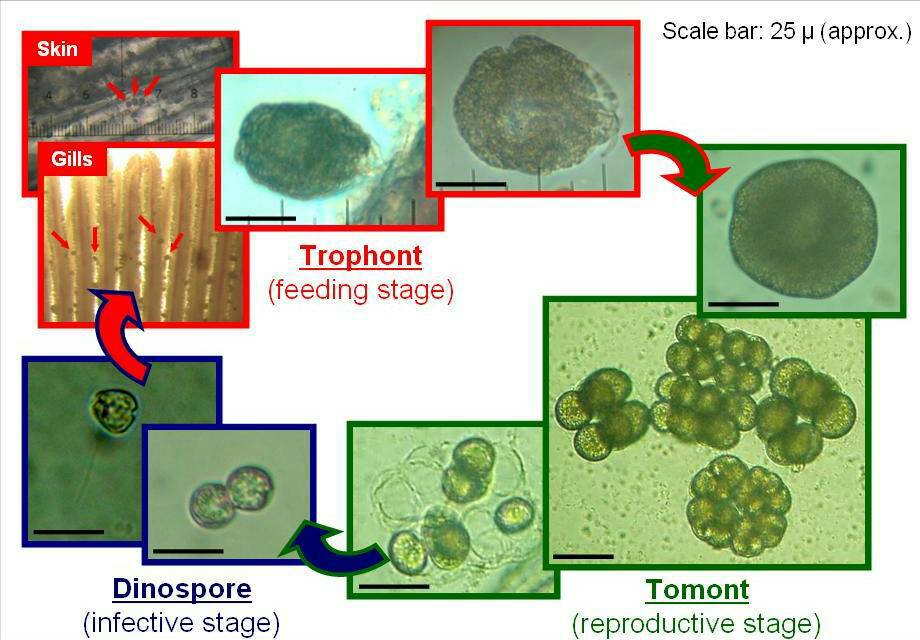
I'm interested in how fish can act as carriers, especially if they are exposed to levels of copper. How does copper exposure actually mask the infection for several weeks?
My theory is that the copper kills or impairs enough of the parasites to prevent the "avalanche-effect" of a "normal" infection, but not enough to clear the fish or the system.
This may also give the fish the time to build up some partial immunity against these parasites, which may account for the delay after the copper is no longer present.
When I was reading the literature, a synopsis f what I could find:
The Life Cycle of Amyloodinium ocellatum
"¢ Free-swimming cells called dinospores are released from a mature cyst and go in search of a host fish. Typically these cells can survive seven to eight days without a host, but at temperatures around 75-80 degrees, some strains may last up to 30 days or more. Raising the temperature will speed up the lifecycle but it also reduces dissolved oxygen in your tank water. For fish with this parasite in their gills, this treatment can be dangerous.
"¢ Once a host is found, typically heading for the soft tissue inside the gills first, the dinospores lose their swimming capabilities and become non-motile parasitic trophozoites. At this stage they turn parasitic, as each attaches to the host fish by sending out a filament for feeding.
"¢ After feeding for 3 days to a week, the trophozoites become mature and either drop off into the substrate, remain hidden in the mucous membrane, or sometimes remain deeply embedded in the tissue of a host fish. At this point, each forms a hard shell covering.
"¢ Inside each encrusted cyst, the cells, now called tomonts, reproduce internally by non-sexual division. Upon reaching maturity in about five days, each cyst ruptures and releases hundreds of new free-swimming dinospores to start the cycle all over again, but in much large numbers.
I actually read in one research paper that the dinospore stays motile for up to 24h after attachment. This allows it to find a new host in case the current host dies or if it gets dislodged by other means. After feeding for more than 24h it is capable of dividing (less often though) should the host die.
The most scary - and the reason why TTM is not a reliable method here - is the fact that it can actually encyst on the fish.
Thought this was pretty cool.
Well, this is the info you find everywhere, but it does not contain the details or time periods of each stage which is the info I'm looking for.
Especially of interest is the duration and properties of the reproductive stage. Also does Amyloodinium form attached cysts like Cryptocaryon or is the reproductive stage rather loose in the substrate? If it attaches, can it attach to inverts, corals,...?
I want to know for how long inverts and corals can possibly carry a "cysts".
After the dinospores have hatched it should be possible to wash free stages away with a series of tank transfers or full water changes. Therefore the maximum "cyst" stage length is what's of most interest.
Raising the temperature may or may not be a possibility with corals and inverts, but it would be good to have time tables how long the fallow period would need to be at which temperature.
The issue with the free infective stage is that it can linger for quite some time as it can generate energy via photosynthesis.
After all, Amyloodinium is not a true protozoan, but rather something in-between plant and animal.
This is the parasite that gives me sleepless nights - not Cryptocaryon.