
You are using an out of date browser. It may not display this or other websites correctly.
You should upgrade or use an alternative browser.
You should upgrade or use an alternative browser.
(Another) DIY LED Controller - Simple Arduino Style
- Thread starter katchupoy
- Start date

liquidarts
New member
Muda,
I don't understand why you have the tank temp sensor in with your heatsink temp sensor to run the heatsink fan.And in order for the moonilghts to run the moonphqasesyou need to remove the following code:
and add
to your definitions as well as remove the MoonOn(); and MoonOff(); out of the loop.
</liquidcrystal.h></dallastemperature.h></onewire.h>
I don't understand why you have the tank temp sensor in with your heatsink temp sensor to run the heatsink fan.And in order for the moonilghts to run the moonphqasesyou need to remove the following code:
Code:
/*||||||||||||||||||||||||||  D E F I N E  :  M O O N  L I G H T  O N - O F ||||||||||||||||||||||||||||*/

void MoonOn()
{
  digitalWrite(moon, HIGH);
}
void MoonOff()
{
  digitalWrite(moon, LOW);
}</pre>
Code:
/************************************************M O O N P H A S E S ********************************************************************/
int iBlueIntensity;       //declare the integer of blue intensity
float fBlueIntensity; //declare the floating point version of blue intensityemailed you too.Code:/******************************************************************************* * work 4 relay bord, and all goodyes that worked before :) * DS18B20 Temp Sensor and reformat for 20x4 LCD added by Tom, droidninjas@gmail.com * Lunar Phases and heater,fan, backlight added by Martin, liquidartstattoos@gmail.com * BAcklight LCD * ------------------------------ * 0 HEATER A0 FAN * 1 ATS A1 * 2 24V A2 * 3 MOON LED PWM A3 * 4 LCD A4 RTC * 5 LCD PWM A5 RTC * 6 LCD PWM * 7 LCD * 8 TEMP * 9 BACKLTH PWM * 10 LED PWM * 11 LED PWM * 12 LCD * 13 LCD * ------------------------------- **********************************************************************************/ #include <onewire.h> #include <dallastemperature.h> #include "Wire.h" #define DS1307_I2C_ADDRESS 0x68 // Set rtc #include <liquidcrystal.h> // initialize the library with the numbers of pins #define ONE_WIRE_BUS 2 // Define the pin of the DS18B20 /*||||||||||||||||||| L E D D I M M I N G P A R T ||||||||||||||||||||||||||*/ int bluemin = 0 ; // minimmum dimming value of blue LEDs, range of 0-255 int bluemax = 255 ; // maximum dimming value of blue LEDs, range of 0-255 int whitemin = 0 ; // minimum dimming value of white LEDs, range of 0-255 int whitemax = 255 ; // maximum dimming value of white LEDs, range of 0-255 int photoperiod = 540 ; // amount of time array is on at full power in minutes int ontime = 9 ; // when start photoperiod fade in int ramptime = 120 ; // time for LEDs to dim on and off in minutes /*||||||||||||||||||||||||||||||||| P I N ||||||||||||||||||||||||||||||||||||||*/ int blue = 11; // blue LEDs connected to digital pin 11 (pwm) int white = 10; // white LEDs connected to digital pin 10 (pwm) int fan = A0; int ats = 1; int heater = 0; int light = A1; int moon = 3; int backlight = 9; int iBlueIntensity; //declare the integer of blue intensity float fBlueIntensity; //declare the floating point version of blue intensity int bluepercent[] = { 0, 13, 26, 52, 78, 103, 128, 154, 180, 205, 230, 255, 255, 255, 255, 255, 255 }; int whitepercent[]= { 0, 0, 0, 6, 9, 13, 26, 52, 78, 103, 128, 154, 180, 205, 230, 255, 255 }; int abc(sizeof(bluepercent)/sizeof(bluepercent[0])); LiquidCrystal lcd(13,12,7,6,5,4); // initialize the library with the numbers of the interface pins byte newChar[8] = { // Set up the custom icon saule leidzias ir kyla ( 0 ir 1 kyla) (2 ir 3 leidzias) (4 ir 5 menulis ) B01001, B01001, B00101, B00101, B10101, B10111, B01111, B11111 }; byte newChar1[8] = { B10010, B10010, B10100, B10100, B10101, B11101, B11110, B11111 }; byte newChar2[8] = { B11111, B01111, B10111, B10101, B00101, B00101, B01001, B01001 }; byte newChar3[8] = { B11111, B11110, B11101, B10101, B10100, B10100, B10010, B10010 }; byte newChar4[8] = { B00111, B01110, B11100, B11000, B11000, B11100, B01110, B00111 }; byte newChar5[8] = { B01010, B10000, B00010, B01001, B00100, B10000, B00100, B10001 }; byte newChar6[8] = { B01010, B00100, B00001, B11011, B00011, B00001, B01000, B10010 }; byte newChar7[8] = { B10010, B00100, B10000, B11011, B11000, B10000, B00010, B01001 }; OneWire oneWire(ONE_WIRE_BUS); // Setup a oneWire instance to communicate with any OneWire devices DallasTemperature sensors(&oneWire); // Pass our oneWire reference to Dallas Temperature. /*||||||||||||||||||||||||||||||||||||||| R T C C L O C K D S 1 3 0 7 ||||||||||||||||||||||||||||||||||||*/ byte decToBcd(byte val) // Convert normal decimal numbers to binary coded decimal { return ( (val/10*16) + (val%10) ); } byte bcdToDec(byte val) // Convert binary coded decimal to normal decimal numbers { return ( (val/16*10) + (val%16) ); } void setDateDs1307(byte second, byte minute, byte hour, byte dayOfWeek, byte dayOfMonth, byte month, byte year) { Wire.beginTransmission(DS1307_I2C_ADDRESS); Wire.send(0); Wire.send(decToBcd(second)); // 0 to bit 7 starts the clock Wire.send(decToBcd(minute)); Wire.send(decToBcd(hour)); Wire.send(decToBcd(dayOfWeek)); Wire.send(decToBcd(dayOfMonth)); Wire.send(decToBcd(month)); Wire.send(decToBcd(year)); Wire.endTransmission(); } void getDateDs1307(byte *second, byte *minute, byte *hour, byte *dayOfWeek, byte *dayOfMonth, byte *month, byte *year) { Wire.beginTransmission(DS1307_I2C_ADDRESS); Wire.send(0); Wire.endTransmission(); Wire.requestFrom(DS1307_I2C_ADDRESS, 7); *second = bcdToDec(Wire.receive() & 0x7f); *minute = bcdToDec(Wire.receive()); *hour = bcdToDec(Wire.receive() & 0x3f); *dayOfWeek = bcdToDec(Wire.receive()); *dayOfMonth = bcdToDec(Wire.receive()); *month = bcdToDec(Wire.receive()); *year = bcdToDec(Wire.receive()); } /*|||||||||||||||||||||||||||||||||||| D E F I N E : B A C K L I G H T ||||||||||||||||||||||||||||||*/ void backlighton() { analogWrite(backlight, 200); } void backlightoff() { analogWrite(backlight, 50); // If too bright or dim adjust the value accordingly. } /*|||||||||||||||||||||||||||||||||| D E F I N E : L U N A R P H A S E ||||||||||||||||||||||||||||||*/ int moonPhase(int moonYear, int moonMonth, int moonDay) { int dayFromYear, dayFromMonth; double julianDay; int phase; if (moonMonth < 3) //keep the month before march { moonYear--; //take away a year moonMonth += 12; //add an extra 12 months (the year taken away from before) } ++moonMonth; dayFromYear = 365.25 * moonYear; //get days from current year dayFromMonth = 30.6 * moonMonth; //get number of days from the current month julianDay = dayFromYear + dayFromMonth + moonDay - 694039.09; //add them all julianDay /= 29.53; //divide by the length of lunar cycle phase = julianDay; //take integer part julianDay -= phase; //get rid of the int part phase = julianDay*8 + 0.5; //get it between 0-8 and round it by adding .5 phase = phase & 7; //get a number between 1-7 return phase; //1 == new moon, 4 == full moon } /*|||||||||||||||||||||||||||||||||||||||| D E F I N E : O N E S E C O N D ||||||||||||||||||||||||||||||*/ void onesecond() //function that runs once per second while program is running { byte second, minute, hour, dayOfWeek, dayOfMonth, month, year; getDateDs1307(&second, &minute, &hour, &dayOfWeek, &dayOfMonth, &month, &year); lcd.setCursor(0, 1); if(hour>0) { if(hour<=12) { lcd.print(hour, DEC); } else { lcd.print(hour, DEC); } } else { lcd.print("12"); } lcd.print(":"); if (minute < 10) {lcd.print("0");} lcd.print(minute, DEC); //lcd.print(":"); //if (second < 10) {lcd.print("0"); } //lcd.print(second, DEC); delay(1000); } /*|||||||||||||||||||||||||| D E F I N E : 24 V O N - O F |||||||||||||||||||||||||||||||||*/ void LightOn() { digitalWrite(light, HIGH); lcd.setCursor(3, 3); lcd.print("+"); } void LightOff() { digitalWrite(light, LOW); lcd.setCursor(3, 3); lcd.print("-"); } /*|||||||||||||||||||||||||| D E F I N E : A T S O N - O F |||||||||||||||||||||||||||||||||*/ void AtsOn() { digitalWrite(ats, LOW); lcd.setCursor(19, 3); lcd.print("+"); } void AtsOff() { digitalWrite(ats, HIGH); lcd.setCursor(19, 3); lcd.print("-"); } /*|||||||||||||||||||||||||| D E F I N E : M O O N L I G H T O N - O F ||||||||||||||||||||||||||||*/ void MoonOn() { digitalWrite(moon, HIGH); } void MoonOff() { digitalWrite(moon, LOW); } /*||||||||||||||||||||||||||||||||||||| S E T U P P I N ||||||||||||||||||||||||||||||||||||||||||||*/ void setup() { pinMode(heater, OUTPUT); pinMode(fan, OUTPUT); pinMode(light, OUTPUT); pinMode(ats, OUTPUT); pinMode(moon, OUTPUT); pinMode(backlight, OUTPUT); sensors.begin(); // Start up the DS18B20 Temp library /*||||||||||||||||||||||||||||||| S E T U P - C L O C K ||||||||||||||||||||||||||||||||||||||||*/ byte second, minute, hour, dayOfWeek, dayOfMonth, month, year; Wire.begin(); // Change these values to what you want to set your clock to. // You probably only want to set your clock once and then remove // the setDateDs1307 call. second = 00; minute = 59; hour = 6; dayOfWeek = 25; // Sunday is 0 dayOfMonth = 4; month = 4; year = 11; //setDateDs1307(second, minute, hour, dayOfWeek, dayOfMonth, month, year); //******* set the clock ******* analogWrite(blue, bluemin); analogWrite(white, whitemin); lcd.createChar(0, newChar); lcd.createChar(1, newChar1); lcd.createChar(2, newChar2); lcd.createChar(3, newChar3); lcd.createChar(4, newChar4); lcd.createChar(5, newChar5); lcd.createChar(6, newChar6); lcd.createChar(7, newChar7); lcd.begin(20, 4); //lcd.setCursor(0, 0); //lcd.write(0); //lcd.write(1); lcd.setCursor(3, 0); lcd.print("Jokubo koralai "); //lcd.setCursor(18, 0); //lcd.write(3); //lcd.write(2); lcd.setCursor(11, 1); lcd.print("B:"); lcd.print(33*bluemin/85); lcd.setCursor(16, 1); lcd.print("W:"); lcd.print(33*whitemin/85); lcd.setCursor(11, 2); lcd.print("L: "); lcd.setCursor(0, 2); lcd.print("W: "); lcd.setCursor(0, 3); lcd.print("24V"); lcd.setCursor(5, 3); lcd.print("Fan"); lcd.setCursor(11, 3); lcd.print("Htr"); lcd.setCursor(16, 3); lcd.print("Ats"); } /*|||||||||||||||||||@@@@@@@@@@@@@@@@@@@@@@@@@@@||||| L O O P |||||||@@@@@@@@@@@@@@@@@@@@@@@@@@@@@@@@||||||||||||||||||||||*/ void loop() { onesecond(); /*||||||||||||||||||||||||||||||||||||||||||||||| L U N A R |||||||||||||||||||||||||||||||||||||||||||||||||||||||||||*/ float fSecond, fHour, fMinute; //turn the times read from the RTC into float for math ops byte second, minute, hour, dayOfWeek, dayOfMonth, month, year; //declare variables to hold the times getDateDs1307(&second, &minute, &hour, &dayOfWeek, &dayOfMonth, &month, &year); //read the RTC times int daybyminute = ((hour * 60) + minute); //converts time of day to a single value in minutes fSecond = (float) second; //sets fSecond as the float version of the integer second from the RTC fMinute = (float) minute; //same as above, but for the minute fHour = (float) hour; //ditto, but for the hour int lunarCycle = moonPhase(year, month, dayOfMonth); //get a value for the lunar cycle //--------MOON LED SETUP----------// if ( ((hour == 7) && (minute < 00)) || (hour < 7))//Off at 730am. { fBlueIntensity = 255; //...then we want the blue LED at the max brightness (255) } else if (hour > 18) //&& (hour < 19)) // On at 5pm { fBlueIntensity = 255 * (((fHour - 16) + (fMinute / 59)) / 7); //...set intensity out of 255 based on time since 17:00 } else { fBlueIntensity = 0; } //---------account for the moon cycle with the blue LEDs---------// if (lunarCycle == 0) //new moon { fBlueIntensity /= 2; } if ((lunarCycle == 1) || (lunarCycle == 7)) //cresent { fBlueIntensity /= 1.75 ; } if ((lunarCycle == 2) || (lunarCycle == 6)) //half moon { fBlueIntensity /= 1.5; } if ((lunarCycle == 3) || (lunarCycle == 5)) //gibbous { fBlueIntensity /= 1.25; } //full moon is full intensity //----------FLOAT TO INT-------------// iBlueIntensity = (int) fBlueIntensity; //---prepare the intensities to be written to pin----// if (iBlueIntensity < 0) //if the blue intensity is less then 0, set it to 0 { iBlueIntensity = 0; } analogWrite(moon, iBlueIntensity); delay(1000); /*|||||||||||||||||||||||||||||||||||||||| T E M P E R A T U R E DS18B20 |||||||||||||||||||||||||||||||||||*/ sensors.requestTemperatures(); // Send the command to get temperatures delay(750); lcd.setCursor(13, 2); float temp1=0, temp2=0; temp1=sensors.getTempCByIndex(1); lcd.print(sensors.getTempCByIndex(1)); lcd.print((char)223); lcd.print("C"); lcd.setCursor(2, 2); temp2=sensors.getTempCByIndex(0); lcd.print(sensors.getTempCByIndex(0)); lcd.print((char)223); lcd.print("C"); if ( (temp2) > 26.5) { digitalWrite(fan, HIGH); lcd.setCursor(8, 3); lcd.print("+"); } else if ( (temp1) > 38) { digitalWrite(fan, HIGH); lcd.setCursor(8,3); lcd.print("+"); } else { digitalWrite(fan, LOW); lcd.setCursor(8,3); lcd.print("-"); } if ( (temp2) < 24.3 ) { digitalWrite(heater, HIGH); lcd.setCursor(14,3); lcd.print("+"); } else if ( (temp2) > 24.3 ) { digitalWrite(heater, LOW); lcd.setCursor(14,3); lcd.print("-"); } /*|||||||||||||||||||||||||||||||||||||||||||||||||||| ATS |||||||||||||||||||||||||||||||||||||||||||||||||*/ if (hour >= 14) { if ( hour < 22) AtsOff(); } else { AtsOn(); } /*|||||||||||||||||||||||||||||||| R A M P T I M E C A L C U L A T I O N ||||||||||||||||||||||||||||||||*/ int rampup; if (daybyminute >= (ontime*60)) rampup = (((ontime*60) + ramptime) - daybyminute); else rampup = ramptime; int rampdown; if (((ontime * 60) + photoperiod + ramptime) <= daybyminute) rampdown = (((ontime*60) + photoperiod + 2*ramptime) - daybyminute); else rampdown = ramptime; /*|||||||||||||||||||||||||||||||||||||||||| F A D E I N ||||||||||||||||||||||||||||||||||||||||||||||*/ if (daybyminute >= (ontime*60)) { if (daybyminute < ((ontime*60) + ramptime)) { LightOn(); MoonOff(); backlighton(); lcd.setCursor(0, 0); lcd.write(0); lcd.write(1); lcd.setCursor(18, 0); lcd.write(0); lcd.write(1); int i; for (int i = 0; i < abc; i++) { analogWrite(blue, bluepercent[i]); analogWrite(white, whitepercent[i]); lcd.setCursor(13, 1); lcd.print((bluepercent[i]*99)/255); if (i < 10) lcd.print(" "); lcd.setCursor(18, 1); lcd.print((whitepercent[i]*99)/255); if (i < 10) lcd.print(" "); int countdown = ((rampup*60)/abc); while (countdown>0) { onesecond(); countdown--; lcd.setCursor(6, 1); if (countdown < 100) lcd.print ("0"); if (countdown < 10) lcd.print ("0"); lcd.print(countdown); } } } } /*||||||||||||||||||||||||||||||||||||||||||||||| M A X |||||||||||||||||||||||||||||||||||||||||||||*/ if ( daybyminute >= ((ontime * 60) + ramptime)) { if ( daybyminute < ((ontime * 60) + ramptime + photoperiod )) { LightOn(); MoonOff(); backlighton(); analogWrite(blue, 255); analogWrite(white, 255); lcd.setCursor(0, 0); lcd.write(6); lcd.write(7); lcd.setCursor(18, 0); lcd.write(6); lcd.write(7); lcd.setCursor(13, 1); lcd.print(99); lcd.setCursor(18, 1); lcd.print(99); lcd.setCursor(6, 1); lcd.print(" "); } } /*||||||||||||||||||||||||||||||||||||||||||||| F A D E O U T |||||||||||||||||||||||||||||||||||||||||*/ if ( daybyminute >= ((ontime * 60) + photoperiod + ramptime)) { if ( daybyminute < (ontime * 60) + photoperiod + (ramptime *2) ) { LightOn(); MoonOff(); backlighton(); lcd.setCursor(0, 0); lcd.write(2); lcd.write(3); lcd.setCursor(18, 0); lcd.write(2); lcd.write(3); for (int i = abc-1; i >= 0; i--) { analogWrite(blue, bluepercent[i]); analogWrite(white, whitepercent[i]); lcd.setCursor(13, 1); lcd.print((bluepercent[i]*99)/255); if (i < 10) lcd.print(" "); lcd.setCursor(18, 1); lcd.print((whitepercent[i]*99)/255); if (i < 10) lcd.print(" "); int countdown = ((rampdown*60)/abc); // calculates seconds to next step while (countdown>0) { onesecond(); countdown--; lcd.setCursor(6, 1); if (countdown < 100) lcd.print ("0"); if (countdown < 10) lcd.print ("0"); lcd.print(countdown); } } } } //*|||||||||||||||||||||||||||||||||||||||||||||||| Night Time ||||||||||||||||||||||||||||||||||||||||||||||*/ if (daybyminute >= (((ontime * 60) + photoperiod + (2 * ramptime)))) { LightOff(); MoonOn(); backlightoff(); lcd.setCursor(0, 0); lcd.write(4); lcd.write(5); lcd.setCursor(18, 0); lcd.write(4); lcd.write(5); lcd.setCursor(6, 1); lcd.print(" "); } } //*|||||||||||||||||||||||||||||||||||||||||||||||| T H E E N D ||||||||||||||||||||||||||||||||||||||||||*/
Ignore lithuanian coments and title
</liquidcrystal.h></dallastemperature.h></onewire.h>
Thanks Martin,
I still dont have moonlights setup. Ill fix this part by your recommendations. Was too lazy to check before.
My LEDs are on passive heatsink and dont need cooling. If tank temp rises too much (hot day), then I need to cool both - tank and leds. This way tank temp reacts faster.
Also one small problem is with displaying 24V to LCD. Sometimes "2" is disappearing from display and I can find what causes it. Seems like overflow from line 1. But why ?...
I still dont have moonlights setup. Ill fix this part by your recommendations. Was too lazy to check before.
My LEDs are on passive heatsink and dont need cooling. If tank temp rises too much (hot day), then I need to cool both - tank and leds. This way tank temp reacts faster.
Also one small problem is with displaying 24V to LCD. Sometimes "2" is disappearing from display and I can find what causes it. Seems like overflow from line 1. But why ?...
Last edited:
liquidarts
New member
So I looked over your code and saw there was extra spacing in the lcd.print(" "); lines...that may have been your problem.I fixed your code hopefully so copy and try it out and let me know if it works out.Because on paper all the character placement seems to be correct.But if it sill cuts out try moving the b: and w: info on line 2 to the left by 1 or 2 spaces.
</liquidcrystal.h></dallastemperature.h></onewire.h>
Code:
 /*******************************************************************************
 * work 4 relay bord, and all goodyes that worked before :)


 * DS18B20 Temp Sensor and reformat for 20x4 LCD added by Tom, droidninjas@gmail.com
 * Lunar Phases and heater,fan, LCD backlight added by Martin, liquidartstattoos@gmail.com


 * ------------------------------
 * 0  HEATER              A0 FAN
 * 1  ATS                 A1
 * 2  24V                 A2
 * 3  MOON LED PWM        A3
 * 4  LCD                 A4 RTC
 * 5  LCD      PWM        A5 RTC
 * 6  LCD      PWM
 * 7  LCD
 * 8  TEMP
 * 9  BACKLTH  PWM
 * 10 LED      PWM
 * 11 LED      PWM
 * 12 LCD
 * 13 LCD
 * -------------------------------

 **********************************************************************************/
#include <onewire.h>
#include <dallastemperature.h>
#include "Wire.h"
#define DS1307_I2C_ADDRESS 0x68 // Set rtc
#include <liquidcrystal.h>       // initialize the library with the numbers of pins
#define ONE_WIRE_BUS 2          // Define the pin of the DS18B20

/*|||||||||||||||||||  L E D   D I M M I N G   P A R T  ||||||||||||||||||||||||||*/

int bluemin = 0 ;          // minimmum dimming value of blue LEDs, range of 0-255
int bluemax = 255 ;        // maximum dimming value of blue  LEDs, range of 0-255
int whitemin = 0 ;         // minimum dimming value of white LEDs, range of 0-255
int whitemax = 255 ;       // maximum dimming value of white LEDs, range of 0-255
int photoperiod = 540 ;    // amount of time array is on at full power in minutes
int ontime = 9 ;           // when start photoperiod fade in
int ramptime = 120 ;       // time for LEDs to dim on and off in minutes

/*|||||||||||||||||||||||||||||||||  P I N    ||||||||||||||||||||||||||||||||||||||*/

int blue = 11;             // blue  LEDs connected to digital pin 11 (pwm)
int white = 10;            // white LEDs connected to digital pin 10 (pwm)

int fan = A0;
int ats = 1;
int heater = 0;
int light = A1;
int moon = 3;
int backlight = 9;


int bluepercent[] =  { 0, 13, 26, 52, 78, 103, 128, 154, 180, 205, 230, 255, 255, 255, 255, 255, 255 };
int whitepercent[]=  { 0, 0,  0,  6,  9,  13,  26,  52,  78, 103, 128, 154, 180, 205, 230, 255, 255 };

int abc(sizeof(bluepercent)/sizeof(bluepercent[0]));

/************************************************M O O N P H A S E S ********************************************************************/
int iBlueIntensity;       //declare the integer of blue intensity
float fBlueIntensity;       //declare the floating point version of blue intensity

LiquidCrystal lcd(13,12,7,6,5,4);   // initialize the library with the numbers of the interface pins

byte newChar[8] = {    //  Set up the custom icon saule leidzias ir kyla    ( 0 ir 1 kyla) (2 ir 3 leidzias) (4 ir 5 menulis )
    B01001,
    B01001,
    B00101,
    B00101,
    B10101,
    B10111,
    B01111,
    B11111
};

byte newChar1[8] = {
    B10010,
    B10010,
    B10100,
    B10100,
    B10101,
    B11101,
    B11110,
    B11111
};
byte newChar2[8] = {
    B11111,
    B01111,
    B10111,
    B10101,
    B00101,
    B00101,
    B01001,
    B01001
};
byte newChar3[8] = {
    B11111,
    B11110,
    B11101,
    B10101,
    B10100,
    B10100,
    B10010,
    B10010
};
byte newChar4[8] = {
    B00111,
    B01110,
    B11100,
    B11000,
    B11000,
    B11100,
    B01110,
    B00111
};
byte newChar5[8] = {
    B01010,
    B10000,
    B00010,
    B01001,
    B00100,
    B10000,
    B00100,
    B10001
};
byte newChar6[8] = {
    B01010,
    B00100,
    B00001,
    B11011,
    B00011,
    B00001,
    B01000,
    B10010
};
byte newChar7[8] = {
    B10010,
    B00100,
    B10000,
    B11011,
    B11000,
    B10000,
    B00010,
    B01001
};

OneWire oneWire(ONE_WIRE_BUS);        // Setup a oneWire instance to communicate with any OneWire devices
DallasTemperature sensors(&oneWire);  // Pass our oneWire reference to Dallas Temperature.

 /*|||||||||||||||||||||||||||||||||||||||  R T C   C L O C K   D S 1 3 0 7  ||||||||||||||||||||||||||||||||||||*/

byte decToBcd(byte val)    // Convert normal decimal numbers to binary coded decimal
{
  return ( (val/10*16) + (val%10) );
}
byte bcdToDec(byte val)    // Convert binary coded decimal to normal decimal numbers
{
  return ( (val/16*10) + (val%16) );
}
void setDateDs1307(byte second,
byte minute,
byte hour,
byte dayOfWeek,
byte dayOfMonth,
byte month,
byte year)
{
  Wire.beginTransmission(DS1307_I2C_ADDRESS);
  Wire.send(0);
  Wire.send(decToBcd(second)); // 0 to bit 7 starts the clock
  Wire.send(decToBcd(minute));
  Wire.send(decToBcd(hour));
  Wire.send(decToBcd(dayOfWeek));
  Wire.send(decToBcd(dayOfMonth));
  Wire.send(decToBcd(month));
  Wire.send(decToBcd(year));
  Wire.endTransmission();
}
void getDateDs1307(byte *second,
byte *minute,
byte *hour,
byte *dayOfWeek,
byte *dayOfMonth,
byte *month,
byte *year)
{
  Wire.beginTransmission(DS1307_I2C_ADDRESS);
  Wire.send(0);
  Wire.endTransmission();
  Wire.requestFrom(DS1307_I2C_ADDRESS, 7);

  *second = bcdToDec(Wire.receive() & 0x7f);
  *minute = bcdToDec(Wire.receive());
  *hour = bcdToDec(Wire.receive() & 0x3f);
  *dayOfWeek = bcdToDec(Wire.receive());
  *dayOfMonth = bcdToDec(Wire.receive());
  *month = bcdToDec(Wire.receive());
  *year = bcdToDec(Wire.receive());
}

/*||||||||||||||||||||||||||||||||||||  D E F I N E  :  B A C K L I G H T ||||||||||||||||||||||||||||||*/
void backlighton()
{
analogWrite(backlight, 200);
}
void backlightoff()
{
analogWrite(backlight, 50);    // If too bright or dim adjust the value accordingly.
}
/*||||||||||||||||||||||||||||||||||  D E F I N E  :  L U N A R P H A S E ||||||||||||||||||||||||||||||*/

int moonPhase(int moonYear, int moonMonth, int moonDay)
{
  int dayFromYear, dayFromMonth;
  double julianDay;
  int phase;

  if (moonMonth < 3)        //keep the month before march
  {
    moonYear--;            //take away a year
    moonMonth += 12;        //add an extra 12 months (the year taken away from before)
  }
  ++moonMonth;
  dayFromYear = 365.25 * moonYear; //get days from current year
  dayFromMonth = 30.6 * moonMonth; //get number of days from the current month
  julianDay = dayFromYear + dayFromMonth + moonDay - 694039.09; //add them all
  julianDay /= 29.53;        //divide by the length of lunar cycle
  phase = julianDay;        //take integer part
  julianDay -= phase;        //get rid of the int part
  phase = julianDay*8 + 0.5;    //get it between 0-8 and round it by adding .5
  phase = phase & 7;        //get a number between 1-7
  return phase;         //1 == new moon, 4 == full moon
}
/*||||||||||||||||||||||||||||||||||||||||  D E F I N E  :  O N E S E C O N D ||||||||||||||||||||||||||||||*/

void onesecond() //function that runs once per second while program is running
{
  byte second, minute, hour, dayOfWeek, dayOfMonth, month, year;
  getDateDs1307(&second, &minute, &hour, &dayOfWeek, &dayOfMonth, &month, &year);
  lcd.setCursor(0, 1);
  if(hour>0)
  {
    if(hour<=12)
    {
      lcd.print(hour, DEC);
    }
    else
    {
      lcd.print(hour, DEC);
    }
  }
  else
  {
    lcd.print("12");
  }
  lcd.print(":");
  if (minute < 10) {lcd.print("0");}
    lcd.print(minute, DEC);
  //lcd.print(":");
  //if (second < 10) {lcd.print("0");  }
  //lcd.print(second, DEC);
  delay(1000);
}

/*||||||||||||||||||||||||||  D E F I N E  :  24 V   O N - O F   |||||||||||||||||||||||||||||||||*/

void LightOn()
{
  digitalWrite(light, HIGH);
  lcd.setCursor(3, 3);
  lcd.print("+");
}

void LightOff()
{
  digitalWrite(light, LOW);
  lcd.setCursor(3, 3);
  lcd.print("-");
}
/*||||||||||||||||||||||||||  D E F I N E  :  A T S   O N - O F   |||||||||||||||||||||||||||||||||*/

void AtsOn()
{
  digitalWrite(ats, LOW);
  lcd.setCursor(19, 3);
  lcd.print("+");
}

void AtsOff()
{
  digitalWrite(ats, HIGH);
  lcd.setCursor(19, 3);
  lcd.print("-");
}

/*|||||||||||||||||||||||||||||||||||||  S E T U P  P I N   ||||||||||||||||||||||||||||||||||||||||||||*/

void setup() {
  pinMode(heater, OUTPUT);
  pinMode(fan, OUTPUT);
  pinMode(light, OUTPUT);
  pinMode(ats, OUTPUT);
  pinMode(moon, OUTPUT);
  pinMode(backlight, OUTPUT);

  sensors.begin();        // Start up the DS18B20 Temp library

  /*|||||||||||||||||||||||||||||||  S E T U P - C L O C K  ||||||||||||||||||||||||||||||||||||||||*/

  byte second, minute, hour, dayOfWeek, dayOfMonth, month, year;
  Wire.begin();

  // Change these values to what you want to set your clock to.
  // You probably only want to set your clock once and then remove
  // the setDateDs1307 call.
  second = 00;
  minute = 59;
  hour = 6;
  dayOfWeek = 25;  // Sunday is 0
  dayOfMonth = 4;
  month = 4;
  year = 11;

  //setDateDs1307(second, minute, hour, dayOfWeek, dayOfMonth, month, year);   //******* set the clock *******

  analogWrite(blue, bluemin);
  analogWrite(white, whitemin);
  lcd.createChar(0, newChar);
  lcd.createChar(1, newChar1);
  lcd.createChar(2, newChar2);
  lcd.createChar(3, newChar3);
  lcd.createChar(4, newChar4);
  lcd.createChar(5, newChar5);
  lcd.createChar(6, newChar6);
  lcd.createChar(7, newChar7);
  lcd.begin(20,4);
  //lcd.setCursor(0, 0);
  //lcd.write(0);
  //lcd.write(1);
  lcd.setCursor(3, 0);
  lcd.print("Jokubo koralai");
  //lcd.setCursor(18, 0);
  //lcd.write(3);
  //lcd.write(2);
  lcd.setCursor(11, 1);
  lcd.print("B:");
  lcd.print(33*bluemin/85);
  lcd.setCursor(16, 1);
  lcd.print("W:");
  lcd.print(33*whitemin/85);
  lcd.setCursor(11, 2);
  lcd.print("L:");
  lcd.setCursor(0, 2);
  lcd.print("W:");
  lcd.setCursor(0, 3);
  lcd.print("24V");
  lcd.setCursor(5, 3);
  lcd.print("Fan");
  lcd.setCursor(11, 3);
  lcd.print("Htr");
  lcd.setCursor(16, 3);
  lcd.print("Ats");
  }


/*|||||||||||||||||||@@@@@@@@@@@@@@@@@@@@@@@@@@@|||||  L O O P |||||||@@@@@@@@@@@@@@@@@@@@@@@@@@@@@@@@||||||||||||||||||||||*/

void loop()
{
  onesecond();

  /*|||||||||||||||||||||||||||||||||||||||||||||||  L U N A R |||||||||||||||||||||||||||||||||||||||||||||||||||||||||||*/


  float fSecond, fHour, fMinute;        //turn the times read from the RTC into float for math ops
  byte second, minute, hour, dayOfWeek, dayOfMonth, month, year, mil_time;
  getDateDs1307(&second, &minute, &hour, &dayOfWeek, &dayOfMonth, &month, &year);
  int daybyminute = ((hour * 60) + minute); //converts time of day to a single value in minutes


  fSecond = (float) second;            //sets fSecond as the float version of the integer second from the RTC
  fMinute = (float) minute;            //same as above, but for the minute
  fHour = (float) hour;                //ditto, but for the hour
  int lunarCycle = moonPhase(year, month, dayOfMonth); //get a value for the lunar cycle
  //--------MOON LED SETUP----------//


  if ( ((hour == 7) && (minute < 00)) || (hour < 7))//Off at 730am.
  {
    fBlueIntensity = 255;        //...then we want the blue LED at the max brightness (255)
  }

  else if (hour > 17) //&& (hour < 19))             // On at 5pm
  {
    fBlueIntensity = 255 * (((fHour - 19) + (fMinute / 59)) / 7);   //...set intensity out of 255 based on time since 17:00
  }
  else
  {
    fBlueIntensity = 0;
  }

 //---------account for the moon cycle with the blue LEDs---------//

  if (lunarCycle == 0)        //new moon
  {
    fBlueIntensity /= 2;
  }
  if ((lunarCycle == 1) || (lunarCycle == 7))    //cresent
  {
    fBlueIntensity /= 1.75 ;
  }
  if ((lunarCycle == 2) || (lunarCycle == 6))    //half moon
  {
   fBlueIntensity /= 1.5;
  }
  if ((lunarCycle == 3) || (lunarCycle == 5))    //gibbous
  {
    fBlueIntensity /= 1.25;
  }

  //full moon is full intensity


  //----------FLOAT TO INT-------------//
  iBlueIntensity = (int) fBlueIntensity;


  //---prepare the intensities to be written to pin----//

  if (iBlueIntensity < 0) //if the blue intensity is less then 0, set it to 0
  {
    iBlueIntensity = 0;
  }


  //------------and finally, we write the values of the lights to the pins--------------//

  analogWrite(moon, iBlueIntensity);
  delay(1000);

/*||||||||||||||||||||||||||||||||||||||||  T E M P E R A T U R E DS18B20  |||||||||||||||||||||||||||||||||||*/

sensors.requestTemperatures(); // Send the command to get temperatures
delay(750);
 lcd.setCursor(13, 2);

float temp1=0, temp2=0;

 temp1=sensors.getTempCByIndex(1);
 lcd.print(sensors.getTempCByIndex(1));
 lcd.print((char)223);
 lcd.print("C");

 lcd.setCursor(2, 2);

 temp2=sensors.getTempCByIndex(0);
 lcd.print(sensors.getTempCByIndex(0));
 lcd.print((char)223);
 lcd.print("C");

 if ( (temp2) > 26.5)
    {
    digitalWrite(fan, HIGH);
    lcd.setCursor(8, 3);
    lcd.print("+");
    }
  else if ( (temp1) > 38)
    {
    digitalWrite(fan, HIGH);
    lcd.setCursor(8,3);
    lcd.print("+");
    }
  else
    {
    digitalWrite(fan, LOW);
    lcd.setCursor(8,3);
    lcd.print("-");
    }

if ( (temp2) < 24.3 )
    {
    digitalWrite(heater, HIGH);
    lcd.setCursor(14,3);
    lcd.print("+");
    }
else if ( (temp2) > 24.3 )
    {
    digitalWrite(heater, LOW);
    lcd.setCursor(14,3);
    lcd.print("-");
    }

/*||||||||||||||||||||||||||||||||||||||||||||||||||||  ATS  |||||||||||||||||||||||||||||||||||||||||||||||||*/
if (hour >= 14)
  {
    if ( hour < 22)  AtsOff();
  }
 else
{
  AtsOn();
}

/*||||||||||||||||||||||||||||||||  R A M P   T I M E   C A L C U L A T I O N ||||||||||||||||||||||||||||||||*/


  int rampup;
     if (daybyminute >= (ontime*60))
       rampup = (((ontime*60) + ramptime) - daybyminute);
     else
       rampup = ramptime;

    int rampdown;
    if (((ontime * 60) + photoperiod + ramptime) <= daybyminute)
      rampdown = (((ontime*60) + photoperiod + 2*ramptime) - daybyminute);
    else
      rampdown = ramptime;

    /*||||||||||||||||||||||||||||||||||||||||||   F A D E  I N ||||||||||||||||||||||||||||||||||||||||||||||*/

 if (daybyminute >= (ontime*60))
   { if (daybyminute < ((ontime*60) + ramptime))
    {
      LightOn();
      backlighton();

  lcd.setCursor(0, 0);
  lcd.write(0);
  lcd.write(1);
  lcd.setCursor(18, 0);
  lcd.write(0);
  lcd.write(1);

      int i;
      for (int i = 0; i < abc; i++)
{
  analogWrite(blue, bluepercent[i]);
  analogWrite(white, whitepercent[i]);

       lcd.setCursor(13, 1);
       lcd.print((bluepercent[i]*99)/255);
       if (i < 10) lcd.print(" ");

       lcd.setCursor(18, 1);
       lcd.print((whitepercent[i]*99)/255);
       if (i < 10)   lcd.print(" ");

       int countdown = ((rampup*60)/abc);
       while (countdown>0)
        {
          onesecond();
          countdown--;

          lcd.setCursor(6, 1);
          if (countdown < 100) lcd.print ("0");
          if (countdown < 10) lcd.print ("0");
          lcd.print(countdown);
        }
       }
     }
    }

 /*|||||||||||||||||||||||||||||||||||||||||||||||     M A X     |||||||||||||||||||||||||||||||||||||||||||||*/

if ( daybyminute >= ((ontime * 60) + ramptime))
  {
    if ( daybyminute < ((ontime * 60) + ramptime + photoperiod ))
     {
    LightOn();
    backlighton();
    analogWrite(blue, 255);
    analogWrite(white, 255);

  lcd.setCursor(0, 0);
  lcd.write(6);
  lcd.write(7);
  lcd.setCursor(18, 0);
  lcd.write(6);
  lcd.write(7);

  lcd.setCursor(13, 1);  //Poss Problem
  lcd.print(99);          //Poss Problem
  lcd.setCursor(18, 1);  //Poss Problem
  lcd.print(99);          //Poss Problem
  lcd.setCursor(6, 1);
  lcd.print(" ");
    }
  }

  /*|||||||||||||||||||||||||||||||||||||||||||||   F A D E  O U T   |||||||||||||||||||||||||||||||||||||||||*/

   if ( daybyminute >= ((ontime * 60) + photoperiod + ramptime))

  {
    if ( daybyminute < (ontime * 60) + photoperiod + (ramptime *2) )
    {
      LightOn();
      backlighton();
   lcd.setCursor(0, 0);
   lcd.write(2);
   lcd.write(3);
   lcd.setCursor(18, 0);
   lcd.write(2);
   lcd.write(3);

      for (int i = abc-1; i >= 0; i--)
{
  analogWrite(blue, bluepercent[i]);
  analogWrite(white, whitepercent[i]);

        lcd.setCursor(13, 1);
        lcd.print((bluepercent[i]*99)/255);
        if (i < 10)  lcd.print(" ");
        lcd.setCursor(18, 1);
        lcd.print((whitepercent[i]*99)/255);
        if (i < 10)  lcd.print(" ");

        int countdown = ((rampdown*60)/abc); // calculates seconds to next step
        while (countdown>0)
        {
          onesecond();
          countdown--;

          lcd.setCursor(6, 1);
          if (countdown < 100) lcd.print ("0");
          if (countdown < 10) lcd.print ("0");
          lcd.print(countdown);
       }
     }
    }
  }


//*||||||||||||||||||||||||||||||||||||||||||||||||  Night Time ||||||||||||||||||||||||||||||||||||||||||||||*/

  if  (daybyminute >= (((ontime * 60) + photoperiod + (2 * ramptime))))
       {
   LightOff();
   backlightoff();

   lcd.setCursor(0, 0);
   lcd.write(4);
   lcd.write(5);
   lcd.setCursor(18, 0);
   lcd.write(4);
   lcd.write(5);
   lcd.setCursor(6, 1);
   lcd.print(" ");
    }
   }
//*|||||||||||||||||||||||||||||||||||||||||||||||| T H E E N D ||||||||||||||||||||||||||||||||||||||||||*/Not the case. 2 is disappearing during ramp up and down. While max, or night time its ok.
I wonder if "lcd.print((whiteercent*99)/255); " can bring more than two digits anytime ? I intentionally used 99 instead of 100 for this purpose. My idea was, that it can maximum be 99, as whitepercent is max 255. But who knows what arduino has in its mind...
I wonder if "lcd.print((whiteercent*99)/255); " can bring more than two digits anytime ? I intentionally used 99 instead of 100 for this purpose. My idea was, that it can maximum be 99, as whitepercent is max 255. But who knows what arduino has in its mind...
liquidarts
New member
I'd try moving the light temp over one then...I know it fixed my problem when I had it

studog86
New member
I did it. 128X64 lcd mega arduino sketch.
I did it. 128X64 lcd mega arduino sketch.
Well it took me a week to learn how to write a sketch, and be able to figure out how to incorporate a 128x64 KS0108 GLCD into a Katchupoy original sketch.
Thanks for all of your guys hard work, especially Molehs who was able to give me a push in the right direction on working with a GLCD.
I felt I had to get this working so I could contribute to this very informative thread, and I hope someone could use this.
I almost gave up on the GLCD, but I just had to have all that extra real estate to be able to play with bitmaps.
Well its late and my kids are going to wake me up in a couple hours, I will have pictures and updates shortly, so goodnight.
Maybe tonight I will be able to dream about something else other than sketches for my arduino.:spin2:
PS the ramptimes are set to 2 minutes for testing purposes and I set the blue white display to show percentage 10%-100%.
I did it. 128X64 lcd mega arduino sketch.
Well it took me a week to learn how to write a sketch, and be able to figure out how to incorporate a 128x64 KS0108 GLCD into a Katchupoy original sketch.
Thanks for all of your guys hard work, especially Molehs who was able to give me a push in the right direction on working with a GLCD.
I felt I had to get this working so I could contribute to this very informative thread, and I hope someone could use this.
I almost gave up on the GLCD, but I just had to have all that extra real estate to be able to play with bitmaps.
Well its late and my kids are going to wake me up in a couple hours, I will have pictures and updates shortly, so goodnight.
Maybe tonight I will be able to dream about something else other than sketches for my arduino.:spin2:
PS the ramptimes are set to 2 minutes for testing purposes and I set the blue white display to show percentage 10%-100%.
Attachments
liquidarts
New member
Sweet....would love to see how it turned out and how much room you have left on the display to be able to show more readings.
Well it took me a week to learn how to write a sketch, and be able to figure out how to incorporate a 128x64 KS0108 GLCD into a Katchupoy original sketch.
Thanks for all of your guys hard work, especially Molehs who was able to give me a push in the right direction on working with a GLCD.
I felt I had to get this working so I could contribute to this very informative thread, and I hope someone could use this.
I almost gave up on the GLCD, but I just had to have all that extra real estate to be able to play with bitmaps.
Well its late and my kids are going to wake me up in a couple hours, I will have pictures and updates shortly, so goodnight.
Maybe tonight I will be able to dream about something else other than sketches for my arduino.:spin2:
PS the ramptimes are set to 2 minutes for testing purposes and I set the blue white display to show percentage 10%-100%.
studog86
New member
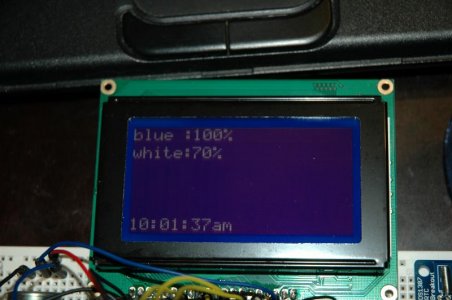
Pics of a 128x64 GLCD ks01080 clone
Pics of a 128x64 GLCD ks01080 clone
Please do not abuse me for the wiring job, I did this at 3am.
More pics of the whole setup on the way.
Thanks again guys, would not have even tried to attempt this with out the headstart you gave me.:bum:
:celeb2:
Pics of a 128x64 GLCD ks01080 clone
Sweet....would love to see how it turned out and how much room you have left on the display to be able to show more readings.
Please do not abuse me for the wiring job, I did this at 3am.
More pics of the whole setup on the way.
Thanks again guys, would not have even tried to attempt this with out the headstart you gave me.:bum:
:celeb2:
Attachments
liquidarts
New member
Very Cool.....because you mentioned something about your GLCD I dusted the one that came with mine off to play with too....remember to add your info to that sketch....u deserve the credit.
studog86
New member
Credit, heck no.
Credit, heck no.
All I did was jump on the backs of you guys and threw a couple of sketches out until it finally worked, besides I have no idea if it is bug proof, as of yet I still have not been able to test the darn thing on a full system, rapid LED stlll has not delivered my 10v regulated power supply to run my Meanwells. I used a 4 volt power supply to test the system but the dimming was eratic. Lights did not come on until 20% and the dimming cycles were barely noticeable. I hope it was just because I had a low voltage going to the pwm. I dont see how I could have screwed up the output to the pwm with the changes I made to the LCD.print.
Have fun.
I will have more pics soon.
This is not a hobby, it is an addiction.
Credit, heck no.
Very Cool.....because you mentioned something about your GLCD I dusted the one that came with mine off to play with too....remember to add your info to that sketch....u deserve the credit.
All I did was jump on the backs of you guys and threw a couple of sketches out until it finally worked, besides I have no idea if it is bug proof, as of yet I still have not been able to test the darn thing on a full system, rapid LED stlll has not delivered my 10v regulated power supply to run my Meanwells. I used a 4 volt power supply to test the system but the dimming was eratic. Lights did not come on until 20% and the dimming cycles were barely noticeable. I hope it was just because I had a low voltage going to the pwm. I dont see how I could have screwed up the output to the pwm with the changes I made to the LCD.print.
Have fun.
I will have more pics soon.
This is not a hobby, it is an addiction.
liquidarts
New member
The fastest way to test the dimming and all the other outputs is by using the 3mm LEDs that came with your kit if you bought it on ebay.....it's how I test it all on the breadboard before moving to my LED drivers and relays....I let everything run for about a week on the 1.5v LEDs though before going forward.I run both the uno and mega on 9v 1A wallwart.
studog86
New member
The fastest way to test the dimming and all the other outputs is by using the 3mm LEDs that came with your kit if you bought it on ebay.....it's how I test it all on the breadboard before moving to my LED drivers and relays....I let everything run for about a week on the 1.5v LEDs though before going forward.I run both the uno and mega on 9v 1A wallwart.
Thanks for the advice and I would do that if I wasn't changing the diaper of one child and putting back together my arduino that my older child just took apart. My power supply is supposed to be her tomorrow, so I am going to wait until then and post back my results.
"I know just enough about electricity to be safe or extremely dangerous."
The Arduino is a buggy beast but packs a huge punch for what it can do for such a small package, I will just keep chuggin alone until I get all the bugs figured out, or until my wife kills me.:deadhorse:
Cheers! Now back to the Vino.
TheFishMan65
New member
I think I found the problem too much Vino and coding are not a good mix
Do you remember this? This is the original wiring diagram "with pot" and without Arduino...

Well the only change we will do with this wiring is to "tap" or "cut" the negative side from the "10v" signal going to the LED driver.

This diagram is only for one channel and for one Arduino pin. It means 1 ramp up and down. One channel can have 1,2 or 4 LED drivers connected to it, but this only means that all of them will ramp up and ramp down at the same time.
If you need to put another channel, example... white, then you just need to duplicate the wiring, resistor, transistor and use another arduino pin.
So the way I understand it this diagram is good for both the "D" and "P" type drivers, just wanted to be sure.
Also, is there a simple code I can enter just for testing purposes of the LED, most importantly the max value so that I can dial in the max current for each string as I go.
I had asked before, and don't think I got a definitive answer one way or the other, but right now I have 96 LEDs which ideally would be 8 drivers. Will a two channel arduino setup be able to handle that many drivers? Will one 10V supply be good for all of the drivers?
Man gotta lot of work ahead of me, and it's all just sitting here laughing at me haha.
liquidarts
New member
int blueramptime = 60 ; <-----change to under 10
int whiteramptime = 180 ; <-----change to under 10
int photoperiod = 240 ; <-----change to under 10
int ontime = 11 ; // time of day (hour, 24h clock) to begin photoperiod fade in
int whiteramptime = 180 ; <-----change to under 10
int photoperiod = 240 ; <-----change to under 10
int ontime = 11 ; // time of day (hour, 24h clock) to begin photoperiod fade in
Last edited:
TheFishMan65
New member
BigCity,
The recommended ELN max is 8. So I would look at the HLGs.
The recommended ELN max is 8. So I would look at the HLGs.
Yeah, unfortunately I got the kits from rapid so I have the drivers on hand already, I may look into driving 2 parallel strings to try to cut down the drivers a bit. I have way more LED's than I need and was looking into running them at a lower amperage any how to allow for any future upgrade on a larger tank if needed.

katchupoy
New member
So the way I understand it this diagram is good for both the "D" and "P" type drivers, just wanted to be sure.
Yes
Also, is there a simple code I can enter just for testing purposes of the LED, most importantly the max value so that I can dial in the max current for each string as I go.
Make sure that you have the 10v supply first then dialed in your SVR2. Then only then you can do the max current for each.
I had asked before, and don't think I got a definitive answer one way or the other, but right now I have 96 LEDs which ideally would be 8 drivers. Will a two channel arduino setup be able to handle that many drivers? Will one 10V supply be good for all of the drivers?
Yes
Yes
Also, is there a simple code I can enter just for testing purposes of the LED, most importantly the max value so that I can dial in the max current for each string as I go.
Make sure that you have the 10v supply first then dialed in your SVR2. Then only then you can do the max current for each.
I had asked before, and don't think I got a definitive answer one way or the other, but right now I have 96 LEDs which ideally would be 8 drivers. Will a two channel arduino setup be able to handle that many drivers? Will one 10V supply be good for all of the drivers?
Yes
Similar threads

- Replies
- 6
- Views
- 2K

- Replies
- 2
- Views
- 182
- Replies
- 0
- Views
- 370