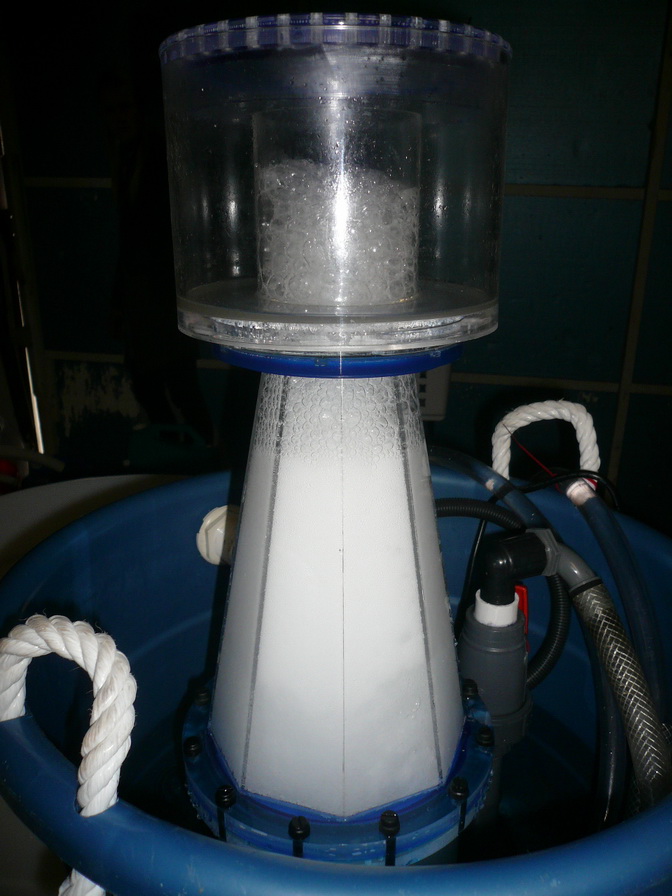
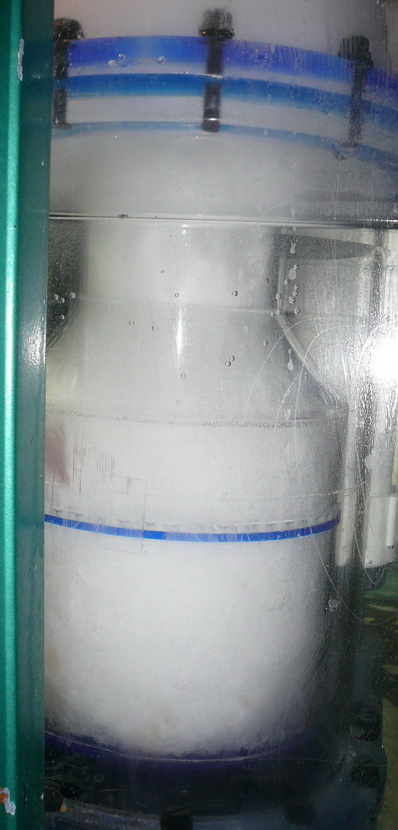
Another DIY skimmer...

RussM

Active member
A while back, I was given a TopFathom TF100A skimmer, and after making extensive mods to it (http://www.sdreefs.com/forums/showthread.php?t=32636), have been using it with adequate success for many months. But, I decided to go down the full DIY path, and embarked on the process of designing and building a new skimmer for my 160g (120g DT) system.

I did a bunch of research, and studied countless photos of production and DIY skimmers. I set several goals...
- Build cost and operating cost must be kept low
- Whatever I devised had to be somewhat unique
- Whatever I built had to have elements of the recent breed of conical skimmer
- It had to be somewhat modular to allow for easy modifications/improvements/fixes
- Skimmer height had to be <30" (my tank stand has 31.5" inside height)

Several months ago I had picked up several 8" diameter / 11" tall 1/4" cast acrylic cylinder segments from a local surplus/liquidation place for only a few bucks each, and wanted to use them if I possibly could to help keep the materials cost low. I also had accumulated a good supply of scraps and cutoffs from a local plastics shop in 1/8", 1/4", 3/8", and 1/2" thicknesses, mostly of cast acrylic. I'd also decided to utilize a mesh-modded Sicce PSK-2500 for recirculation and (at least for starters) a MJ1200 as the feed pump.

I created quite a few partial designs in AutoCAD, and after getting the concept down and rough dimensions hammered out, I ended up with a semi-cone skimmer design - traditional cylindrical shape for the lower half of the reaction chamber, and a cone forming the upper half.
I tried to make the cone first, since I knew that was going to be the most challenging considering at my modest experience and skill level as a hobbyist in working with acrylic, and considering what tools/equipment I had available (mainly homeowner-grade woodworking tools... table saw, table-top drill press, routers, etc.)

After several horrible failures in attempting to fabricate the cone in the traditional round shape, I tried a different tactic... making a conical shape from pieces of flat stock. I modeled the shape in Cone with eight sides, making an octagonal cone; I then tweaked it a bit in AutoCAD.
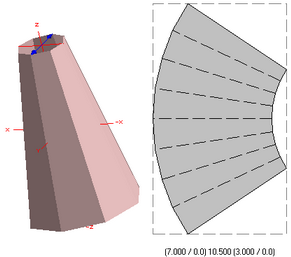
conemodel.png


I made an angled fence jig for my table saw, set it at the right angle and started cutting some 1/4" acrylic. Next step... make a jig to route the proper angles on the long edges of the panels, which needed to be beveled for the 8 panels to fit together properly. Now let's see who's paying attention... what's wrong in this picture?
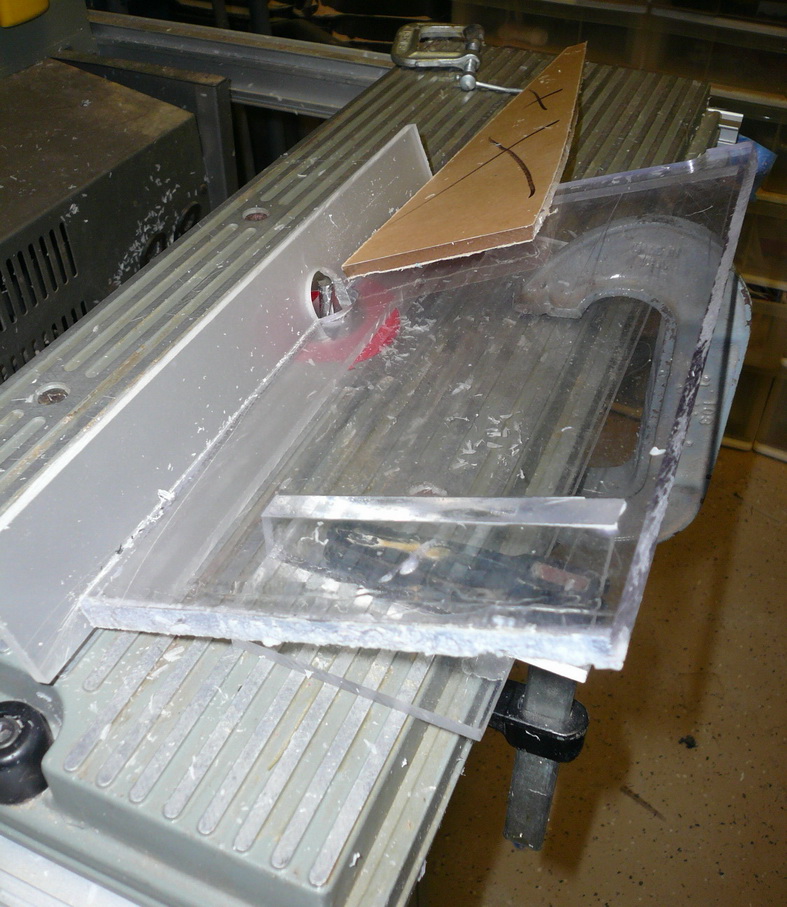
jig.jpg


Next step... gluing the panels together. This too was a dismal failure - it was my first experience using Weld-On #40 - I made a real mess - there was cement all over the place! Obviously, my technique needed improvement. Back to the table saw, and cut another batch of panels. This time, I tried a different method, and the first 2 joints came out OK, but not good enough for me. Cut a few replacement panels, and tried again. This time, I was satisfied with the result... some small bubbles in the Weld-on, and a bit of excess cement, but what the heck... I'm not a pro! ;)

Test fitting the cone panels:
coneglueing.jpg

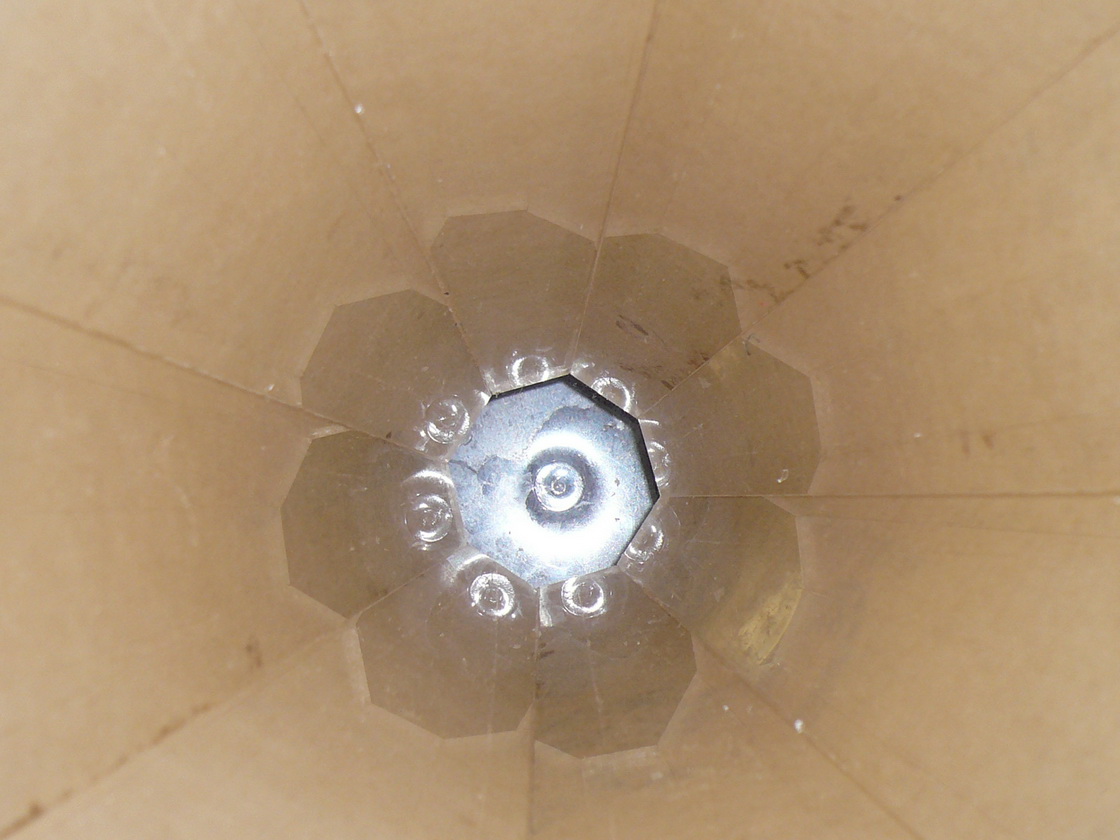
I glued two joints at a time, let them set up for a few hours, then did the next pair of joints. After removing the masking tape I’d put on to help keep myself from making a bloody mess again, here is a shot into the cone:
insidecone.JPG
 
As my final design included multiple flanges of the same diameter, I made a template in AutoCAD, and used that to make a master flange pattern from 3/8" acrylic; the 12 equally-spaced holes were drilled with 13/64" holes (the right size for tapping of ¼-20 threads), which was then used as a guide for routing out the actual flange disks and as a drilling guide. In the final flange pieces that screws would penetrate through, the holes were then drilled out to a full 1/4".
After the base cone, the lower skimmer body was next to be made from two of the 8" diameter / 11" tall 1/4" cast acrylic cylinders and flanges made from 1/2" Polycast. 1/2" stock is probably serious overkill, but I had enough on-hand.

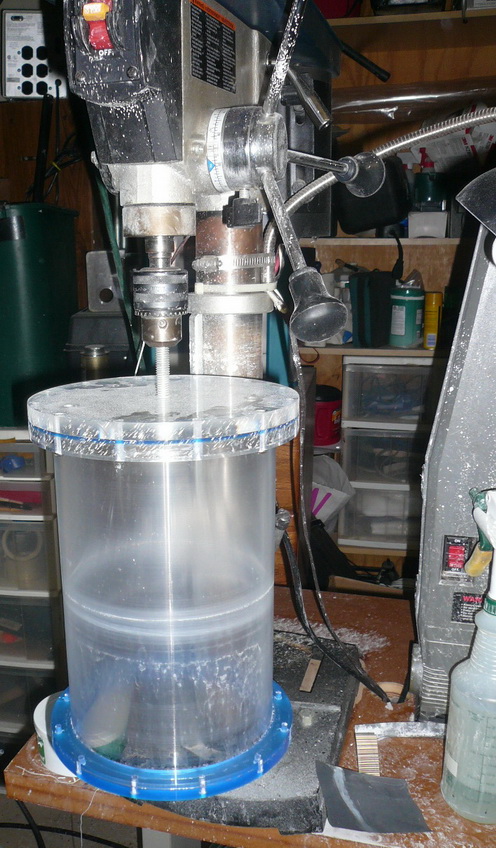
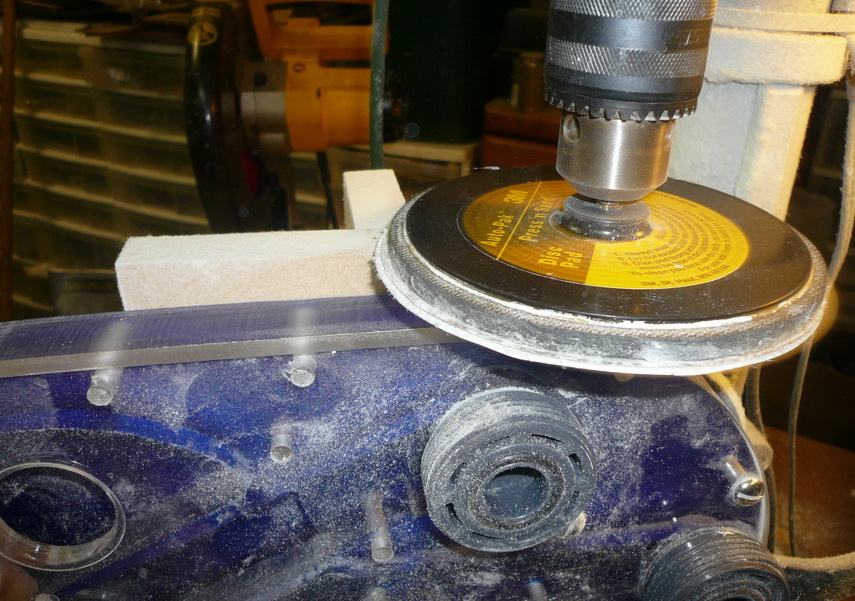
After assembly, I jury-rigged a way of chucking the cylinder assembly in my drill press. Done at the lowest speed, it made the job of final sanding and polishing easy and fast.
cylindersanding.jpg

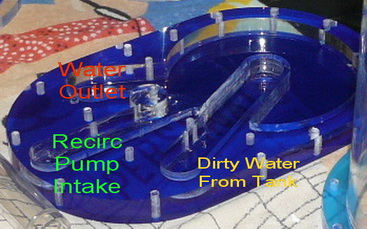
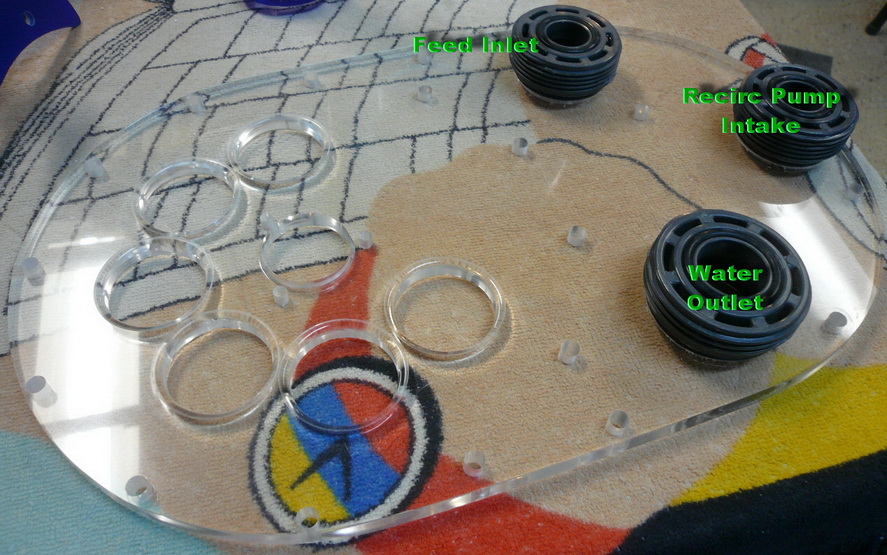
During the design process, I agonized over how to do the plumbing; I wanted it clean and simple. And then I saw the RC thread of Landy’s awesome & brilliant calcium reactor build [url]http://www.reefcentral.com/forums/showthread.php?s=&threadid=1520111[/URL], and the proverbial lightbulb came on... channels routed into a baseplate. (Thanks, Landy!!!)
The baseplate is 3/8" and ½" stock Polycast laminated together with Weld-On #40, with a cap piece of 3/8" attached with nylon thumbscrews.
baseplatelabeled.jpg

topofbase.jpg


The main baseplate assembly was modeled in AutoCAD, printed, and the printouts were attached to sheets of 1/8" Plexiglas, which were then cut/routed/drilled for use as templates. The templates were then used with a pattern-following router bit to make the baseplate sections. The block made from the laminated thicknesses was cut all the way through. 1/8" blue acrylic was then added to form a solid bottom. The round bulbous thing at the junction of the recirc intake & water outlet channels was repair of a major stupid screw-up - no additional details will be provided! ;) The edges of the pieces didn’t all quite match up perfectly, and there was some excess Weld-On in places, so sanding of the edges was necessary: 150 grit, 220, 320, 400, 600, 1200, 2000, then polishing.
basesanding.jpg


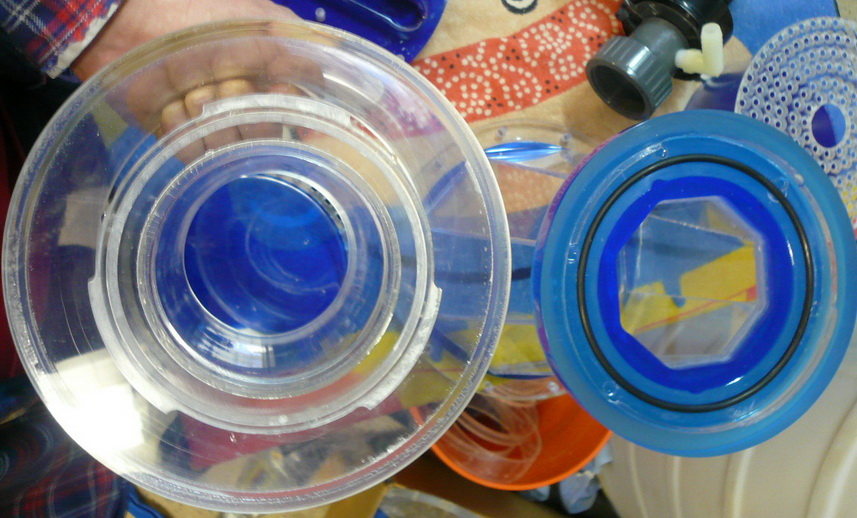
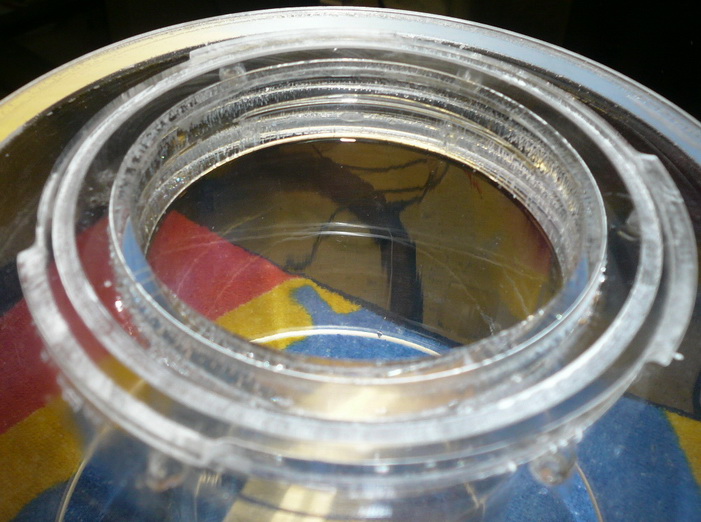
The collection cup assembly itself was made from another 8" cylinder piece, and was a breeze to make, but fabricating a quick-disconnect between it and the cone was a major PITA. I got a functioning bayonet flange that functioned properly on my third try! Good thing I was using scrap acrylic that was cheap. ? The collection cup holds 56oz!
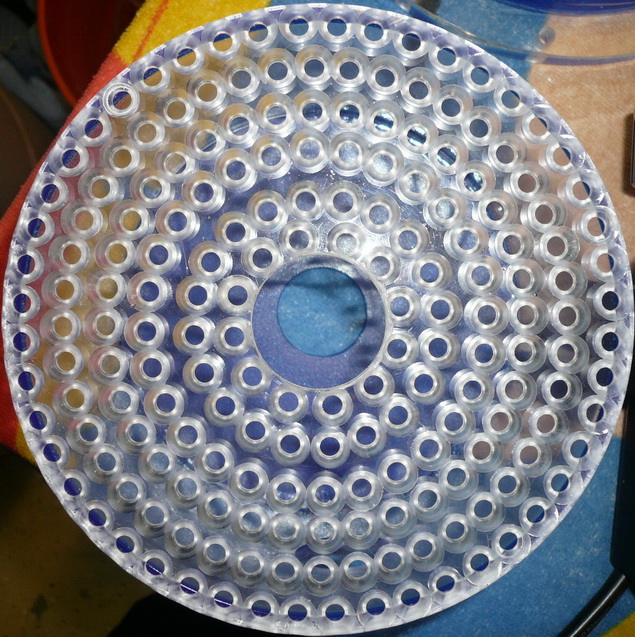
Collection cup cover, bubble plate & diffuser assembly, air silencer, up-flow tube were all made last.
bayonet.jpg

bayonet2.jpg

bubbleplate.jpg


The up-flow tube is where ‘dirty' water is pumped into the skimmer, right into the bubble column just above the bubble diffuser. This may be a crazy idea, but I’d seen pics of recirc skimmers that had the feed water being injected relatively high in the reaction chamber, right into the bubble stream. The net result is sort of the opposite of Warner Marine’s VBT.
upflowtube.jpg
 
The final fabrication step was making the holes in the lower body and diffuser assembly for the water/air mix output from the PSK-2500. I wanted to make sure the holes were perfectly positioned, as I had no room for error since the baseplate and bulkheads were already completed. BTW, the blue parts are blue just for the sake of appearance. I figured that with as much time as this project took, I might as well make it look good too.
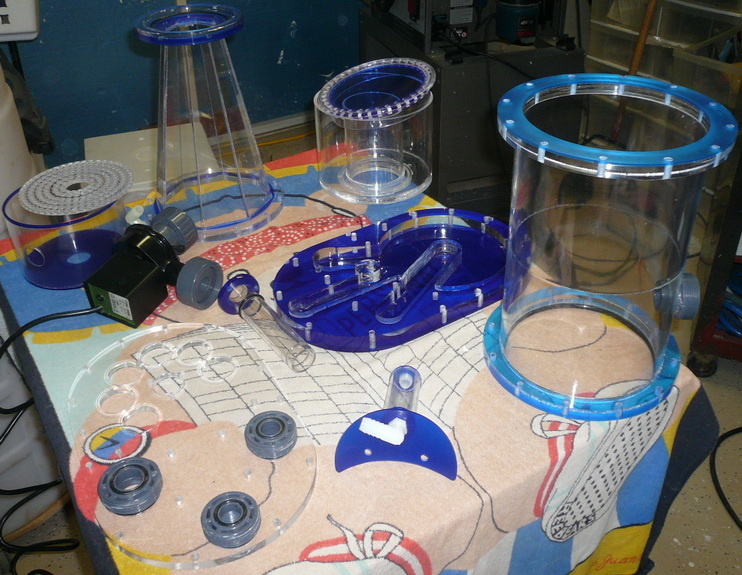
All the pieces ready for assembly...
allthepieces.jpg


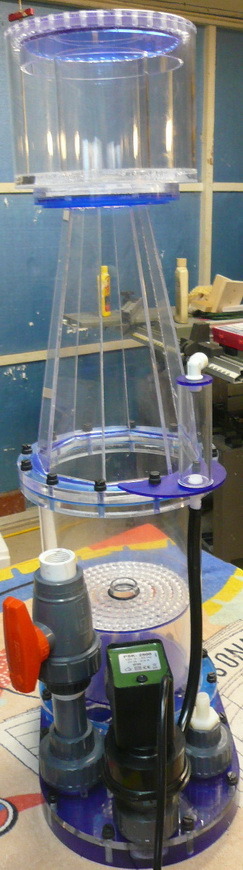
Final assembly...everything was washed with warm soapy water, rinsed thoroughly, then washed in white vinegar/water again before assembly. I also chased all threads with the tap to get out all the sanding debris and polishing residues.
assembled1.jpg


The ball valve is temporary... I was sure I had a gate valve on-hand, but couldn’t find it. This cobbled-together outflow will be replaced with something more effective when I get the chance.
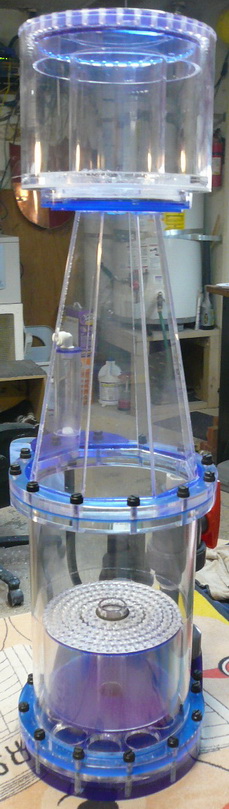
assembled2.jpg


Test run in a tub of Scripps NSW...
testrun.JPG

My skimmers have always gone a bit crazy after a water change with Scripps water, so I took that into account even though I was not impressed with the bubble production. After running for a few hours, it was producing some very wet skimmate, but was running a bit noisier than at first. I removed and disassembled the Sicce, and found that the mesh was frayed with lots of loose Enkamat threads. The pump came mesh-modded from Marine Solutions; I was not thrilled with the appearance of the mesh job "out of the box", but decided to try it as it was. After immediately going online to order some PF4 Flatback, in went the pinwheel that also came with the pump.

While waiting on the new Enkamat, I went ahead and removed my old skimmer and put the new one into service, along with my new DIY kalkwasser reactor [url]http://www.reefcentral.com/forums/showthread.php?s=&threadid=1518560[/URL], which had been sitting on my workbench since I finished it a few weeks ago.
Bubble production was almost immediately better than that with fresh Scripps NSW, but still not what I had hoped for. One problem that was apparent (which I couldn’t see when it was being tested in the tub) was that a significant amount of bubbles were being sucked down around the outside of the diffuser assembly and being expelled from the water outlet. An idea formed, and an hour in the garage later, a new inner cone was formed. It sets atop the diffuser’s bubble plate, and acts to ‘focus’ the bubble stream at the center of the reaction chamber. It seems to work nicely - very few bubbles are getting recirculated or expelled now.
innercone.JPG


My Enkamat order arrived a few days ago, and I reworked the mesh-mod with 3 layers of Flatback. I followed the directions I found in a RC thread, which said to trim to Enkamat slightly larger than the diameter of the impeller plate. I started with about 3/16" of overhang, but the pump wouldn’t start at all; trimmed a little more, and still had startup issues, but could get it going with a good puff of air into the air tubing. Once the mesh was trimmed to the same diameter as the impeller plate, it seems good. After re-installing the pump on the skimmer, I could see a huge difference in bubble quantity and fineness compared to either the original mesh job or with the pinwheel.
It’s currently skimming a bit wetter than I’d prefer, but producing some dark smelly gunk. I’ll get some skimmate pics in a few days. I think it is still "breaking in."
 
Last edited:
That is a NICE DIY skimmer, much better than mine. Great Job!

Question though: How is your Sicce holding up running external, I always thought they would overheat if ran external due to their smaller volute?

I guess I was wrong.
 
A few more contruction notes...

A few more contruction notes...

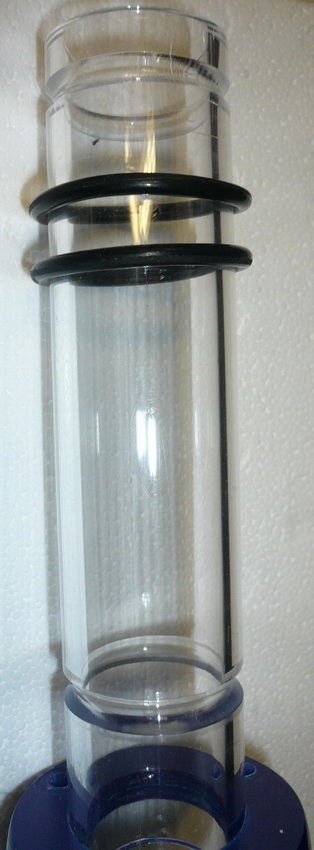
The up-flow tube also serves to support the diffuser assembly, which is held in place by snugly-spaced o-rings above and below the diffuser (note the o-ring groves in the up-flow tube pic). The whole diffuser is removable simply by rolling off the upper o-ring and lifting it off the tube. The tube itself is attached to the base with three small nylon screws, so it is easily removable as well.

I did make a major construction oversight... somehow I totally overlooked including a seal of some sort between the flanges at the top of the cylindrical part and the flange at the base of the cone. I had planned to machine an o-ring groove. When I went to do final assembly, and this dawned on me, being impatient after many many hours of working on this, I thought of that infamous Tom Cruise line from Risky Business, "Sometime you just gotta say..." :eek:, and just slathered both mating surfaces with a thin layer of silicone grease - for the time being. It does the trick. I'll make it right eventually.

Actual height measures out to 29.75". And it's friggin' heavy!
 
<a href=showthread.php?s=&postid=14006965#post14006965 target=_blank>Originally posted</a> by troylee
nice job there look's pro.........

Coming from you, Troylee, those words are especially deeply appreciated.
 
Last edited:
how is it working for ya?? mine runs in sump because i was to lazy to plumb it external.......look similiar to your's but i dont have a round base just a pyramid all the way up.........i put a cone on the bubble plate and it work's great as you mentioned at keeping the bubbles in the center and not in the return....
 
how is it working for ya?? mine runs in sump because i was to lazy to plumb it external.......look similiar to your's but i dont have a round base just a pyramid all the way up.........i put a cone on the bubble plate and it work's great as you mentioned at keeping the bubbles in the center and not in the return....the only thing i hate about mine is the ugly union for the cup.........i will make a new flange some day...lol
 
<a href=showthread.php?s=&postid=14007059#post14007059 target=_blank>Originally posted</a> by troylee
how is it working for ya?? mine runs in sump because i was to lazy to plumb it external.......look similiar to your's but i dont have a round base just a pyramid all the way up.........i put a cone on the bubble plate and it work's great as you mentioned at keeping the bubbles in the center and not in the return....

So far, well enough... it's only been in service for 2 days. I'm hoping for improvement as it breaks in.

And your skimmer build was one of the ones I studied, IIRC...
 
i don't even want to talk about that lol........i just made that 200$ mistake a couple weeks ago..........if you try to heat form it there is no way possible to join it without crazing..........i knew better but it was all they had in stock.........
 
after a few days if it is not performing like you want i would suggest check the diy red dragon thread on here and roll with a laguana 1500 pump and make the volute for it...........i think it will step it for ya really nice.........im telling you just like i was told you did a nice job..... you built that you can handle the motor block........
 
The ball valve was a real PITA - touchy as can be; currently using 2 pieces of pipe and a compression coupling for height adjustment, which is working OK. I still need to order the gate valve. Water level adjustment is rather sensitive, due to the cone shape I believe.
 
The compression coupling just allows me to easily raise/lower the upper piece of pipe by slipping it up or down within the coupling.
 
Folks, please post questions and comments here in public for the benefit of all. Both praise and critical comments are welcomed for all to see. In response to PMs received, answers to questions received elsewhere, and some additional construction notes...

1. Cost in $$$ was relatively low, since I used mostly scrap/cutoff acrylic ($2/lb at my local plastics shop). The blue 1/8" acrylic was found at a local liquidation store... (10 2x2ft squares for $15), as were the 8" cylinders were found in 11" lengths ($4 each for nice 1/4 cast acrylic!!) The black nylon thumbscrews came from a industrial surplus warehouse ($18 a pound - I still have plenty of 1/4x20 and 10-32 screws left from the half-pound I bought... beats HD prices for sure.) The bulkheads were leftovers from my tank build. The only thing of significance I really bought new/retail was the 3.5" acrylic tubing (cheap extruded, which was horrible to work with)... next time I will spend the money for cast tube), and the Sicce pump, which probably cost more than everything else combined.

2. Footprint is 14" x 8.5"

3. The 8" cylinders were joined with Weld-On #40. I sanded the joint edges using a 5" disk chucked in the drill press, and rotated the cylinders under the spinning sanding pad while they resting on the drill press table, applying light pressure on the sanding pad. I put blue 3M painters' tape on the inside and outside of the cylinders, pressed it down well, then trimmed the tape flush with the rims to be joined using a single edge razor blade. After applying a bead of #40 to one edge with a syringe & a wide dispensing tip, I aligned the two cylinders, and fit them together; I only pressed them together gently so as to not squeeze out too much of the #40. After it set up a bit (45-50 minutes), I carefully peeled off the tape, taking almost all excess #40 with it. A tiny ridge of cement remained inside and outside, which was then sanded off and finally the joint was polished, as was the rest of the cylinder assembly. The cylinders all had some small scratches when I got them, so I sanded as needed and polished the entire assembly.

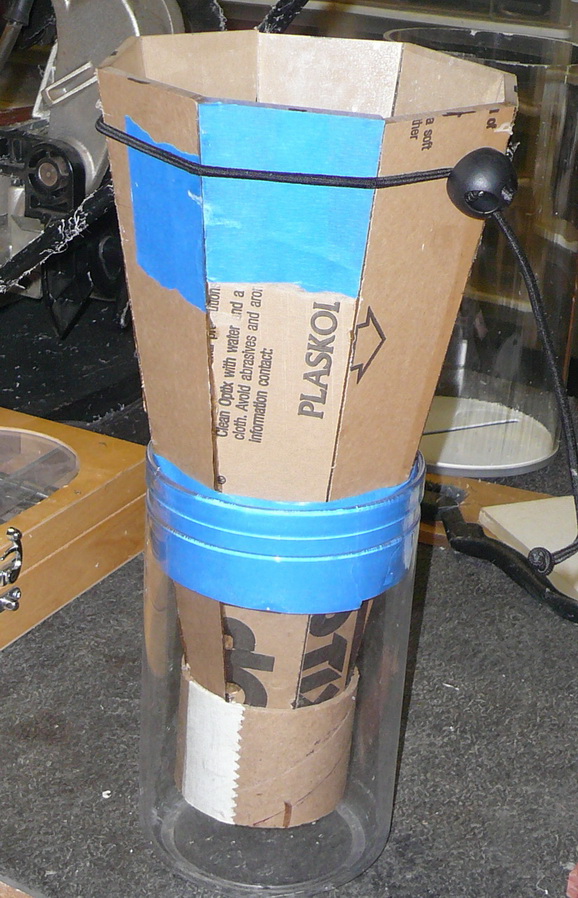
4. Gluing the cone panels: I started by laying out two panels with the wider side up (the long edges were routed with a 23-degree bevel) butted together. Masking tape overlapping the joint to be glued, and smoothed down tight. I flipped the assembly over, and laid a fine bead of #40 into the resultant groove. I then 'folded' the two panels being joined at the joint, so the beveled edges just met; a strip of tape served to hold the angle & position until it could be placed in the form. This was repeated on a second set of panels, and then all 8 panels were placed into the form shown in the one pic for about 4 hours. Then the process was repeated for the remain 4 individual panels, and finally for the 4 joined pairs of panels, resulting in a full "octocone." Getting the right amount of #40 took 3 tries, as mentioned in the original posts.

5. The lower cone flange and the female bayonet flange was joined to the cone with #4 just enough to hold it together. The crescent-shaped recesses that resulted were then filled with Weld-On#40. I had some fiberglass resin colorant, so mainly for S&G I tinted the #40 blue when mixing it. Similar for the blue in the collection cup cover... I just poured tinted and thinned #40 into the underside of the cover, filling the area with blue stuff about 1/16" thick.

6. The software used to model the multi-sided cone is called Cone Layout (sorry... I didn't put the software full name in my original post); the software allows export of both 2D and 3D cone models to DWF format for later use in AutoCAD.

7. There is no seal between the baseplate pieces... I figured that doing so would be a real PITA, and the skimmer is for in sump use, so I really don't care if there is a bit of seepage around the baseplate edges. The barb fitting on the feed water connection is for flexible tubing, which does make it appear that the skimmer is designed for external use. However, my sump is actually in three sections. The only section with room for the skimmer is in the middle section, and I wanted feed water to come directly from the section where the drain is. So, the MJ1200 sits in that section, right below the filter sock, so it pushes dirty water fresh from the tank overflow through 1/2" tubing over the boundary between sump sections to the skimmer.

8. In response to the person who stated I should have just duplicated an existing product ... have you no sense of adventure? I did this for the challenge and the fun of it, not just to save money & clone a readily-available product.
 
Back
Top