
You are using an out of date browser. It may not display this or other websites correctly.
You should upgrade or use an alternative browser.
You should upgrade or use an alternative browser.
basic LED help
- Thread starter salty joe
- Start date

oreo57
Well-known member
As stated above THAT doesn't work..I hope you don't mind...I lifted this line as part of my response. :bigeyes:
He asked me to test a single red. I plan to dim it way down and monitor the voltage to see where it fails.
Still going back and forth-my impression is once the eBay seller is convinced he sent the wrong thing, he'll take care of it.
Thanks.
THE ONLY WAY to determine this is to use a regulated power supply putting out the V(f) of say.. 2.whatever volts.. THEN measure the current draw.
Again PWM dimming only effectively "pulses' 700mA.. to "fake" lower output..
EVEN at 10% the driver outputs 700mA BUT for only 10% of the on time...

salty joe
Active member
Well darn. I thought that worked because as I dim the single blue LED, my digital multi meter shows a steady drop in voltage. It turned on at 2.36V and max was 3.68V.
I hooked up a single red that was dimmed way down and slowly increased the intensity until the LED died. So the voltage value that my DMM shows for when the red LED lights up and when it fails are useless phony numbers?
So I guess I start looking for a 2.5-2.8 power supply. Is that the simplest way to determine that I got 1W red LEDs?
Thanks
Edit; the blue fV is 3.4-3.8 and the max voltage shown was 3.68. Is the 3.68V a good number because it was full intensity? I assume that the LDD somehow read the fV of the blue LED?
I hooked up a single red that was dimmed way down and slowly increased the intensity until the LED died. So the voltage value that my DMM shows for when the red LED lights up and when it fails are useless phony numbers?
So I guess I start looking for a 2.5-2.8 power supply. Is that the simplest way to determine that I got 1W red LEDs?
Thanks
Edit; the blue fV is 3.4-3.8 and the max voltage shown was 3.68. Is the 3.68V a good number because it was full intensity? I assume that the LDD somehow read the fV of the blue LED?
Last edited:

Gorgok
New member
It doesn't read the Vf, it just raises/lowers voltage to maintain 700mA. It doesn't care if its a fan attached to it or LEDs. It also doesn't care if doing so will kill whatever is attached.
Your multimeter is most likely showing you an average voltage when dimming, instead of the instantaneous value, as its changing 100 to 1000 times a second (on/off). You would need to have a scope to see the actual values of each peak, which should be the same no matter what dimming level you are at.
At 100% dimming it should be accurate though, so that is the max Vf of that blue LED.
Many LEDs also have specs on how long and hard (in duty cycle) they can be overdriven without damage, so like a 700mA LED could be run at 1000mA for say 30% duty cycle without significant loss of lifespan. Which is why you can ramp up your reds on 700mA even if they were 350mA rated at least for a while.
Your multimeter is most likely showing you an average voltage when dimming, instead of the instantaneous value, as its changing 100 to 1000 times a second (on/off). You would need to have a scope to see the actual values of each peak, which should be the same no matter what dimming level you are at.
At 100% dimming it should be accurate though, so that is the max Vf of that blue LED.
Many LEDs also have specs on how long and hard (in duty cycle) they can be overdriven without damage, so like a 700mA LED could be run at 1000mA for say 30% duty cycle without significant loss of lifespan. Which is why you can ramp up your reds on 700mA even if they were 350mA rated at least for a while.
oreo57
Well-known member
You could try running a couple in parallel...
Tim
DANG Didn't think about that..
2 in parallel will feed 350mA to each..
Shouldn't burn out at full.
Brilliant..
Here I kept thinking of terminating resistors and batteries..
oreo57
Well-known member
I hooked up a single red and it died at 2.71V. Then I hooked up two in parallel and at max intensity voltage was 2.37 and they stayed on.
The eBay seller said he will see what his boss says. All this time I thought he was the boss. We'll see.
Thanks all.
BINGO.. 350mA reds....

oreo57
Well-known member
I hooked up a single red and it died at 2.71V. Then I hooked up two in parallel and at max intensity voltage was 2.37 and they stayed on.
The eBay seller said he will see what his boss says. All this time I thought he was the boss. We'll see.
Thanks all.
MOST of the time nothing gets their attention as fast as opening a case as "not as listed" on eek bay.
Pay attention to timing, you do not have forever..
Be nice but be honest and firm..
salty joe
Active member
Sorry it's been a while but the scrubber lights got repurposed to grow my son's vegetable seedlings. I used a couple 110V AC 4" fans. We put the plants by a window and they did not stretch for the outside at all.
PayPal refunded my money for the 1W red LEDs even though I made that purchase a few days before their 180 day policy was effected. I got lucky.
So now I have 40 3W 450nm and 40 3W 660nm LEDs. One of the 5V fan relays would only make the switch if it was tapped. There seem to be a whole lot more 12V fans than 5V, so I ordered four 12V 70mm fans and a dual 12V relay. Until they arrive, I am running the Arduino on 12V and have the LEDs dimmed. I found I can take a voltage reading at the LDD dim terminal for a benchmark of brightness. If that voltage is kept around 0.75, the rig barely warms up. Max is around 5V. From what I've read on the scrubber threads, you need to start out well below full power anyway. So now the only time I'll need to plug the Arduino into a computer is to change the timing.
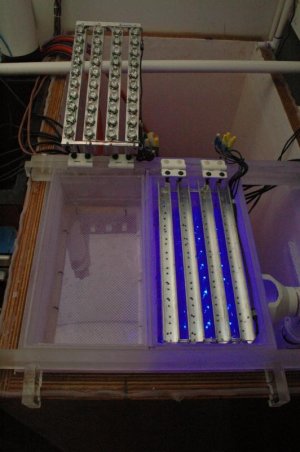
Here's a pic with the red LEDs raised. This entire aquarium project has taken forever but this month there should finally be saltwater in the tank! I'll let you guys know how the scrubber works. I can't thank you guys enough for guiding me through a proper LED setup. :wavehand:
PayPal refunded my money for the 1W red LEDs even though I made that purchase a few days before their 180 day policy was effected. I got lucky.
So now I have 40 3W 450nm and 40 3W 660nm LEDs. One of the 5V fan relays would only make the switch if it was tapped. There seem to be a whole lot more 12V fans than 5V, so I ordered four 12V 70mm fans and a dual 12V relay. Until they arrive, I am running the Arduino on 12V and have the LEDs dimmed. I found I can take a voltage reading at the LDD dim terminal for a benchmark of brightness. If that voltage is kept around 0.75, the rig barely warms up. Max is around 5V. From what I've read on the scrubber threads, you need to start out well below full power anyway. So now the only time I'll need to plug the Arduino into a computer is to change the timing.
Here's a pic with the red LEDs raised. This entire aquarium project has taken forever but this month there should finally be saltwater in the tank! I'll let you guys know how the scrubber works. I can't thank you guys enough for guiding me through a proper LED setup. :wavehand:
Attachments
salty joe
Active member
I filled er up with salt water a couple weeks ago and added a little live rock. I've been feeding the tank with a couple big pinches of flake food a day. The tank is shaded for now. The algae filter is growing algae, but there is a bald spot about the size of a dime under every LED. That's even with being dimmed way down. 60 degree lenses at 2" looked great diagrammed on paper, but apparently punches too much concentrated light so I removed half the lenses from both sides.

60° lens doesn't always mean the light is an even spread thru that 60°
Tim
+1
The beam angle is typically the angle at which they measure half intensity of the beam at center. And depending on the particular beam shape that center beam could be very narrow or could be nice and wide. You can typically see this if you hold a sheet of paper near the leds, there will be a very bright point in the center. the graphs available at the LEDil website are pretty informative of this if you're curious. Even comparing two lenses with the same angle rating the beam shape can be drastically different.
For your scrubber setup since the lenses are burning algea you might be just as well off to take them all out.
I started with 30 degree on my sump to grow cheato so that not much light would spill out of the fuge section, but it ended up burning the stuff too easily once it started floating to the surface, so I had to swap them all out for 120 degree (60 was still too narrow). Lots more light spill and subsequent algea growth in the rest of my sump but the cheato is much happier.
Hi,
I was having algae issues (esp. brown filamentous algae) in my 180.
I installed a Turbo L2 waterfall ATS. Obviously very well made, serviced by a RIO 1700 pump (550 gph flow at 2 feet head), and 2 sets of LED lights (on for 8-10 hrs a day) on either side of 6” x 4” screen. It grew increasing amount of algae for a month or so but then algae production slowed.
I have always run a GFO/GAC reactor (cup each of GFO/GAC changed weekly), dosed vinegar at 90 ml a day, and run an efficient skimmer (SRO 3000INT).
When I installed the ATS, I also sharply reduced feedings from ¾ sheet of nori + 2 cubes of FF daily to 0 nori, plus 1 cube of low phosphate frozen food.
Fish are mainly herbs (Yellow/Purple Tangs and Scribbled Rabbitfish), which do not touch the algae. Also 8-line wrasse, yellow tail damsel, and lyretail anthias – the sole survival of QT of 8 LAs.
I also added many snails (including 2 dozen of the fabled Mexican Turbo Snails, which did not touch filamentous algae) and Dolabella Sea Hares, which ate a patch of GHA behind rocks before disappearing.)
But nothing stopped proliferation of filamentous algae.
Weirdly, algae did not seem to interfere with growth/health/color/PE of SPS coral covering rocks and good portion of substrate in tank.
Anyways, I eventually gave up on ATS and did the Algae Fix Marine thing while preserving the ATS screen in the overflow of my other tank, which is below a MH 250 watt bulb.
So after 7 doses of AFM, algae in 180 disappeared. I waited a few days, did the obligatory 20% water change, scraped the screen, and fired up the ATS again.
Now I’m wondering what I can do to help the ATS outcompete DT algae.
I’ve cut back on V dosing – down from .5 ml per gallon daily to .25 ml per gallon of DT.
Should I cut it back further?
I’m still running GFO in reactor (changing a cup a week), which is more than even BRS recommends
Should I reduce/eliminate the GFO?
I’m not touching the FF until I see some real growth on ATS.
Throughout all of this, I have consistently gotten zero PO4 and N03 readings with Salifert and API kits.
Using Hanna PO4 Checker I get readings from 0 to .27. Despite the inconsistency of Hanna test results, I’m assuming there is some PO4 in system. Further, despite Salifert and API zero readings in N03 tests, I’m also guessing that there is NO3 in system.
I’m also assuming that the Marco dry rocks I used to set up DT are leaching PO4 and that this is driving algae growth.
So what can I do to help the ATS get going?
Feed more?
Get an ATS with a larger screen?
Anything else?
Thanks,
Mike
I was having algae issues (esp. brown filamentous algae) in my 180.
I installed a Turbo L2 waterfall ATS. Obviously very well made, serviced by a RIO 1700 pump (550 gph flow at 2 feet head), and 2 sets of LED lights (on for 8-10 hrs a day) on either side of 6” x 4” screen. It grew increasing amount of algae for a month or so but then algae production slowed.
I have always run a GFO/GAC reactor (cup each of GFO/GAC changed weekly), dosed vinegar at 90 ml a day, and run an efficient skimmer (SRO 3000INT).
When I installed the ATS, I also sharply reduced feedings from ¾ sheet of nori + 2 cubes of FF daily to 0 nori, plus 1 cube of low phosphate frozen food.
Fish are mainly herbs (Yellow/Purple Tangs and Scribbled Rabbitfish), which do not touch the algae. Also 8-line wrasse, yellow tail damsel, and lyretail anthias – the sole survival of QT of 8 LAs.
I also added many snails (including 2 dozen of the fabled Mexican Turbo Snails, which did not touch filamentous algae) and Dolabella Sea Hares, which ate a patch of GHA behind rocks before disappearing.)
But nothing stopped proliferation of filamentous algae.
Weirdly, algae did not seem to interfere with growth/health/color/PE of SPS coral covering rocks and good portion of substrate in tank.
Anyways, I eventually gave up on ATS and did the Algae Fix Marine thing while preserving the ATS screen in the overflow of my other tank, which is below a MH 250 watt bulb.
So after 7 doses of AFM, algae in 180 disappeared. I waited a few days, did the obligatory 20% water change, scraped the screen, and fired up the ATS again.
Now I’m wondering what I can do to help the ATS outcompete DT algae.
I’ve cut back on V dosing – down from .5 ml per gallon daily to .25 ml per gallon of DT.
Should I cut it back further?
I’m still running GFO in reactor (changing a cup a week), which is more than even BRS recommends
Should I reduce/eliminate the GFO?
I’m not touching the FF until I see some real growth on ATS.
Throughout all of this, I have consistently gotten zero PO4 and N03 readings with Salifert and API kits.
Using Hanna PO4 Checker I get readings from 0 to .27. Despite the inconsistency of Hanna test results, I’m assuming there is some PO4 in system. Further, despite Salifert and API zero readings in N03 tests, I’m also guessing that there is NO3 in system.
I’m also assuming that the Marco dry rocks I used to set up DT are leaching PO4 and that this is driving algae growth.
So what can I do to help the ATS get going?
Feed more?
Get an ATS with a larger screen?
Anything else?
Thanks,
Mike
Wow - lots of acronyms and lots of questions!
Which salifert and API kits? I wouldn't use API for anything and I wouldn't use salifert for phosphate! Not sure if you have the same kits your side of the pond, but our side, API is not really up to much and the salifert has a terrible reputation for phosphate (although some say it has improved recently).
Irrespective of test results, if algae is growing, there's something there for it to feed on. Unless you are talking about cyano, than means both phosphate and nitrate is in the water column (until the algae uses it!).
In theory an algae scrubber is ideal to out compete the growth in the DT so your results are surprising. What LEDs are you using to light it? Where is it in your system (eg in sump after skimmer & GFO reactor)? Flow from DT to ATS is how much?
To give any useful responses, more info is needed.
Plus, to be honest, you'd probably do better with starting another thread to ask this!
Tim
Which salifert and API kits? I wouldn't use API for anything and I wouldn't use salifert for phosphate! Not sure if you have the same kits your side of the pond, but our side, API is not really up to much and the salifert has a terrible reputation for phosphate (although some say it has improved recently).
Irrespective of test results, if algae is growing, there's something there for it to feed on. Unless you are talking about cyano, than means both phosphate and nitrate is in the water column (until the algae uses it!).
In theory an algae scrubber is ideal to out compete the growth in the DT so your results are surprising. What LEDs are you using to light it? Where is it in your system (eg in sump after skimmer & GFO reactor)? Flow from DT to ATS is how much?
To give any useful responses, more info is needed.
Plus, to be honest, you'd probably do better with starting another thread to ask this!
Tim
SantaMonica
Well-known member
As an EE, I wish I could design all this electrical stuff all day. I'll just have to make do with the other fun stuff.


Similar threads
- Replies
- 5
- Views
- 731

- Replies
- 0
- Views
- 129
