Beginning research and treatment of Marine Snot

hypnoj

Member
My office tank is a little over 6 years old now, filled from top to bottom with LPS and soft corals.
I've been battling what has been called "Marine Snot" for close to a year now. Some reefers have stated that I have dinoflagellates, and I admit that my knowledge of marine bacteria is limited. My description of my problem is as follows.
My "marine snot" is transparent, long, and wavy. It collects on everything including live rock, glass, overflow (gums up and decreases flow at my overflow grid), pumps etc. Once my overflow grid is fairly plugged (when not cleaned) it stops filtering the top layer of water where the snot just swirls in large colonies on the surface. Since beginning of my snot, my algae problems completely ceased. I haven't seen algae of any type in my tank for some time. All coralline algae has died off. My glass is cleaned daily, and the "snot" colonies will collect on the glass in only a few hours it seems. My skimmer cup is filled with the foulest skimmate every 3 days or so.
Water parameters:
Temp: 78*
NO3: 0
Ca: 400
P04: haven't tested (usually base my phosphates on algae growth)
Alk: 7.2
pH: usually around 8.0 ( I usually don't worry about pH unless my Alk starts swinging)
Mag: don't test for it unless my Ca/Alk go out of wack.
I use IO reef salt

Previous reef habits included 10% water change every other week and daily dosing of vinegar. I believe this occurred due to vinegar, but with anecdotal information only. Once snot started forming vinegar was stopped.

Things I have tried:
1) Cut back my feeding to 3 x week and increased water changes to weekly x 3 months with no help
2) Lights out for 3 days with no help (did not cover tank)
3) stopped skimming and stopped water changes for 1 month; did not help
4) started vacuuming snot and then dosing H2O2 for 3 weeks straight. This seemed to help a little bit, but only seemed to get the amount down to about 50% from total amount.

I am a physician at a private practice. So finally I just took a sample of the snot and sent it to my lab. This is what came back in the report.

MICROBIOLOGIC CULTURE RESULTS:
CULTURE AEROBIC/ANAEROBIC
GRAM STAIN No white blood cells (polys) seen
Many gram negative rods
CULTURE:
Heavy growth of Vibrio alginolyticus
Heavy growth of Stenotrophomonas maltophilia
No anaerobes isolated

STATUS FINAL 10/26/2014

SUSCEPTIBILITY
ORGANISM: Heavy growth of Vibrio alginolyticus
METHOD MIC
Amoxicillin/Clavulanic Acid SUSCEPTIBLE 4
Ampicillin/Sulbactam SUSCEPTIBLE 4
Cefazolin INTERMEDIATE 16
Cefepime SUSCEPTIBLE <= 1
Ceftazidime SUSCEPTIBLE <= 1
Ceftriaxone SUSCEPTIBLE <= 1
Ciprofloxacin SUSCEPTIBLE <= 0.25
Gentamicin SUSCEPTIBLE <= 1
Imipenem SUSCEPTIBLE <= 0.25
Levofloxacin SUSCEPTIBLE <= 0.12
Piperacillin/Tazobactam SUSCEPTIBLE <= 4
Tobramycin SUSCEPTIBLE <= 1
Trimethoprim/Sulfamethoxazole SUSCEPTIBLE <= 20

SUSCEPTIBILITY
ORGANISM Heavy growth of Stenotrophomonas maltophilia
METHOD MIC
Levofloxacin SUSCEPTIBLE 0.5
Trimethoprim/Sulfamethoxazole SUSCEPTIBLE <= 20


I plan on beginning to dose Bactrim DS (trimethoprim/sulfamethoxazole) probably tomorrow. I'll do one pill for my tank (60 g) dissolved in tank water first and then poured in slowly in the sump. I'll monitor my fish and corals etc for changes.
Do you see any problems with this or have any advice? Let me know. I'll keep everyone posted either way.
Jim
 
I do worry about it. But I'm not sure what else I should try. When it's all said and done we have these tanks, not necessarily just for pets, but for beauty. This tank has become ugly with this outbreak.
 
Seems kinda drastic if your livestock is not in danger. What are the chances of killing every one of this bug? If you did not get every single one, wouldn't the snot come right back but probably be resistant to the med? Just thinking out loud...maybe it will work like a champ.

It's good to know what kills those bacteria, I wonder what conditions about your office tank are conducive to growing the stuff. What is the water movement in the tank like? Could UV or O3 be useful?
 
I don't expect to kill bacteria of this strain fully, only enough so that other bacteria strains can grow and compete. I forgot to mention that I also added a whole bottle of micro-bacter 7 as well as my other treatment methods. I would add microbacter 7 again once the main problematic strain started to die off.
I've treated whole tanks with antibiotics before (when treating an H. Mag anemone). Most reef species respond to antibiotics like humans; without any problems. I'm actually not to worried about my livestock, I think they'll be ok.
I have an MP10 and a WP24 in the tank for water movement.
I think UV could be helpful; expensive, but helpful. I think O3 could be helpful as well, but I don't think antibiotics are any more dangerous then ozone in a tank. (depending on how much you dose that is)
 
You don't know those two bacteria are causing your issue, you only know those are the two bacteria the lab was capable of isolating. Marine bacteria are notoriously difficult to isolate and identify via culturing. Special marine medias are needed, and even those will fail to grow many marine bacteria. A lab specializing in human infectious bacteria is going to miss most bacteria in a marine specimen as a result of using the wrong techniques.

As for dosing antibiotics, going to be a lot of beneficial bacteria effected. Not something I'd really recommend. I'd go back to basics, give us rundown of your tank set up...filtration, internal circulation, etc. Also might be worth locking away the fish food, you might have someone in your office feeding the fish that you don't know about ;)
 
Bill,
good point on the culture results and my staff feeding my tank. I'll make sure the fish food is put up, also, I've been running an open top tank, and it may be time to put the glass back on (easier now that it's getting cooler too). Very simple set up. Lots of live rock, 2 to 3 inch sand bed, 2 power heads, eheim 1260 return pump, SCA 302 cone skimmer (bubble magus knock off) that skims very well. ATO with RODI water used. Filters changed yearly. I feed Ocean nutrition food once daily (pellets). I can take pics if you think it will help. Since the bacteria colonies are transparent, it's hard to capture them though.
 
I've got the "snot" too, except what I have is clear blobs, not long and wavy. Hypnoj, since we are both in NC maybe we picked up the snot from the same source?
 
I'd echo the advise against medicating the tank. The bacteria found in aquarium additives represent just a fraction of the many beneficial species present in a healthy tank. It's really impossible to say how these various species will be affected; but you stand to substantially reduce the biodiversity (of good microbes) in your tank by medicating.

Personally, I'd tear down a tank and try to salvage some of the pieces before I'd medicate it.

But I don't think you're there yet. The approach I recommend is to figure out what about your filtration and maintenance routine is causing these undesirable microbes to flourish; and then change things such that they aren't (as) happy. I suspect it would be unsurprising to find the species you discovered in your sample in many mature, healthy tanks; their populations just get kept in check by the number of available desirable microenvironments and competition for resources from beneficial (or at least less problematic) species.

You need to test for phosphate. I'd also double check the nitrate result with a different kit if you haven't done that already.

Keep skimming. And keep up the weekly 10% water changes.

Dosing vinegar or hydrogen peroxide are not things I'm at all sold on. I don't know that they created your problem; but I don't think they'll help.

Feed less. What fish are in this tank? Any chance they could be relocated and you could avoid feeding at all for a little while?

What are the filters you refer to changing yearly?
 
Feeding wasn't the problem in my case. My tank was in fallow for 12 weeks with not a drop of food added during the 12 weeks, and snot is still there. I still kept up the same skimming, GFO running, and water change schedule.
 
I would..
stop dosing vinegar and bacter7 and peroxide if you haven't already..
do a few decent water changes..
increase flow in problem areas or re-target existing flow.
then wait it out.

Your coraline is probably disappearing because your alk is low(ish)

You just have a large population of bacteria from the dosing
 
I'd echo the advise against medicating the tank. The bacteria found in aquarium additives represent just a fraction of the many beneficial species present in a healthy tank. It's really impossible to say how these various species will be affected; but you stand to substantially reduce the biodiversity (of good microbes) in your tank by medicating.

Personally, I'd tear down a tank and try to salvage some of the pieces before I'd medicate it.

But I don't think you're there yet. The approach I recommend is to figure out what about your filtration and maintenance routine is causing these undesirable microbes to flourish; and then change things such that they aren't (as) happy. I suspect it would be unsurprising to find the species you discovered in your sample in many mature, healthy tanks; their populations just get kept in check by the number of available desirable microenvironments and competition for resources from beneficial (or at least less problematic) species.

You need to test for phosphate. I'd also double check the nitrate result with a different kit if you haven't done that already.

Keep skimming. And keep up the weekly 10% water changes.

Dosing vinegar or hydrogen peroxide are not things I'm at all sold on. I don't know that they created your problem; but I don't think they'll help.

Feed less. What fish are in this tank? Any chance they could be relocated and you could avoid feeding at all for a little while?

What are the filters you refer to changing yearly?

The filters I'm referring to are my RODI filters. I'm not saying I couldn't relocate and tear down this tank to some extent; obviously there are many more options available then the one that I'm about to attempt. I just don't think they are practical in my situation (busy medical office). I really don't think that dosing a strong antibiotic is going to sway the tank toward a major kill off of all bacteria. Humans do it all the time and are totally fine. Humans would also be in trouble if all bacteria inside of us was killed. I'm hoping to level the bacteria playing field instead of running a monoculture (or something close to it) is all.
 
I would..
stop dosing vinegar and bacter7 and peroxide if you haven't already..
do a few decent water changes..
increase flow in problem areas or re-target existing flow.
then wait it out.

Your coraline is probably disappearing because your alk is low(ish)

You just have a large population of bacteria from the dosing

I stopped dosing vinegar when the "snot" outbreak occurred. I never started to dose bacter7 or peroxide until after trying multiple other things. Both were stopped after a couple of weeks of no positive results. I tried the water change thing. Have not tried to change the existing flow; I could/should do that.
I actually believe that I could wait it out too and that just waiting might work, but I'm ready to experiment.
 
for those following:
dosed 1 dissolved pill of Bactrim DS this morning when the lights first came on. I chose to do it with the lights on because lots of antibiotics break down quickly in light and I could also monitor the tank easier. Not much as changed so far, all fish and corals are still open and responding normally. All fish fed fine today. As of typing this it seems like there are less colonies floating on top, but that could be for a number of reasons, so I'm staying skeptical. I'll keep you posted on what the tank looks like tomorrow.
 
GFO is another one of those newfangled things I'm not sold on. I'd much rather rely on skimming and macroalgae/plants for nutrient export/uptake. Specific chemical binding agents might lower a specific visible water quality parameter; but the parameters we can test for, while certainly important, fall far short of encompassing the health of the system. I trust a healthy algal turf to pull nutrients out of the system in a variety of chemical forms, including the ones I can't test for.

The "snot" is getting its nutrients from somewhere. If not food, then other sources: possibly some die-off in the tank (even the aforementioned loss of coralline algae), residual detritus in the sand bed, etc. If the snot isn't removed, then it may die off and bloom again, recycling its own nutrients.

There will invariably be some source of nutrients in any non-bare tank. Export of nutrients via skimming (and even chemical binders) will only get you so far. There need to be nutrient consumers in the aquarium as well. In the absence of desirable ones, the undesirable ones will move in.
 
GFO is another one of those newfangled things I'm not sold on. I'd much rather rely on skimming and macroalgae/plants for nutrient export/uptake. Specific chemical binding agents might lower a specific visible water quality parameter; but the parameters we can test for, while certainly important, fall far short of encompassing the health of the system. I trust a healthy algal turf to pull nutrients out of the system in a variety of chemical forms, including the ones I can't test for.

The "snot" is getting its nutrients from somewhere. If not food, then other sources: possibly some die-off in the tank (even the aforementioned loss of coralline algae), residual detritus in the sand bed, etc. If the snot isn't removed, then it may die off and bloom again, recycling its own nutrients.

There will invariably be some source of nutrients in any non-bare tank. Export of nutrients via skimming (and even chemical binders) will only get you so far. There need to be nutrient consumers in the aquarium as well. In the absence of desirable ones, the undesirable ones will move in.

I do agree that I need to find the nutrient source and cut it down or find another way to take up excess nutrients. I neglected to mention that I have started running an algae turf scrubber, in hopes that once nutrients become more available (due to monoculture dying off), that I'll be able to grow algae again. No algae as of yet though.
 
Have you taken a piece out and placed in the pitch dark to verify if it's photosynthetic?

If that's the case you would have a better known plan of attack:)
 
Have you taken a piece out and placed in the pitch dark to verify if it's photosynthetic?

If that's the case you would have a better known plan of attack:)

no I haven't, I did go lights out for 3 days; but I admit, I didn't cover the whole tank in a blanket like some have.
 
Pictures might help, certainly won't hurt.

I'd be altering flow to keep stuff stirred up has much as possible. Keep the food to a minimum and locked away (I've seen many an office tank with such problems that turned out to be office staff overfeeding behind the bosses back).

Not sure where the idea that a clear "snot" would be photosynthetic, but considering the lack of color I think it's safe to say there's no chlorophyll present in the snot ;)
 
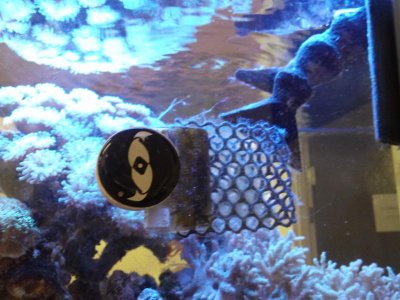
I think the Bactrim is working well to knock out the bacterial colonies. There has always been a layer of it on the surface of my water and on my glass every day when I get to work; none this morning for the first time since it started. I still have it on my over-flow plastic, but otherwise it looks to be knocked down by about 60%. I was going to dose at lights out tonight, but just decided to dose again with lights on. I took a picture of my "veggie clip" that shows the stringy colonies as good as can be expected when transparent. The meshing of the clip is filled with it. Hope this helps.
 

Attachments

  • CAM00459.jpg
    CAM00459.jpg
    68.5 KB · Views: 8
Back
Top