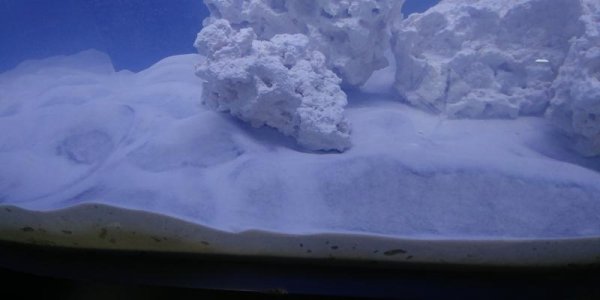
Black soot on sand

Icewing726

New member
So I filled the tank and dosed for chlorine and chloramine, and I was about to start adding salt on day 3.

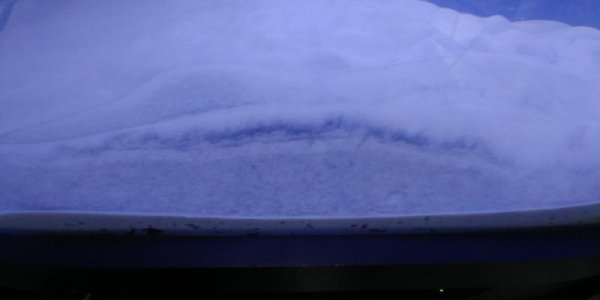
I just noticed what looks to be black soot on some sand ridges (this was dry oolite sand). I haven't begun to filter the water and actually only started the circulation pumps yesterday and the soot is appearing where those pumps made ruts in the sand.

Anyway, hoping someone can help inform me about whats going on and how to fix it.

Recap
1) tank has no salt yet
2) tanks been filled for 2 days
3) tanks been dosed with prime
 

Attachments

  • 15237288211641572856512.jpg
    15237288211641572856512.jpg
    16.3 KB · Views: 5
  • 15237290767182103588865.jpg
    15237290767182103588865.jpg
    24.6 KB · Views: 5
Not sure about the black substance but with a 2 day tank it is definitely not life.

Now, I believe you are not doing things the best way imo. You should not be mixing the salt in the tank. If you're planning on mixing your own water at a minimum you need a big bucket and mix it there, then use it in your tank.

Getting the right salinity in the tank, where is tough to add more water or salt because overflow issues is not easy, and I'd say impossible to do in a water change.

Good luck

Sent from my SM-N950U using Tapatalk
 
run a magnet thru it and see if the soot sticks. i have something similar in my tank and it sticks to the magnets. i just remove it when i clean the powerbeads and mag algae cleaner.
 
I'm not exactly sure what the black is.. May have been in the sand from the start.. May be some bacteria/diatom or sulfide/bacteria reactions..
BUT
I will suggest though that you replace the sand.. And the only reason why is because very fine sugar sand like that just sucks because you tend to be limited to needing low flow to keep it from blowing all over the place/sandstorms,etc... That can be a problem in the future as decent flow really helps keep detritus,etc... in suspension and some corals,etc... just need decent flow to keep the algae from growing on their skeletons,etc...
I would suggest replacing it with caribsea special floor reef sand (dry)...

I've done fine sand in the past and always kicked myself for that decision.. easier to replace it now than later...

Since you are starting with all dry the way you have added the water without salt yet is really just fine and not a problem.. But it can take longer to mix and you need to add it slowly in decent flow so it doesn't just cake up on the sand in a pile..
 
I'm not exactly sure what the black is.. May have been in the sand from the start.. May be some bacteria/diatom or sulfide/bacteria reactions..
BUT
I will suggest though that you replace the sand.. And the only reason why is because very fine sugar sand like that just sucks because you tend to be limited to needing low flow to keep it from blowing all over the place/sandstorms,etc... That can be a problem in the future as decent flow really helps keep detritus,etc... in suspension and some corals,etc... just need decent flow to keep the algae from growing on their skeletons,etc...
I would suggest replacing it with caribsea special floor reef sand (dry)...

I've done fine sand in the past and always kicked myself for that decision.. easier to replace it now than later...

Since you are starting with all dry the way you have added the water without salt yet is really just fine and not a problem.. But it can take longer to mix and you need to add it slowly in decent flow so it doesn't just cake up on the sand in a pile..

I'm going to second mcgyvrs suggestion to replace the sand before you go any further. I started my 120DT with similar sand, and although it will work, your powerheads will quickly move it to where the flow dictates. I have been slowly replacing mine with caribsea special floor reef sand and although it still gets moved some, it is nowhere near like it was at first.

Another very important reason to remove the sand that is in there is because it looks like you have placed your rocks on top of the sand. That will bite you in the behind sooner or later. As the sand is moved around, both by the powerheads and any burrowing fish/shrimp/crabs/etc, if the base structure is not on the glass bottom of the tank there will be rockslides. Not only can corals be damages, it is not unheard of to have a tank be damaged (cracked) by a falling rock. Regardless of the size of the tank, having it empty itself in your living room is, well, not a good thing.

Although you can get away with mixing the salt into your water now, with no life in the tank, this is the ONLY time you can get away with that. For water changes, the water MUST be premixed to the correct salinity and temperature BEFORE you add it to the tank with life in it. You "mixing station" can be as simple as a 5g bucket or as elaborate as your imagination can make. (see thread on mixing stations in the DIY forum)

jm.02
 
Thank you for all the replies, ill try the magnet and Ill be sure to dig down for the base rock to secure them. Thanks again.

Oh and noted on the salt.
 
Please consider getting a RO/DI unit. you do not want to be topping off with water that may contain Chlorine. The truly only safe water for reef tanks is zero TDS water and that is only possible with a RO/DI unit for both top off and water changes.
 
Back
Top