Bulkhead fitting help

SFish

New member
Ok so the pump says 1/2" hose will fit on the out put. I want to pipe this pump to a tank from the sump and let it drain by gravity back to the sump. So I want to run 1/2" PVC. What size bulk head do I get for the inlet? Is it 1/2"? On the outlet I think I was told to go 2 1/2 times bigger so I would go 1 1/4"? Is that the size build head I would buy? Also what screws into the bulk head and what size of that would I need? I want to put strainers in as well would those be 1/2" as well or smaller? Not sure how any of this stuff works.

:hammer:
 
Ok so the pump says 1/2" hose will fit on the out put. I want to pipe this pump to a tank from the sump and let it drain by gravity back to the sump. So I want to run 1/2" PVC. What size bulk head do I get for the inlet? Is it 1/2"? On the outlet I think I was told to go 2 1/2 times bigger so I would go 1 1/4"? Is that the size build head I would buy? Also what screws into the bulk head and what size of that would I need? I want to put strainers in as well would those be 1/2" as well or smaller? Not sure how any of this stuff works.

:hammer:

What pump? What head height? What flow rate?
 
The hight would be a little over 1ft. The pump I was looking at was Eheim 600 compact. I would probably go for a flow rate of 40gph.
 
Not sure what your talking about the pump is rated for 4' 4" of head pressure. The pump can run any where from 40gph to 160gph.
 
Last edited:
Not sure what your talking about the pump is rated for 4' 4" of head pressure. The pump can run any where from 40gph to 160gph.

every elbow bend bulkhead and restraint adds to your head pressure"¦i have not seen a setup yet where there is only 1' of head loss"¦that is in all practicality impossible"¦an in stand sump to tank is typically3+ ft of vertical drop plus all the elbows, bulkheads, fittings etc"¦

that said, you very rarely want to match the output side of the pump for plumbing"¦if your pump has 1/2" output you should at least plumb it with 3/4" minimum"¦

i don't know why you are concerned with the inlet of the pump as far as i know the ehiem pumps are internal and must be submerged so you will have no inlet plumbing..

and 99% of the time your return plumbing is run up the back of the tank and not through a bulkhead, as bulkheads add to leak potential and cracking"¦

as for your drains to your sump you should plumb at minimum 1" plumbing"¦that said you would need a minimum of 2 1" bulkheads to safely drain a tank with 1" plumbing. the hole size for a 1" bulkhead is 1.75"

i would at the very least be looking at a mj1200 for a return"¦it is 295gph, and mine has been working flawlessly at about 5' total head pressure, maybe even a little higher, and i don't think i get much more then 50gph out of it at the tank.
 
I don't know the flow characteristics of that particular pump and they don't publish a flow-head pressure curve, but flows for that style pump frequently drop off pretty quickly with head pressure; you may well get considerably less flow than you're expecting.
 
every elbow bend bulkhead and restraint adds to your head pressure…i have not seen a setup yet where there is only 1' of head loss…that is in all practicality impossible…an in stand sump to tank is typically3+ ft of vertical drop plus all the elbows, bulkheads, fittings etc…

There will
one 90•
One pipe going up any where from 1' to a little under 2'
one vertical pipe
And two bulk head only one that the pump is going to


that said, you very rarely want to match the output side of the pump for plumbing…if your pump has 1/2" output you should at least plumb it with 3/4" minimum…

It says use 1/2 hose for the out put of the pump.


i don't know why you are concerned with the inlet of the pump as far as i know the ehiem pumps are internal and must be submerged so you will have no inlet plumbing..

I'm not talking about the pump. I'm talking about and inlet and outlet on a tank and not the DT.

and 99% of the time your return plumbing is run up the back of the tank and not through a bulkhead, as bulkheads add to leak potential and cracking…

This is for a second sump.

as for your drains to your sump you should plumb at minimum 1" plumbing…that said you would need a minimum of 2 1" bulkheads to safely drain a tank with 1" plumbing. the hole size for a 1" bulkhead is 1.75"

i would at the very least be looking at a mj1200 for a return…it is 295gph, and mine has been working flawlessly at about 5' total head pressure, maybe even a little higher, and i don't think i get much more then 50gph out of it at the tank.

I only want a flow rate of 20-40gph. The pump is rated for 160gph. I'm going less then 2' up and across a few feet. All I really wanted to know was how bulk head fittings work. I think this went off topic. Which is why I didn't add all this info.
 
Last edited:
I don't know the flow characteristics of that particular pump and they don't publish a flow-head pressure curve, but flows for that style pump frequently drop off pretty quickly with head pressure; you may well get considerably less flow than you're expecting.

It says max head pressure 4' 4" but in any case that's why I went with a bigger pump that can run 4 times higher then what I need.
 
Well that is not how centrifugal pumps work. You have 4 times what you need at 0' of pressure head. At 4.4' of pressure head, you have 0. The shut off head is lower than 4.4', though without a good flow curve, I won't speculate as to what it is. That rating is with NO pipe on the pump, just 4.4' of water above the pump.

As soon as you put pipe on the pump outlet, the flow curve no longer applies, unless the pressure head is adjusted to account for the dynamic head, or the addition of friction loss, in the plumbing. That is why it is called fluid dynamics, or "fluids in motion."

You are saying < 2' of static pressure head. So lets say ~2'. You put pipe on them (especially these little pumps that do poorly against pressure head) and the friction loss adds up. In the plumbing you were describing, the friction loss due to pipe size, and other things, would probably bring the pressure head close to the shut off pressure head, dropping the output to nothing. When you hit the shut off point, you are just using electricity to accomplish nothing.

See wanabe's post. It may seem like the thread went off topic, however, it did not.

Whoever told you to use 2.5x the outlet diameter was sadly mistaken. 3/4" would be plenty. However, using 1/2" tubing, as suggested in the pumps specs, is a bad idea as well. 3/4" pipe/tubing will show ~ 2/3 less friction loss. Centrifugal Pumps 101 says up-size the outlet pipe at least one size above the actual output diameter of the pump. Mag drive being the exception (another rather lame pump) where the 3/4" outlet needs 1.5" pipe to get any flow out of them. That only applies to Mag Drive 9.5 and larger.

 
every elbow bend bulkhead and restraint adds to your head pressure…i have not seen a setup yet where there is only 1' of head loss…that is in all practicality impossible…an in stand sump to tank is typically3+ ft of vertical drop plus all the elbows, bulkheads, fittings etc…

There will
one 90•
One pipe going up any where from 1' to a little under 2'
one vertical pipe
And two bulk head only one that the pump is going to


that said, you very rarely want to match the output side of the pump for plumbing…if your pump has 1/2" output you should at least plumb it with 3/4" minimum…

It says use 1/2 hose for the out put of the pump.


i don't know why you are concerned with the inlet of the pump as far as i know the ehiem pumps are internal and must be submerged so you will have no inlet plumbing..

I'm not talking about the pump. I'm talking about and inlet and outlet on a tank and not the DT.

and 99% of the time your return plumbing is run up the back of the tank and not through a bulkhead, as bulkheads add to leak potential and cracking…

This is for a second sump.

as for your drains to your sump you should plumb at minimum 1" plumbing…that said you would need a minimum of 2 1" bulkheads to safely drain a tank with 1" plumbing. the hole size for a 1" bulkhead is 1.75"

i would at the very least be looking at a mj1200 for a return…it is 295gph, and mine has been working flawlessly at about 5' total head pressure, maybe even a little higher, and i don't think i get much more then 50gph out of it at the tank.

I only want a flow rate of 20-40gph. The pump is rated for 160gph. I'm going less then 2' up and across a few feet. All I really wanted to know was how bulk head fittings work. I think this went off topic. Which is why I didn't add all this info.


I ran mj's, two of them, like this for a couple years. I avoided elbows by using vinyl, and killed the next bird plumbing them to each there own tfl reactor: one GAC, the other GFO hung hob style. Flow wasn't great with <4' surface to surface. These are maybe the greatest little pump as far as reliability, but loading them up certainly shortened there durability. A set up like this could help the op, but I'm not sure why the sump is being drilled. An mj with hose barb 1/2" to 3/4" slip/thread to bulkhead and up with PVC seems sound to me.
 
Well that is not how centrifugal pumps work. You have 4 times what you need at 0' of pressure head. At 4.4' of pressure head, you have 0. The shut off head is lower than 4.4', though without a good flow curve, I won't speculate as to what it is. That rating is with NO pipe on the pump, just 4.4' of water above the pump.

As soon as you put pipe on the pump outlet, the flow curve no longer applies, unless the pressure head is adjusted to account for the dynamic head, or the addition of friction loss, in the plumbing. That is why it is called fluid dynamics, or "fluids in motion."

You are saying < 2' of static pressure head. So lets say ~2'. You put pipe on them (especially these little pumps that do poorly against pressure head) and the friction loss adds up. In the plumbing you were describing, the friction loss due to pipe size, and other things, would probably bring the pressure head close to the shut off pressure head, dropping the output to nothing. When you hit the shut off point, you are just using electricity to accomplish nothing.

See wanabe's post. It may seem like the thread went off topic, however, it did not.

Whoever told you to use 2.5x the outlet diameter was sadly mistaken. 3/4" would be plenty. However, using 1/2" tubing, as suggested in the pumps specs, is a bad idea as well. 3/4" pipe/tubing will show ~ 2/3 less friction loss. Centrifugal Pumps 101 says up-size the outlet pipe at least one size above the actual output diameter of the pump. Mag drive being the exception (another rather lame pump) where the 3/4" outlet needs 1.5" pipe to get any flow out of them. That only applies to Mag Drive 9.5 and larger.

Thanks

So what pump would you use? Also are you saying the inlet and outlet can be the same size?
 
Last edited:
what inlet and outlet are you referring too?

is your sump drilled for an external pump?

if so you should be looking at an external pump not a submersible…otherwise there is no inlets…your pump will sit in water and draw from there…

as for your question, no, the inlet side of a pump should always be larger then the return side, and there are very specific rules concerning plumbing leading to the inlet side of your pump…

typically return pumps are plumbed up tieback side of the display tank and returned into it over the top..
 
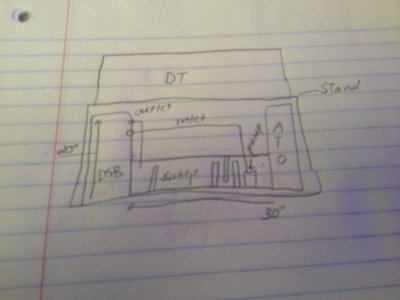
Ok let's start this over I think I'm confusing people. I'll draw it out and take a pick. If you help me I can map it all out.


Thank you by the way
 
I'm going to have 3 tanks in the stand.

1 20gal long

1 DSB

1 ATO

The DSB tank will recirculate in the sump. The sump is about 30" long and the DSB tank is 20" high. I need to go from the sump to the DSB and back to the sump. I'm looking for a lower flow rate. I'm guessing 20-40 ish. Let's say I want to go up 20" and over 33" so there will be only 1 90• on the inlet going to the tank / the pipe going from the outlet of the pump to the DSB. It will gravity feed from the DSB back to the sump. I want to run PVC and use bulk heads on the DSB tank. One as an inlet and one as an outlet. I don't know if it's right but I was told to make the outlet on the DSB tank 2.5 times bigger then the inlet on the DSB tank. The stand it self is only about 24" tall so it's a tight fit. That's why I was thinking to use two bulk heads on the DSB tank. I need a smaller pump that will do the job because space is tight. The DSB is made out of acrylic and drilled. The sump is made out of glass and not drilled. I would rather use a submersible pump because of space.

How do I figure out which pump to buy and what flow rate I need?
 
Last edited:
See Pic
 

Attachments

  • image.jpg
    image.jpg
    30.1 KB · Views: 5
Sometimes it's about getting the correct terminology. It sounded to me like you are planning on drilling your sump and hard plumbing it. A pump like a mj1200 (maybe not the best choice, but a very inexpensive option) is not set up to hard plumb especially through a bulkhead, I don't know about the Eheim. Therefore to attatch a pump like that to a bulkhead one way would be to use a hose barb. Most who use internal submersible pumps don't drill there sump, but there is no reason why not to. I don't know if there are slip hose barbs, but they could composed. They do come threaded. Bulkheads come in different combinations from slip/slip, slip/threaded, threaded/threaded, and maybe even threaded/slip, therefore one could thread a hose barb into the bulkhead and use it with a section of vinyl to hard plumb a pump. If you have a drilled sump with a slip bulkhead that you are planning using you might find a slip hose barb or fasion one with different fittings.
Just tell us again how you are planning to drain the tank, how big it is, and how you hope to return the water to the tank. Maybe none of that even applies?
 
The pump in the sump will pump water to the DSB tank and it will drain back to the sump by gravity. I'm just talking about the DSB tank.
 
The flow you are taking about is virtually nothing; I have the same thing going on with my fuge: to drain it I simply overflow into an upturned 1" elbow connected to a bulkhead. I'm a bit of a redundant person here, so I did this twice. I have a slightly higher set backup just in case. If you can see past all the other stuff, my primary drain is plumbed hard so that it drains just under the sump's water level. I want to hear if the emergency drain is draining so water falls out the vinyl and into the sump. The same could be done for getting water to the dsb (fuge) but I simply use 1/2" vinyl. An syphon break hole is a must regardless of how you plumb it; a hard plumbed water supply will never fall out of the tank causing a flood. You are talking very little flow and little head, I think just about anything will get the job done.
image.jpg1.jpg

Here's a top view:
C636B7EF-3251-4FBE-AE54-BB349C70E329-604-000000E8E4FC44C3.jpg


Let's talk about the sump; I believe that the main pump chamber should be as big as you can make it, baffles are overrated and generally unneeded, giving a good skimmer one baffle that sets water level is all I find necessary. All your evaporation shows up in the pump section. If the ATO ever falls behind its nice having a wee bit of water volume to save the pump.
 
Back
Top