Bulkhead Question

GQsmooth

New member
I want to fill my system to the brim, but I haven't completed my plumbing yet as I will be busy for a few weeks.

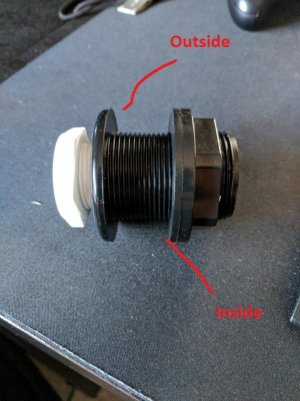
So basically I want to plug my overflow and return holes so I can fill the tank all the way. I bought screwed bulkheads for this temporary setup, I was thinking of reversing the bulkheads and putting the gasket on the inside of the tank while using a screw cap on the outside with teflon tape to hold the water. The reason for this is because I don't want to have the white PVC cap showing in the tank:p

Would this work? or is the bulkhead only meant to go one way?

Any other solutions?
 
Last edited:
The only thing I can think of is that by putting it in upside down inside the tank/overflow it's going to be a pain if/when the bulkhead comes loose to tighten it back up. If it's on the outside, it's easier, less gross. easier to grab, etc.
 
It will likely be difficult to find a cap that screws onto the bulkhead, typically those thread are only there for the nut that holds them. If you don't want to reuse them you could silicone the heck out of the threads and put a push cap on that I guess but it would be a pain to undo it.
 
I have the plug, basically I want to try like this.

I assume the gasket always has to stay on the inside, but for when reversed maybe not??? I guess the only way to find out is to try it out lol, unless anyone has any suggestions?
 

Attachments

  • IMG_20170529_174408.jpg
    IMG_20170529_174408.jpg
    69.2 KB · Views: 6
Oh I see it's threaded on the inside also. Yes that would work but I would use silicone and not teflon tape myself.

The gasket always goes on the wet side, so inside the overflow.
 
The gasket has to be on the side of the head of bulkhead, never on the side of the turning nut. Otherwise it will leak.

In your case the head is outside of tank? If so, make sure the OUTSIDE surface of the glass is clean to seal properly with the gasket.

Also use teflon tape on the threads of the plug. It provides good seal.
 
The gasket has to be on the side of the head of bulkhead, never on the side of the turning nut. Otherwise it will leak.

In your case the head is outside of tank? If so, make sure the OUTSIDE surface of the glass is clean to seal properly with the gasket.

Also use teflon tape on the threads of the plug. It provides good seal.

If he puts the gasket on the outside, it will leak. It has to be on the inside but also being on the nut side he has to be careful it doesn't turn or pinch when tightening.

At the end of the day he should have used regular bulkheads and just placed tall pvc standpipes in them higher than the level of the water. Or, use those ones the normal way.
 
Just last week I installed a bulkhead with head side (i think it is called flange side) outside the tank and the nut inside tank. Initially I put the gasket inside tank against nut. It leaked no matter how careful i tighten the nut.

Water actually travels along the threads between nut and stem if the bulkhead, through the center of gasket. There is nothing to provide a seal along this path.

I think my original statement is correct.


Sent from my iPhone using Tapatalk
 
If he puts the gasket on the outside, it will leak. It has to be on the inside but also being on the nut side he has to be careful it doesn't turn or pinch when tightening.

The gasket always goes between the flange and the glass regardless of which way it is installed. It is perfectly acceptable to have the flange on the outside of the tank - I have installed many of them this way (usually to save some space).

My suggestion to the OP is to install the bulkhead the traditional way, with the flange inside the tank and the tail underneath, and screw a piece of PVC pipe glued to a male adapter that extends up above the water level. That way you can fill the tank without completed plumbing but still then complete the plumbing without a flood.
 
Ok, that seems fair.

You're still allowing water outside the aquarium doing it that way though, which I don't know is the best way to go about it. I still say using standpipes with silicone inserted into normal bulkheads is the way to go. They're easily twisted out later when needed without touching the bulkheads.
 
I think it's an immaterial amount, though I agree that bulkheads are best installed in overflows with the flange inside. That makes them easier to unscrew as well.
 
How do you plan on removing the bulkhead without a flood?

Lower the water level...

The gasket has to be on the side of the head of bulkhead, never on the side of the turning nut. Otherwise it will leak.

In your case the head is outside of tank? If so, make sure the OUTSIDE surface of the glass is clean to seal properly with the gasket.

Also use teflon tape on the threads of the plug. It provides good seal.


Yeah, I tested it out, it did leak. Will it still leak if I put another gasket on the outside?

Otherwise I guess I'll have to put the plug on the inside.


The gasket always goes between the flange and the glass regardless of which way it is installed. It is perfectly acceptable to have the flange on the outside of the tank - I have installed many of them this way (usually to save some space).

My suggestion to the OP is to install the bulkhead the traditional way, with the flange inside the tank and the tail underneath, and screw a piece of PVC pipe glued to a male adapter that extends up above the water level. That way you can fill the tank without completed plumbing but still then complete the plumbing without a flood.

Yeah, my last resort was to glue pvc internally, with a glued cap. I was hoping to avoid that though as it will be a waste of bulkheads.
 
You only need one gasket. As long as it is on the flange side. In your case, relocate that gasket to between the flange and the glass (it will be out side surface of the glass).


Sent from my iPhone using Tapatalk
 
No, flange is sealed by the gasket, regardless of which side it is on. You don't want a gasket under the nut because it deforms and can actually prevents adequate torque.
 
I had to plug 3 holes drilled on the bottom that was used at one time for a closed loop system which I'm not currently using. I plugged the thread/thread bulkheads just like you did. I just wrapped the schedule 40 plug threads in a lot of teflon tape and installed each bulkhead with gasket on the wet side. Tightened everything down with a strap wrench. Perfect water right seal. I plumbed under the tank for those three bulk heads with ball valves which go to nothing as of now but I may use one in the future as an easy tank drain for easy water change system.
 
I had to plug 3 holes drilled on the bottom that was used at one time for a closed loop system which I'm not currently using. I plugged the thread/thread bulkheads just like you did. I just wrapped the schedule 40 plug threads in a lot of teflon tape and installed each bulkhead with gasket on the wet side. Tightened everything down with a strap wrench. Perfect water right seal. I plumbed under the tank for those three bulk heads with ball valves which go to nothing as of now but I may use one in the future as an easy tank drain for easy water change system.

Thrilled it worked for you - still not the right way to do it though.
 
Hi guys I've been browsing the forums for a couple of months and now have decided to join, I bought a aqua reef 400 and it's nearly finished cycling can't wait to get some fish in it, I'm new to this whole saltwater thing been reading loads love the forum see ya around
 
Back
Top