Can drain water flow uphill at any point?

Jeffie

New member
So, I am faced with a dilemma.. I have plumbed a ton of tanks and sump rooms. What I am working on now is plumbing a tank from an office down to a sump room in the basement. The problem is that in the basement where the pipes will enter the sump room the pipes are too low. The water will come down about 2 feet, exit out of the office into the basement and ideally I would then like it to come back up about 2 feet, travel over six to eight feet sideways and then down about 4 feet into the sump. Will this work? I know that in home plumbing water travels up and down alot. Would some sort of breather help where it comes up or am I just over thinking the whole thing? There will be two drain lines. One actually draining and a backup drain line incase something gets plugged on the first... Anyone have any input on this?
 
I would think as long as the drain does not become higher than the origin point gravity and head pressure will continue to push the water to the exit point. although it may lose some flow.
 
The area where it turns up could possibly become a trap for heavy debris although not much should collect there with good flow. As long as the high point is not excessive you should have flow. It will act much the same as a trap under your sink or bathtub. I would place a valve above this area and connect it with unions for easy cleaning if it becomes clogged.
 
I agree that head pressure alone will push water uphill. But the point is its def not desirable to have it work that way. And solids will most definately collect in the low points if the flow is not fast enough to scour the pipes. Any joints/bends in the low span will most likely be somewhat of a bottle neck for solids if say you have some sand get into there. Over time it will just sit in the low spot and impede or eventually block the flow.

I work for a water department and any pipes/sewers we have that have reverse grade on any span of the mainline are what are called trouble spots and have serious issues with solids settling in those low spots and without more than usual maintenance they are expected to fail.
 
Last edited:
maybe you could install a 1/2 inch drain at the low point to occasionally purge any collected debris.

This is a great suggestion... I'm trying to figure out a different way to not have to make it run uphill but it just doen't seem like there is a good way in this situation.
 
I hear ya sometimes we just have to work with what we got. Might think about some spa flex hose. maybe you could minimize the amount of the trouble area.
 
There are basically two styles of drain used on reef tanks - mixed (air and water mix, i.e. a durso or stockman) and full siphons (i.e. the siphon on a herbie or beananimal). Both would have problems with this arrangement - full siphons can have difficulty purging air on a restart when there are "uphill" sections - it'll work fine once running, the problem is GETTING it running. Meanwhile, mixed drains tend to slowly collect air bubbles near uphill sections, which tends to cause the flow rate to slowly fluctuate - then it'll reach a point where it all gets sucked down and the rate will swing back up - they're pretty much impossible to tune for stability.

I'd rethink the location of your plumbing and/or sumps to get around this.
 
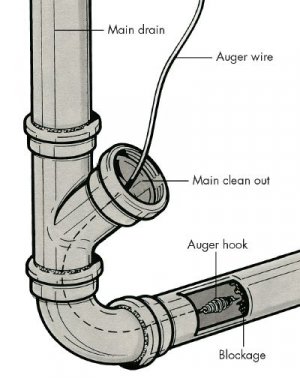
At the upward bend install an elbow with a cleanout (there is a name for this piece of pipe but I dont know what it is) or a threaded "T" that you can put a cap on if it needs to be unclogged.
 
Y clean out

Y clean out

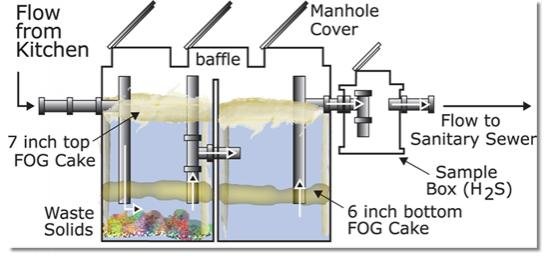
I hope both attachments come through. You could install a simple Y clean out port and / or something like a grease trap. Not so complex or large as that pictured but there are smaller ones.

Then have a way to empty the "grease trap" from below. Also, keep in mind that the reason you installed this will become forgotten over time. I suggest that you clearly and permanently label instructions on the box trap.

I think this will solve the problem...
 

Attachments

  • how-to-clear-a-clogged-drain-4.jpg
    how-to-clear-a-clogged-drain-4.jpg
    35.8 KB · Views: 7
  • Grease-Interceptor-FOGs.jpg
    Grease-Interceptor-FOGs.jpg
    24.9 KB · Views: 7
Oh...of course the Y trap must have a threaded plug for access.

smaller grease traps from brief google search http://plasticgreasetrap.com/Small-Capacity-7-15-GPM_c3.htm there are also residential sizes I'm sure.

The grease trap could be placed in a convenient, accessible spot. As long as it stops the debris at some point, there won't be any to gather down the line.

Looks like both images came through.
Let me know what you think.
 
How far is the drop form the tank down to where it enters the basement...then how much rise do you need to overcome.... Its been about 15 years since my dreaded fluid dynamics class but i think this problem is solvable if you get out a tape measure and use the right size plumbing and try to minimize 90degree turns (spaflex) also need to know what the flow rate is from your sump up to the display tank.. the plumbing cleanouts are a great idea
 
I don't know if this is possible, but you can install flex piping or flexible PVC to decrease the turns. I have an area that it actually goes up 2 ft then drops back down. The flex tubing can give you better flow and hence decreased resistance. Again if this is possible for you to do.

Alex
 
drain

drain

i agree with a valve at the bottom of the "trap". being a master plumber, we do this on boilers, it is called a blow down-drip leg. it catches dirt and such. at the bottom where "90" would be put a tee in and drop your drip let and valve there
 
My drain pipes go into my crawlspace then run back up about two feet to get to the sump in the garage. I have never had any problems the only thing is make sure the sump sits lower than your tank. My sump is roughly 3 feet lower than the bottom of my tank.
 
Back
Top