Carbon Dosing & Skimmerless

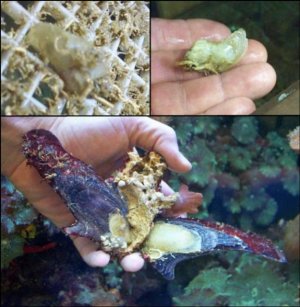
I am definitely curious how this works long term, particularly in regards to scallops. Having had "Turkey Wing" clams successfully reproduce in one of my display systems (skimmerless) I've wondered if there was something I could do to increase the success rate (more than one :D ).

Tank video http://youtu.be/5AnmQXmE8d0
Calm and sump video http://youtu.be/WDj0daKV2B8
 

Attachments

  • Clam Trio TFC.jpg
    Clam Trio TFC.jpg
    54.8 KB · Views: 24
IMO, this is a good experiment to see what happens when carbon dosing and skimmerless.

While I think my carbon dosing (vinegar) increases food for creatures like sponges, not skimming might increase it still further (I skim).

It may also help clarify how important skimming is in exporting nutrients in an organic dosed system long term. As far as I know there is no real info on that method.

Yes, I understand the need to impart accurate knowledge about methods. To be blunt, I am loaded up with work:
I maintain the 75G Jaubert system in the study as well as 135G laqgoon biotheme with a maturing 12" DSB to grow true marine plants. Also inside my home are two 55G lagoon biothemes, four 20G lagoon biothems and four 40G lagoon biothemes. Outside includes an extended integrated system of 10,000 gallons under natural sunlight, some tanks are buried in the ground and some are under a 20' by 40' greenuouse. I maintain 1 1/2 acres with a gargen by myself at the age of 67.

If the "genie in a bottle" sends an apprentice, I will add that to my "to do" list.
Patrick


There are several cases documented on carbon dosing and skimmerless. I linked Melvins Reef on post #2.

http://www.advancedaquarist.com/201...ider&utm_medium=slider&utm_campaign=clickthru

James Fatheree published an article recently documented his experiences.
 
I am definitely curious how this works long term, particularly in regards to scallops. Having had "Turkey Wing" clams successfully reproduce in one of my display systems (skimmerless) I've wondered if there was something I could do to increase the success rate (more than one :D ).

Tank video http://youtu.be/5AnmQXmE8d0
Calm and sump video http://youtu.be/WDj0daKV2B8


Timfish,

If you produce enough clams, will you send me some. Being in the Texas Hill Country, I am 200 miles from being able to harvest fresh seafood. Just teasing.

In my early days of growing Red Ogo, I posted a thread about eating some harvested from my refugium. A chef in Kansa City asked my how I removed the amphipods. When I told him that I was a Cajun and we eat most everything, I heard him laugh in Kansas with me in Southwest Louisiana as I explained that I considered it extra protein.
Patrick
 
Did I miss where he said he was carbon dosing?

"Nothing goes in except food, kalkwasser, and water, which is next."


Pardon my error. I have spoken with James in the past and found him to be open to different ideas. I will get in touch with him thru his author forum and inquire about his thoughts on the process.
Patrick
 
You sure melev's tank was skimmerless?

He shows a picture of his skimmer on the page you linked, with the title "Resulting skimmate".

I see the picture with skimmate in the linked article. I met Melvin for the first time in May of 2013 at The C4 Conference in Austin. He talked about the tank in question. Obviously, I confused his scenario with Timfish who was at the same conference with pictures of his 20 year old skimmerless tanks. Coincidently James Fatherre was at the same conference talking about economy in reefkeeping.

I have posted the question on the Advanced Aquaria feature article that James wrote. Let us see what he says.

Timfish may be willing to participate and grow clams in his 20 year old skimmerless tanks.
Patrick

PS. Another lapse in memory. The "Economy of Reefkeeping" talk was 3 years ago at Next Wave Conference in Dallas. James spoke on clam husbandry at C4 Conference in Austin.
 
Last edited:
Did I miss where he said he was carbon dosing?

"Nothing goes in except food, kalkwasser, and water, which is next."


From the displayed results of the tank in the article, it would seem that carbon dosing is not necessary. Carbon is entering with the food as James has balanced his system. What I like about biological filtration is that it responds to nutrients in with a corresponding growth. If there is enough diversity to generate multiple nutrient pathways, then the system prospers and grows in desirable ways.

Feldman refers to that as the "hidden part" of the equation. When one looks at the beautiful display in Fatherree's tank it does not look hidden to me. While it definitely is not hidden, it is hard to quantify with numbers. The processes that are involved in the "dynamic equilibrium" of our reef tanks will befuddle attempts to seperate individual processes within these multiple nutrient pathways. Science, Art, and Technology as the title to Reef Aquarium V 3 and as the method to balance our systems is an appropiate mix.

Martin Moe said it well about the hobby in the early 1970's:

"It is not rocket science. It is more complicated."
 
Martin Moe said it well about the hobby in the early 1970's:

"It is not rocket science. It is more complicated."


Biology usually is. That's why we put men on the moon almost 50 years ago, but still cannot cure most cancers.
 
After one week of adding 25ml of 5% vinegar, I see a clarity of water improvement that I had not observed in sometime. Part of the observation was a new attention to the tank which has been suffering from "too many tanks" syndrome. It has been neglected.

Because of my awareness of carbon dosing principals, I have put this tank unto the road of recovery. I had let it get taken over in areas with macro algae which were interfering with the DSB operation. Also complicating the issue was removing macro from the refugium and replacing with nitrate test study winners: bioballs and rock rubble. Two weeks ago, I put Ulva in the macro section of the refugium and turned the lights on with the same cycle as the display tank. An evaporating fan comes on at the same time to control temperature. Initially, it happened this way because of only one timer. As I have further embraced natural cycles, I decided that the normal pH fluctuation, observed on natural reefs have a purpose, that is unknown to me. I trust nature and decided to forgo the opposite photoperiod that is imbedded in the hobby. To start with, I see two advantages. First, the effect of vinegar on pH is offset with photosynthesis in top and bottom. The second advantage is the increased automatic buffering/dosing at night time from arroggonite sand beds.
Removing the UV sterilizer was the third change in 2 weeks.

I now observe some soft coral polyps extended at nighttime, that did not extend previously, both GSP and Green Nepthea are feeding. I suspect bacteria have more to do about it than pH.

 
Last edited:
After servicing GAC with no bacterial films evident, I have increased vinegar dose to 50 ml each day. As I am using the herbivores to remove excess macro growth, I have kept food input constant. When micro and macro growth gets where I like it, then I will increase food to tank. Instead of using decreasing nitrates and phosphates as a barometer to find carbon maintenance dose, I am using bioindicators to adjust carbon dosing and food.
Patrick
 
After servicing GAC with no bacterial films evident, I have increased vinegar dose to 50 ml each day. As I am using the herbivores to remove excess macro growth, I have kept food input constant. When micro and macro growth gets where I like it, then I will increase food to tank. Instead of using decreasing nitrates and phosphates as a barometer to find carbon maintenance dose, I am using bioindicators to adjust carbon dosing and food.
Patrick

A very interesting experiment Patrick
 
Not sure what you mean here?


My tank maintenance had declined due to lack of enthusiasm on my part. Bad attitude. Because of my recent interest in carbon dosing, my enthusiasm to apply carbon dosing methods has added a highened level of interest. good attitude.
Patrick
 
My tank maintenance had declined due to lack of enthusiasm on my part. Bad attitude. Because of my recent interest in carbon dosing, my enthusiasm to apply carbon dosing methods has added a highened level of interest. good attitude.
Patrick

Sort I meant how macro algae could affect the functioning of a dsb
 
"Activated sludge" is the mainstay for industrial wastewater treatment. Bacteria are feed a concentrate slurry of mans organic waste. Using air to circulate this organic soup, the bacteria feed on nutrients, including other bacteria. The spent shells of bacteria that are not consumed in the process settle to the bottom as floc (detritus) and are decanted off to drying beds. After the flock goes thru a process to significantly reduce pathogens, it is spread across farm land to grow food for cattle or people.

When a DSB is vacuumed, I see a similarity in purpose and methodology.

Many things can impair the functioning of a DSB. Calcium phosphate or calcium carbonate can cement up the sand bed. Bacteria films combined with the cement can impair diffusion of water thru the sand bed. Between the reefkeeper using good husbandry and a wise selection of janitors and detrivors, DSB can be maintained long term.
Patrick
 
A form, yes, but different since it adds nutrients as well, and it may not as readily drive bacteria if a lot of it is consumed by fish and such. :)
 
A form, yes, but different since it adds nutrients as well, and it may not as readily drive bacteria if a lot of it is consumed by fish and such. :)

Does fish poop also contribute to the carbon balance equation as well as the nutrient balance equation.
Patrick

PS. When macro grows does it consume any of the carbon source.?
 
Back
Top