Chrysopterus Color Loss Thread

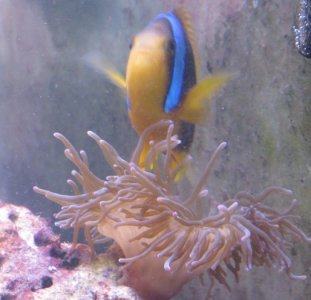
I had a white tail juvi that started to turn dark its hosted a mertenssi and a sebea anemone.

It is at a lfs turning darker by the day
 
I used to collect chrysopterus while living in Guam and as for lighting they were many times in 15 or less feet of water and the lighting is pretty darn bright at that depth. I shipped several to a few different breeders and they all had the same problem they faded in the orange yellow color. 90% of the crysopterus were in mertensii anemones the only other anemone I saw them in was crispas. They were breeding them at the Guam Aquaculture Center and the young in and outside dulled out and the broodstock also dulled out, "they never did anything with the young they were just ugly. I just wanted to give a different perspective and a look in the wild hopefully someone can figure this out because the dominant orange yellow ones are magnificent.
Before I forget one of the breeders ask me about this and he said he had tried just about everything food wise and had no luck.
 
After seeing wild pictures of the Vanuatu white tail chrys, I think it is a normal progression to lose their bright colors. Some wild type photos look exactly like my grown up white tail chrys which were bright orange when I bought them, but faded over time. Seems like just a local variant.

Dan
 
Last edited:
I have seen dull one's in Guam but not the same fading the captured ones get, not near as faded I believe just a different strain.
 
I can't say why it happens, but I can offer up my observations and what I'm doing. I've been wanting chime in here all weekend but am just sitting down with the laptop this was going to be too long to type out on the phone.

1989-1992 we got a pair after a long wait. Correction - my dad got a pair of WTC (supposedly from the Marshalls). We put them into a ritteri, had absolutely no issues with acclimation, no Q, etc.. and we kept them until the tank was shutdown and they were resold (in San Diego FYI). They held the black body/orange finnage and white tails the entire time. Let's say back then Dad wasn't as fancy as I am now. We kept the tank at 1.023, used IO, 82deg, and 60 watts of NO T12's. Great for the fish, ritteri's not so much - typical 6 month slow decline. Fish fed only prime reef/F2 and brine shrimp (not fortified). The pair spawned from 1991-1992 and memory is a little hazy but they were in the 5" and 4.5" range? There were other fish spawning as well which I think is a good indicator that the system was doing well.

Fast forward to 2010. Always wanted to give WTC another shot so decided to commit to the search. Knowing their current reputation for being difficult (and a whole lot wiser overall btw) I got a few of them (solomons) and put them into my Q system. Unfortunately they dropped like flies losing 5 of 6 within 30hrs. It was bad. The lone one to make it was very very hurting and despite repeated dipping, formalin baths, hypo, the works I finally gave up at about 48hrs into it and coiled up the hoses and gave up. Well that fish lay on the bottom for another 2 days before starting to stand back up. OK something to work with! After 6 wks in the Q including hypo, 2 courses of prazi, and M2 (freshwater) for some other issues, that fat sassy WTC went into the DT with absolutely beautiful colors. Black body color, orange finnage, white tail. In Q there was no direct light, 80deg, and food consisted of NLS pellets, enriched brine, hikari/PE mysis. I slowly transitioned out of hypo to 1.025 and when the DT and Q matched I moved it over. It took about one week for the fish to set up shop in the magnifica. It wanted in, but was getting stung to high heaven I believe based on what I was watching.
Within 2 weeks of being in the DT the color started to change. I took a work trip and 2 weeks later when I came back the fish was brown, finnage dull orange, and a dirty white tail. Only thing that got better were the blue stripes. Fish showing HLLE? signs as well with forehead pitting and lateral line more visible in the 2nd stripe. My DT is a primarily SPS setup, 1.025, 2x250W MH 20K, nem/fish combo in ~400 umol, IO with typical reef chemistry numbers, very clean system with minimal fish load. Stepped up feeding to NLS pellets, NLS thera-a, enriched brine, hikari/PE mysis, F1, F2, prime reef flakes, cyclops, in an attempt to counteract the HLLE. I do believe during December and here in January it's slowly gotten a little better and the washed out brown is more like a deeper chocolate brown. Finnage still drab. Interesting to see which way it goes moving forward.

What I can't say is whether or not the environment had anything to do with the color. Looked fine for the 6wks in the Q, but would it have changed shortly thereafter had I left it - I'll never know. Is it the nem? well one time they stayed black, the other not. Salinity - 1.023 with a swing arm may have been today's 1.025 with calibrated refractometer? Food even has some overlap. Lighting is definitely different, temperature is close. Corals now, that's another difference - no carbon used in either system - so could be chemical. Or something altogether different. I mentioned the hell the fish went through in Q - big difference as well.

So to summarize, my first experience resulted in WTC's that looked very close to the ones in Wilkerson p.144. This second experience resembles Jordan's spawning video.

Now for the YTC pair in the Q now;)
 
this is just throwing a possibility out there but could the general color loss be a long term result from the stressful acclimation process? what if the very treatments used to keep them alive are causing them to loose color?

tetracycline(a broad-spectrum antibiotic) can cause humans to be susceptible to severe sun burns even in overcast. Why couldn't a similar reaction be happening here?
heck even the changes in salinity from their home environment can't be 100% ruled out
 
i am using kent salt.

i dont think medication is the problem. mainly because i see the issue as specific to white tail specimens.

my yellow tails did not lose any color after copper treatments.

my first pair of white tails did not even go into a QT tank...they went straight into the main display. and within two weeks...lost their color.

but i would like to explore the issue of lighting.
i would agree that most of these fish are found in super shallow water under the brightest of the suns light. but what experiences do people have with T5s vs halides? i have only ever had WT specimens under 400w halides in a 18" tall tank. perhaps that is just too bright and the dull color is a response to that...like a tan of sorts.

thoughts?
 
there was a discussion about sunlight, UVB UVA and goldfish color over at mofib in regards to some super orange occellaris vaporize had acquired.

anyone attempted some sort of UV light supplement over chrysopterus?
 
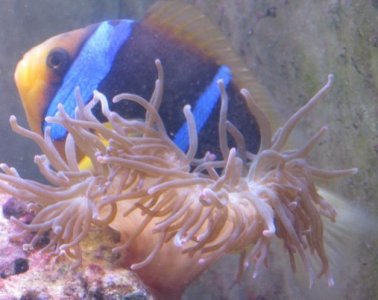
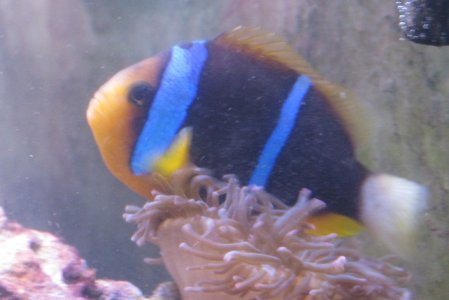
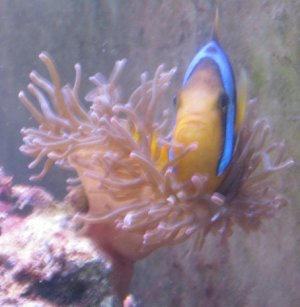
Per Ron's request here are some pics of my big female white-tail. The pics suck partly because of the camera (I think) and a recent cloudy water/cyano outbreak which I'm just now getting a hold on.

attachment.php


attachment.php


attachment.php


attachment.php


My Ritteri which she completely ignores.

attachment.php


I've had her for about 8 months in a 75 gallon display. My lighting consists of 2, 250w Plusrite 14Ks. I keep the water around 78-80 degrees, and 35 ppt salinity.

Her only swimming tank mate is a Domino Damsel. I have 2 anemones. A 10 inch plus Ritteri, and a small bubble tip which you can see her frolicking in above. Why she chose the Yugo instead of the Cadillac I have no idea.

I wish I had taken some before pics but I had no idea these fish were prone to color loss. She has darkened very little since I got her. Most noticeably on her dorsal fin and around her eyes. This happened before I had an anemone in the tank and hasn't progressed in several months.

I feed PE mysis and NLS color enhancing pellets. She also gets some Cyclopeeze when I feed my LPS.
 

Attachments

  • IMG_1316.jpg
    IMG_1316.jpg
    52.5 KB · Views: 6
  • IMG_1349.jpg
    IMG_1349.jpg
    39.7 KB · Views: 13
  • IMG_1334.JPG
    IMG_1334.JPG
    81.5 KB · Views: 11
  • IMG_1340.JPG
    IMG_1340.JPG
    70.3 KB · Views: 6
  • IMG_1339.JPG
    IMG_1339.JPG
    97 KB · Views: 6
The only thing I'd like to add to this is very obvious color loss on intro of BTA's to my picasso pair.
I actually documented this transition pretty well.
I had heard before of the change in color after adding BTA's and in Todd's case LTA but didn't put much thought to it until I actually saw my clowns that had alot of black lose almost all black, and then regain black when BTA's were pulled.
I know we are talking different species, but still, very strange occurance.
 
The only thing I'd like to add to this is very obvious color loss on intro of BTA's to my picasso pair.
I actually documented this transition pretty well.
I had heard before of the change in color after adding BTA's and in Todd's case LTA but didn't put much thought to it until I actually saw my clowns that had alot of black lose almost all black, and then regain black when BTA's were pulled.
I know we are talking different species, but still, very strange occurance.

I didn't notice a color change with the addition of either anemone.
 
thank you for posting. your fish certainly seems to hold more yellow than mine ever have. im extremely interested in knowing why.
 
Only clear photo I had while dipping during Q. Fish was like this for a good 6-7 wks even after moving into DT.

95a10efb.jpg


Recent pic. Fish maintained color for 2 wks in the display and sometime in weeks 3 and 4 it turned brown. I was gone on a work trip for 2 wks and didn't actually see the daily change. Fish tends to move too fast for the phone but clear color difference.
One thing that doesn't show is recently the tail has gone back to white (instead of "dirty" white) and ventral fins are jet black again (instead of brown).

92eaa01e.jpg


I'd like to figure it out as well Jordan.
 
Last edited:
are there any other fish that will so dramatically and rapidly lose their vibrant coloration in captivity? likewise any fish in our hobby that have lost their colors, but then were able to regain them via food, additives, lighting changes....?
 
i have a fiji Chrysopterus pair that are about 6" Long. mine have very vibrant yellow and the brown is getting a little darker on them, but the yellow is still blazing golden. the white stripes still have a bold blue tint to them and i think mine are stunning. one of the best pairs i seen around. i am trying to breed clowns and i got these guys last month and they are one of my fav pairs that i have. i have a rose and green bta that they have. the female stays in the rose and the male in the green.
i also use IO salt and always have. i feed them 4x a day, my water temp is 82.
i feed them a homebrew food containing shrimp, clam, mussels, pe mysis, cyclops and nori and a few other stuff. i also feed pe mysis. i also feed them otohime ep1 pellets cause i bought the starter kit and the bigger pellets are good for them.
i also use spectum pellets, omega 1 flake and freeze dried mysis, another pellet that has a green bottle and another of the same mfger with the blue bottle.
i feed lot of different foods.
my lighting is a 48" T5 4 bulb fixture.
not sure what else to put down so if you have any other questions, ill answer later. i will post a pic or 2 of them shortly after i upload them
 

Similar threads

Back
Top