
You are using an out of date browser. It may not display this or other websites correctly.
You should upgrade or use an alternative browser.
You should upgrade or use an alternative browser.
Closed Loop Design & Pictures
- Thread starter rlpardue
- Start date


uncleof6
Active member
All the "flow enhancer" devices offer great resistance to the flow. The use of a pressure rated pump, is practically obligatory, when using such devices, just as on a Beckett, down draft, or venturi skimmer. But the effect, is misleading. You are cutting down the flow from the pump, with the restriction, (pressure increase = flow decrease.) You may get greater water movement, or no gain at all, at the cost of a higher load on the pump. e.g. a waste of the pump. For our purposes we want volume of flow not high pressure using a restriction. Low pressure bulk water movement vs a jet stream, as it were.
OK, so I've done some more research and have decided that an OM 4-way would cost me too much friction loss. (Unless Paul at Oceans Motions emails me back and says I'm wrong, which he might do).
Question: I've been reading lately that people are downgrading their return pumps to 3x-5x DT volume, generally aiming for the same GPH-rating as their skimmer pump. Correct/wise or no?
Regarding the closed loop, I downloaded the head loss calculator available online from many places (RC, others). I used the Sequence 3600 pump instead of the Reeflo Dart because I figured they should be similar if not identical - same maker, GPH rating, etc. The calculator gave me a feeling for how much flow I lose using different sizes of pipe, number of elbows (45/90), etc. However, one thing I'm not sure about is how the number of exits comes into play. If I have a Dart behind the tank, and I pump water through two outlets in the back panel of the tank (one on each side), then have a spraybar connected to each outlet running to the front of the tank with 4 exits each, do I lose flow by using the multiple-port spraybar? Should I just have two outputs with 1.5" pipe ending at the tank's rear wall? (I'm not planning on having an ugly spraybar, just thinking about going over the top with a manifold on each side of the tank. The idea is that it can be easily changed over time since it's not incorporated into the tank, rock structure, etc. The outputs would be just barely under the water level. Your thoughts, Uncle? I want to get as close to 3600 GPH out of this Dart as I can.
Question: I've been reading lately that people are downgrading their return pumps to 3x-5x DT volume, generally aiming for the same GPH-rating as their skimmer pump. Correct/wise or no?
Regarding the closed loop, I downloaded the head loss calculator available online from many places (RC, others). I used the Sequence 3600 pump instead of the Reeflo Dart because I figured they should be similar if not identical - same maker, GPH rating, etc. The calculator gave me a feeling for how much flow I lose using different sizes of pipe, number of elbows (45/90), etc. However, one thing I'm not sure about is how the number of exits comes into play. If I have a Dart behind the tank, and I pump water through two outlets in the back panel of the tank (one on each side), then have a spraybar connected to each outlet running to the front of the tank with 4 exits each, do I lose flow by using the multiple-port spraybar? Should I just have two outputs with 1.5" pipe ending at the tank's rear wall? (I'm not planning on having an ugly spraybar, just thinking about going over the top with a manifold on each side of the tank. The idea is that it can be easily changed over time since it's not incorporated into the tank, rock structure, etc. The outputs would be just barely under the water level. Your thoughts, Uncle? I want to get as close to 3600 GPH out of this Dart as I can.
AHA!!! I have been reading!:reading:
And, Uncle, follow my math and confirm whether I'm right in all of my assumptions, or whether I'm missing something. I intend to demonstrate that my original proposition is correct - that using an OM 4-way with 1" outputs which always has exactly two 1" outputs open will only introduce reasonably low friction loss.
OK, so:
-Reeflo Dart pushes 3600GPH at 0" head
-I plugged this into the head calculator that's been floating around RC and other sites (Adv Aquarist, etc)
-For Pipe Diameter: (THIS IS CRITICAL) I ran the calcs for both 1.25" output pipe and for 1.5" output pipe. Why did I run both, you might ask? Because with TWO 1" pipes leaving the OM 4-way, I'll have 2x 0.785 (surface area of a 1" PVC pipe, assuming it's actually 1", which may not be true; not sure on that, but the assumption would have negligible consequences if wrong)
-2x.785= 1.57 - the surface area of the inside of the two 1" pvc pipes leaving the OM
-Now, 1.57 is about midway between the 1.25" pvc result (1.22") and the 1.5" pvc result (1.76).
-So, before we plug 1.25" pipe or 1.5" pipe into the calculator, we input the other aspects of the proposed CL system:
---horizontal feet:2
---# of 90 deg elbows:3
---# of 45 deg elbows:1
---For kicks, we'll throw in a gate valve, ball valve, and union
---1x pipe entrance and 1x pipe exit
OK, so the ACTUAL FLOWTHROUGH: (drumroll please)
-At 1.25" = 2,638.44 GPH
-At 1.5" = 3,010 GPH
:deadhorse::deadhorse::deadhorse:
Lol, this problem has been popping up in my dreams, so it feels cathartic to be able to have finally found the answer. The answer is that my proposed CL system, running a Dart with OM 4-way with four 1" PVC outputs (either over-the-back of the tank or through the back panel, since head loss = 0 in a closed loop) is thatI will still have approximately 2,850 GPH flowing through my cycling closed loop system, enabling me to "BLAST" 1/4 of the tank with each of the four output nozzles (each blowing 1,425 GPH). The Vortech will then keep the kicked-up detritus in suspension.
I give my sincere gratitude to Uncle06 for challenging me into tracking down the data and even learning some basic software programming to solve this problem! You are very helpful (albeit in a challenging law professor kind of way lol).
I move forward with my triumphant closed loop! (until Uncle proves me stupid again lol)
EDIT: I just got an email from OM saying they could increase the size of the outlets from 1" to 1.5" for a small charge.
And, Uncle, follow my math and confirm whether I'm right in all of my assumptions, or whether I'm missing something. I intend to demonstrate that my original proposition is correct - that using an OM 4-way with 1" outputs which always has exactly two 1" outputs open will only introduce reasonably low friction loss.
OK, so:
-Reeflo Dart pushes 3600GPH at 0" head
-I plugged this into the head calculator that's been floating around RC and other sites (Adv Aquarist, etc)
-For Pipe Diameter: (THIS IS CRITICAL) I ran the calcs for both 1.25" output pipe and for 1.5" output pipe. Why did I run both, you might ask? Because with TWO 1" pipes leaving the OM 4-way, I'll have 2x 0.785 (surface area of a 1" PVC pipe, assuming it's actually 1", which may not be true; not sure on that, but the assumption would have negligible consequences if wrong)
-2x.785= 1.57 - the surface area of the inside of the two 1" pvc pipes leaving the OM
-Now, 1.57 is about midway between the 1.25" pvc result (1.22") and the 1.5" pvc result (1.76).
-So, before we plug 1.25" pipe or 1.5" pipe into the calculator, we input the other aspects of the proposed CL system:
---horizontal feet:2
---# of 90 deg elbows:3
---# of 45 deg elbows:1
---For kicks, we'll throw in a gate valve, ball valve, and union
---1x pipe entrance and 1x pipe exit
OK, so the ACTUAL FLOWTHROUGH: (drumroll please)
-At 1.25" = 2,638.44 GPH
-At 1.5" = 3,010 GPH
:deadhorse::deadhorse::deadhorse:
Lol, this problem has been popping up in my dreams, so it feels cathartic to be able to have finally found the answer. The answer is that my proposed CL system, running a Dart with OM 4-way with four 1" PVC outputs (either over-the-back of the tank or through the back panel, since head loss = 0 in a closed loop) is thatI will still have approximately 2,850 GPH flowing through my cycling closed loop system, enabling me to "BLAST" 1/4 of the tank with each of the four output nozzles (each blowing 1,425 GPH). The Vortech will then keep the kicked-up detritus in suspension.
I give my sincere gratitude to Uncle06 for challenging me into tracking down the data and even learning some basic software programming to solve this problem! You are very helpful (albeit in a challenging law professor kind of way lol).
I move forward with my triumphant closed loop! (until Uncle proves me stupid again lol)
EDIT: I just got an email from OM saying they could increase the size of the outlets from 1" to 1.5" for a small charge.
Last edited:
uncleof6
Active member
OK, so I've done some more research and have decided that an OM 4-way would cost me too much friction loss. (Unless Paul at Oceans Motions emails me back and says I'm wrong, which he might do).
Well, since his job is to sell you stuff, I can imagine the response. However, the OM 4-way, cannot do any other, than create friction loss.
This is an extremely involved subject, the pursuit of which draws out more "creative" science, than just about any other facet of this hobby, save that concerning live rock, and DSBs.Question: I've been reading lately that people are downgrading their return pumps to 3x-5x DT volume, generally aiming for the same GPH-rating as their skimmer pump. Correct/wise or no?
The bottom line is: it is an attempt to justify the use of smaller pumps (read less power consumption,) without consideration for other needs of the system; based on the lack of knowledge of how a skimmer works, what it does and does not do, and the parameters that govern its efficiency.
[QUOTE}Regarding the closed loop, I downloaded the head loss calculator available online from many places (RC, others). I used the Sequence 3600 pump instead of the Reeflo Dart because I figured they should be similar if not identical - same maker, GPH rating, etc. The calculator gave me a feeling for how much flow I lose using different sizes of pipe, number of elbows (45/90), etc. However, one thing I'm not sure about is how the number of exits comes into play. If I have a Dart behind the tank, and I pump water through two outlets in the back panel of the tank (one on each side), then have a spraybar connected to each outlet running to the front of the tank with 4 exits each, do I lose flow by using the multiple-port spraybar? Should I just have two outputs with 1.5" pipe ending at the tank's rear wall? (I'm not planning on having an ugly spraybar, just thinking about going over the top with a manifold on each side of the tank. The idea is that it can be easily changed over time since it's not incorporated into the tank, rock structure, etc. The outputs would be just barely under the water level. Your thoughts, Uncle? I want to get as close to 3600 GPH out of this Dart as I can.[/QUOTE]
Flow calculators are inaccurate and misleading. For one, you need a starting velocity in the pipe size being used. For this you need the a lot more information, that cannot be input to the calculator.
For instance: you have a dart that starts a @ 3600 gph @ 0'. Fine. So you add up all your fittings, lengths of pipe, sizes etc etc etc. But you still have one thing missing. You have the vertical lift, cross sectional area, etc. but you don't have the actual flow rate, the pump will provide, in the plumbing system you have designed, you cannot figure the velocity, and the friction loss varies with velocity. Without that, the numbers are useless.
This problem is solved in the opposite direction. You start with a flow rate, from that the friction loss can be calculated, added to the vertical lift and velocity head, arriving at a specification for a pump that will provide the XXXX gallons per hour @ YY foot of dynamic head. This is the way pump fed plumbing systems are designed. The other way is just guesswork, although it is a rather complex calculus model to arrive at the final figure.
If you want 3600 gph through your system, you are going to need a bigger pump. I am sure you know that. That pump would need to flow 3600 gph, @ YY foot of dynamic head. So you begin your friction loss calculations @ 3600 gph. 60 gpm on most friction loss charts. The pump would probably be at least above 4000 gph @ 0'. The goal is < 5' of head per 100' of pipe. The complexity of aquarium plumbing examples I see all the time, far exceeds this due to pipe size, and number of fittings, horizontal runs; the classic example was here on RC, where a 14' vertical lift equated to 42' of dynamic head, running the pump about a foot below the shut off point.
The number of exits, just complicates things. To a point. For a closed loop to be of any benefit at all, it must exit at multiple points. The top of the tank being least effective--the sump return/overflow deals with that. Multiple points through the bottom/back of the tank. But every fitting, length of pipe, reduction in pipe size, loc-line fittings, reduces the output from the pump. With a closed loop there is no static lift, and that is too your advantage. But still without a very large pump, you are going to come up way shy of the target flow rates for a tank this size.
For me, I would run the dart on the main return, and were I inclined to do a closed loop, the pump for it would be much larger than a dart. That is the problem with closed loops: large pumps--aside from the limited adjustability.
Last edited:

Question: I've been reading lately that people are downgrading their return pumps to 3x-5x DT volume, generally aiming for the same GPH-rating as their skimmer pump. Correct/wise or no?
There are a couple schools of thought on this subject, but to my knowledge, no actual science. If someone has actual science I would love to read it. The decision on how much turnover from display to sump is a personal one. The type of skimmer you run can impact this decision as well. There is no set rule on this, just opinion and observation. This is also not a new idea, I first got the idea from a thread back in 2005, and I did replace my high wattage, high gph pump with a smaller one.
http://www.reefcentral.com/forums/showthread.php?s=&threadid=550482
At the time I was running 4 or 5 Mag pumps, which are horrid pumps for efficiency, their high wattage was heating the water, I ended up with a chiller to keep temps where I wanted them. I read this thread when it was first posted, and replaced all of the Mags shortly after with low wattage, and in the case of the return, a lower gph pump. Two things happened, one I didn't need the chiller any more, and more importantly my skimmer began pulling out more on a daily basis.
My skimmer is a recirculating skimmer, with about 300 gph feed, so by pushing more than triple that amount through the sump, I was also pushing water past it that ended up not going through the skimmer, but right to the return to be mixed back into the display. Even though my skimmer feed pump was getting as much water as it could from the display, it was only getting a third of what it could process in one pass. While there is nothing wrong with that, it isn't exactly the most efficient way to have it. If I had been running a high gph skimmer like a Beckett or a downdraft, I probably would have lost skimmer efficiency by slowing the flow that much. What our skimmers remove doesn't happen 100% on a single pass, and some of the "proteins" (it is more lipid than protein) need far more contact time than the straight pass through skimmers can process. So the longer the contact time with the most concentrated amount of nutrient laden water should result in better skimmer performance.
IME you really only need enough turnover to surface skim the tank, that amount of gph will vary from tank to tank, but any more gph than that is not needed and is a waste of electricity. I won't be one of those people who will tell you there is only one way to do something, their way, but rather suggest there is no right or wrong answer here, just different ways of doing it. There is also nothing wrong with a little experimentation on your own, you may find what many, many others have found, that slowing the flow through the sump has far more benefits than negatives. It is also important to note that what works in tank A may not work in tank B, this is just how it is, not everyone has the same off the shelf tank setup. It may take you a few different setups to find what works best for your tank.

Good discussion sirreal. I have a nagging feeling that I will have to drop a bunch of cash on a bigger skimmer in the medium-term future. A Reef Octopus 150-rated skimmer (or maybe 180) may not be enough for the 150 that I'm building.
I run a Mag 9.5 on my 75g and have to throttle it back a bit. I'll probably open it up for the 150 and keep it until it breaks or I acquire a larger skimmer. The very unusual (but AWESOME) fact about my reef is that:
I HAVE FLAT RATE ELECTRICITY lol!
Pretty neat huh? We own the place but because of arcane legal issues we pay flat rate. I am about to install 4x250w MH above my 5x2x2 tank :smokin:
Anyway, so running a Mag in my tank is fine - I keep the A/C at 70. I just paid for the OM 4-way and will be drilling the tank soon. I'm thinking I should run the returns over the top (and slightly into the water) since there's no head loss in a CL. I'll pipe it at 1.5" and have the OM bored out to 1.5" outlets. Maybe this will keep me from buying another Vortech, or maybe I'll end up buying another 1-2, but the CL won't hurt the flow.
What do you guys think about using a pallet rack/industrial shelving as a stand? (Pics attached). They're steel, have a 2,000 lb shelf capacity, and are $159! Lol.
I was thinking I could hang my light-rack on the top shelf, put the tank in the middle, and put the sump on the bottom. I've been thinking about this for a couple weeks and want to pull the trigger. Should I start a new thread elsewhere?
I run a Mag 9.5 on my 75g and have to throttle it back a bit. I'll probably open it up for the 150 and keep it until it breaks or I acquire a larger skimmer. The very unusual (but AWESOME) fact about my reef is that:
I HAVE FLAT RATE ELECTRICITY lol!
Pretty neat huh? We own the place but because of arcane legal issues we pay flat rate. I am about to install 4x250w MH above my 5x2x2 tank :smokin:
Anyway, so running a Mag in my tank is fine - I keep the A/C at 70. I just paid for the OM 4-way and will be drilling the tank soon. I'm thinking I should run the returns over the top (and slightly into the water) since there's no head loss in a CL. I'll pipe it at 1.5" and have the OM bored out to 1.5" outlets. Maybe this will keep me from buying another Vortech, or maybe I'll end up buying another 1-2, but the CL won't hurt the flow.
What do you guys think about using a pallet rack/industrial shelving as a stand? (Pics attached). They're steel, have a 2,000 lb shelf capacity, and are $159! Lol.
I was thinking I could hang my light-rack on the top shelf, put the tank in the middle, and put the sump on the bottom. I've been thinking about this for a couple weeks and want to pull the trigger. Should I start a new thread elsewhere?
Attachments
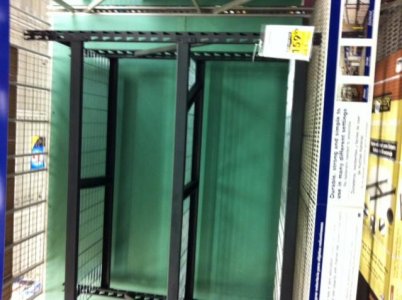
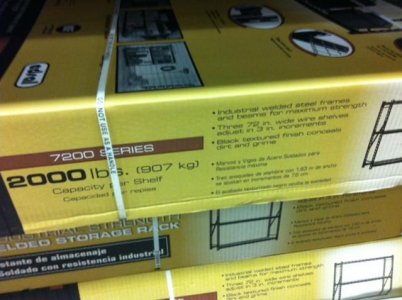
I know people have used racks like that before, but I would not do it. They are usually made in China and while they may hold, what happens if they don't? If you have put one together, you know they don't handle racking very well, the last one I built at work moved a lot with side to side force. Making a proper stand is just too easy to not do.
I am not a fan of closed loops, as Uncle stated, they offer no real advantage to properly placed water movers like a Tunze or Vortech. With my three Tunzes, at max volume I am using 92 watts to create 8700 gph, which is controllable and I can direct that flow where it is needed. Closed loops certainly can work, but the reward is not usually worth the expense. If the goal is get flow in the tank, a closed loop is normally not the best way to accomplish it. Going to all 1-1/2" plumbing will help, but even in an impossible best case scenario, the most you will get is 3600 gph, (won't happen either) and use a lot of wattage (heat) to get that, when you could get that same gph with 35 watts and set it up to vary intensity, pulse or do just about anything short of making you an English muffin. I do not want to dissuade from your plan, but rather consider the benefits vs. the drawbacks.
I am not a fan of closed loops, as Uncle stated, they offer no real advantage to properly placed water movers like a Tunze or Vortech. With my three Tunzes, at max volume I am using 92 watts to create 8700 gph, which is controllable and I can direct that flow where it is needed. Closed loops certainly can work, but the reward is not usually worth the expense. If the goal is get flow in the tank, a closed loop is normally not the best way to accomplish it. Going to all 1-1/2" plumbing will help, but even in an impossible best case scenario, the most you will get is 3600 gph, (won't happen either) and use a lot of wattage (heat) to get that, when you could get that same gph with 35 watts and set it up to vary intensity, pulse or do just about anything short of making you an English muffin.
I do not want to dissuade from your plan, but rather consider the benefits vs. the drawbacks.
I know people have used racks like that before, but I would not do it. They are usually made in China and while they may hold, what happens if they don't? If you have put one together, you know they don't handle racking very well, the last one I built at work moved a lot with side to side force. Making a proper stand is just too easy to not do.
I am not a fan of closed loops, as Uncle stated, they offer no real advantage to properly placed water movers like a Tunze or Vortech. With my three Tunzes, at max volume I am using 92 watts to create 8700 gph, which is controllable and I can direct that flow where it is needed. Closed loops certainly can work, but the reward is not usually worth the expense. If the goal is get flow in the tank, a closed loop is normally not the best way to accomplish it. Going to all 1-1/2" plumbing will help, but even in an impossible best case scenario, the most you will get is 3600 gph, (won't happen either) and use a lot of wattage (heat) to get that, when you could get that same gph with 35 watts and set it up to vary intensity, pulse or do just about anything short of making you an English muffin. I do not want to dissuade from your plan, but rather consider the benefits vs. the drawbacks.
I am not a fan of closed loops, as Uncle stated, they offer no real advantage to properly placed water movers like a Tunze or Vortech. With my three Tunzes, at max volume I am using 92 watts to create 8700 gph, which is controllable and I can direct that flow where it is needed. Closed loops certainly can work, but the reward is not usually worth the expense. If the goal is get flow in the tank, a closed loop is normally not the best way to accomplish it. Going to all 1-1/2" plumbing will help, but even in an impossible best case scenario, the most you will get is 3600 gph, (won't happen either) and use a lot of wattage (heat) to get that, when you could get that same gph with 35 watts and set it up to vary intensity, pulse or do just about anything short of making you an English muffin.
I do not want to dissuade from your plan, but rather consider the benefits vs. the drawbacks.Yeah, I love my MP 40, and am about to buy a Tunze as well. My economics are different from everyone else's though - I pay flat rate electricity and can therefore run 4x250w MH on a 150g, lots of hot pumps, and just keep the A/C at 70. I don't even need a chiller lol. I acquired the Dart for 75$ and the OM for $200, so for the price of an MP 10 I can get more flow. It's an odd situation but I think it works. LONG LIVE THE CLOSED LOOP! lol. (if only for the 1/1000 people who have flat-rate power).

MileHiReefR
New member
This was a good discussion. It has made me reconsider my own plans for a closed loop system I have been planning on a 240 gallon tank upgrade from my 125. I was thinking of having the pump under the tank in a sound insulated stand with returns tapped into six LR pillars on pcv framework that doubles as the conduit for the CL returns. I have made a list of pros and cons for my CL, it is as follows: feel free to add any I have missed. PROS...#1. No unsightly powerheads which creates a cleaner, sleaker DT look without mechanical pumps visable). #2. Less electrical cords from PHs and only 1 plugin needed. #3. The ability to centrally pump out of sight from my DT to a chiller and UV w/bypass. #4. Design freedom regarding location of CL intakes and returns to please the eye and the needs of the particular system. #5. Less heat from PHs but I guess this is debateable given the fact that a large ecternal CL pump will raise the temp slightly.
CONS...#1. High wattage consumption for large pump (hammerhead). #2. Inefficent compared to powerheads on a gph versus wattage comparison. #3. Risk of leaks in bulkheads, piping, and pump. #4. Risk of entire water movement (aside from sump return) failing if pump dies out. I guess it comes down to visual appeal VS. efficency and cost effectiveness. The initial cost of waveboxes, wavemakes, and PHs will be offset by their efficent use of watts on the monthly power bill while the low startup cost of the CL with just 1 large pump, pvc, and bulkheads will be countered by the high monthly cost of the large watt pump. rlpardue if you do not need to pay for power u should sell the Dart on ebay and buy a larger pump to make your CL more effective.
CONS...#1. High wattage consumption for large pump (hammerhead). #2. Inefficent compared to powerheads on a gph versus wattage comparison. #3. Risk of leaks in bulkheads, piping, and pump. #4. Risk of entire water movement (aside from sump return) failing if pump dies out. I guess it comes down to visual appeal VS. efficency and cost effectiveness. The initial cost of waveboxes, wavemakes, and PHs will be offset by their efficent use of watts on the monthly power bill while the low startup cost of the CL with just 1 large pump, pvc, and bulkheads will be countered by the high monthly cost of the large watt pump. rlpardue if you do not need to pay for power u should sell the Dart on ebay and buy a larger pump to make your CL more effective.
I was thinking of having the pump under the tank in a sound insulated stand with returns tapped into six LR pillars on pcv framework that doubles as the conduit for the CL returns. I have made a list of pros and cons for my CL, it is as follows: feel free to add any I have missed. PROS...#1. No unsightly powerheads which creates a cleaner, sleaker DT look without mechanical pumps visable). #2. Less electrical cords from PHs and only 1 plugin needed. #3. The ability to centrally pump out of sight from my DT to a chiller and UV w/bypass. #4. Design freedom regarding location of CL intakes and returns to please the eye and the needs of the particular system. #5. Less heat from PHs but I guess this is debateable given the fact that a large ecternal CL pump will raise the temp slightly.
CONS...#1. High wattage consumption for large pump (hammerhead). #2. Inefficent compared to powerheads on a gph versus wattage comparison. #3. Risk of leaks in bulkheads, piping, and pump. #4. Risk of entire water movement (aside from sump return) failing if pump dies out. I guess it comes down to visual appeal VS. efficency and cost effectiveness. The initial cost of waveboxes, wavemakes, and PHs will be offset by their efficent use of watts on the monthly power bill while the low startup cost of the CL with just 1 large pump, pvc, and bulkheads will be countered by the high monthly cost of the large watt pump. rlpardue if you do not need to pay for power u should sell the Dart on ebay and buy a larger pump to make your CL more effective.
Yes, this was a pretty good discussion. Uncle raised a number of good points and challenges to using closed loops, and my hat is off to him for the help.:strooper:
I think at a subconscious level I decided to do a closed loop because, frankly, it sounds fun lol. Especially with an Oceans Motions 4-way
Your list of pros sounds good. I'm not sure about the heat issue (as to whether CL pump or powerheads generate more heat). I imagine a Vortech generates practically none, but other types of powerheads probably do contribute heat. Regarding the possibility of using the CL pump to tee off to a chiller and UV, I think it's definitely a possibility. In fact, a necessary component to my closed loop system is a "drain valve" at the lowest point in the piping so that when I close the ball-unions above, I can drain water from the portion that I need to remove in order to clean the pump and the OM 4-way. You could easily use that tee-off to feed a chiller or whatnot.
Your cons seem valid as well, except on #4 (the risk of having a single point of flow-failure in case of pump failure), I think that risk may be overestimated in many systems. Besides the return pump, I personally will be using an MP 40 as well. I see their use with closed loops as complimentary. The point of water flow is to get the entire mass of water moving, and they both have their particular strengths here. Vortechs are GREAT at moving the whole body of water with their under-current and output. The closed loop is good at targeting areas where the Vortechs typically don't reach.
Since there is still some interest in this thread, I think I'll go ahead and post about my progress so far. I did a freshwater-test of my plumbing on my back patio last week and managed to do a full test of the closed loop including the Dart pump and OM 4-way. (Picture attached below).
Just to recap the design, I used a Reeflo Dart pump (bought for $75!, very glad it works lol), an Oceans Motions 4-way unit with a 1.5" intake and four 1" outputs. I plumbed with 2" pipe from the tank to the pump, then 1.5" for all the rest of the plumbing. At the end of each of the 4 "arms" I had two 3/4-inch locline outputs. The drum sequence of the OM unit is 1-2, 2-3, 3-4, 4-1, so there is always exactly two 1-inch outputs open at all times. This roughly equates to plumbing the whole thing in 1.28-inch diameter PVC (my math skills are not my forte however).
My observations are as follows:
-I will change from using spa-flex (a kind of flexible PVC) on the outputs from the OM unit and instead use hard-piping. This will cause a tad more friction loss but I can live with it in order not to block too much light.
-I plumbed the CL outputs over the top of the tank to allow for greater versatility and future modifications.
-The only thing you will see in my tank (semi-in-wall) is about 1" of locline at the top, just below the water line.
-The flow coming out of the locline was much more than I anticipated. It was more than my garden hose if that helps describe it. I plan to add a third locline output port at the end of each arm. This third output will have a ball valve attached, since most of the flow wants to go through the last output.
-If I find some way to add flow-rotators that don't cut too much flow off, I will do so in order to really get the whole mass of water moving. Currently it seems like there really aren't any worthwhile products on the market

-The intakes for the closed loop had significant suction, even with a bulkhead strainer, so I may opt to add a reverse-flow "spraybar" made out of black PVC with holes drilled in it.
-The plan is to terminate each arm on the edge of the tank, with the arm's outputs running along the rim. This is to minimize blockage of light.
-On the whole, the water was churning like a hot tub and I don't foresee needing to purchase another Vortech, although I will stay open to the possibility.
-Thanks again to Uncle and the other contributors to this discussion!:wavehand:
MileHiReefR
New member
Nice picture but it just seems so large and inefficient. After re-reading this entire post and based off Sirreal's post about the water movement of the 3 Tunze's for such low wattage, I have decided to cancel my own plans for a CLS and go with the Tunze, I cannot justify running a high wattage pump just to move the water after this discussion...
So now that my tank build is nearing completion, I thought I'd update the thread and describe what I feel are the pros and cons of the outcome of the closed loop.
I would say that I'm glad I included it in the system, but not for the reasons I had initially planned. My other circulation devices are a Mag18 return pump, one MP40, and a Koralia 4 (which will be replaced by the Chinese "WP40" once it arrives from China). Since I will have the MP40 and WP40 providing massive amounts of broad flow, I plan on using the closed loop to hit the (fairly few) spots in the tank where the flow is not ideal. For example, the corners of the overflow, the back corner behind the MP40 which would otherwise be nearly a dead zone, etc.
The cons of the closed loop:
-I haven't gotten my OM 4-way to work yet. This is my fault; I've had so many other items on my to-do list that I haven't taken the time to dissassemble it, clean it and lube it up. So I guess this "con" should really be labeled "I am lazy/preoccupied".
-The Dart is louder than I'd prefer. This may be due to a rusted fan; once the tank is "walled-in" by a contractor I think it won't be an issue.
Pros:
-The "over-the-top-along-the-sides" method of plumbing the outputs with multiple 3/4" locline outputs for each of the four CL arms; this allows for extremely flexible/versatile direction of flow. This allows the closed loop to function as an effective supplement to the Vortech and the knock-off Tunze (which I haven't tested yet but I expect it won't have quite as broad of flow as the MP40).
-Low profile. The closed loop outputs are only visible as 1-2" of locline outputs spaced around the tank. Since the 1.5" PVC "arms" travel around outside the rim of the tank, they don't block any light.
I'm pleased overall. It was a lot of work, but I think I have a kind of guilty pleasure in over-engineering aquarium DIY projects lol. Fun stuff.
I would say that I'm glad I included it in the system, but not for the reasons I had initially planned. My other circulation devices are a Mag18 return pump, one MP40, and a Koralia 4 (which will be replaced by the Chinese "WP40" once it arrives from China). Since I will have the MP40 and WP40 providing massive amounts of broad flow, I plan on using the closed loop to hit the (fairly few) spots in the tank where the flow is not ideal. For example, the corners of the overflow, the back corner behind the MP40 which would otherwise be nearly a dead zone, etc.
The cons of the closed loop:
-I haven't gotten my OM 4-way to work yet. This is my fault; I've had so many other items on my to-do list that I haven't taken the time to dissassemble it, clean it and lube it up. So I guess this "con" should really be labeled "I am lazy/preoccupied".
-The Dart is louder than I'd prefer. This may be due to a rusted fan; once the tank is "walled-in" by a contractor I think it won't be an issue.
Pros:
-The "over-the-top-along-the-sides" method of plumbing the outputs with multiple 3/4" locline outputs for each of the four CL arms; this allows for extremely flexible/versatile direction of flow. This allows the closed loop to function as an effective supplement to the Vortech and the knock-off Tunze (which I haven't tested yet but I expect it won't have quite as broad of flow as the MP40).
-Low profile. The closed loop outputs are only visible as 1-2" of locline outputs spaced around the tank. Since the 1.5" PVC "arms" travel around outside the rim of the tank, they don't block any light.
I'm pleased overall. It was a lot of work, but I think I have a kind of guilty pleasure in over-engineering aquarium DIY projects lol. Fun stuff.
coralreefdoc
New member
Yeah, I love my MP 40, and am about to buy a Tunze as well. My economics are different from everyone else's though - I pay flat rate electricity and can therefore run 4x250w MH on a 150g, lots of hot pumps, and just keep the A/C at 70. I don't even need a chiller lol. I acquired the Dart for 75$ and the OM for $200, so for the price of an MP 10 I can get more flow. It's an odd situation but I think it works. LONG LIVE THE CLOSED LOOP! lol. (if only for the 1/1000 people who have flat-rate power).
Your power isn't flat rate for the rest of the World ...
It undoubtedly comes at a much higher price !
Just because you can afford to abuse the situation, by running electrically inefficient, doesn't mean that you should. Aside from just your tank
Yes, I know. It's called the "free rider dilemma" in economics and is also the reason why people should pay for their own health care. Also, I do pay $600 per month for the electric bill, which is more than I would if I were billed per kwh. In any case, keep the Intro to Philosophy stuff out of the thread. Thanks.
Anyway, I think paying the extra money for the closed loop pump to run rather than using powerheads would be worth it for me even if I paid per kwh. Frees up space and is a little more versatile.
Anyway, I think paying the extra money for the closed loop pump to run rather than using powerheads would be worth it for me even if I paid per kwh. Frees up space and is a little more versatile.
Last edited:

Aquatron
Refugium pat.#D414,242
The reason i run a close loop system is because i can control what kind of flow and where i want it. Using 12 1" outlets with gate valves powered by four pumps gives me endless flows for my system and allows adjustments as corals grow and aquascape changes.
While some like powerheads and feel they are the best option others like me feel the same with close loop set ups. To me a well thought out build which includes the aquascape layout close loop is the only way to go
While some like powerheads and feel they are the best option others like me feel the same with close loop set ups. To me a well thought out build which includes the aquascape layout close loop is the only way to go
Similar threads
- Replies
- 0
- Views
- 129

- Replies
- 11
- Views
- 197

