
Concern over two corals

TtoThe3

New member
Hey everyone! I'm very new to this hobby and I have a few growing concerns over a few of my corals..

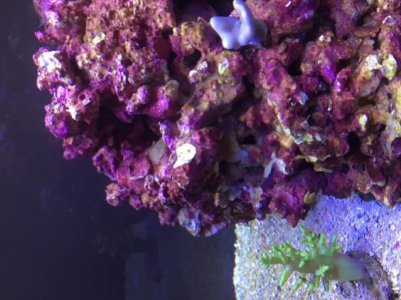
As per the image attached, my torch coral on the right has been "closed" like that for a little over a day now, and that seems unusual.

On the bottom left (honestly not sure what type of coral that is), has been "shrunken" and not outstretched for over 3 days, it hasn't really changed shape at all. Usually it's stretched out or completely shrunk into itself for some period of time, or any length in between. That thing is pretty awesome..

Now, the whole setup I have is a BIOTA Aquarium. It came with the live rock, live sand, and 4 corals, 2 Clownfish and a Rainford Goby.

Some specifications of the tank (copy & pasted from website) : The Biota Aquarium includes a 16w full spectrum marine LED light. Biota's LED light is a 16 watt output, 1383 lumens. Biota uses a submersible pump with a flow rate of 500 gallons per hour (GPH). Biota's heater is 100 watts. It is needed to maintain the water temperature above 74 degrees to maintain healthy, happy marine life.

Also, just short of an hour ago I used a API Saltwater Mater Test Kit. The only results I have are as follows :
pH between 8.2 - 8.4.
Ammonia - 0ppm.
(NO2-) -0 ppm.
(N03-) - 0 ppm (clear in color)
Temperature of tank around 78 degrees Fahrenheit.

I'm not sure if the corals are not an a ideal location as far as distance from the light or good flow of water or anything of the sort. Please, any advice would be helpful. :fun2:
 

Attachments

  • IMG_1159.jpg
    IMG_1159.jpg
    53.1 KB · Views: 3
I'm not seeing a torch coral in your picture. I see a unhappy leather coral on the right, and what may be a green sinularia on the left. I'm not entirely sure, but I think your lighting is probably a bit on the underpowered side for corals, even softies like you have.

How old is your tank? You might consider a better set of tests (API might be ok for basic cycle testing) I prefer Salifert for their ease of use and repeatability.

What else is in the tank? Are you running carbon? Soft corals are known to release turpines into the water, especially when stressed that can adversely affect other corals who will then release their own chemical reactants and create a chain reaction of nastyness. Carbon, even if it's just in a bag someplace getting some flow, will help with that quite a bit. Water changes will help to dilute things as well.
 
Oh okay, I was under the impression that was a torch coral. Excuse my ignorance.. So an update on the leather coral, it opened up last night, shortly before I turned the light off. It's shedding almost it looks like.. A clear to brownish film coming off of it.. A bacteria infection or something perhaps?

My tank is a little over 3 months old now. The fish have only been in the tank for about a month and a half now. I understand that my tank is still very young. As far as residents in the tank, I have 2 clownfish, a rainford goby, 2 astral snails and 2 cortez crabs I believe they are called. Also, there is two other corals.

Yes, I have a carbon filter I replace once a month in it. Also I do a 1 gallon water change using RO water and add 1/3rd cup of salt to it each time (per the video on Biotaaquarium.com)

I'll look into the Salifert test, thank you!
 
No worries at all!!! Corals get incorrectly ID'd all the time. It is especially difficult because what might be a common name for a given coral in one locale can be something else entirely somewhere else. The sometimes comical names sellers make up to justify stupid prices on some (super ultra rare)(NOT) corals just makes it that much harder.

It sounds like your leather is just shedding a mucous layer. It won't surprise me at all if it is just fine in another day or so. It took my wife months to believe that my shriveled up Elegance coral wasn't dying but instead just expelling waste. She still has the occasional panic attack when something changes, which, btw, is just fine with me - sometimes I get busy and don't pay close enough attention.

What specific gravity is your water testing at? Adding 1/3 cup of salt to a gallon of water and hoping it's correct is a recipe for disaster. At the very minimum a hydrometer (checked against a refractometer) or better yet a properly calibrated refractometer is required to make sure the s.g. stays at or very near 1.024 - 1.026.
 
Haha yeah, I really wasn't sure what they were so thank you again! I checked into that green sinularia, and I think that is exactly what I have in the tank. It's a pretty neat coral. Hope it starts doing better soon! The leather coral is looking much better, you are right!

I just tested my water yesterday and the hydrometer said 1.023.. and I checked it now and it said 1.020.. right on the edge of the green area of the hydrometer.. I really don't know how much I trust it, and I think it my salinity must be on the low side if those two measurements are still quite low..

Yeah.. the video on the website where the tank was purchased says do a gallon water change once a week and add a 1/3rd cup to the water being mixed in.. I'm just really following directions and it seems that my salt content is lower than it should be.. which is pretty frustrating.

I don't have a refractometer yet, and there is not one available in stores near me.. Should I take some water out and add some more salt? I just am not sure how much to add.. It's only a 13.5 gallon tank.
 
This hydrometer is wildly inaccurate it seems, or I am that unskilled with it ha. Now its saying it super low.. into the black region..
 
You need to bring it up slowly. Do that by replacing evaporation loss with fresh salt water mixed to 1.025. You will bring the water up over several days that way - it will be much easier on your livestock than a sudden increase would be. Most of our critters will be able to survive a sudden drop of .010 or more but even more will do very poorly if it is raised that much in a short time.

You can use your hydrometer, but I strongly suggest calibrating it by using a sample of known s.g. . Your LFS should be happy to help with that. If they aren't, find a new LFS! It may very well be off a bit. Most are a little, but you will know how far off and can mark it accordingly. I have 2 hydrometers that I use that are both more than 25 years old. The markings on one read about 0.001 high, the other about 0.003 low. and have since day 1.

You can get a refractometer online for $35 and up. If it is calibrated properly, the $35 one performs as well as the $100 unit. Mine is one of the $35 crowd.
 
Yeah, Ill definitely be getting a refractometer soon.. seems like a must. I appreciate the help billdogg, a lot. This is a very new hobby to me, and it's so much to learn.
 
To use the hydrometer, I fill and dump it several times in the tank water to make sure there is no dried salt crystals that might impede the swing arm. After several quick rinses, fill it again and then tap it on a hard surface a couple times to dislodge and little air bubbles that might be trapped. I find both of mine to be extremely consistant, if off a bit from what my refractometer reads. As I said, however, once you know where it actually reads, it is a very simple device to use.

The bottom line with salinity is that the exact number is less important than it being consistent as long as it falls someplace in the range of 1.024 - 1.026. I try to keep mine at 1.024-.025 so that the daily loss due to evaporation doesn't make it go too high.

Many people rely on a ATO (automatic top off) to keep the water constant. With a smaller tank like yours the swing in s.g. can be more significant. If you were to lose 1g to evaporation that's almost 10%. If I lose 1g in my 120 (~140g total with sump, that's less than 1%. Personally, I would just make a habit of adding whatever water is needed by hand, at the same time each day.

While on the topic of top off water - are you using RO/DI or at least distilled? Tap water is notorious for bringing in unwanted things - just because you can drink it doesn't mean it's good for your tank! I used tap for over 20 years, and battles nutrient issues in the form of algae blooms way too much, especially in late summer or after big rains. Turns out that the Nitrates and Phosphates would spike and trigger the issues. Since switching to RO/DI, those problems have gone away. Tap can also have copper and other heavy metals in it that humans can tolerate, marine life, not so much (think Flint, Michigan)
 
Back
Top