Cryptocaryon treatment for goby, dartfish and gramma

Biodork

New member
Hello everyone,

I have a royal gramma, dartfish and an orange spotted shrimp goby currently in a quarantine tank. The gramma has been flashing and has white spots on its fins and body, along with some loose scales. I've seen a couple of white specks on the dartfish. No symptoms on the goby. All fish are eating. Would you recommend copper or hypo salinity as a treatment for these specific species?
 
I would do hypo over copper any day, though with only 3 rather small fish you may also consider TTM.
TTM could be combined with hypo to save saltwater, reduce stress, increase oxygen saturation and act as an additional safety layer.
 
TTM would work. If you want to reduce SG to about 1.017 it is beneficial but going down to the therapeutic value of 1.009 has no additional value with tank transfer.
 
What's wrong with copper in this situation?

Copper is just plain wrong in any situation - it's a poison that weakens or outright disables the fish's immune system which may open the door to all kinds of diseases, some way nastier than ich.

Copper is also only effective against ich which can be treated much better with TTM, CP or (with some restriction) hyposalinity.
 
copper is just plain wrong in any situation - it's a poison that weakens or outright disables the fish's immune system which may open the door to all kinds of diseases, some way nastier than ich.

Copper is also only effective against ich which can be treated much better with ttm, cp or (with some restriction) hyposalinity.

+1
 
Copper is just plain wrong in any situation - it's a poison that weakens or outright disables the fish's immune system which may open the door to all kinds of diseases, some way nastier than ich.

Copper is also only effective against ich which can be treated much better with TTM, CP or (with some restriction) hyposalinity.


Why is copper the most popular method for treatment of ich then? Is Cupramine any gentler? Also most medicines are poisonous at a certain dose and therapeutic at others.

Is CP really much better for the fish? Where can one acquire cp and what testing equipment is necessary to monitor/use it. I've always been uncomfortable with the idea of copper but just can't do ttm due to my work/travel schedule. Also is CP proven to treat ich "better" ?

Is hypo less maintenance than ttm? I'm gone 3 days a week every week so I need something that my wife can monitor/not need to do much at all. She has zero experience and will actually be gone those same 3 days occasionally.

In 2 months max I will be working from home every day so I will be able to use any method however. That may already be the case by the time my tank finishes cycling. Just trying to learn about all methods as much as possible. TTM seems to be a popular choice with you vet reefers, can you guys both please explain to me your full QT protocols?

I will have a pair of a. ocellaris, midas blenny, firefish, chalk bass, rainford goby or green clown goby, and 2 Cleaner shrimp. (Too much for 50b?)

Plus tuxedo urchin and bunch of snails.

Also do you QT your CUC? If so how?

Is dipping corals in coral rx pro sufficient?

Any help/gameplan would be greatly appreciated!

Thanks,

Big J
 
Last edited:
Copper, like many nonsense it's deeply rooted in tradition and how things were done in the old days. But today we know better and have less toxic ways to clear fish of cryptocaryon.
TTM is probably the best and suitable for all fish, but depending on the fish and required tank size it can be labor intensive and a bit costly (you may go through a lot of water).
Hyposalinity is in my opinion easier and cheaper but it leaves a slight risk that certain strains of ich can survive.
CP is effective if done right but some fish (seahorses, pipefish, some wrasses) don't tolerate it. Most importantly, CP treats a variety of parasites: ich, velvet, uronema, likely also brook and possibly more. Some inverts like crabs and shrimp can handle it, but snails and all corals won't. If you want to try it: New Life Spectrum Ick-Shield Powder is CP and available without prescription from Amazon.
 
Copper, like many nonsense it's deeply rooted in tradition and how things were done in the old days. But today we know better and have less toxic ways to clear fish of cryptocaryon.
TTM is probably the best and suitable for all fish, but depending on the fish and required tank size it can be labor intensive and a bit costly (you may go through a lot of water).
Hyposalinity is in my opinion easier and cheaper but it leaves a slight risk that certain strains of ich can survive.
CP is effective if done right but some fish (seahorses, pipefish, some wrasses) don't tolerate it. Most importantly, CP treats a variety of parasites: ich, velvet, uronema, likely also brook and possibly more. Some inverts like crabs and shrimp can handle it, but snails and all corals won't. If you want to try it: New Life Spectrum Ick-Shield Powder is CP and available without prescription from Amazon.
If I qt the above mentioned fish with CP and then prazipro + observation. Is that sufficient? Or do you do formalin just incase on clowns for brook
 
Copper, hyposalinity, and CP only treat the infectious life cycle stage of ich which emerges in a variable time frame from the back end of the cryptocaryon irritans life cycle. That means for theronts emerging in a delayed fashion, the treatment period must catch those by being long enough. TTM eliminates cryptocaryon irritans by working on the highly deterministic front end of the life cycle by not allowing the infectious stage to emerge. Twelve days and you are done. Prophylactic chemical treatment to prevent cryptocaryon irritans is not the way to go. But everyone is free to do what they think best.
 
Last edited:
Copper, hyposalinity, and CP only treat the infectious life cycle stage of ich which emerges in a variable time frame from the back end of the cryptocaryon irritans life cycle. That means for theronts emerging in a delayed fashion, the treatment period must catch those by being long enough. TTM eliminates cryptocaryon irritans by working on the highly deterministic front end of the life cycle by not allowing the infectious stage to emerge. Twelve days and you are done. Prophylactic chemical treatment to prevent cryptocaryon irritans is not the way to go. But everyone is free to do what they think best.

Interesting. I am currenlty unable to do TTM. How long would I have to quarantine with CP or hypo? Is hypo less effective?
 
Even with all the chemical treatments you should treat in an HT and do at least one transfer (or thorough tank sterilization) each week. Otherwise you may need to treat way too long.
If you treat with chemicals inside the infected DT you need to treat for up to 11 weeks, which I deem way too long to be safe for the fish.

Hyposalinity is highly effective and works on preventing the protomont to encyst to create new infectious stages. It does however not affect those that are already encysted by the time you take the salinity down.
The only uncertainty with hyposalinity comes from two Cryptocaryon strains found at Taiwanese fish farms that turned out to be able to handle way lower salinities than safe for reef fish. I don't know if these have made it into the hobby trade but my guess would be not.
So if the infection isn't too progressed I would still give hyposalinity a shot. (in a hospital tank). If it turns out to be ineffective you can still instantly switch to TTM without the need of raising the salinity.

BTW: all you need for TTM are two plastic containers, a heater, one air pump and two airlines. Further you need a tank that is big enough to fit one of the containers in (or both).
The heater goes into the tank which is filled with freshwater and one of the containers to hold the fish go into the tank and is aerated .with the air pump. This setup will minimize the equipment that needs to be sterilized to just the container and the airline.
 
Even with all the chemical treatments you should treat in an HT and do at least one transfer (or thorough tank sterilization) each week. Otherwise you may need to treat way too long.
If you treat with chemicals inside the infected DT you need to treat for up to 11 weeks, which I deem way too long to be safe for the fish.

Hyposalinity is highly effective and works on preventing the protomont to encyst to create new infectious stages. It does however not affect those that are already encysted by the time you take the salinity down.
The only uncertainty with hyposalinity comes from two Cryptocaryon strains found at Taiwanese fish farms that turned out to be able to handle way lower salinities than safe for reef fish. I don't know if these have made it into the hobby trade but my guess would be not.

Well, that is not the only uncertainty. There is also the problem of execution error.
 
Even with all the chemical treatments you should treat in an HT and do at least one transfer (or thorough tank sterilization) each week. Otherwise you may need to treat way too long.
If you treat with chemicals inside the infected DT you need to treat for up to 11 weeks, which I deem way too long to be safe for the fish.

Hyposalinity is highly effective and works on preventing the protomont to encyst to create new infectious stages. It does however not affect those that are already encysted by the time you take the salinity down.
The only uncertainty with hyposalinity comes from two Cryptocaryon strains found at Taiwanese fish farms that turned out to be able to handle way lower salinities than safe for reef fish. I don't know if these have made it into the hobby trade but my guess would be not.
So if the infection isn't too progressed I would still give hyposalinity a shot. (in a hospital tank). If it turns out to be ineffective you can still instantly switch to TTM without the need of raising the salinity.

BTW: all you need for TTM are two plastic containers, a heater, one air pump and two airlines. Further you need a tank that is big enough to fit one of the containers in (or both).
The heater goes into the tank which is filled with freshwater and one of the containers to hold the fish go into the tank and is aerated .with the air pump. This setup will minimize the equipment that needs to be sterilized to just the container and the airline.

Haha ok well then how long does it take if you do one transfer each week with CP? also what is HT?

I can't do ttm due to travel, it's not a matter of equipment or cost. However I eventually will be able to do so and like your method. Here is the question though, is TTM 100% effective regardless of the stage the fish arrives in? Also how often are transfers necessary? If I could do every 4 days I could do TTM from the get go. However I would be too concerned to leave fish in a small container like that with no filtration for that long.
 
Last edited:
Well, that is not the only uncertainty. There is also the problem of execution error.
Uncertainty basically makes hypo QT too risky IMO. Do it right or not at all.
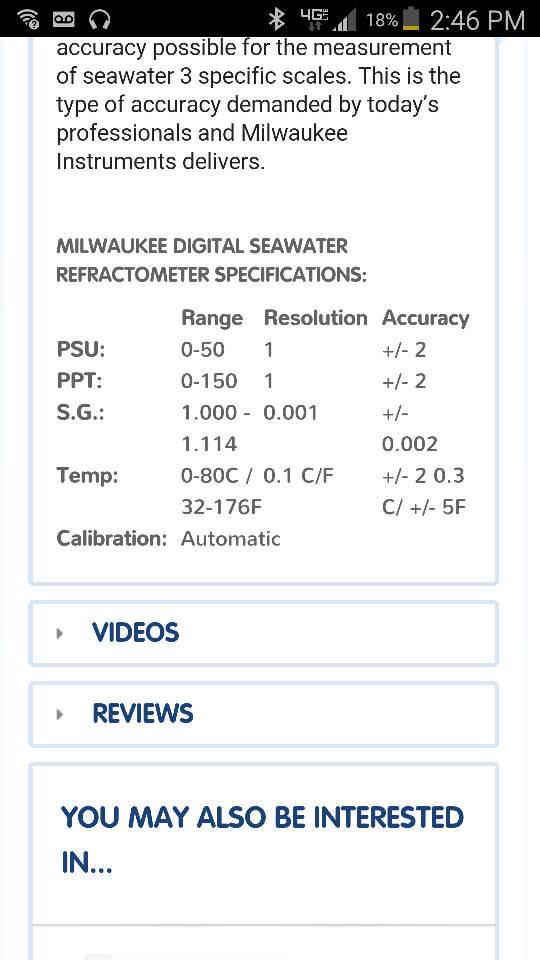
I do have a digital refractometer[emoji6] , but the uncertainty regarding certain strains/stage of the cycle is a concern for me.

How do you do TTM snorvich? As far as schedule/equipment?
 
Uncertainty basically makes hypo QT too risky IMO. Do it right or not at all.
I do have a digital refractometer[emoji6] , but the uncertainty regarding certain strains/stage of the cycle is a concern for me.

How do you do TTM snorvich? As far as schedule/equipment?

What is the standard error of the mean for the digital refractometer?
 
Haha ok well then how long does it take if you do one transfer each week with CP? also what is HT?

I can't do ttm due to travel, it's not a matter of equipment or cost. However I eventually will be able to do so and like your method. Here is the question though, is TTM 100% effective regardless of the stage the fish arrives in? Also how often are transfers necessary? If I could do every 4 days I could do TTM from the get go. However I would be too concerned to leave fish in a small container like that with no filtration for that long.

Please read the TTM sticky for the answers to all of your questions. It makes no sense to reiterate here.
 
You have that problem with every method, even TTM.

That is clearly true. TTM can be messed up but the variables are more controllable. Hyposalinity as a treatment depends on factors such as the standard error of the mean in the refractometer being used as well as auto top off methods to control salinity.
 
What is the standard error of the mean for the digital refractometer?
c61fa471c47e5c850568514c077cf601.jpg
 
Back
Top