
Cupramine dosage + water change CONFUSION... Again.

fixingstill

New member
I wrote this to Seachem tech support. Maybe you can answer before they will.

I understand cupramine remains in solution (like salt then) and I should ramp up the dosage slowly (2 step?) to reach the final concentration of 0.5mg/L and keep it there for 14 days. Your instructions says 1mL per 10.5G on day 1. What concentration does that give us? According to a thread on RC (http://www.reefcentral.com/forums/sh....php?t=2284605), it is 0.25mg/L. Please confirm.
Then it says wait 48 hrs and repeat. That will double up the concentration to 0.50mg/L, right? Then, assuming we do not do any water change (but we have to), we just leave it for 14 days, right?
Instructions then says "Do not redose without testing (MultiTestâ„¢: Copper). " Why would anyone redose if it remains in solution? Maybe you should explain how we should handle it when we do water change?

If we do water change when the QT is already in final concentration of 0.50mg/L, then for every 10.5G water we take out, we add 2mL (40 drops) to the new SW, right?

The way you use mL, mg/L, and 20 drops (and sometimes 16 drops on some old bottles) could really confuse so many people. I for one had to spend an hr online to research.

Now, my BIG question:
I have a newly setup 10G QT but it is filled up to about 7G of freshly mixed salt water. The tank has NO filtration at all.
I added 14 drops per instructions (20 /10.5 * 7 = 13.33) and I waited for 30 mins and did a copper test (using your kit) - it is now 0.5 mg/L - already the final concentration. Why?
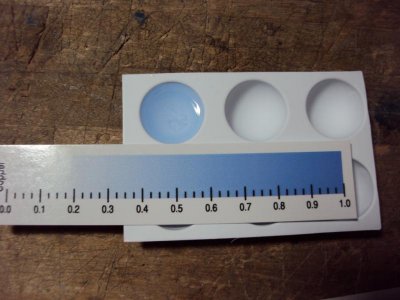
 
attachment.php


I hate reading color chart. My wife and my kids voted for 0.5.
 

Attachments

  • DSC03879.jpg
    DSC03879.jpg
    51.7 KB · Views: 5
Copper won't evaporate, but can be absorbed by some things, such as carbon or liverock, which would change the levels in your water. (One good reason to use PVC for decor in QT!)

~Bruce
 
Cooper is dangerous for fish and very stressful to the user of cooper as proof this discussion just started. Over 0.5ppm can become toxic to the fish and under 0.5ppm can be ineffective. Cooper can mask other diseases/parasites. So basically, once in your DT, those parasites will show their ugly face and your DT is now infected. There are other safer options and guaranteed treatments for fish.

Formalin can be used as a preventative bath/dip and for brook.
1. Ich- Tank Transfer Method (TTM)
2. Flukes- Prazi-Pro
3. Velvet- Chloroquine phosphate (CP)
 
I have a newly setup 10G QT but it is filled up to about 7G
of freshly mixed salt water. The tank has NO filtration at all.
I added 14 drops per instructions (20 /10.5 * 7 = 13.33) and I waited for 30 mins and did a copper test (using your kit) - it is now 0.5 mg/L - already the final concentration. Why?

it looks closer to 0.4. (did you compare to the test sample, which i found comes out pretty dark) it sounds like you're trying to be as concise as possible so perhaps measuring the exact amount of water you're treating will help with that.
see what it reads after the 2nd dose.

also, cupramine states anything 0.8 higher to be toxic. so there is some room for error on the high side it sounds like.
 
I recently finished my 14-day cycle. After my initial doses over 48 hours I test my water and was at .5. A week later I did a 50% W/C and added 10 more drops (10-gal QT), tested again and was at .5. Last week did another 50% and will continue to do so weekly until they go back in the DT around mid Feb. By then all the copper will be out of the water.

Contrary to all the misgivings I've read about Cuperamine I never had any problems. The one sick fish that had Ich looks good now and all the healthy fish all tolerated it fine too.
 
Just so you know, Seachem has not answered my questions (first post) yet. I actually sent it twice (thru their website contact page.) Are they trying to avoid this? I will email them directly and reference this thread.
 
I have used Cupramine on about 7-8 patches of fishes (5 fishes in each patch) following the instruction on the bottle without a problem. I do many water changes (5g every 3-5 days) and I up the Cupramine accordingly per instruction. For Butterflies, I stayed at .35 and for Tangs, I kept the Cupramine at .5 for 3 weeks.

I don't have their test kit and I rarely used one. I have Salifert and I used it probably couple of times when I doubted myself on how much I dosed.

Seachem is usually very good at answering emails. I think you will be OK, if you follow the instructions.
 
Per instruction, 3.8 drops per gallon to raise the concentration to 0.5. For 7g, you need 26 drops total approximately. You can dose 13 drops on day one, and 13 drops on day 3.

When you do water change, add 3.8 drop per each gallon of water.

I don't want to confuse you, but also, you can dose over 3 days: 8 drops day 1, 9 drops day 2, and 9 drops day 3.

I hope that helps,
 
Thank you. That helps and I actually figured that out after some research. Their instructions on the bottle is just not straightforward and I bet there are people who get confused about ml, then mg/L and some are holding bottle that says 16 drops, not 20. I just wanted to ask them directly and get an straight answer from them.
 
They replied back:

Seachem Support 10256 (Seachem Laboratories)
Dec 16, 17:55 AST

Hello Derek,
Thank you for your email. You are correct! Initial dose brings the copper concentration to 0.25 mg/L and the second dose brings the concentration to 0.5 mg/L. Assuming all goes as planned, it should stay there for a full 14 days.
Basically, we recommend checking the copper after the first dose, then after the second dose, and doing a third dose if necessary. The dosing should be according to the actual volume of water in the tank, not to the volume of water that the tank could hold, were it empty of decorations and substrate. Most fish keepers don't actually know this volume, so it is sometimes necessary to do a third dose. Alternately, porous surfaces will sometimes absorb a bit of the Cupramine and muck around with the final concentration (don't worry - this is temporary, and will come right back out once you add some Carbon or Cuprisorb. You might also get an unusually high copper reading if you had, in the past, done a copper treatment with a different copper medication.
You are correct - adding 2 mL of Cupramine to 10.5 g of water will return the copper concentration to 0.5 mg/L in the new water.
We changed the drop count because while drop counts are useful, they are not actually an accurate unit of measure. A mL is anywhere between 16 and 20 drops, and customers were calling us to say "your directions are wrong and my copper is too low" when our directions read 16 drops. We changed around the recommend drops and we don't get those calls any more.
mg/L is the correct scientific term to describe concentration of copper in water. For reference, mg/L is about the same as ppm for our purposes.
If you're ever in doubt as to the reading your test kit is giving you, it can be a good idea to do a quick reference test. We have a reference sample in the kit that ha a reading of 0.5. If the reference sample turns out right, then odds are good that you happen to be a customer whose drops are exceptionally large, and the copper concentration got up to 0.5 mg/L on the first try.
Thank you,
Seachem Support
10256

And here is their instructions on the bottle in case you wonder how they have it written:

If the bottle has a dropper cap, use 20 drops (1 mL) per 40 L (10.5 US gallons) the first day, wait 48 hours, then repeat. On non-dropper caps, each inner ring is 1 mL. In freshwater use half dose. Final copper concentration is 0.5 mg/L (0.25 mg/L in freshwater). Leave at this concentration for 14 days. Do not redose without testing (MultiTest™: Copper). If tank has ever been treated with an ionic copper (e.g. copper chloride, sulfate or citrate), test copper level after initial dosing. Although most fish tolerate Cupramine™ to 0.8 mg/L, it is not advisable to exceed 0.6 mg/L copper.
 
Back
Top