DIY PVC Overflow on Nuvo 16 Problems

Yellow Eyes

Member
Here is background information:

I recently bought a Nuvo 16, and decided that I wanted to add a 10 gallon sump below to add some water volume, a refugium, and to keep the skimmer out of the display tank.

I debated drilling or building the DIY Overflow, and I figured it was cheap enough at first to attempt the PVC Overflow (the one with two U bends, one in the aquarium, one out, to a T).

I tested it before putting it on my tank and it worked great. I then filled my tank with fresh ro/di water to test everything, and it was working great. I would leave it off overnight and the siphon would hold, etc etc.

I turned it all off to go home for the labor day weekend, and when I came back, the siphon still held.

But now here is the problem:

While the siphon held, the aqua lifter pump I'm using to draw air out (in case), has gone from sucking out water, to consistent amounts of air. While the overflow does still work, the sump level fluctuates to where I get concerned that the return pump (Ehiem Compact 2000) will draw air.

The stand pipe above the T is also gurgling a lot more than it was.

I've triple checked that the siphon hose was sealed (super glue), everything is level, the two U bends are at the same level etc.

Does anyone know what might cause air to get into the system constantly like that?

I know a lot of people will say to drill, and I've only seen a couple posts about Nuvo 16's being drilled, does anyone know if its possible? It is basically 1/4" glass, will that be able to maintain its integrity if I drill 1" bulkheads say halfway down?

Thanks a lot!
 
I did the same thing with my bc29 (and had the same issues) and I just broke down and ordered a glass-holes.com overflow. I am overly happy with having a drilled overflow and they have an awesome product. Not sure if you have the option to drill the tank but I worry less and this over flow is super quite
 
DIY PVC overflows don't work as advertised, and will never work as advertised. They are a waste of even the cheap cost they are to build. Save the money toward a good overflow system, which in most cases you have to build yourself. Commercial examples are all over-rated as well, unless you run them well under the flow rates you desire. (glass-holes overflows are way over-rated as well.)
 
What style of PVC overflow did you go with? There are various ways that air can be introduced into the siphon, a small leak where the air hose goes through the PVC, the PVC joints need to be cemented with a good amount of solvent or they can let air in, or there could be bubbles that the siphon is pulling in.

A properly made siphon can be quite reliable, and when done right it wont fail.

Can you post pictures of your overflow? It may help to assess what the problems are
 
What style of PVC overflow did you go with? There are various ways that air can be introduced into the siphon, a small leak where the air hose goes through the PVC, the PVC joints need to be cemented with a good amount of solvent or they can let air in, or there could be bubbles that the siphon is pulling in.

A properly made siphon can be quite reliable, and when done right it wont fail.

Can you post pictures of your overflow? It may help to assess what the problems are

A properly made siphon is absolutely reliable, but not fool proof—as it can fail: by becoming plugged. However, a DIY pvc overflow is not a siphon, (siphon does not allow air into the line) and it is not even an overflow. It is nothing more than an open channel drain (read durso,) with NO overflow; altering the method or location of the air entering the line, has no relevance on the performance of the drain.

The DIY pvc overflow, irregardless of design, is a very low flow device, that is easily overcome by common flow rates used in marine systems. They cannot be made to perform outside their limitations, provide little to no surface skimming, will suck in more air if it does, and the physics cannot be beat. If you watch the videos carefully, you will notice they are using half inch pipe, and a little trickle of water flowing into the pipe...they don't work as advertised.

When faced with the no drill option, the only reasonable solution is to purchase an HOB overflow. If solutions for drains were actually as simple as a DIY pvc overflow, we would not have systems such as BeanAnimal's design, which IS a siphon system.
 
Mpy I will try and post pictures later, but I have thought of how air could be getting in, I have a rather large amount of glue covering the check valve, and I also put super glue around all the connections thinking air might be getting in that way, so unfortunately it may be coming from the intake itself?

uncleof6, I am starting to see why all the other threads I read trying to find a solution to my problem (before I broke down and decided to ask), lose the diy overflow and either drill or get a hang on the back. I honestly would love to just drill it, but I am concerned about the integrity of the glass if I do.
I was thinking of doing a herbie style overflow, probably one inch pvc to match/save what I can of the pvc overflow. I would probably drill the main siphon line halfway up the tank (around 7 inches) just left of center and then drill the emergency line a few inches higher on the right side of center. Will the 1/4" glass be able to support all the weight of water against it after drilling? (since the Nuvo16 has the back overflow chamber). I'm mainly worried about the siphon as there will be 7 inches of water below it plus maybe 5 or so above it that is tuned to the emergency...(about 3.7 gallons roughly calculated in the back chamber at that height).

Thanks for all your help.
 
If you run a PVC siphon in an overflow box, or pipe of some method, you do not have the problems that are inherent with trying to use 1"-3/4" pvc for surface skimming.

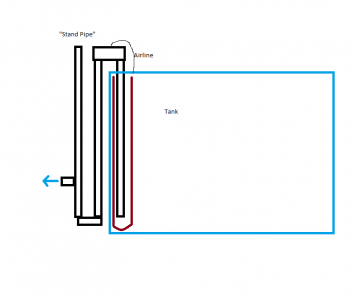
A siphon can have air flowing through it so long as it does not cause a large enough pocket of air to cause the suction to break. Herbies or Bean Animals siphon systems can suck air at times if they are not properly adjusted. its just how it works. If you do not want to call what I made a DIY PVC Overflow, go ahead and come up with a different term for it. but it works as an adjustable flow rate siphon. If runs perfectly fine from 150 gph to 400 gph, and its 1" pvc.

You do not have to get a commercial option or drill your tank to have a reliable siphon. Most people greatly prefer drilled tanks because they look far sleeker and can more easily have extra redundancies. However, if you take the time to properly design a PVC overflow it can work just as well.
 

Attachments

  • Siphon.png
    Siphon.png
    5.7 KB · Views: 13
If you run a PVC siphon in an overflow box, or pipe of some method, you do not have the problems that are inherent with trying to use 1"-3/4" pvc for surface skimming.

A siphon can have air flowing through it so long as it does not cause a large enough pocket of air to cause the suction to break. Herbies or Bean Animals siphon systems can suck air at times if they are not properly adjusted. its just how it works. If you do not want to call what I made a DIY PVC Overflow, go ahead and come up with a different term for it. but it works as an adjustable flow rate siphon. If runs perfectly fine from 150 gph to 400 gph, and its 1" pvc.

You do not have to get a commercial option or drill your tank to have a reliable siphon. Most people greatly prefer drilled tanks because they look far sleeker and can more easily have extra redundancies. However, if you take the time to properly design a PVC overflow it can work just as well.

Here is the thing, what you have is a DIY PVC overflow—in a box...it is NOT a siphon, by any definition of the word however. A siphon, has no air in it, nor is air allowed to enter at any point from the water inlet, the the water outlet. It is still an open channel no different than a durso standpipe, other than where exactly the air enters, and very much like the noisy drains in your residence.

The physics are what they are, and the physics say that at the flow rates you are describing, this device will be everything but stable, and quiet. You cannot beat the physics; I suggest you put a flow meter on the system and check your estimated flow rates... the difference between a DIY pvc overflow, and the siphon system designs, are vast. I spent far too much time building and testing various designs, and some that can't be found on forums, yet ...even. There is no way, except at very low flow rates, that device will work as well, or well enough, as the siphon systems... they do not work as advertised... and in most cases, an HOB overflow will be a vast improvement :)
 
We need to be careful that we are talking about the same siphon.

How a HoB Overflow Works:
overflow-dynamic-labeled.gif


The u-tube actually contains a siphon and this is what allows the water to get from the inside of the tank to the outside. However, because of the need to keep both ends of this siphon tube underwater, there is an air break in the external box. Now some HOB boxes have two drains in which case it would be possible to introduce a Herbie setup with one of those two drains being controlled by a gate valve to be full of water (a siphon) while the other runs dry. However, most HoB overflows are just not designed to handle quite that much flow.

The problem with a PVC siphon tube is the elbows/tee all have very sharp corners which introduce a large amount of resistance to flow. If you look at a commercially available u-tube you will note that it is one smooth curve. This minimizes turbulence, allowing the water to push any bubbles that form out of the tube thus helping to maintain that siphon. This flushing of bubbles is one reason adding a second u-tube to an existing HOB overflow could cause trouble as the water in each u-tube is only moving half as fast, allowing bubbles stay in the top of the tube and grow.

A siphon drain and a siphon overflow aren't quite the same. They use the same overall physics of no air in the water but they are used to accomplish two different jobs in our systems.

Hope that clarifies things.
 
From Google:
si·phon
noun: siphon; plural noun: siphons; noun: syphon; plural noun: syphons

a tube used to convey liquid upwards from a reservoir and then down to a lower level of its own accord. Once the liquid has been forced into the tube, typically by suction or immersion, flow continues unaided.

How is what I have not the definition of the word above?

A siphon works with any non compressible fluid. So long as there is not enough air to cause the siphon to fail there can be air in it. When preforming a water change, often someone will accidentally suck in an air bubble, but so long as its not too big and the flow is fast enough the siphon doesn't break. Is that no longer a siphon? It is still conveying liquid upwards from a reservoir down to a lower level.

The only noise my system generates is the flow into the overflow pipe, just the same as a standard overflow box would have. Granted my drop is a little further than most overflow boxes so it does have a bit more splashing than most drilled systems. Yes, the siphon does open into a standpipe but the air can be restricted, just like on a bean animal set up and the durso part of the system is relatively quiet.

The only advantage that a hang on back overflow has over my system is that they have clear tubes so you can see how much air you have in your U tube; and that is not even an advantage since it encourages algae to grow in the U tube causing a reduction in flow and extra hassle. I yield that RocketEngineer has a valid point about the abruptness of the 90* joints on a PVC siphon.


Aaaaany way, Yello Eyes, any change in the state of your siphon?
 
What Uncleof6 is describing is a siphon that goes from the internal overflow box to the sump with no interruptions.

All HOB overflows use a siphon to get the water to an external box where there is an air break before the water heads to the sump.

The air break in the middle is the difference and it impacts how the systems work. A Herbie or BeanAnimal has no noise from the water entering the drain pipe.
 
What is your method or noise reduction for the PVC overflow? Mine sounds like a train engine.

From Google:


How is what I have not the definition of the word above?

A siphon works with any non compressible fluid. So long as there is not enough air to cause the siphon to fail there can be air in it. When preforming a water change, often someone will accidentally suck in an air bubble, but so long as its not too big and the flow is fast enough the siphon doesn't break. Is that no longer a siphon? It is still conveying liquid upwards from a reservoir down to a lower level.

The only noise my system generates is the flow into the overflow pipe, just the same as a standard overflow box would have. Granted my drop is a little further than most overflow boxes so it does have a bit more splashing than most drilled systems. Yes, the siphon does open into a standpipe but the air can be restricted, just like on a bean animal set up and the durso part of the system is relatively quiet.

The only advantage that a hang on back overflow has over my system is that they have clear tubes so you can see how much air you have in your U tube; and that is not even an advantage since it encourages algae to grow in the U tube causing a reduction in flow and extra hassle. I yield that RocketEngineer has a valid point about the abruptness of the 90* joints on a PVC siphon.


Aaaaany way, Yello Eyes, any change in the state of your siphon?
 
Back
Top