DIY Sump/Refuguim Help.

jcacuracl

New member
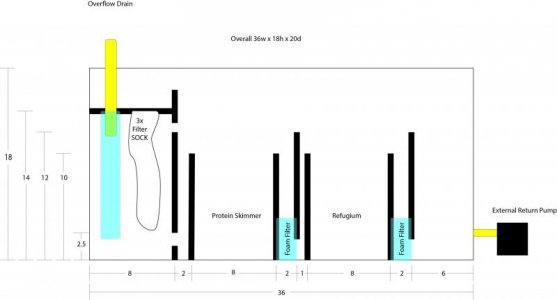
I am in the process of setting up a new 120 gallon reef tank (my tank dimensions for my tank are 48"x42"x24"). I need some advice of a DIY sump/refugium tank (36"x20"x20"). Attached is the concept I would like to create out of ½" acrylic. Cutting all of the acrylic with a laser machine. I've never made a custom sump before and need help spacing the dividers so all the equipment will fit properly, flow properly, and improvement of the design. If some could please help guide me I would appreciate it.

Thanks!
 

Attachments

  • 2dSump.jpg
    2dSump.jpg
    24.7 KB · Views: 9
IMO ditch the 4 chamber. Goto a 3 chamber by taking out the skimmer section. Figure out what protein skimmer you will be using then space your first(drain) section big enough to hold your sock and the skimmer. Then add your fuge then return
 
I am in the process of setting up a new 120 gallon reef tank (my tank dimensions for my tank are 48"x42"x24"). I need some advice of a DIY sump/refugium tank (36"x20"x20"). Attached is the concept I would like to create out of ½" acrylic. Cutting all of the acrylic with a laser machine. I've never made a custom sump before and need help spacing the dividers so all the equipment will fit properly, flow properly, and improvement of the design. If some could please help guide me I would appreciate it.

Thanks!

You have too many baffles to start with. This takes up room, that in a sump, is valuable. Also, you do not need or want the "sponge" mechanical filters. Mechanical filtration does not really fit into a marine system, as what we are concerned with, cannot be removed by mechanical filtration. The same applies to "socks."

Sumps should be as simple as you can make them. Only need three sections, and the return section should be the "largest" to provide passive protection for the pump. "Fuge" is extremely optional, and personally, I find their usefulness (considering implementation) very iffy and questionable.

I build glass, but design is no different, rather than acrylic which I consider a poor choice for aquariums due to water absorption, and it always warps when wet on one side and dry on the other.

This is practical design, return middle, fuge on right feed from return pump, not the drain line, dimensions are not difficult to figure out once you have the equipment in hand:

sump3B.jpg
 
Uncle, do we have any chance to see side view of the sump above? Also, what do you advise, if we decide to skip the fuge section? Cut out that part, enlarge the return area or the PS area ? Or is there any other potential use so we should keep that area for a future use? Thanks.
 
Thanks Mixedreef89 and uncleof6 for the reply. I will redesign my sump with 3 chamber and remove the filters. I am considering on getting the Reef Octopus Classic Space Saver Protein Skimmer 210 gallon rating. What is your personal recommendation on a skimmer? I read some good things about this skimmer so this is what I am considering but not a definite unless there is a better one.
 
Uncle, do we have any chance to see side view of the sump above? Also, what do you advise, if we decide to skip the fuge section? Cut out that part, enlarge the return area or the PS area ? Or is there any other potential use so we should keep that area for a future use? Thanks.

Naw, I don't know where this particular model is...

Skimmer section size is set by the skimmer footprint, plus enough room to get it out. Beyond that, more volume is not worth much. You need to gather your pump together and do a little math to figure out the return section volume you should have. What is left, may or may not be of much value space wise, but it depends.
 
Thanks Mixedreef89 and uncleof6 for the reply. I will redesign my sump with 3 chamber and remove the filters. I am considering on getting the Reef Octopus Classic Space Saver Protein Skimmer 210 gallon rating. What is your personal recommendation on a skimmer? I read some good things about this skimmer so this is what I am considering but not a definite unless there is a better one.

Skimmers are rather ambiguous. Aside from the fact that there are garbage skimmers out there, there is hardly any difference between one or another. They are pretty much "me too" clones, with not much useful innovation going on, and you can expect any skimmer you choose (adjusted and sized "right") to remove around 30% of the TOC, but that paints a somewhat rosy picture, as TOC's are removed, more TOC's are being added...

I think the larger issue rather than this or that model, is getting the sizing right, and since there are no sizing standards whatsoever, that is not easily decerned. Manufacturers/fabricators slap a number on them at x gallons, and there is nothing to validate that number. Couple that with there is no hobby level measure of skimmer performance, and it is all just a mess.

Long story shorter, some have figured out that a major cause of issues in marine systems is an undersized skimmer, the not oft spoken of recommendation is when looking at manufacturer numbers involving tank size suitability, tripple your tank size, and get a skimmer the manufacturers say will serve that larger size tank, with a light to medium load. When it comes to selling highly competitive virtually identical (functionally) equipment, the sale comes first, and factual information comes second.

 
Skimmers are rather ambiguous. Aside from the fact that there are garbage skimmers out there, there is hardly any difference between one or another. They are pretty much "me too" clones, with not much useful innovation going on, and you can expect any skimmer you choose (adjusted and sized "right") to remove around 30% of the TOC, but that paints a somewhat rosy picture, as TOC's are removed, more TOC's are being added...

I think the larger issue rather than this or that model, is getting the sizing right, and since there are no sizing standards whatsoever, that is not easily decerned. Manufacturers/fabricators slap a number on them at x gallons, and there is nothing to validate that number. Couple that with there is no hobby level measure of skimmer performance, and it is all just a mess.

Long story shorter, some have figured out that a major cause of issues in marine systems is an undersized skimmer, the not oft spoken of recommendation is when looking at manufacturer numbers involving tank size suitability, tripple your tank size, and get a skimmer the manufacturers say will serve that larger size tank, with a light to medium load. When it comes to selling highly competitive virtually identical (functionally) equipment, the sale comes first, and factual information comes second.

You have a lot of valid points. I am second starting to doubt myself whether or not to build my own sump/refugium or purchase one somewhere online. I do have all the tools at my disposal to create one but is it worth the time and effort and is it cost effective? Probability not in my case. I am looking to do use 1/2" plexiglass all around to create my sump which would cost me roughly $700-800. I know most sump off the shelf do not use this thick of plexiglass. I guess I need to do more thinking on what to do. :headwally:
 
Why not just use a 40 breeder or 70 tall. And build it that way. That is what I did. I don't want to buy one of the shelf because I can't change it or customize it the way I want it.
 
You have a lot of valid points. I am second starting to doubt myself whether or not to build my own sump/refugium or purchase one somewhere online. I do have all the tools at my disposal to create one but is it worth the time and effort and is it cost effective? Probability not in my case. I am looking to do use 1/2" plexiglass all around to create my sump which would cost me roughly $700-800. I know most sump off the shelf do not use this thick of plexiglass. I guess I need to do more thinking on what to do. :headwally:

I would have to say, it is worthwhile to build your own, though I would not build it with acrylic at all, rather glass. The glass will be far less expensive to boot. Acrylic, no matter how thick is going to bow period. If eurobraced at the top, it will pot belly (bow between the top and bottom.) No way around it.

The commercial sumps I see look pretty, but that is about where it ends. A lot of money for something too complicated, that can be done simpler for a great deal less.
 
You both are right that is always an option. I never like the look of a glass tank as a sump but it should be more superior than acrylic. LOL, decisions, decisions, and decisions. I am more confused than I started.
 
Here is mine for now. I'm building a 55 right now which will still be a 3 chamber but my skimmer and drain will be in one then I will have 24"L fuge a 12" drain/skimmer section and then a 12" return section.
 

Attachments

  • 1403665818716.jpg
    1403665818716.jpg
    45.3 KB · Views: 8
I would have to say, it is worthwhile to build your own, though I would not build it with acrylic at all, rather glass. The glass will be far less expensive to boot. Acrylic, no matter how thick is going to bow period. If euro-braced at the top, it will pot belly (bow between the top and bottom.) No way around it.

The commercial sumps I see look pretty, but that is about where it ends. A lot of money for something too complicated, that can be done simpler for a great deal less.


Spot on!
 
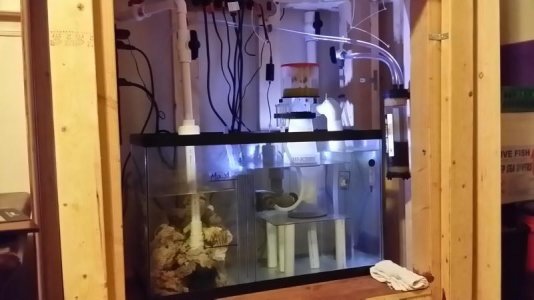
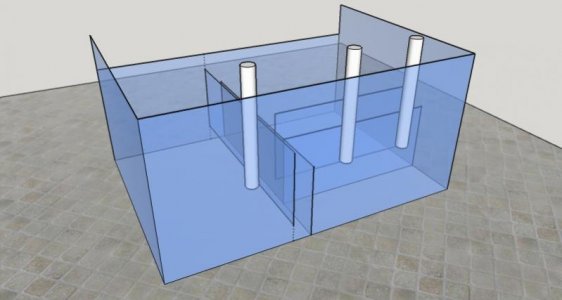
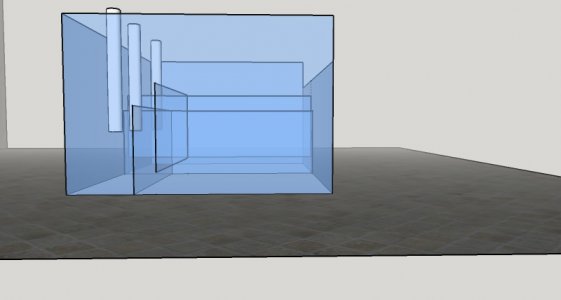
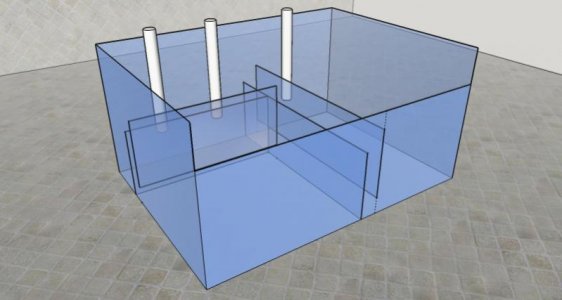
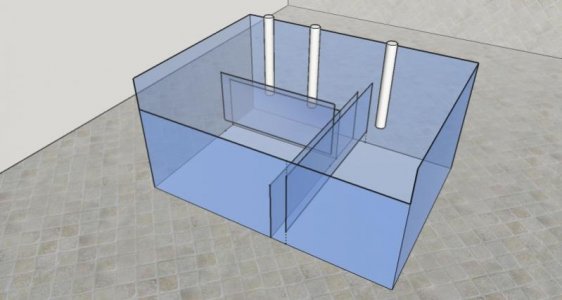
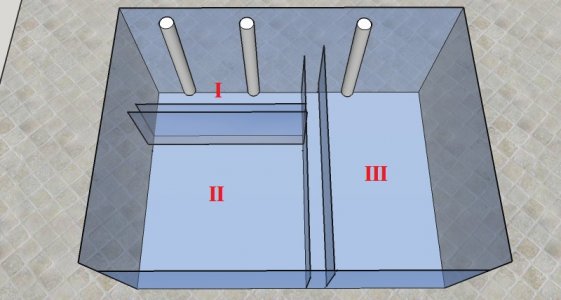
Here is the sump I am planning to build. Siphon and open channel will terminate at section I, then water will reach to section II, where the protein skimmer placed (POV DC-2, 12.4x10" footprint), then the section III, home of return pump. I want to learn your opinions whether this design is appropriate or are there any hidden issues? Seperator glasses are spaced 2" from bottom, or top (top of front glass, since the other three walls are about 4" longer then front to prevent spills or drops etc..)
 

Attachments

  • sump_design01.jpg
    sump_design01.jpg
    31 KB · Views: 7
  • sump_design01a.jpg
    sump_design01a.jpg
    79.5 KB · Views: 8
  • sump_design01b.jpg
    sump_design01b.jpg
    33.5 KB · Views: 8
  • sump_design01c.jpg
    sump_design01c.jpg
    32.9 KB · Views: 8
  • sump_design01e.jpg
    sump_design01e.jpg
    88.1 KB · Views: 8
Here is the sump I am planning to build. Siphon and open channel will terminate at section I, then water will reach to section II, where the protein skimmer placed (POV DC-2, 12.4x10" footprint), then the section III, home of return pump. I want to learn your opinions whether this design is appropriate or are there any hidden issues? Seperator glasses are spaced 2" from bottom, or top (top of front glass, since the other three walls are about 4" longer then front to prevent spills or drops etc..)

You are wasting valuable space, by making two sections that really should be one section. The BA does not produce bubbles, provided it is setup right, so there is no need to drop the drains in seperated from the skimmer section, nor is there a need for the space hogging seperator. The remote dry emergency is fine, and consistent with the design criteria. Square (cube) sumps can be a challange sometimes...
 
You are wasting valuable space, by making two sections that really should be one section. The BA does not produce bubbles, provided it is setup right, so there is no need to drop the drains in seperated from the skimmer section, nor is there a need for the space hogging seperator. The remote dry emergency is fine, and consistent with the design criteria. Square (cube) sumps can be a challange sometimes...

You are right, I just forgot the main benefit of BA, Then I will remove the seperator between section I and II, also cut out same area from section III, which makes about 8-9" gain in the sump cabin where I can put RO bins etc. Is there any practical rule for the space to reserve around PS? Currently I am adding about 3" for each side. I remember a note like keeping PS a bit away from sidewalls decreases the noise.. Thats why I am asking.

ps. Above sump size was stn. like 32x24x12, with modifications, it will be around 32x18x12 inches.
 
Back
Top