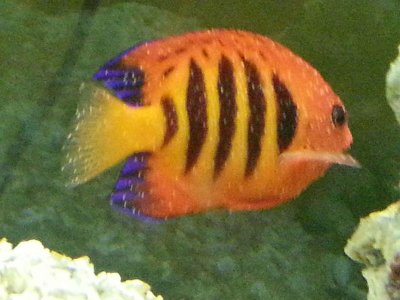
Does my Flame Angel have Ich?

jmt420

New member
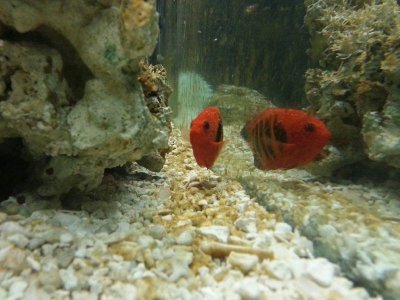
Hello everyone this is my first post but have read a lot on the site. I am wondering if this is for sure ich. I am scared that it is but the flame angel isn't rubbing against the rock or glass from what I have seen. I just got him two days ago and didn't see it when I got him from the store.

I am fairly new to the salt tank game. So any info is appreciated.

It is housed with 2 clowns(FALSE PERC), Sabae anemone, snow flake eel, 3 emerald crabs, 11 snails, 16 blue hermits, and 3 scarlet leg hermits, red star fish, and about 15- 20 pounds of live rock with some feather dusters and a trumpet worm I think?

It is a 60 gallon, with 2 300 gpm over the back filters from cascade, keep my temp around 72(heard it is better to be around there to keep risk of infections and such down), and medium crushed coral as my floor.

And nothing else has any spots, just trying to give a lot of info so you know what I am dealing with.

Thanks
 

Attachments

  • 2013040195192306.jpg
    2013040195192306.jpg
    69.2 KB · Views: 10
  • 2013040195192347.jpg
    2013040195192347.jpg
    65.6 KB · Views: 11
Most definitely ich, you need to get a QT setup ASAP, like a 20g and treat the fish with copper. Would also take the other fish out and put them in the QT to let the tank go fallow and then add the fish back after the 8 week period, otherwise your tank will always have ich in it evenif the fish aren't showing signs of it at present
 
that is what I was afraid of. . would a ten gallon be big enough? and are you saying put my clowns and false in the same qt tank?
 
Yes, it's Ich for sure. All fish need to be removed to a hospital tank and treated. Your display tank must be left fallow (fishless) for 72 days. Eight weeks is not enough. You have a couple of treatment options. I would suggest you read the stickies at the top of this forum so you understand the life cycle of Ich and preferred treatment, of which copper (Cupramine) or tank transfer are the most successful.
 
Should I put the fish in a hospital tank or put the inverts in a separate tank and treat my display tank?
 
You need to do some reading about Ich. There are stickies at the top of this forum. It is only visible during one stage of its life cycle, so even though you don't see the spots, your fish is still infected. You must not treat your display tank. You'll need to move ALL your fish, including the two clowns and the eel to a hospital tank and whatever you decide to do treatment wise, your display tank must be free of fish for 72 days. The tank transfer method is detailed in the stickies. It's very effective, but you need to know exactly how to do it and there is no denying the fact that you'll need to read about various treatments and decide for yourself.

One other thing, 72 degrees is too cold for our tanks. Optimum temperature is open to debate, but it's generally recommended at 78 to 80.
 
so I decided to do cupramine in a qt. I put my angel and both of my clowns in there but left my eel in the DT since they won't tolerate copper and he shows no signs of it and have read it is very hard for them to get ich.

do you think this is a good move our asking for trouble?
 
I don't see why eels would be less susceptible to Ich. They are fish and anything with gills will host Ich in the Trophont stage. I can't respond to whether eels have trouble with copper, but I think if you leave the eel in the display tank, the rest of your fish will get it again when they're back in the tank.
 
I can tell you TTM method is easy and it is almost fool proof :) You need to do 4 transfers. If you are just treating that fish you could use a simple 5 gallon bucket. I fill the bucket up with water to the rim. I throw a HOB filter on the side of the bucket and add some instant cycle to the tank. I feed light the first two days then on the third day when I transfer the fish I will feed a heavy feeding then let the fish sit a couple hours before moving it so it doesn't cough up the food. It is best to have two sets of equipment so you don't have to try and use the set, but if you do decide to use the same set of equipment, heater filter etc.. Bleach it and use HOT water so you kill anything that is on it. Be sure to rinse it out until you can't smell any of the bleach. I never use nets when getting my fish, I usually just gently pick them up, place them into a container then acclimate them to the new tank water. Usually its just temp difference. THEN I put them in another container of the tank water they are going into. I let the fish stay in there for a couple minutes basically to rinse itself off. You can't completely eliminate the possibility of transferring some of the water, but in my experience of doing this.. Which is in the hundreds now I have not had it fail me!


Also note, just because the spots will be gone after the third day or so does not mean the parasite is gone. Most of these parasites first attach at the gills before spreading to the rest of the body. Just because you can't see it doesn't mean that it isn't there. A majority of the parasites do hatch in three days, but sometimes you will have a couple that aren't the majority and that can ruin it. So please do it for the 12 days. Transfer the fish in the morning if you can as well. The parasite tend to fall off at night when the fish is sleeping! So the morning would allow even some more to have fallen off before the next transfer :)


If a fish can't survive me picking it up and placing it in a container every three days then it doesn't deserve to be in my display tank :)
 
I can tell you TTM method is easy and it is almost fool proof :) You need to do 4 transfers. If you are just treating that fish you could use a simple 5 gallon bucket. I fill the bucket up with water to the rim. I throw a HOB filter on the side of the bucket and add some instant cycle to the tank. I feed light the first two days then on the third day when I transfer the fish I will feed a heavy feeding then let the fish sit a couple hours before moving it so it doesn't cough up the food. It is best to have two sets of equipment so you don't have to try and use the set, but if you do decide to use the same set of equipment, heater filter etc.. Bleach it and use HOT water so you kill anything that is on it. Be sure to rinse it out until you can't smell any of the bleach. I never use nets when getting my fish, I usually just gently pick them up, place them into a container then acclimate them to the new tank water. Usually its just temp difference. THEN I put them in another container of the tank water they are going into. I let the fish stay in there for a couple minutes basically to rinse itself off. You can't completely eliminate the possibility of transferring some of the water, but in my experience of doing this.. Which is in the hundreds now I have not had it fail me!


Also note, just because the spots will be gone after the third day or so does not mean the parasite is gone. Most of these parasites first attach at the gills before spreading to the rest of the body. Just because you can't see it doesn't mean that it isn't there. A majority of the parasites do hatch in three days, but sometimes you will have a couple that aren't the majority and that can ruin it. So please do it for the 12 days. Transfer the fish in the morning if you can as well. The parasite tend to fall off at night when the fish is sleeping! So the morning would allow even some more to have fallen off before the next transfer :)


If a fish can't survive me picking it up and placing it in a container every three days then it doesn't deserve to be in my display tank :)

1. In general, if ich infestation has already happened in a reef tank, TTM is not useful. This is because you have to keep fish separate during the fallow period. If you have taken the preparation to support the fish in QT for 12 weeks, by cycling well, TTM will be less attractive even from the start. If you do WC for 12 weeks, either you are not doing well enough or you are doing a lot.

2. Not cycling the medium for QT, using TTM, does not provide any help IF eradication has failed and ich infestation has happened in DT. If you have cycled enough medium, ich infestation in DT will be far less a calamity. You can repeat eradication attempt more easily.

Moreover, I do not prefer TTM because:

1. I do not like to handle livestock.

2. I do not like any ammonia exposure

3. I do not want to have to set up my UV during each transfer.

4. I prefer to prepare well and do very little during QT period, so I do QT for a long time.

TTM is sound as ich is concerned, but the drawbacks in general QT considerations are in the details.

If ich infestation has not happened, TTM can be the method when the number of fish is small and bioload is low. In any larger setups with greater bioload, there is no alternative to cycling the medium for QT well in advance.
 
1. In general, if ich infestation has already happened in a reef tank, TTM is not useful. This is because you have to keep fish separate during the fallow period. If you have taken the preparation to support the fish in QT for 12 weeks, by cycling well, TTM will be less attractive even from the start. If you do WC for 12 weeks, either you are not doing well enough or you are doing a lot.

2. Not cycling the medium for QT, using TTM, does not provide any help IF eradication has failed and ich infestation has happened in DT. If you have cycled enough medium, ich infestation in DT will be far less a calamity. You can repeat eradication attempt more easily.

Not sure I follow you here. TTM by definition means you cannot have a cycled QT (or at least cycled tank transfer tanks.) If your DT is infected, you cannot use media from it to 'instantly cycle' your QT or tank transfer tanks, as the media will be infected. You could potentially use media from the DT in your QT if you are treating with Cu. Are you assuming there to be a cycled QT or cycled media from the DT ready to seed the QT?
 
If you use the TTM method you need to be doing this in a QT tank. If the display tank is infected then you would need to remove all the fish and put them in some kind of QT tank. When I had a huge outbreak on my 150 I just used 45 gallon garbage cans a heater and a powerhead filter. I also dropped the salinity to save on salt. Everyone is different with how they treat ich. I prefer not using meds, as they are poison and it's just enough poison to kill the parasite before it kills the fish. Just like chemo for cancer.. Just hope it kills it off before the person. Anyway, if you do the TTM method then you need to leave your DT fallow (empty of any fish) for 9 weeks, preferably 10 to allow the ich to go through it's full cycle and die off. During this time try and keep all parameters in line so that there isn't a salinity change!


For cycling the tank you could buy some instant cycle from the store and use that. Or in most cases use prime or some kind of product that detoxifies ammonia. Depending on your load of fish and how much you are feeding will depend on the ammonia build up. I just bought foster and smiths giant bottle of instant cycle and just add a dosage when I start QT new fish. The stuff works great and is cheap.


Everyone is different, my fish do very will with me handling them and transfering them between tanks. I am very gentle with them as to not stress them out. I have yet have a bacteria infection come up because of handling them. Part of a fish coming into the house is getting used to the person. I can see the handling being very stressful on a wild fish or one that isn't yet eating. But when I had my tank issue the fish were used to me feeding and watching them so I think to some extent it isn't as stressful for them to be transfered.
 
Back
Top