
You are using an out of date browser. It may not display this or other websites correctly.
You should upgrade or use an alternative browser.
You should upgrade or use an alternative browser.
Donovan's Nitrate Destroyer
- Thread starter djbon
- Start date

ReefKeeper64
Wanna be a reefkeeper
my day job
I run a molecular neurobiology reseach lab.
and it's often my evening job and weekend job also...
@Nematode, I'm not surprised a bit. Keep providing the data they way you are doing. it's rare that we see someone taking such a scientific approach.
@Donovan, My build is another month out or so before I'll even be cycling my tank so I'm just following along to learn what I can. It sounds like there is much to be learned from you - all the way over in Malaysia no less!
The reason I am running the denitrator is that this system won't grow SPS and barely LPS.
Only soft (xenia zoas doing OK ).
So I can't really look for feeding responses by my SPS or LPS.
I will move a few frags from my other system back in now that nitrates are down to ~25. I really would like them at 5. But that may take another month.
The lower thenitrates get, the less effective the denitrator is: at least probably.
Why? Because flow through the reactor determines the rate at which the nitrates can be reduced. I have reasonable evidence that if I run the denitrator at 100ml per minute, that it can eat at least 25ppm nitrates, probably 100 ppm. This is great- but with a 500 gallon system it takes over 10 days to run my whole tank through the reactor at that flow! Lets say it 20 days. Then first day my nitrate go from 100> 95 ( 1/20 of the tank went to zero); day 2 95>90.25(another 5% of the tank went to zero), day 3 90.25 >86.5> etc
it will take a little more than 10 days to go from 100 >50 But it will then take 10 days to go from 50 > 25 and 10 to go from 25 to 12 and 10 to go from 12 to 6.
This is because flow through the reactor is limiting nitrate reduction - and the assumption is that this is because if we increase flow we increase oxygen going through the reactor, and so efficency goes down greatly-
This may not actually be the case. But, for us to test if the reactor, it is much easier to run at 100ml/ min and reduce nitrates from 100 >0 and see that the test clearly shows that nitrate is being removed, than to run it at 1000 ml/min and see nitrates go from 100-90 (I is hard to make the test kits we see a 10% difference.)
So, now that my nitrates are down, I can't easily test for the efficiency of the reactor in reducing nitrates quickly at low nitrate concentration. If we can run the reactor at 10 fold the flow and still get significant reduction in nitrates, then it ought to be easy to reduce nitrates to 0. If increasing flow kills nitrate reduction due to oxygen, then it will be slow to reduce nitrates to very low levels.
So, I am trying to increase the flow on my reactor to see if it works at any reasonable efficiency at higher flow. It could work, or not.
One possibility is that the bacteria doing the job will just be bacteria in more inner parts of the pumice when they now get some nutrients that we before being eaten by bacteria in th outer regions of the pumps (at lower flow).
I hope this makes some sense..
Only soft (xenia zoas doing OK ).
So I can't really look for feeding responses by my SPS or LPS.
I will move a few frags from my other system back in now that nitrates are down to ~25. I really would like them at 5. But that may take another month.
The lower thenitrates get, the less effective the denitrator is: at least probably.
Why? Because flow through the reactor determines the rate at which the nitrates can be reduced. I have reasonable evidence that if I run the denitrator at 100ml per minute, that it can eat at least 25ppm nitrates, probably 100 ppm. This is great- but with a 500 gallon system it takes over 10 days to run my whole tank through the reactor at that flow! Lets say it 20 days. Then first day my nitrate go from 100> 95 ( 1/20 of the tank went to zero); day 2 95>90.25(another 5% of the tank went to zero), day 3 90.25 >86.5> etc
it will take a little more than 10 days to go from 100 >50 But it will then take 10 days to go from 50 > 25 and 10 to go from 25 to 12 and 10 to go from 12 to 6.
This is because flow through the reactor is limiting nitrate reduction - and the assumption is that this is because if we increase flow we increase oxygen going through the reactor, and so efficency goes down greatly-
This may not actually be the case. But, for us to test if the reactor, it is much easier to run at 100ml/ min and reduce nitrates from 100 >0 and see that the test clearly shows that nitrate is being removed, than to run it at 1000 ml/min and see nitrates go from 100-90 (I is hard to make the test kits we see a 10% difference.)
So, now that my nitrates are down, I can't easily test for the efficiency of the reactor in reducing nitrates quickly at low nitrate concentration. If we can run the reactor at 10 fold the flow and still get significant reduction in nitrates, then it ought to be easy to reduce nitrates to 0. If increasing flow kills nitrate reduction due to oxygen, then it will be slow to reduce nitrates to very low levels.
So, I am trying to increase the flow on my reactor to see if it works at any reasonable efficiency at higher flow. It could work, or not.
One possibility is that the bacteria doing the job will just be bacteria in more inner parts of the pumice when they now get some nutrients that we before being eaten by bacteria in th outer regions of the pumps (at lower flow).
I hope this makes some sense..

djbon
New member
Got it nematode. Once nitrate is below 5, keeping that level is no issue as long as the addition of nitrate is below your reactor capability to remove at that flow on daily basis. It took close to one month for me to reach zero no3 from 80ppm when I first started. I am not sure what is my no3 daily production, I have to shut down my reactor to tell. But 25ppm can be easily brought down back to 5 in 6 to 8 days with no changes in feeding.
djbon,
it works for your system at ~ 100 gallon. But the reactor I am using on my 500g isn't much larger (if at all) than yours. And I am using similar flows to what you are using. So my job is 5 X more challenging (unless I put in 5 reactors in my sump). Not necessarily because my load is larger than what is in your 100, but because I need to feed 5 X more water in my reactor to have the same fractional turnover as you have.
it works for your system at ~ 100 gallon. But the reactor I am using on my 500g isn't much larger (if at all) than yours. And I am using similar flows to what you are using. So my job is 5 X more challenging (unless I put in 5 reactors in my sump). Not necessarily because my load is larger than what is in your 100, but because I need to feed 5 X more water in my reactor to have the same fractional turnover as you have.
Have you made the experiment with the more frequent, 2ml carbon dosing? I am very interesting to learn, if you have seen any different results , than 5ml carbon dosage.I am aiming for 5 ppm or less and barely detectable phosphates. I have no idea if it is "mature". If mature means stable, then I don' think so, since I am still having to do almost daily adjustments in flow.
Today, I took apart my reactor (briefly). It was starting to overflow through the inputs and was requiring more and more pressure to run. I wanted to find out what things looked like inside. Reactor is lava rock pumice on the input side, pumice, then lava on the output side.
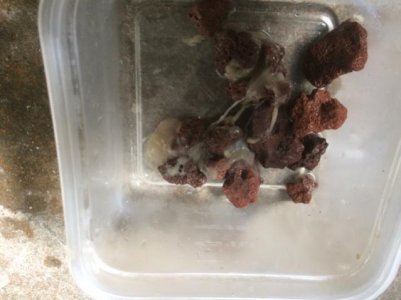
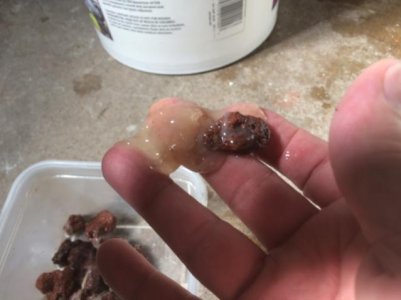
On the input side the lava rock was completely covered with thick white slimy almost jello-like consistancy tranlucent stuff. As one got further down into the pumice, the stuff was more orangy and less thick. On the output side there was very little slime or detectible junk compared to the input side.
I've now put the reactor back together ( a different slightly bigger reactor that is plexiglas (so I can look in)- I know they say light inhibits denitrification- but it is dark in the rocks.
I replaced some of the lava on the input side with glass and ceramic rings thinking these will allow better flow on the "dirty " side of the reactor.
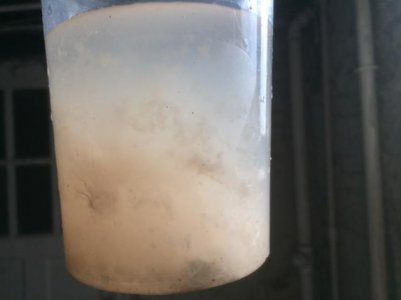
Attached are 3 pictures.
rock showing junk, and one of the water. Have about 3 gallons from the reactor that looks like that.
On the input side the lava rock was completely covered with thick white slimy almost jello-like consistancy tranlucent stuff. As one got further down into the pumice, the stuff was more orangy and less thick. On the output side there was very little slime or detectible junk compared to the input side.
I've now put the reactor back together ( a different slightly bigger reactor that is plexiglas (so I can look in)- I know they say light inhibits denitrification- but it is dark in the rocks.
I replaced some of the lava on the input side with glass and ceramic rings thinking these will allow better flow on the "dirty " side of the reactor.
Attached are 3 pictures.
rock showing junk, and one of the water. Have about 3 gallons from the reactor that looks like that.
Attachments

jml1149
New member
Well heck.
Never truly got to an anaerobic ORP, but then my reactor clogged and ORP started lowering (increased pH in the attqched chart). The flow was dripping out, I measured to be roughly 10 gallons per day volume. I unclogged the reactor, where the flow increase from 0 to 1.2gph, and the ORP starts rising like mad (falling pH #). So I wonder, are any of us really operating anerobic environments?
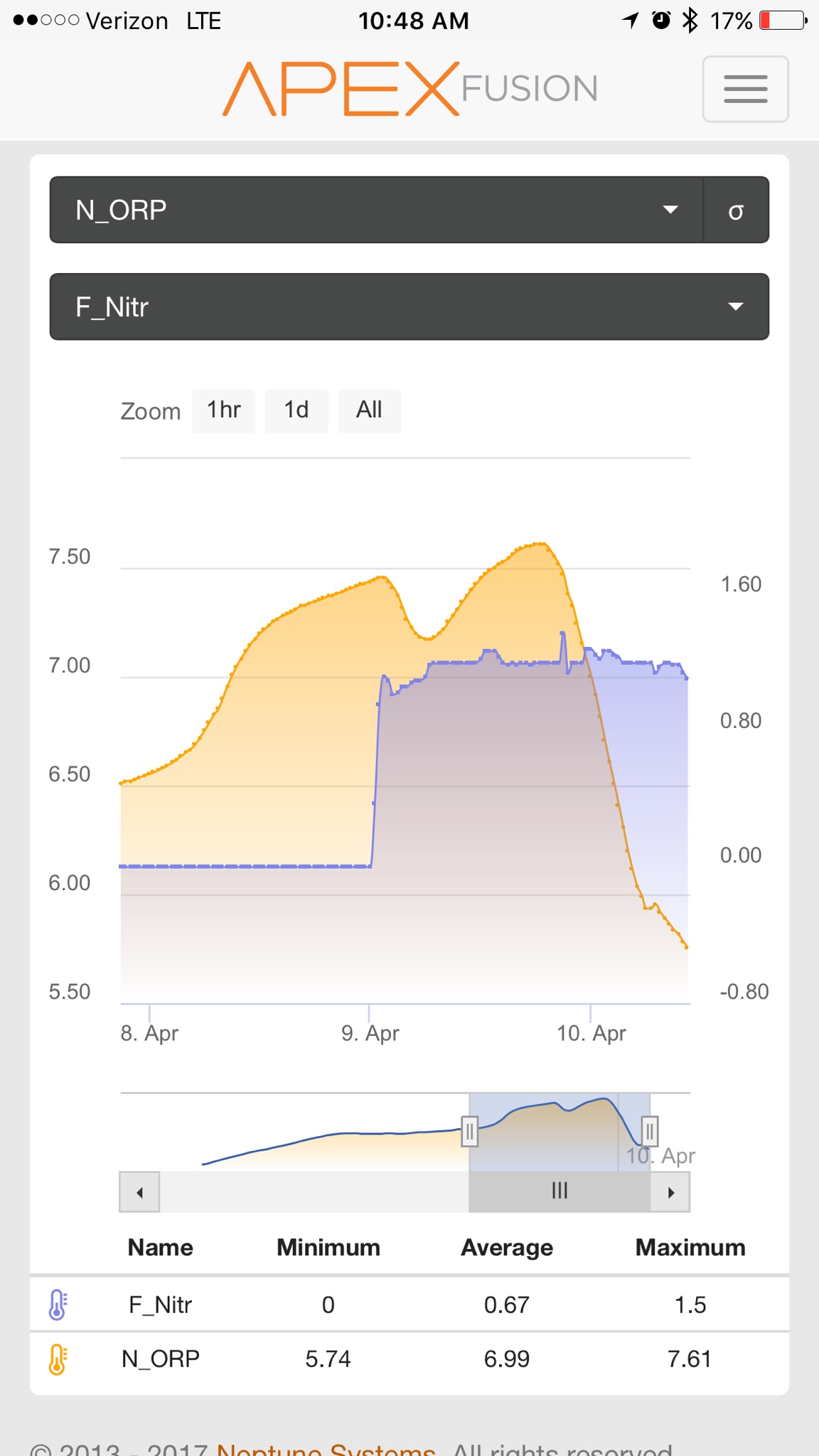
Never truly got to an anaerobic ORP, but then my reactor clogged and ORP started lowering (increased pH in the attqched chart). The flow was dripping out, I measured to be roughly 10 gallons per day volume. I unclogged the reactor, where the flow increase from 0 to 1.2gph, and the ORP starts rising like mad (falling pH #). So I wonder, are any of us really operating anerobic environments?
Wish I knew. The best case scenario would be where flow doesn't really matter too much.
This could be the case. One could envision that the sweet spot for denitrification would just shift from just below the surface in the media to a little deeper as flow increases.
The negative side of high flow is that the doses of carbon go through the reactor faster.
The positive is that it is easier to control and probably less sensitive to clogging.
This could be the case. One could envision that the sweet spot for denitrification would just shift from just below the surface in the media to a little deeper as flow increases.
The negative side of high flow is that the doses of carbon go through the reactor faster.
The positive is that it is easier to control and probably less sensitive to clogging.
I need a better nitrate test kit to measure.
Or just track over longer periods of time.
While it is difficult to see that your output nitrates are 1-2 ppm lower than your input, it should become clear that the reactor is working if you look at total level of nitrates in the tank over weeks.
Or just track over longer periods of time.
While it is difficult to see that your output nitrates are 1-2 ppm lower than your input, it should become clear that the reactor is working if you look at total level of nitrates in the tank over weeks.
jml1149
New member
Wish I knew. The best case scenario would be where flow doesn't really matter too much.
This could be the case. One could envision that the sweet spot for denitrification would just shift from just below the surface in the media to a little deeper as flow increases.
The negative side of high flow is that the doses of carbon go through the reactor faster.
The positive is that it is easier to control and probably less sensitive to clogging.
Agree, I'm currently dosing 30ml of vinegar into the reactor, but broken up into 8 second doses every 30 minutes, to try and keep the vinegar levels more constant in the chambers.
High flow, low flow, I've never not had clogs, and it's always white stringy snots somewhere. Lately its been on the output line.
Also, I've been thinking about adding a recirculating pump to this, so the output would flow back into the top of the input, the intake from the tank would be via venturi, and controlled by a valve on the output. The intent is to recirculate low oxygen water, to increase the area available for de-nitrification.
Similar threads

- Replies
- 10
- Views
- 2K
