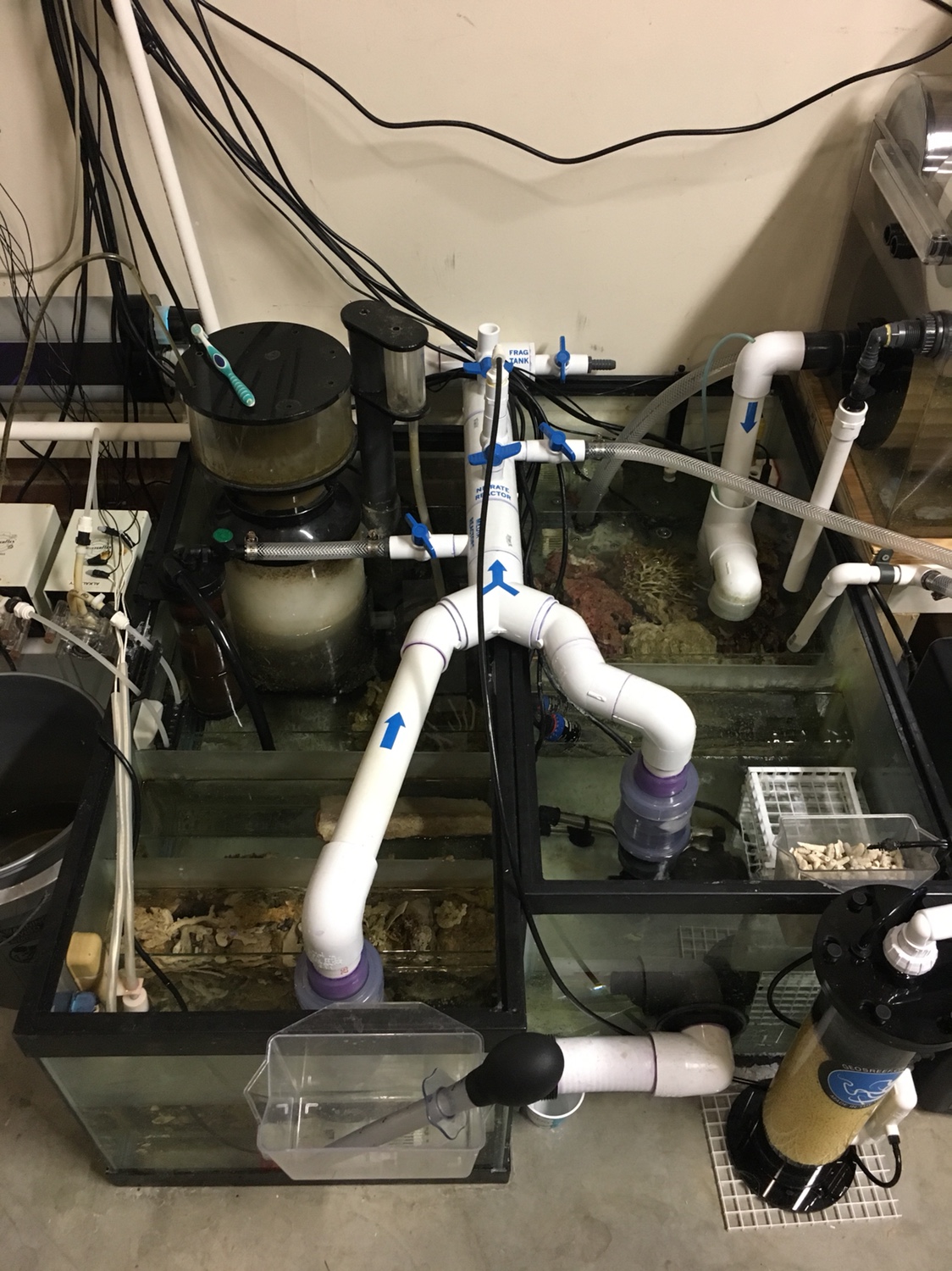
Dual Return Pumps? Same Pipe?

malx

Active member
Hi, All.

So I'm going to be swapping out my return pump soon with the new COR 15 from Neptune Systems. Right now, I'm running a Vectra M1 which is a great pump, but I'd like to not have to use a plug outlet (the COR 15 runs off of the 1LINK).

Here's my question, can I run dual return pumps for redundancy, and have them plumbed to the same pipe? For example, both pumps would run to 3/4" pipe individually, that would meet a foot or two down the line into a single 1" pipe. Is that OK? Or will I have issues with them causing head pressure for each other?

Let me know!
Joey
 
I believe it would work fine as long as both pumps are running, however if either pump stops for any reason, the flow from the still running pump would, at least largely, exit out the stopped pump, instead of going to the display tank.
 
If you run 2 pumps into the same return line you will need to install a check valve on the top of each pump before they tee together. Without them if one pump stops the water will mostly flow back through the pump not running instead of to the display. Thus basically making your redundancy plan not effective.

You will loose some flow due to the check valves and running 2 pumps with 3/4" output into a single 1" line will further reduce the flow from each pump. Uping your 1" to 1.5" would be better. OR better yet run 2 separate 3/4" returns one from each return pump to each side of the tank. (you will still need the check valves on each pump)
 
As much as I hate check valves this is the one cSe where they are needed. As posted above if one pump is turned off for any reason it would start to run backwards due to head pressure. If power was restored to that pump while it was turning backwards it would put a lot of strain on the impeller. You really would be much better off running two separate return lines if possibke.
 
Dual Return Pumps? Same Pipe?

Two pumps from 3/4 into 1 inch would probably be ok if you aren't running the pumps at full speed. I do agree that check valves would be needed if you use a single pipe. Also make sure that you aren't relying on the check valves for flood control. Check valves are mechanical and they do fail.

I have two return pumps (although I have separate plumbing for each of them), but I normally run them at about 80% (controlled by my apex). If one of them were to fail I would be able to bump the remaining one up to 100% to regain some of the flow lost from the failed one. It would still be lower flow than normal, but certainly enough to run the tank indefinitely while I work on replacing the failed pump.

The other thing to consider would be to put the two
pumps on separate circuits, if possible, although that may be a little more difficult with the COR pumps. Maybe if you used the one link port on an EB832 for one and a separate one link adapter with its own power supply for the other. I had two dedicated circuits run for my tank and while I haven't had a pump failure I did have one GFCI trip while I was 1000 miles away from home. That took out one pump and one heater, but the second pump and second heater on the other circuit kept the tank going for several days until I returned home.
 
Thanks for all of the comments. Unfortunately I cannot run two separate returns. My tank is already built out in the wall and there is no extra space for this. I do, however, only use my Vectra on about 40% flow. I imagine that the two APEX pumps I can get away with 30% each while they are running, so I don't think I would have flow issues.

What I do realize now I'll have is if the one pump fails, the other one would have flow forced through it, so the check valve idea was exactly what I was looking for.

Thanks everyone!
Joey
 
What are you going to do about flow rates monitoring/energy usage?

"If" I was going to run dual pumps then I'd want some system to monitor the flow and run each pump at 50% or something like that and then automatically switch the working pump to 100% or whatever to keep the same flow rate and then to alert of a failure to allow replacement..
 
What are you going to do about flow rates monitoring/energy usage?

"If" I was going to run dual pumps then I'd want some system to monitor the flow and run each pump at 50% or something like that and then automatically switch the working pump to 100% or whatever to keep the same flow rate and then to alert of a failure to allow replacement..


I have considered doing this and it would certainly be possible with the Apex. Either by monitoring energy usage of the pumps with the EB832 or flow rate with the flow kit, but I don't want to plug both pumps into my EB832 because I want to keep them on separate circuits for fault tolerance. I could get another EB832 or the flow kit, but so far I haven't really been willing to spend the money.

Frankly, though, I'm not sure it's really necessary. The remaining pump running at reduced flow is more than enough to sustain the tank indefinitely. It's not ideal and I would prefer more flow, but it could run for days like that without a problem. In the event I notice a failure I'll manually increase the speed of the remaining pump to mitigate the issue somewhat (although I run my pumps at more than 50% most of the time, so it will be better, but still not normal with a single pump at 100%).

When one pump stops it affects the balance of my herbie drains and they become rather loud. So even if the apex can't alert me to the failure I still become aware of it quite quickly.
 
When one pump stops it affects the balance of my herbie drains and they become rather loud. So even if the apex can't alert me to the failure I still become aware of it quite quickly.

I agree that a 50% reduction in flow (assuming you are equaling each pumps flowrate to start) isn't going to cause any problems except as you stated overflows.. no matter which kind will change in their noise at the very least..

You will know just by the sound when/if one pump fails..
 
Dual Return Pumps? Same Pipe?

Here is my thread on the topic. I run two separate pumps combined into a single line (with check valves), both controlled off the apex, and plugged into separate circuits.

https://www.*********.com/threads/two-return-pumps-parallel-or-series.315448/


Sent from my iPhone using Tapatalk
4335c7191210d704318bc06022244196.jpg
 
Here is my thread on the topic. I run two separate pumps combined into a single line (with check valves), both controlled off the apex, and plugged into separate circuits.

https://www.*********.com/threads/two-return-pumps-parallel-or-series.315448/


Sent from my iPhone using Tapatalk


Oh goodness RC, now you know why I made the thread on a different forum. Believe it or not some information on the internet exists outside RC.

Google "œTwo Return Pumps - Parallel or Series?"


Sent from my iPhone using Tapatalk
 
FWIW 3/4" pvc pipe is the maximum flow rate you will get out of the deal no matter how big of a pipe you put further down the road.
3/4" pvc will support maximum of 2160 gph so if you have 2 pumps rated less than 1100 gph a piece then you will get the max rate.
But if you have say 2 reeflo darts that pushed 2600/3600 depending what impeller you use will be a complete waste of second pump because you wont be able to push more than 2160 gph out of the pipe.
1" pipe will push 3500 gph.
 
Gosh, that all seems so complex. Just thinking out loud, but I wonder if the dubious reliability of the current generation of DC pumps run redundantly actually gets you better overall reliability than just using a tried-and-true AC. I've never bothered to run redundant pumps because mine just don't fail. Iwaki for 20 years .... PanWorld for 10 .... etc. etc. Just food for thought.
 
FWIW 3/4" pvc pipe is the maximum flow rate you will get out of the deal no matter how big of a pipe you put further down the road.
3/4" pvc will support maximum of 2160 gph so if you have 2 pumps rated less than 1100 gph a piece then you will get the max rate.
But if you have say 2 reeflo darts that pushed 2600/3600 depending what impeller you use will be a complete waste of second pump because you wont be able to push more than 2160 gph out of the pipe.
1" pipe will push 3500 gph.


And what PSI are you calculating those numbers at?

You missed my point.

Two pumps each with a 3/4" output teeing into one 3/4" line will most definitely reduce the flow of each pump. Upping the pipe the pumps tee into to 1" or more will greatly reduce the back pressure on each pump and increase the flow vs a 3/4" line.
 
And what PSI are you calculating those numbers at?

You missed my point.

Two pumps each with a 3/4" output teeing into one 3/4" line will most definitely reduce the flow of each pump. Upping the pipe the pumps tee into to 1" or more will greatly reduce the back pressure on each pump and increase the flow vs a 3/4" line.

again what size pumps are you going to use?
it doesnt matter if you put a 2" or 4" pipe after a 3/4" pvc as your flow will always be determined by the smallest pipe which is 3/4" and that will only support 2160 gph at 100+ psi. at lower psi 20-100 it will only do 1410 gph. you will relief the pressure but your flow will only be at its max of the smallest pipe in the line.
 
again what size pumps are you going to use?
it doesnt matter if you put a 2" or 4" pipe after a 3/4" pvc as your flow will always be determined by the smallest pipe which is 3/4" and that will only support 2160 gph at 100+ psi. at lower psi 20-100 it will only do 1410 gph. you will relief the pressure but your flow will only be at its max of the smallest pipe in the line.

Correct but were talking about two 3/4" lines feeding into one line which requires up-sizing the single line if you don't want to increase back pressure and reduce flow from each pump.
 
Back
Top