Emergency Power

<a href=showthread.php?s=&postid=11728675#post11728675 target=_blank>Originally posted</a> by WarrenG
"Caveat"? Not exactly.
Is there a reason that your responses to my posts always appear to have an obtuse or arrogant air about them?

Part of my occupation is working with (specification and installation) of back up power systems. Like it or not Warren, this topic is my field of expertise.

Taken directly from the FAQ on the same website you just pasted a link to:
Pure sine wave power inverters motor's run cooler, last longer and provide very clean power like you would receive from a power company. Devices such as laser printers, digital clocks, and most medical equipment require a pure sine wave inverter to run correctly. As noted above, as a precaution, please contact the manufacturer of your device to determine if pure sine wave power is required.

This is a modified sine wave:
modified-sine-wave1.gif


Once again: Depending on the actual shape of the wave form, motors and other inductive loads may run hot, or not run at all. Electronic devices that DO NOT have a built in switch mode power supply may not operate as expected.

The effects can be small, such as motors running slightly warmer. The can be large, such as motors not running at all, or becoming damaged.

If you would like, I can explain exactly why and use qualified reference materials to do so. The comments were not made to oppose YOU or your idea. They were made to help inform people.

So yes Warren, the particular inverter that you purchased may be able to run the loads in question. However, advising people that all modified sine wave inverters will behave the same would be very bad advice.

The fact is that there many of the inverters sold will not run those loads properly and can easily damage them.

Another FAQ for your reference:
http://www.donrowe.com/inverters/inverter_faq.html
 
Last edited:
I read the suggestions on the packaging. Tried it. It worked for the things I listed and for the days I needed it. Per the manufacturer's suggestions, I won't use it for medical equipment, digital clocks, or laser printers.
 
What does that have to do with the general advice that motors and electronic ballasts do not operate well (or at all) from modified sine wave devices?

YOU have purchased a modified sinewave inverter that appears to have a clean enough output to meet your needs. If we put it on a scope, we would find that the "modified sine wave" is fairly close approximation to a real sinewave. In other words the inverter has a pretty darn good output.

Lets rephrase that so that there is no confusion:
It either MUST:
1) have a very good output to run those devices.
-or-
2) the output is not so good and you are telling a fish tale.

You have stated that it ran those devices with no problems, so I will take you at your word. That means that the inverter must have a pretty damn good output wave form.

Once again, the problem is that MANY of the inverters being sold do NOT have outputs that are suitable for running motors and similar devices. This was the WHOLE POINT that you have obscured by your flip comment and off handed suggestion that I am wrong.

Moreover, it takes the modified sinewave unit more power to run a motor as compared to a real sinewave unit. This will cause the output transistors to run hotter and live a shorter life as well.

The advice given here is general and valid. You have tried to frame it around YOUR inverter to give the impression that the advice and reasoning are wrong. This appears to be a growing pattern in threads that you and I participate in. I find it rather adolescent.

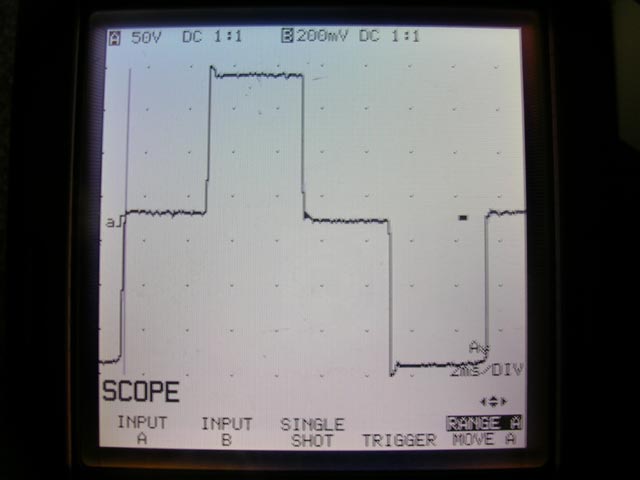
Here is a scope shot of the output of a pretty common inverter that will NOT do well with motors:
MSW_NOLOAD_TOP.JPG


Here is the output from an APC BackUPS "modifed sine wave" 650VA ups
apcbu650-noload.jpg

It will not even spin a small motor! They just hum and get hot.

I would be more than happy to discuss this topic further in any amount of detail that you desire. However, if your point is that YOUR inverter works, then we have nothing further to discuss.

The purpose of my responses in these threads is to help other people and try to ensure that they get valid information.
 
Last edited:
<a href=showthread.php?s=&postid=11730966#post11730966 target=_blank>Originally posted</a> by BeanAnimal
YOU have purchased a modified sinewave inverter that appears to have a clean enough output to meet your needs. In other words the inverter has a pretty darn good output.
We agree on that.
 
What you agree with, or disagree with is not my concern. As I stated, my true concern is ensuring that the casual reader walks away better informed with factual information instead of anecdote.
 
Bean you need to rein in your Animal. You clearly have lots of knowledge and some pretty charts. And Warren how dare you settle for a less than the perfect solution!

I think BeanAnimal has really helped us with this tricky technology and we now know what to look for in the fine print. But in a pinch I would rather have what Warren is using rather than letting the tank fend for itself in an outage.
 
What you should walk away with is rather simple...

It has nothing to do with a "perfect solution" or fine print. It has to do with what will work and what will not work.

When you are looking for an inverter, you should try to select one that has a true sine wave output. If you select one that has a modified sine wave output, you may (more than likely will) have problems with certain loads like pumps and ballasts.

This holds true for Inverters, UPS system, and generators.

The inverter that Warren purchased is the exception when it comes to cheap modified sine wave units.

Even a quick search here at RC will provide many threads where people have had problems with "modified sine wave" units.

Warren knows that too... he just likes to troll a bit here and there.
 
Last edited:
I have to admit that I did not know that. It would be a really bad day if an ice storm takes out your power and then your emergency backup system fries your gear. Usually in a power outage at least your gear will live through it.

This thread has been really far better than I had hoped when I started it.

These threads are so helpful that I just might start one on how to pay for a full blown reef addiction :)
 
With any backup system it is important to run extended outage simulation to ensure that the unit will perform as expected.

You will find that many people setup UPS systems or buy equipment and never really test it, other than to run it for a minute or two. When crunch times comes, they are out of luck.
 
I think that after all the work and expense of setting this up the testing would be the fun part. And its critical to test to see if you have enough power left over to run your XBox :)
 
When you size an inverter you need to take a few things into consideration. The biggest issue is the startup current drawn by inductive devices like motors and transformers (tar ballasts).

For moderate sized pumps, you should use at least 2x the rated wattage for the purpose of calculating inverter size. For things with induction motors (fridge, freezer, AC, LARGE pumps) etc.. you should use 6x the rated current.

It is very easy to fry the output of the inverter due to high starting currents pushing the outputs past their rating.

Pure resitive loads (heaters) also need to be accounted for. A good rule is to use at least 1.5x the rated wattage.

Remember, a modified sinewave inverter is only about 70% efficient. The poor quality waveform means that many load devices will consume more wattage than the label states.

Just stuff to keep in mind.
 
I am building a UPS for my system, and I chose a "PowerBright 1000" as my inverter.

Why did I spend $300 when $75 "might have worked"?

Because the PowerBright is a true-sine inverter. I am not going to get into this argument because I happen to agree with Bean.

I love a quote from another controversial thread around here:

"...there is none so deaf as he that will not listen,"

Nuff Said

Stu
 
Oh, & BTW,

I stumbled across this lately.

http://www.donrowe.com/inverters/rs2000.html

It may seem a bit pricey, but slap a couple of $120 Deep cycle marine batteries on that and it is as good as some industrial units worth 10k.

It even has a network monitor function ( I dont know how to convert to 'xanbus' but Bean might )

Stu
 
<a href=showthread.php?s=&postid=11733610#post11733610 target=_blank>Originally posted</a> by BeanAnimal

Even a quick search here at RC will provide many threads where people have had problems with "modified sine wave" units.

Warren knows that too... he just likes to troll a bit here and there.

Beananimal, what you said is a LIE and an outright insult.

I posted about my own recent experience with the topic. I don't recall reading any other posts about inverters and problems with them. On my local RC forum other people posted about their positive experiences using inverters during our power outage.

I am going to contact the moderator immediately.
 
An insult? Warren you have done nothing but sling little one line insults at me in half a dozen threads this week, and plenty of other times previous to now. I suppose that acting offended and calling the moderator would be fitting given the pattern that is emerging.

It is becoming very common for you to follow my posts with what you feel is discrediting information and a flip comment. I consider that trolling and that is what the comment was in reference too.

Your experience with the topic was noted and kindly elaborated on in hopes of providing other people with valid and factual information. It does not appear that you were willing to listen and instead were more intent on giving others the impression that I was wrong.
 
As it turns out, we had an ice storm last night... I lost power sometime between 2 AM and 4 AM (when the breaking limbs rousted the dog). The power company says 12:00 PM at the earliest... The freezing rain is still coming down, so I figure it may be MUCH longer. FWIW the doors on the truck are frozen solid, it will take several hours with a heat gun to get into it!

I have (2) very large Liebert UPS systems that have carried the return pump and heater through the night, as well as my phone system and server. I now have a small 2000W genset (honda knock off) running to take care of the tank and the sump pumps.

I am an authorized general dealer (server rooms and the like) and never got around to putting a standby genset here... go figure! BTW, you can buy them (Generac standby generators) cheaper at Home Depot!

I tried to edit my post last night.... but it appears there were issues with the forum.

On another note:
Warren, if I have honestly offended you, then you have my apologies. On the same token, I would ask that you refrain from taking pot shots at my posts. Are your attempts to constantly discredit what I say not akin to trying to insult me? Maybe put me on your ignore list (honestly?). I have tried to reply to your comments kindly (in several threads) over the last week. Many times, editing a reply several times to ensure that it was kind but still to the point.
 
I don't know whether it's of any use, but I have a thirty gallon tank. I have a battery back up system with and inverter, which i think is a true sinewave inverter. It is connected to a 12V 60AH lead acid battery and has a maximum capacity of 500VA. For my 30 gallon I run The main pump rated at thirty watts (263 GPH), and two power heads that are strategically placed to provide basic flow to virtually all parts of the tank. These two powerheads are rated at 10 watts each (totally: 342 GPH). As far as I have tested, I've been able to run them for six hours, but at that point the battery wasn't low. I just couldn't take it anymore. I am sure it would have run for a few more hours.

For most purposes I think this is fine. I would love to also have a back up generator with at least two weeks worth of fuel instock, but unfortunately I can't afford it right now. Most importantly with a back up system is automated switching. Power faliures etc. have a wonderful habit of happening when you're not around.

Whatever happens I think it's always best to have a battery back as part of any back up system. Imagine having to be there to start generators etc... But this is all just my two cents...
 
You can get a standby genset (Generac) from home depot for around $2500 installed. It comes with an automantic transfer switch and is big enough to run most modest size households.

It sounds like a lot of money, but consider what you have invested in a mature tank and what a crash would cost!

As you have already figured out, you don't need to have the system fully running to keep things safe. A modest amount of flow will keep things alive by providing aeration and waste removal. The lower temperatures help to reduce respiration and activity so a heater is only a secondary concern. It is nice to have a heater that can kick if the temperature gets TOO low but your livestock will last longer in cold water than it will in water with no oxygen.

The method that Warren uses is certainly not a bad idea at all. If you purchase a suitable inverter and a few batteries you can be very flexible with your emergency setup. You can run the inerter right from the car, or you can use the car to charge batteries and swap them out in the house. As with any setup, a good practiced plan is important.
 
Trying to find your inverter in the dark... bad planning.

I would like to plug something into a wall outlet that's shared with my tank, and if the power goes out it will call my cell phone. How much would reefers pay for that device? How can it be done?
 
It could be as simple as a $2 microcontroleller interfaced to a $3 DTMF chip and a $5 voice chip. A little bit of code to read the A/D input and determine if mains is present, if not the unit would dial out and play a prerecorded message. It would be powered from the phone line.

You could also use one of the MANY home automation controllers (like the ocelot) to poll an A/D input or even a use a relay to determine of mains is present. The automation controller would be on a UPS. If the mains fails, it could dial out, send an SMS message or email. DonW is the ocelot guy...

You could also use a PC on a UPS and it's internal modem. A simple circuit tied to the USB, Serial, or parallel port would monitor the mains presence.

You could also use the UPS software to kick off a script that dials the modem, or have it send an email, page or SMS message.

If you have a dedicated "fish rooom" then you may also want to grab an emergency lighting unit from the local electric supply... you know the kind that adorn the walls of every commercial building. You can get them surpluss for maybe $50, new for $100.
 
Back
Top