
You are using an out of date browser. It may not display this or other websites correctly.
You should upgrade or use an alternative browser.
You should upgrade or use an alternative browser.
Fairy wrasse Photo Library
- Thread starter JohnL
- Start date
- Status
- Not open for further replies.
achillesheel
New member
thanks hiroyuki.
oh and that swalesi wrasse in your gallery is beautiful. any info on it
oh and that swalesi wrasse in your gallery is beautiful. any info on it
achillesheel
New member
oh i mean sulawesi. is the chest that blue?
The species from Sulawesi is to be named soon.
It comes mainly from islands off southewastern Sulawesi and is a shallower water species. It is often available at retailers and reaches 75mm at maximum as far as I know.
The chest is broadly blue and seems close to C. rubripinnis (I will load photos up soon), but has a prominent slightly dark red blotch on dorsal fin basally that never be seen in C. rubripinnis. It will be described by my friend by using Indonesian specimens. He states that his specimens came from Java but we doubt and we suspect that his ones came via Java.
It comes mainly from islands off southewastern Sulawesi and is a shallower water species. It is often available at retailers and reaches 75mm at maximum as far as I know.
The chest is broadly blue and seems close to C. rubripinnis (I will load photos up soon), but has a prominent slightly dark red blotch on dorsal fin basally that never be seen in C. rubripinnis. It will be described by my friend by using Indonesian specimens. He states that his specimens came from Java but we doubt and we suspect that his ones came via Java.
I posted photos of two species from Vanuatu; C. condei and C. bathyphilus.
Males of C. condei from there has a yellow area on dorsal fin but those from Papua New Guinea (holotype) do not.
Males of C. bathyphilus have three distinct color morphs.
1 Great Barrier Reef around Holmes Reef
2 Vanuatu~ Efate Island
3 Vanuatu~ Tanna island
Most available specimens will be collected in Efate that have a red head and a yellow side and abdomen (see my shots; often called the Hooded Fairy Wrasse).
Those from Tanna Island (just south of Efate) have a red streak on side.
Holmes Reef males have a reddish body and a yellow abdomen.
I have been suspecting that these are distinct.
Males of C. condei from there has a yellow area on dorsal fin but those from Papua New Guinea (holotype) do not.
Males of C. bathyphilus have three distinct color morphs.
1 Great Barrier Reef around Holmes Reef
2 Vanuatu~ Efate Island
3 Vanuatu~ Tanna island
Most available specimens will be collected in Efate that have a red head and a yellow side and abdomen (see my shots; often called the Hooded Fairy Wrasse).
Those from Tanna Island (just south of Efate) have a red streak on side.
Holmes Reef males have a reddish body and a yellow abdomen.
I have been suspecting that these are distinct.


slobound,
Your specimens, at least the male, came from Tanna Island; the male has a red streak centrally on side, but males from Efate do not.
C. adornatus was once shipped from western Sumatra but I have never seen these six months.
coreno16,
It is a large female of C. solorensis as snorvich pointed out. C. cyanopleura has a white abdomen, but in C. solorensis and C. aurantidorsalis it is not white but bluish. Also the pelvic fins seem still shorter. Very large females of C. solorensis just exceeding 10cm have very long pelvic fins but the color pattern on side is not that of male. In some cases they are hard to identify by color pattern only, and some of these may be natural hybrid specimens.
'Solar' is not correct and please call it 'Solor' Fairy Wrasse (Solor is a name of an island in Indonesia, therefore it was named solorensis).
Your specimens, at least the male, came from Tanna Island; the male has a red streak centrally on side, but males from Efate do not.
C. adornatus was once shipped from western Sumatra but I have never seen these six months.
coreno16,
It is a large female of C. solorensis as snorvich pointed out. C. cyanopleura has a white abdomen, but in C. solorensis and C. aurantidorsalis it is not white but bluish. Also the pelvic fins seem still shorter. Very large females of C. solorensis just exceeding 10cm have very long pelvic fins but the color pattern on side is not that of male. In some cases they are hard to identify by color pattern only, and some of these may be natural hybrid specimens.
'Solar' is not correct and please call it 'Solor' Fairy Wrasse (Solor is a name of an island in Indonesia, therefore it was named solorensis).

jimsflies,
Yes, the male is typical and female seems this species. We could see this species in Tokyo sometime ago but only males were shipped from Indonesia. I have never seen the female in the aquarium trade in Japan.
Female of C. adornatus is quite similar to that of C. flavidorsalis and C. lubbocki. If it comes from central western Sumatra I am sure that it is adornatus. There is no C. flavidorsalis or C. lubbcki where C. adornatus exists.
Yes, the male is typical and female seems this species. We could see this species in Tokyo sometime ago but only males were shipped from Indonesia. I have never seen the female in the aquarium trade in Japan.
Female of C. adornatus is quite similar to that of C. flavidorsalis and C. lubbocki. If it comes from central western Sumatra I am sure that it is adornatus. There is no C. flavidorsalis or C. lubbcki where C. adornatus exists.
achillesheel
New member
coreno- that may be a C. rubisquamis/ rosey-scale. not to second guess. the first picture seems to show the scale definition much more than i would think the solor wrasse would. correct me if im wrong, im by no means positive. its been a while since ive seen a female solorensis.
Thanks for all the help guys. Ill see if i can't snap some better pics when i get a chance just for fun. I dont mind showing off my fairy. I actually thought it was a male, so i got a good suprise when i was told its female. Does this mean i could add one more!?!?!  Thanks again. Oh and happy Easter everyone
Cory
Thanks again. Oh and happy Easter everyoneCory

jimsflies
Member
<a href=showthread.php?s=&postid=7183989#post7183989 target=_blank>Originally posted</a> by H.Tanaka
jimsflies,
Yes, the male is typical and female seems this species. We could see this species in Tokyo sometime ago but only males were shipped from Indonesia. I have never seen the female in the aquarium trade in Japan.
Female of C. adornatus is quite similar to that of C. flavidorsalis and C. lubbocki. If it comes from central western Sumatra I am sure that it is adornatus. There is no C. flavidorsalis or C. lubbcki where C. adornatus exists.
Yeah, its seems hard to tell the females of the species. This particular female is quite small...about 2 inches overall length. They were sold as a pair and do seem to swim together quite a bit. After I first introduced them to the tank, my orchid dottyback gave chase to the female and it seemed as if the male was reacting to the threat by "rushing" toward the dottyback. I'd like to go back to the lfs and see if I can get more information about their origin.

achillesheel
New member
the best i can do on an in tank shot of my pin tail

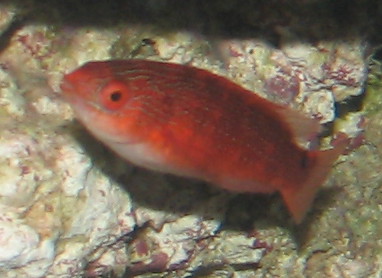
also my new C. roseafacia, i believe a female.


also my new C. roseafacia, i believe a female.
achillesheel
New member
i also seem to recall reading about it not being a good idea to mix anthias with fairies. if this is the case, why not? will the fairies be in trouble or the anthias?
-shad
-shad
- Status
- Not open for further replies.
Similar threads


- Replies
- 0
- Views
- 98