Fairy wrasse Photo Library

Status
Not open for further replies.
redfish- has your new baby come out yet?

hiroyuki- is there any wrasse that you havent owned/ cared for? your collection of photos is quite impressive and im sure all of them have come from your own collection of wrasse.
 
redfish- has your new baby come out yet?

After much consideration and not seeing her for a day. I checked the overflow boxes. Yep, there she was. She is back in the tank now. We will see how quickly she comes out.
 
Thaks for your comment. No, I have not kept all the species of Cirrhilabrus. I show home aquarium photos taken by myself. If there is a credit it was taken by a friend. Here is the list of all species of Cirrhilabrus.

?? The List of Cirrhilabrus- Availability in Japanese Market

Availability; very common to scarce at retailers/ * has never been sold in Japan
My Experience; ?? I have been keeping more than three specimens/ 1 or 2; I have kept a few until now/ X has never experienced

Cirrhilabrus adornatus very rare (only males from Sumatra) ??
Cirrhilabrus aurantidorsalis common ??
Cirrhilabrus balteatus very rare 1
Cirrhilabrus bathyphilus rather rare (from Vanuatu & only females from GBR) ??
Cirrhilabrus blatteus *
Cirrhilabrus brunneus (I have kept four but I am not sure if it is ?@the species)
Cirrhilabrus claire *
Cirrhilabrus condei rare (Vanuatu) ??
Cirrhilabrus cyanopleura very common (highly variable) ??
Cirrhilabrus earlei *
Cirrhilabrus exquisitus very common (highly variable) ??
Cirrhilabrus filamentosus very common ??
Cirrhilabrus flavidorsalis common ??
Cirrhilabrus joanallenae scarce (only from Ace Province, northern Sumatra) X
Cirrhilabrus johnsoni very rare 2
Cirrhilabrus jordani rather rare ??
Cirrhilabrus katherinae very rare (from Cebu) X
Cirrhilabrus katoi *
Cirrhilabrus laboutei fairly common ??
Cirrhilabrus lanceolatus *
Cirrhilabrus lineatus fairly common ??
Cirrhilabrus lubbocki very common ??
Cirrhilabrus lunatus very rare (from Sulawesi) 1
Cirrhilabrus luteovittatus common ??
Cirrhilabrus marjorie *
Cirrhilabrus melanomarginatus scarce (only from Vietnam) X
Cirrhilabrus morrisoni *
Cirrhilabrus punctatus fairly common ??
Cirrhilabrus pylei rare (from Vanuatu, Sulawesi & Cebu) ??
Cirrhilabrus randalli *
Cirrhilabrus rhomboidalis rather rare (from the Marshalls) ??
Cirrhilabrus roseafascia rare (only from Cebu) ??
Cirrhilabrus rubrimarginatus very common ??
Cirrhilabrus rubripinnis common ??
Cirrhilabrus rubrisquamis rather rare (only from the Maldives) ??
Cirrhilabrus rubriventralis very common (only from Sri Lanka) ??
Cirrhilabrus sanguineus scarce 2
Cirrhilabrus scottorum common (highly variable) ??
Cirrhilabrus solorensis very common ??
Cirrhilabrus sp. 1 (Pin-tail) rare (only from Cebu) 1
Cirrhilabrus sp. 2 *
Cirrhilabrus sp. 3 very rare (only from Kenya) ??
Cirrhilabrus sp. 4 *
Cirrhilabrus sp. 5 scarce (only from Fiji) 1
Cirrhilabrus sp. 6 *
Cirrhilabrus sp. 7 *
Cirrhilabrus sp. 8 *
Cirrhilabrus sp. 9 *
Cirrhilabrus sp. 10 *
Cirrhilabrus sp. 11 common (from southern Sulawesi) ??
Cirrhilabrus sp. 12 *
Cirrhilabrus sp. 13 *
Cirrhilabrus temminckii rare (variants from Indonesia, Malaysia & Vietnam) ??
Cirrhilabrus tonozukai rather rare ??
Cirrhilabrus walindi *
Cirrhilabrus walshi *

Please note that species 1-13 are tentatively narrated by me.
 
<a href=showthread.php?s=&postid=7197925#post7197925 target=_blank>Originally posted</a> by H.Tanaka
benny z,
Thanks for the picture. It is one of the Cirrhilabrus rubriventralis- complex that includes four spp.; joanallenae, morrisoni, rubriventralis and unnamed species (Lenya). Juveniles and females of these four are quite similar and hard to tell which sp. it is on occasion.

It it came from northern Sumatra or Thiland it is joanallenae.
It is rubriventralis if it came from the Red Sea or Sri Lanka.
It is morrisoni if it came from Western Australia (off shore islands).
It is undescribed species (I call this the Goldtail) if it came from Kenya or South Africa (known as Kwa-Zulu); probably the same species.

Observe and take more shots of it and I hope it to be successfully maintained for some period to a male form. Perhaps a half of a year will make it a young male.

Thank you!

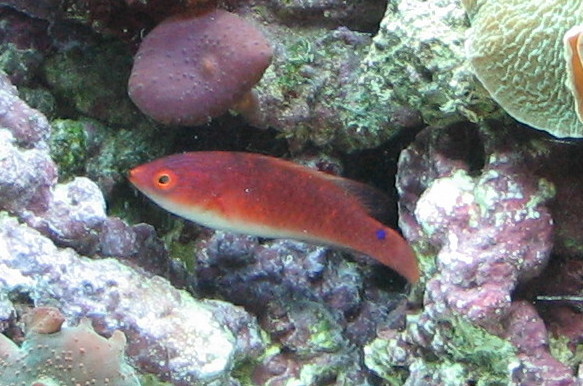
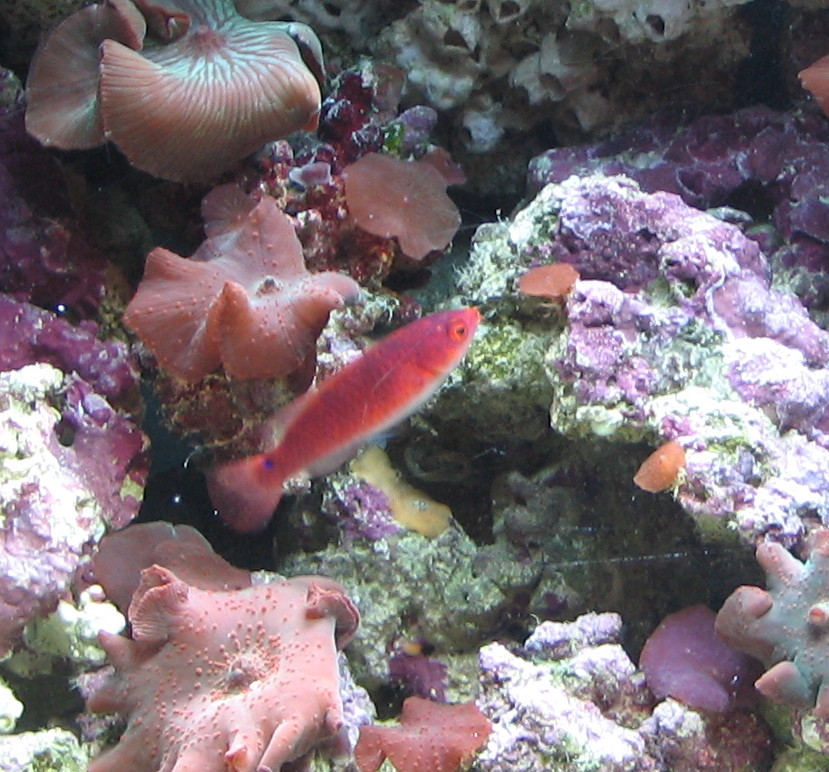
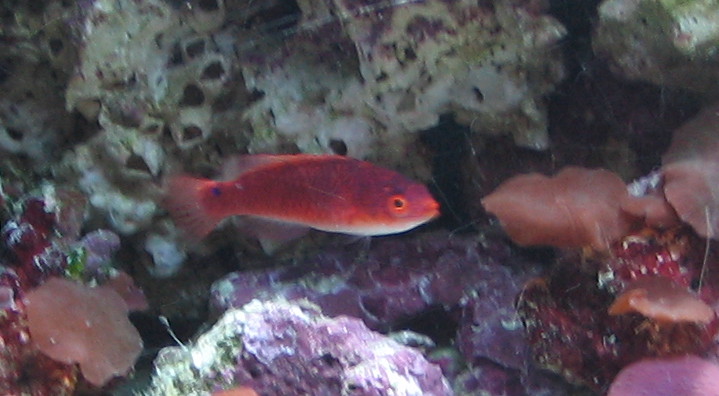
I was able to snap some more pictures of this fish.

redwrasse.jpg


redwrasse2.jpg


redwrasse3.jpg
 
Benny Z,
Good pictures, and I am sorry that I have misidentified. It seems a juvenile of Cirrhilabrus rubripinnis or of an undescribed one from southern Sulawesi. Not a member of Cirrhilabrus rubriventralis- complex. I am so sorry.
 
<a href=showthread.php?s=&postid=7210710#post7210710 target=_blank>Originally posted</a> by H.Tanaka
Benny Z,
Good pictures, and I am sorry that I have misidentified. It seems a juvenile of Cirrhilabrus rubripinnis or of an undescribed one from southern Sulawesi. Not a member of Cirrhilabrus rubriventralis- complex. I am so sorry.

Thank you for the quick reply. I believe the common name then would be a Red-Fin Fairy? Any way to tell if this is a male or female?
 
Benny Z,
It is still a juvenile; a black spot is on the caudal peduncle. Males and femals of most Cirrhilabrus members do not possess such a spot there.

If it is C. rubripinnis it is the Redfin Fairy, but if it is an undescribed one it has no popular name yet.

The latter ranges only southwestern part of Indonesia, where it is common in shallower waters. Also known from eastern Malaysia, around Sipadan.

Scott Michael sent me aquarium shots and he stated that it has been collected in Java, but now we doubt its locality. Perhaps his specimen was shipped via Java.

If your specimen will have a red blotch basally on the dorsal fin with growth, it will be an unnamed one from Sulawesi (or Malaysia). See the male of the species here. Keep up happy observation !

122564CirrSpeciesSSulawesi8cm1.jpg
 
This is the Redfin(ned) Fairy Wrasse, Cirrhilabrus rubripinnis. Still young but it has a male coloration (5cm). This species does not have such a marking on dorsal fin. It ranges the Philippines to northern Indonesia.

122564RubripinnisM5cm.jpg
 
Question, Bronco/Hiroyuki

Question, Bronco/Hiroyuki

Just got this Rosy Fin from another reefer, have not seen the black on the head like this before. Is this common or some kind of illness. There seems to be nothing wrong with him, eats like crazy.I also included a pic of one of my other favorites.
122832rscale.JPG
122832rosyfin6.JPG
 
Hey guys,

I just picked up a male linneatus at the store that was a pretty beat up around his mouth. I figured I could care for it better than the fish store could and come out with a great looking fish as long as I can heal it. Well, it's been a couple days now and it still hasn't started eating... bad sign. It's currently in a breeder cup but is desperate to get out. I'm wondering if I should set up a completely seperate QT for it, continue to try feeding in the breeder cup until it eats, or release it in the tank and hope for the best? What do you think???

Thanks
 
slobound,

I suggest you place this fish in its own QT and begin using a light dose of maracyn 2 (saltwater version) to help heal his wounds. He's probably very stressed out from the wounds and now also has the transfer shock of being moved around from one place to another. He may continue to rub up against his wounds and make things worse if he stays in the specimen cup all stressed out.
Keep the lights dim in the QT and provide a PVC fitting for him to hide and rest in. Give him two weeks in there and if possible give him a varied diet of Mysis, Krill, and cyclopeeze. FYI, also add a strong airstone to the QT while medicating him with Maracyn 2 and do some 20% water changes every 3 days. If you do this I think you'll have him up and running in a couple of weeks...ready for the big tank.
When you are ready to transfer him to the big tank use the specimen cup method with him and start this process at night right before you shut down the lights for the day.
 
GREAT! Thanks for the info bronco. I'll get the QT up this afternoon and pick up some marcyn 2! I'll update his progress soon...
 
Bronco,
Nice to hear from you again !

The Beaut,
These two are different species, the top is Rosy0scaled (Cirrhilabrus rubrisquamis; Chagos, Maldives and Sri Lanka), and the bottom is Rosy-fin (Cirrhilabrus bathyphilus). They differ in coloration of dorsal fin and that of chest. Both are nice pics.
 
first off.. I would like to thank everybody here that has contributed to this great thread... I've learned a lot and enjoyed looking at the pictures of different fairies and flashers.. I've been really into fairies and flashers since two months ago when I purchased a flasher out of the blue... Just out of curiosity, what is your oldest fairy or flasher? just wanted to know the average life span of these beautiful animals on a fish tank...

Thanks in advance..

Marvin
 
Thanks Hiroyuki......work is really busy right now and it's been keeping me away from the thread.

I see your very active here. Great to have you.
 
I have a 4 year old orangeback and a flame almost 5. In the past I've had a Lineatus for 4 1/2" years. Died in a heater accident, otherwise it would have kept on going strong.
 
Yikes! I came home from work today and there is a gaping hole on the left side of the head of the red wrasse I've posted pictures of! The flesh is torn and is hanging loosely and there is about 2cm of white flesh exposed. I'll try to get a shot of it later tonight.

What can I do to help mend the wound?

Do you think this was caused by him scraping his head on a rock, or do you think my Carpenter could have done this? The Carpenter flashes at this wrasse every now and then and they chase each other around the tank a lot, but there have never been any obvious signs of attack before.

???
 
Status
Not open for further replies.
Back
Top