
First Sump Build...Suggestions Please!!

Hi Everyone,

I'm new to the site and new to saltwater. I have a 20 gallon tall that i bought already set up on craigslist which i have had for 2 months now. It came with a protein skimmer, UV sterilizer, an in-tank filter, and 2 powerheads. This week i am building a 10 gallon sump for my system. I have a crude drawing of my design but would appreciate input and suggestions from more experienced individuals like yourselves. I have a few questions first.

1.) What is the best filtering media to use in the first chamber? I have heard of the sock method and i have also seen what look to be plastic balls ( im sorry for my lack of lingo). What is the pros and cons of these methods.

2.) What kind of pump should i be looking to get. I'm not really asking about size but more the type of pump. Also is the flow of these pumps adjustable?


Any other tips and suggestions are greatly appreciate. Please see the attachment to see the design.
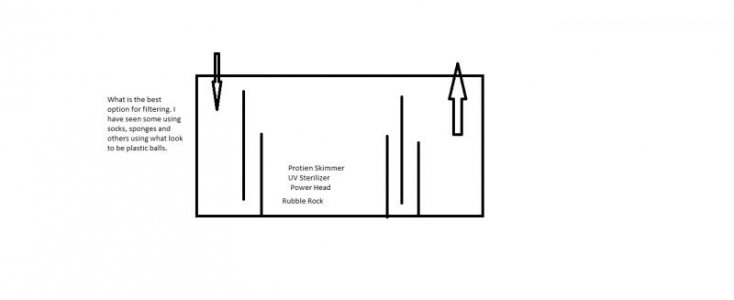
 

Attachments

  • Sump Design.jpg
    Sump Design.jpg
    11.8 KB · Views: 20
Welcome to RC and the hobby!

There are at least as many opinions as there are reefers so...

Current thought is to not use any mechanical filter or bio balls. In your design you could eliminate the first set of dividers.

For a return pump, it should be capable of 5-10 water exchanges per hour. So for 20G that would be anywhere between 100 and 200 gph. Your overflow has to be sized to handle this otherwise it's flood time! Does the tank currently have an overflow?

Most pumps can be adjusted by adding a valve to the output. Never restrict the input. There are DC pumps that can be run at different speeds.

You might want to spend some time reading the 'New to the hobby' subforum. Lots of great info there.
 
Thanks for your reply and suggestions, I have actually spent the last 30 minutes in the new to the hobby forum. The tank does not currently have an overflow, I was just planning on buying an overflow box. How do I know what size box to get?
 
Thanks for your reply and suggestions, I have actually spent the last 30 minutes in the new to the hobby forum. The tank does not currently have an overflow, I was just planning on buying an overflow box. How do I know what size box to get?

Are you drilling the tank? This provides the most reliable OF but does risk the tank during drilling.

OFs are rated for flow. So let's just say you wanted 7 water exchanges per hour for your 20G. That would be 7x20=140gph. Find a pump rated for at least that (there will be loss from head and pipe) and an OF rated for at least that and you should be good to go.

How is the tank set up now? Is there a HOB filter? HOB skimmer?

You mention you are new to SW. Are you new to aquariums? I ask because a 20g is hard to do for a rookie. Small tanks are actually harder than larger because they can fluctuate much faster that larger tanks. I recommend a minimum of 55G for a rookie.

Another thought... :o
You might want to consider something like the JBJ AIO tank. This comes already setup with an internal sump so lots of the technical aspects of sump construction are already set up for you. As you are just starting out, it's better not to get stuck with the frustrations of DIY.
 
Are you drilling the tank? This provides the most reliable OF but does risk the tank during drilling.

OFs are rated for flow. So let's just say you wanted 7 water exchanges per hour for your 20G. That would be 7x20=140gph. Find a pump rated for at least that (there will be loss from head and pipe) and an OF rated for at least that and you should be good to go.

How is the tank set up now? Is there a HOB filter? HOB skimmer?

You mention you are new to SW. Are you new to aquariums? I ask because a 20g is hard to do for a rookie. Small tanks are actually harder than larger because they can fluctuate much faster that larger tanks. I recommend a minimum of 55G for a rookie.

Another thought... :o
You might want to consider something like the JBJ AIO tank. This comes already setup with an internal sump so lots of the technical aspects of sump construction are already set up for you. As you are just starting out, it's better not to get stuck with the frustrations of DIY.

Just a heads up: most, if not all, commercial overflows are way overrated in flow capacity. This is due to both effective linear length and drain capacity. The effective length usually being 1/2 to 2/3 less than the actual length. The effective length, not the actual length, determines the flow capacity.

Also, all-in-ones are convenient, however, like everything else that is all-in-one they don't do anything particularly well...IME or if you prefer MHO, it is better for a beginner to learn the basic ways of doing things rather than the convenient or short cut things. They will learn a lot more, a lot sooner, which is good for the animals. Not only that, but sumps are so incredibly simple to set up, it is hard to justify the purchase of all-in-ones or even prefabbed sumps...and save for the set of baffles that are not necessary, he has it done.

For the OP:

The smallest recommended tank size for a beginner is 40 gallons, which is also the smallest practical size for a marine system. Most marine species have minimum tank size requirements, and those requirements are all 40 gallons and larger. 60 gallon being the most common. There are quite a few reasons for this, too many to enumerate here. I agree with aquanut, but I don't agree with his tank choice: a 55 (as well as tanks with similar proportions) is a poor choice for a marine system: Too small a surface area for the volume, and you cannot get a decent sump under them.

I would suggest you pick up a 40 breeder at a petco $1/gallon sale, and use the 20 for a sump. 20 is not an ideal sump, but... Your initial investment will be higher, but the chances of having a successful experience will be greatly increased. A 50 breeder is also a good starter tank, but then a 120 gallon is not a bad place to start: in the long run you will save money, by avoiding the inevitable stops along the way. I started with a 20 many years ago—big mistake.

Mechanical filter media is not something that is needed in a marine system, so there really aren't any decisions to make concerning that. When mechanical filtration is used, there are problems associated with the filter.

Nanos and pico tanks, should be reserved for advanced hobbyist that have at least a year in the hobby. For some species, there is a 1 - 1 recommendation: 1 year in the hobby, the tank running at least 1 year. This applies especially to anemones. This hobby is about the welfare of the animals, every bit as much as anything else. :)
 
Last edited:
Hi Everyone,

I'm new to the site and new to saltwater. I have a 20 gallon tall that i bought already set up on craigslist which i have had for 2 months now. It came with a protein skimmer, UV sterilizer, an in-tank filter, and 2 powerheads. This week i am building a 10 gallon sump for my system. I have a crude drawing of my design but would appreciate input and suggestions from more experienced individuals like yourselves. I have a few questions first.

1.) What is the best filtering media to use in the first chamber? I have heard of the sock method and i have also seen what look to be plastic balls ( im sorry for my lack of lingo). What is the pros and cons of these methods.

2.) What kind of pump should i be looking to get. I'm not really asking about size but more the type of pump. Also is the flow of these pumps adjustable?


Any other tips and suggestions are greatly appreciate. Please see the attachment to see the design.

1) I would suggest you redesign the sump. Take out the first set of baffles and consider a 4 inch filter sock, changed out every 2-3 days. This will catch any large debris coming in from the overflow. Also it will eliminate the need for the first bubble trap as the sock will handle most of the bubble created by draining. You can simply hang it with a piece of 1/2 inch PVC pipe. Bio balls are just a nitrate factory.

2) Any pump that's rated for the amount of flow you need. Many of the smaller pumps will have a cover that can be turned to decrease flow. You can buy more reliable brand names or pick up a pump at Harbor Freight for $10. (What I use for my reactors and uv) Keep in mind of head height. Match the flow with the overflow box.

Also you don't need a powerhead in your sump. If you have room you can put live rock rubble anywhere in the sump to increase biological filtration. You can even place it in a DIY egg crate container or tupperware with tons of holes to make it easy to pull it all out when you do complete sump clean outs.

Good luck.
 
Again I appreciate your responses. I am really only asking about the sump. I know other suggestions like a bigger tank are great but its not what I am looking for. I know smaller tanks are not great for beginners but I like my set up and only want to improve it, not buy another. From the many articles I have read about nano and pico tanks the big issues are overstocking and water quality. I have been in the freshwater hobby for 5+ years and know the danger and pain of overstocking. I have one clown fish. I check my water daily and every 10-14 days I send a sample to work with my girlfriend who is an R&D chemist for LaMotte. Like I said I appreciate these comments as they are in the best interest of the animals that we keep which is always the most important thing whenn keeping any animal but I really just need tips on the sump.

My tank is not drilled. I am just buying an overflow box made by eshopps. These semm to have decent reviews online.


Thanks,
 
1) I would suggest you redesign the sump. Take out the first set of baffles and consider a 4 inch filter sock, changed out every 2-3 days. This will catch any large debris coming in from the overflow. Also it will eliminate the need for the first bubble trap as the sock will handle most of the bubble created by draining. You can simply hang it with a piece of 1/2 inch PVC pipe. Bio balls are just a nitrate factory.

2) Any pump that's rated for the amount of flow you need. Many of the smaller pumps will have a cover that can be turned to decrease flow. You can buy more reliable brand names or pick up a pump at Harbor Freight for $10. (What I use for my reactors and uv) Keep in mind of head height. Match the flow with the overflow box.

Also you don't need a powerhead in your sump. If you have room you can put live rock rubble anywhere in the sump to increase biological filtration. You can even place it in a DIY egg crate container or tupperware with tons of holes to make it easy to pull it all out when you do complete sump clean outs.

Good luck.

While to an extent this is true, no marine system has a lack of nitrate producing bacteria, or 'biological filtration.' Every single surface, be it rock, glass, pipe, provides a substrate for nitrifying bacteria. Adding rock in a sump is just adding to the nitrate problems. The rock rubble is not going to do anything else. Quite literally, it is no different than using bio-balls. The only difference is you can make an aquascape out of rock, and you can stick corals to it...with the somewhat silly rules of thumb, most tanks have too much rock in them from the get go.

Also, putting sand in a sump, outside of some very specific conditions, contributes to nitrate problems as well as other pollution problems.
 
While to an extent this is true, no marine system has a lack of nitrate producing bacteria, or 'biological filtration.' Every single surface, be it rock, glass, pipe, provides a substrate for nitrifying bacteria. Adding rock in a sump is just adding to the nitrate problems. The rock rubble is not going to do anything else. Quite literally, it is no different than using bio-balls. The only difference is you can make an aquascape out of rock, and you can stick corals to it...with the somewhat silly rules of thumb, most tanks have too much rock in them from the get go.

Also, putting sand in a sump, outside of some very specific conditions, contributes to nitrate problems as well as other pollution problems.

I would like to believe there is a lot more surface area on a 1 inch square piece of porous rock than a 1 inch square piece of glass. Maybe 5 to 10 times more. I dont know.

Nevertheless, I doubt you would have much success without rock in a system with any kind of bioload that would be enjoyable to call, "your tank". And any way to increase biological filtration, especially in a small tank is good.

A filter sock will catch nearly all detritus coming into the sump. And as my suggestion of an egg crate container it makes pulling it out and shaking it off in some water change water very easy. Like 5 seconds easy. If it needs to be done at all.
 
I would like to believe there is a lot more surface area on a 1 inch square piece of porous rock than a 1 inch square piece of glass. Maybe 5 to 10 times more. I dont know.

Nevertheless, I doubt you would have much success without rock in a system with any kind of bioload that would be enjoyable to call, "your tank". And any way to increase biological filtration, especially in a small tank is good.

A filter sock will catch nearly all detritus coming into the sump. And as my suggestion of an egg crate container it makes pulling it out and shaking it off in some water change water very easy. Like 5 seconds easy. If it needs to be done at all.

If this were indeed true, we would still be using bio-balls, which are far more efficient at converting ammonia to nitrate than rock, due to how they are used, and no one would have nitrate problems. You can't have nitrate problems if there is insufficient 'biological filtration' in the system. The real issue with marine systems is not nitrate, or phosphate for that matter. Rather it is the build up of dissolved organics that bring a system down. Controlling nitrate levels is part of the equation, and you don't control them by producing more of them, in a area that is intended to export them, as well as export a percentage of the dissolved organics. It is simply illogical.

You do not need more surface area for bacterial colonization. This is a myth. When a tank is initially cycled, x amount of bacteria will populate x amount of surface area, keeping in mind that is every square micro meter of surface area. This brings how the tank is initially cycled into the equation, and that many do not do this right anymore, due to many of the same myths. After that, the population will remain fairly stable, death/growth rate being much in balance. Changes in load, will bring about metabolic rate changes, not the need for additional colonization. If you increase the population, the metabolic rates will slow down, and the net result will be no change.

There is no difference in 'biological filtration' needs in a nano or pico, than there is in larger tanks, proportionally speaking, especially if we look at the maximum possible bio-load. The supposed need for more surface area is a myth; that both small and large tanks all show excessive nitrates, makes it clear there is no lack of 'biological filtration' in smaller tanks, and what is actually lacking is dissolved organic control and nitrate control. Putting rock and sand in the sump (depending on implementatoin) is fighting the fire with gasoline.

Be careful not to assume I am saying rock is not needed. What I am saying is in a given size tank, there will be more than enough rock, sand, or other substrates in the DT, to 'biologically filter' the water, making the need for additional 'biological filtration' pointless, and merely makes the nitrate levels higher. Denitrification is a completely seperate topic, and rock is not involved with this.
 
If this were indeed true, we would still be using bio-balls, which are far more efficient at converting ammonia to nitrate than rock, due to how they are used, and no one would have nitrate problems. You can't have nitrate problems if there is insufficient 'biological filtration' in the system. The real issue with marine systems is not nitrate, or phosphate for that matter. Rather it is the build up of dissolved organics that bring a system down. Controlling nitrate levels is part of the equation, and you don't control them by producing more of them, in a area that is intended to export them, as well as export a percentage of the dissolved organics. It is simply illogical.

You do not need more surface area for bacterial colonization. This is a myth. When a tank is initially cycled, x amount of bacteria will populate x amount of surface area, keeping in mind that is every square micro meter of surface area. This brings how the tank is initially cycled into the equation, and that many do not do this right anymore, due to many of the same myths. After that, the population will remain fairly stable, death/growth rate being much in balance. Changes in load, will bring about metabolic rate changes, not the need for additional colonization. If you increase the population, the metabolic rates will slow down, and the net result will be no change.

There is no difference in 'biological filtration' needs in a nano or pico, than there is in larger tanks, proportionally speaking, especially if we look at the maximum possible bio-load. The supposed need for more surface area is a myth; that both small and large tanks all show excessive nitrates, makes it clear there is no lack of 'biological filtration' in smaller tanks, and what is actually lacking is dissolved organic control and nitrate control. Putting rock and sand in the sump (depending on implementatoin) is fighting the fire with gasoline.

Be careful not to assume I am saying rock is not needed. What I am saying is in a given size tank, there will be more than enough rock, sand, or other substrates in the DT, to 'biologically filter' the water, making the need for additional 'biological filtration' pointless, and merely makes the nitrate levels higher. Denitrification is a completely seperate topic, and rock is not involved with this.

Makes perfect sense. Perhaps I'll yank my rock crate, although it's crawling with pods so I'm hesitant to give it up. I purposefully did not set up a fuge for the reasons you mentioned. I figured it would be something I would neglect and would become filthy. Furthermore, my understanding is you need a substantially sized fuge to make any kind of dent in nutrient export.
 
Makes perfect sense. Perhaps I'll yank my rock crate, although it's crawling with pods so I'm hesitant to give it up. I purposefully did not set up a fuge for the reasons you mentioned. I figured it would be something I would neglect and would become filthy. Furthermore, my understanding is you need a substantially sized fuge to make any kind of dent in nutrient export.

Here again, we can apply a little logic to the pod population in the sump. We know that pods will populate we will say a 'rocky environment' in the sump. Therefore it is only logical that they would also populate the rocky environment in the display tank. Well it seems that not many pods are seen, if any, in the DT, because they are gobbled up pretty quickly. It is natural to assume it is necessary to breed them elsewhere, then right?

Not really. You have noted a sizable population of pods in the sump. Great! But wait, why are all the pods in the DT gobbled up, yet there is a good population in the sump. Rather than being a food source for the other critters, the pods are remaining in the sump, doing nothing but adding to the biological oxygen demand, and producing more dissolved organics, which in turn are producing more nitrates. This furthers the cause of using your export facilities as production facilities...

Culturing natural food sources has always been a part of the hobby. However, a little more care—in choosing where to do such culturing, should be used. The all-in-one approach is not unique by any means, but most should know, that even though an all-in-one (anything) may do several things at once, it will not do anything particularly well...since it is all about the water, the methods we use should be the best at a particular task.
 
Back
Top