
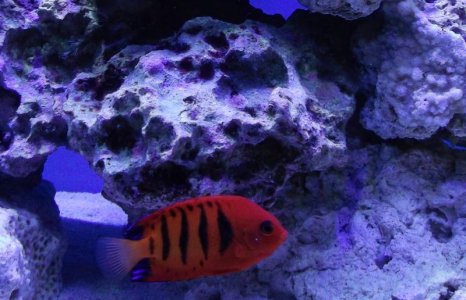
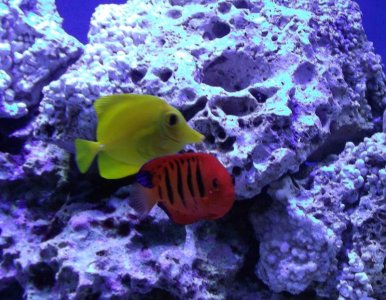
Hi everyone. First post here. I have been keeping saltwater aquariums for 35 years, but believe it or not this is my first flame angelfish. My flame angelfish has been in the tank (I only have one tank) for 5 days, and today I see a single white spot that looks like the "grain of salt" appearance that I usually think is cryptocaryon. Two pics are attached.
Over the decades I have had many run-ins with parasites and diseases, and this one isn't quite like what I have had in the past. First, the fish is very active and feeding. Second, it has not scratched a single time. Third, there is only one single spot. Fourth, no other tank mates show any signs or symptoms. Fifth, the spot is sticking way out farther than I am accustomed to seeing, almost like a small fungus spot.
I know that any one or two of these indicators would not be any reassurance, but I have never had a problem where there were no other warning signs except the spot itself.
Before I net all of the fish out of the tank, does anyone else have any other ideas? Questions that inevitably will be asked:
No the fish was not quarantined (yes, I know, and I don't need to hear it again)
Tank size is 40 gallon
PH, ammonia, nitrite, nitrate, phosphate all perfect according to recent tests by LFS
Salinity 1.023 to 1.024
Coralline algae is growing, no unwanted algae is growing, and two anemones are happy, so I assume tank is otherwise in good shape
No corals are in the tank
Fish inhabitants are 1 Heniochus, 1 small yellow tang, and the flame angelfish
No other inhabitants show any signs of distress or disease
Tank age is ~5 months
Water changes every 2 weeks
I use my own RODI water for changes and top offs
I'm tempted to leave the angel in the tank to see what happens. In the past I have seen a suspicious spot disappear and never come back, but I also have been hit with a wiped out tank once in the past where every fish got covered with spots and died. It almost looks like a single tiny fungus spot like from one scale that got ripped off by a net, but I obviously can't say for sure.
I live in a tiny (and I mean tiny) apartment, and therefore I do not have another tank to remove the fish. I suppose I could find a way to set up a 10 gallon somewhere somehow, but it's not going to be possible immediately. I don't have the equipment on hand, and I would have to find someplace to put it temporarily, probably right in the middle of the living room floor.
I don't want to overreact, but I also don't want to loose these three fish and then have to leave the tank vacant for 2 months. All suggestions welcome. Thanks.
-Jax Reef-
Over the decades I have had many run-ins with parasites and diseases, and this one isn't quite like what I have had in the past. First, the fish is very active and feeding. Second, it has not scratched a single time. Third, there is only one single spot. Fourth, no other tank mates show any signs or symptoms. Fifth, the spot is sticking way out farther than I am accustomed to seeing, almost like a small fungus spot.
I know that any one or two of these indicators would not be any reassurance, but I have never had a problem where there were no other warning signs except the spot itself.
Before I net all of the fish out of the tank, does anyone else have any other ideas? Questions that inevitably will be asked:
No the fish was not quarantined (yes, I know, and I don't need to hear it again)
Tank size is 40 gallon
PH, ammonia, nitrite, nitrate, phosphate all perfect according to recent tests by LFS
Salinity 1.023 to 1.024
Coralline algae is growing, no unwanted algae is growing, and two anemones are happy, so I assume tank is otherwise in good shape
No corals are in the tank
Fish inhabitants are 1 Heniochus, 1 small yellow tang, and the flame angelfish
No other inhabitants show any signs of distress or disease
Tank age is ~5 months
Water changes every 2 weeks
I use my own RODI water for changes and top offs
I'm tempted to leave the angel in the tank to see what happens. In the past I have seen a suspicious spot disappear and never come back, but I also have been hit with a wiped out tank once in the past where every fish got covered with spots and died. It almost looks like a single tiny fungus spot like from one scale that got ripped off by a net, but I obviously can't say for sure.
I live in a tiny (and I mean tiny) apartment, and therefore I do not have another tank to remove the fish. I suppose I could find a way to set up a 10 gallon somewhere somehow, but it's not going to be possible immediately. I don't have the equipment on hand, and I would have to find someplace to put it temporarily, probably right in the middle of the living room floor.
I don't want to overreact, but I also don't want to loose these three fish and then have to leave the tank vacant for 2 months. All suggestions welcome. Thanks.
-Jax Reef-
Attachments
Last edited:


