gap between tank and stand

"engineering standards" depends on what the specs and tolerances are. Glass is flexible. and a small amount of variance is probably ok. The problem is a larger variance and larger amount of flexion puts more stress on the glass and more importantly more stress on the silicone joints. The bottom glass plate will flex downward, but the glass wall that is standing on edge will not. At all. All that stress is being put on the silicone joint. At some point this joint will fail prematurely, you just don't know when.

I challenge anyone to show specs from aquarium manufacturers showing how much of a gap is acceptable under a tank; I have yet to see such data.

Given the unknowns, the problems of a blown seal in X months and the relative ease of leveling a stand before the tank has water in it, it seems like a no-brainer to me.

But then I'm just an engineer.

Dougdstecklein - sorry for the hassle of leveling your tank, but I (obviously) think you made the right choice.
 
Definitely fix the stand. I had a stand that I made when I was a kid, and I made it unlevel. I used some styrofoam per my lfs's advice. It lasted maybe a month until the weight of the tank had me shimming it to get it level.
 
Sleepydoc,

They won't tell you what is acceptable. It puts them at risk if you are within tolerance and it still leaks.

I have two 150's, one brand new; the other is about 10 years old. The bottom braces have such huge gaps in them. Essentially, the tank rests on the 4 corners and the short sides and hit or miss along the long runs of the brace.

This alone would put stress on the tank, yet one is doing well 10 years later. I also put a veneer on the glass of a 150 I took apart after the outside corner got chipped (darn kids). The glass thickness on the front piece varied 4 thou over the span of 6 feet, and 3 thou over 2 feet in height. The bottom varied 10 thou over the same distance.

Nothing is ever going to be true and flat. Our goal should to be minimize or eliminate the gaps as much as we can, but they will be there.
 
I challenge anyone to show specs from aquarium manufacturers showing how much of a gap is acceptable under a tank; I have yet to see such data.

I was just told directly by Perfecto to ignore a 1/8" corner gap between their tank/stand and fill with water. They said the tank would "settle" when full. I don't like that answer.
 
"engineering standards" depends on what the specs and tolerances are. Glass is flexible. and a small amount of variance is probably ok. The problem is a larger variance and larger amount of flexion puts more stress on the glass and more importantly more stress on the silicone joints. The bottom glass plate will flex downward, but the glass wall that is standing on edge will not. At all. All that stress is being put on the silicone joint. At some point this joint will fail prematurely, you just don't know when.

I challenge anyone to show specs from aquarium manufacturers showing how much of a gap is acceptable under a tank; I have yet to see such data.

Given the unknowns, the problems of a blown seal in X months and the relative ease of leveling a stand before the tank has water in it, it seems like a no-brainer to me.

But then I'm just an engineer.

Dougdstecklein - sorry for the hassle of leveling your tank, but I (obviously) think you made the right choice.

A wee bit of History: popular aquaria came out of the toy departments. One of the first major brand of tank was Mettaframe; Mattel bought and owned it for much of its existance. I would be surprised if there is even one engineer anywhere close to a name brand shop; maybe I'm wrong on that, but i believe they are made of glasscutters and glue guns and not likely those with 18-20 plus years of education. Its not like a nose cone produstion facility for a Boeing airplane where everything is observed and designed by an RPI grad. Engineers are specialists and not very many can tell you what happens in say a 1" pipe at 50gpm, but they likely have an associate who might.

I'm glad you managed to knock the crown out of it.
 
Sleepydoc,
I have two 150's, one brand new; the other is about 10 years old. The bottom braces have such huge gaps in them. Essentially, the tank rests on the 4 corners and the short sides and hit or miss along the long runs of the brace.

Hit and miss is much different (and better) than missing completely, or worse yet, rocking on a point. What it means is the glass is being asked to support a shorter span than 6'. This is essentially how the Marineland stand for my 120 is designed - support at the corners and a solid support in the middle. The cross piece along the front on either side is in contact with the tank, but (based on the design) I don't suspect it is providing significant support. The difference is that all 6 points (4 corners and 2 middle) are all on the same plane.

This alone would put stress on the tank, yet one is doing well 10 years later. I also put a veneer on the glass of a 150 I took apart after the outside corner got chipped (darn kids). The glass thickness on the front piece varied 4 thou over the span of 6 feet, and 3 thou over 2 feet in height. The bottom varied 10 thou over the same distance.

Not sure what you mean there - the glass thickness will not vary or change appreciably after it is cast/cut. Were you referring to the thickness of the silicone seal?

Nothing is ever going to be true and flat. Our goal should to be minimize or eliminate the gaps as much as we can, but they will be there.

Exactly - which goes back to the original post. Before filling the tank it is (relatively) easy to fix the problem. Afterwards, not so much.
 
No, the glass is not the same thickness over the span of the tank. It is not uniform in thickness. I removed the silicone, the glass is just different thickensses.
 
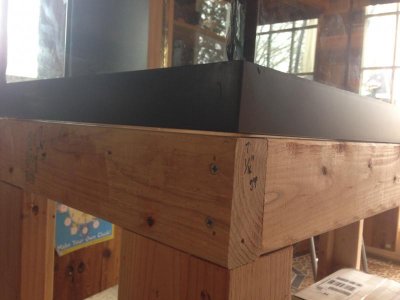
So I finished building the stand and decided to fill the tank up in my garage to test for leaks. I had assumed that any gaps under a 1/16" would disappear under the weight of the filled tank. I also thought the weight would push the crown out of the center of the 2x4s since they are unsupported. Neither of these two things happened. All gaps are still visible. Luckily I sanded until the gaps were less than a 1/16". Here is a picture of the gaps before sanding.
 

Attachments

  • image.jpg
    image.jpg
    41 KB · Views: 22
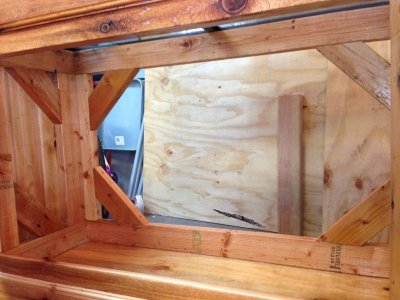
Here is the frame of the stand. I attached my plywood floor underneath the stand to give me an extra 4 inches of height for the sump. This also gives me a space to contain spills of up to 5 gallons to the stand and not on my carpet.
 

Attachments

  • image.jpg
    image.jpg
    61.6 KB · Views: 22
I would be doing some more sanding till the tank sits flat and square on the stand. Saying that gaps ~>=1/16, is a dodge: to tell you what you want to hear.

The stress caused by the "hump" (the crook") puts stress on the tank at the high point. So that point goes up, and the ends go down. It is not exactly the way it should be. You want ZERO stress on the tank, achieved by having the tank sit flat on the stand with no water in it.

I could have told you that filling it would not fix it. But I don't think you really asked...;) Better you found out for yourself. Just lucky the tank did not go "boom." :) Sometimes it is not good to find things out the hard way.
 
After I spent a few hours sanding out the humps I felt like it was a little overkill, but now that I can see that the weight of the tank does not push out the remaining imperfections, I agree, that all gaps should be fixed. I feel comfortable with the 1/32" gaps I have left, especially since they are only about 6 inches in length. The majority of the tank sits perfectly flush and distributes the weight evenly over 95% of the tank.
 
This is the kind of post that I was looking for. I am having the exact same problem. My stand is built and the tank is on the stand but one end has some gap. It is about 3/16 gap for about a foot from one end of the tank then levels out. About the distance of the overflow inside. It is every bit 3/16 of a gap. The tank is 7ft long and shows to be perfectly level but its obviously not. I can pull down on that one end and it pops the other end up just a bit, like a seesaw. How do i fix this? I definately dont want to spend 3k on a tank only to have it shatter when i fill it with water. The stand and tank show level even with the small gap at one end. Does that mean there is a small hump in the middle? The tank sits on plywood. So is the plywood humped up in the center? I just dont get it with everything showing perfectly level on my level no matter where I put it. Any advice? I am still grabbing equipment like sump and skimmer so I have time to fix this. What do I do?3/16 seems rather large for a gap...
 
That is a pretty large gap. What I did was set the tank on the stand and mark the stand in the places where the gaps end with a vertical line. I did this on the side of the 2x4 that my tank rests on. I also drew a horizontal line 1/8 inch down from the top of the 2x4 the length of my stand(1/8" was the width of my gap). As I sanded I used the lines as reference points to how much and where I needed to sand. I still had to put the tank back on the stand 4-5 times to recheck the gaps and remark and resand. It's a pain in the butt, especially with a large tank, but I'm glad I did it.
 
Not sure I 100% follow what you mean. With the gap being just on that one end do i take the tank off and sand in the middle? I am guessing it is a hump since one end is flush and it is flush all the way until the last foot or 10 inches...Or what about adding another piece of plywood on top of the one i have now?
 
I can't tell from the level pics if you are leveling the stand or the tank. Either way it's not level yet!

So one end of the tank is not touching the stand? That's not good. Looks like you'll have to remove lots of material on the 'touching' side of the stand to get good contact. If you don't have a hand plane this will be a PIA with sand paper. If the tank is not in good contact with the stand you are creating stresses. Will the tank fail? Most likely. It might be OK for quite some time then, while you are on vacation, CRACK! Murphy always gets his due!
 
You would need to sand down all areas of the stand that are flush so that the 3/16" gap narrows. If the only gap is the last ten inches, it might be easier just to fill in that section with something. I would consider ripping a 2x4 to 3/16" and glueing it to the 10" area with the gap. Then, if you need to, you can sand the "shims" you added until the tank sits flush.
 
What if I ripped a new piece of plywood, grabbed a straight board and made sure it was level and put it in place of the jacked up one? Is that a fix? I just know taking the stand off and sanding, putting it back on and checking is a chore with a 400 lb tank and doing it alone...
 
My problem was the tank, not the lumber. You need to take your straight edge level and see if your problem is the tank or the stand. If it is the tank, new lumber isn't going to help.
 
Back
Top