
You are using an out of date browser. It may not display this or other websites correctly.
You should upgrade or use an alternative browser.
You should upgrade or use an alternative browser.
green tipped pbta
- Thread starter Coralgrabber
- Start date


OrionN
Moved on
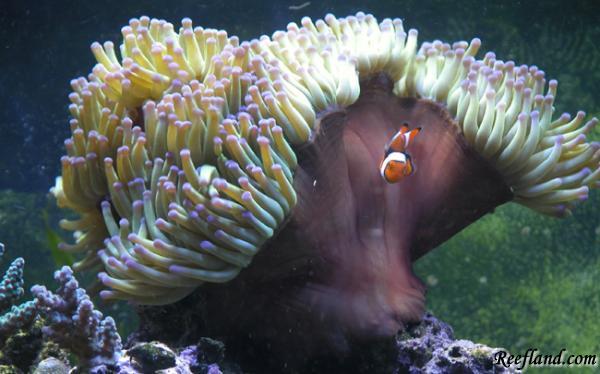
It looks like a H. magnifica (Ritteri). What the bubble tips look like. BTA have dilation, the bubble, not at the tip but just near the tip which give it a nipple look. Magnifica sometime have dilated tip at the end.
If it has bubble tip with nipple then it is a BTA, otherwise, it is more likely a Magnifica.
Magnifica needs much brighter light and much more flow than BTA, much bigger, more aggresive too.
If it has bubble tip with nipple then it is a BTA, otherwise, it is more likely a Magnifica.
Magnifica needs much brighter light and much more flow than BTA, much bigger, more aggresive too.
Amphiprion
Premium Member
I am having a difficult time finding any verrucae on the underside of this anemone, so at first glance, I don't think it is H. magnifica. It just looks like a very nicely colored E. quadricolor to me. a better pic of the underside and the presence or absence of verrucae will give a more definite ID.
OrionN
Moved on
How does that rule out H. magnifica. Neither E. quadricolor nor H. magnifican have any verrucae. The tentacles have the look of H. magnifica instead of E. quaduadricolor<a href=showthread.php?s=&postid=8266900#post8266900 target=_blank>Originally posted</a> by Amphiprion
I am having a difficult time finding any verrucae on the underside of this anemone, so at first glance, I don't think it is H. magnifica. It just looks like a very nicely colored E. quadricolor to me. a better pic of the underside and the presence or absence of verrucae will give a more definite ID.
Amphiprion
Premium Member
<a href=showthread.php?s=&postid=8267248#post8267248 target=_blank>Originally posted</a> by OrionN
How does that rule out H. magnifica. Neither E. quadricolor nor H. magnifican have any verrucae. The tentacles have the look of H. magnifica instead of E. quaduadricolor
Actually, H. magnifica have faint verrucae, whereas E. quadricolor's may as well be nonexistent
 .
.

Amphiprion
Premium Member
They aren't nonexistent in H. magnifica, rather, they can be translucent and be the exact same color as the column. They may be hard to see, but are not really approaching nonexistent. This characteristic, however, is variable in this species, as some verrucae can be darker or lighter.
http://www.edge-of-reef.com/anemoni/ESAHeteractismagnificaen.htm
This link shows an H. magnifica with quite visible verrucae in the fourth pic down--anything but nonexistent.
http://www.edge-of-reef.com/anemoni/ESAHeteractismagnificaen.htm
This link shows an H. magnifica with quite visible verrucae in the fourth pic down--anything but nonexistent.
OrionN
Moved on
Well, as you can see in the two pictures I posted. High quality pictures that show essentially non existentent verrucae.
My point is that we cannot use non visible verrucae as aomething to rule out H. magnifica. IMO/IME Coralgrabber anemone looks more like H. magnifica than BTA. To tell the different between the two species from picture of a non settle, not yet healthy anemone may be difficult.
My point is that we cannot use non visible verrucae as aomething to rule out H. magnifica. IMO/IME Coralgrabber anemone looks more like H. magnifica than BTA. To tell the different between the two species from picture of a non settle, not yet healthy anemone may be difficult.

puter
Active member
It would be very interesting to see an updated picture (Coralgrabber, where'd you go?). I would have confidently guessed H. magnifica as well were it not for the picture on page 91 of Fautin's "Anemone Fishes" showing an E. quadricolor similiar in color to the initial photograph.
- Mark
- Mark
Coralgrabber
New member
hey guys ,
ill take some pics tonight. The anemone right now is hanging upside down in a rock cave. My dad bought one too, so i'll post pics of both of ours.
ill take some pics tonight. The anemone right now is hanging upside down in a rock cave. My dad bought one too, so i'll post pics of both of ours.

phender
Active member
I can't believe you guys are arguing about an ID on an anemone that is totally deflated and not showing many identifying characteristics of either species. But since your are, here is my opinion.  Its a BTA. The fact that is the result of a split is also good but not conclusive evidence.
The tentacle color and shape look very similar to a BTA I sold recently.
Deflated:

Inflated:

But since your are, here is my opinion. Its a BTA. The fact that is the result of a split is also good but not conclusive evidence.The tentacle color and shape look very similar to a BTA I sold recently.
Deflated:
Inflated:
Coralgrabber
New member
it looks just like that.
phender
Active member
<a href=showthread.php?s=&postid=8270339#post8270339 target=_blank>Originally posted</a> by Coralgrabber
it looks just like that.
I thought it might. Glad I could help.
Amphiprion
Premium Member
<a href=showthread.php?s=&postid=8270327#post8270327 target=_blank>Originally posted</a> by phender
I can't believe you guys are arguing about an ID on an anemone that is totally deflated and not showing many identifying characteristics of either species.
The tentacle color and shape look very similar to a BTA I sold recently.
Deflated:
Inflated:
I wasn't arguing about the identity of the anemone (note I said at first glance)--but rather, I gave my opinion and both anemones' identifying characteristics
.Coralgrabber
New member
thanks for everyones opinions.
phender
Active member
<a href=showthread.php?s=&postid=8270522#post8270522 target=_blank>Originally posted</a> by Amphiprion
I wasn't arguing about the identity of the anemone (note I said at first glance)--but rather, I gave my opinion and both anemones' identifying characteristics
Ahh, I was just giving you guys a hard time. I have have huge respect for both you and OrionN in the anemone knowledge department.

55semireef
Moved On
Thats a very beautiful color morph of a BTA.
Similar threads


- Replies
- 3
- Views
- 658
- Replies
- 3
- Views
- 1K