HCBTA just died - MANY QUESTIONS!!

<a href=showthread.php?s=&postid=7324765#post7324765 target=_blank>Originally posted</a> by Flighty
Phender, you think doorensis, not malu? I need to brush up on my other-than-magnifica-or-bta IDs :)

A malu doesn't usually have red on their foot like that, sometimes yellow or orange, but not red. The tentacles are also too long for malu.

The tentacles in the first pic do have a somewhat LTA but I don't see any verrucae, do LTA lose their verrucae when ill?

The verrucae on LTAs are under the oral disk only. On this specimen the oral disk is so consticted that the verrucae are hard to see in the pics. I think you can just barely make some out in the second pic at the top of the anemone just behind the tentacles.
 
Thanks Phender,

I can sort of see verrucae in the second picture like you said. That thing must have been really really ill before Mary ever got it. I didn't see any verigation on the tentacles.

I hope you can get a better specimen next time.
 
I had lots more pictures. Are the verrucae the raised bumps that are after the tentacles before the red part? It had those. When I first got it, there was very light green tips on the tentacles.

Cindy, I thought from the pictures in the books that a lot of the mags looked more flat like you said, but I thought maybe it was just me. I do have one picture of a H. mag in my Fautin and Allen book, "Anemone Fishes and their host sea anemones" that looks JUST like mine (obviously a LOT healthier!!)! It's on page 33.

Oh, and I still don't have the PhosBan thing on my tank yet. But, when I do, it will NOT leach out phosphate or other contaminents back into the tank.

For clarification, the phosphate is getting into my tank because our city water has a "higher than normal" level of phosphate in it. However, prior to the day we added the clownfish and anemone, the level was only .5.

I think I ended up getting a raw end of a deal. The sad thing is that the person that sold me the nem IS a RC member!! That's why I thought the advice and specimen would be ok. I felt like it wasn't just a "LFS". Bad luck?:confused: I guess it's a live and learn situation.

I do a LOT of research before I make any changes or make a purchase. Obviously one cannot learn/know everything. I probably should have been talking to this forum first instead of just relying on my local forum and books. But I take my tanks seriously. I've been into SW under a year, but researched it for MANY years before even starting. I've done FW with live plants for 10 - 15 years and breed angelfish.

Thanks for all your help. I will just need to choose a healthier specimen next time. Now I'm all the wiser. Hopefully I'll be knowledgable enough about nems that when someone tells me it's "a" I'll be able to tell if they're correct or not!! But, it appears as if there's always some dissention... so maybe it's not neccesary to know!! Just stick to the general do's and don'ts!

 
The "other stuff" I would wory about is anything else in your water including things we don't test for. Maybe copper, iron, arsinic and even pesticides, MTBE etc. As the water evaporates and you topoff, these things concentrate and can cause hard to diagnose problems. Corals and inverts are much more sensitive to these things than freshwater systems are. Thats why most of us only use RODI because it removes everything from the water including the things we don't or can't test for.
 
Thanks Cindy.

I did actually test for Copper. There was just a trace. That was strange actually because I don't have copper pipes in my house!! LOL! I'm going to get a RO/DI unit soon.

The thing that surprises me is that all of my corals are perfect. Not a single problem. Shrimp - fine. Electric blue crab - fine. Snails - fine. I would think that if something, anything were SO whacked out to KILL something that quickly that something else should at least be showing signs of stress!! In fact, several of my corals are multiplying right now. So, I think I really did have a bad specimen that for whatever reason, I just wasn't able to save. I wonder if I had brighter lights if I could have done it? Who knows. I think I'll never know for sure. But, I think I've learned a lot.

I know about the differences between FW/SW. That's why I waited so long to get into it. I was chicken! :p It seemed like many more parameters you could screw up on and more $$$$! But, I figured that I became very successful at FW and was great with growing difficult plants and had even (unintentionally) started to raise angelfish, so I was ready for SW!
I was reading, reading, reading for a long time. So, I knew I wanted to do a live reef. Plus, it's just prettier and healthier anyway. Then, I finally took the plunge. Never been happier!
 
Well heres my opinion good or bad.

.5 phosphate isnt going to kill anything. And as far as other toxins go the snails and shrimps would bite the dust too.

As for marine animals being so "hard to keep" and the myth that you have to have "pure" water to sustain them, nothing is farther from the truth.
Freshwater fish such as Discus and Killi are harder to please than any corals.

But dont take my word for it. Heres a snippet from an article by Rober Fenner on water qualty.

The principal ingredient, by weight and volume in a marine system is... H2O. Your tap water has much more to it then Hydrogen and Oxygen. Ordinary mains water sports dissolved and suspended gases, solids, other liquids, remnants of, and organic life; and a sanitizer (usually chloramine). Here in Southern California we regularly have several hundred parts per million (ppm) of total dissolved solids (TDS) in our tap.

Does all this glop (non-scientific term) pose real problems for an earnest marine aquarist? No, in all honesty, it's minor spuds (small potatoes) compared with all the other contributing factors affecting the make-up of your system's water.

Hear me out. The E.P.A., among other agencies, mandates just how much of several (from the Middle English, meaning 'many') chemical and biological species are allowable in potable water. For instance, tap must have a concentration of less than 1.0 ppm total Nitrate (NO3). Further influences? Have you thought of the ongoing effects from dissolving substrates, rock, decor, feeding (one ounce of food in one million ounces of water would be 1 ppm), biological processes going on in your closed system? And what about the interactions between all this and the salts and more you add to the water?

If you've grown fond of lugging bottled water, utilizing reverse-osmosis, or even distilled water, more power to you. But let's keep all this in perspective. The bulk of undesirable "extras" in tap water can be either ignored or easily removed either through an in-line chemical contactor" (e.g. Aquarium Pharmaceutical's Tap Water Purifier (tm)) or commercially produced conditioners.

Not to disparage the use of more "purified" water out of hand/proportion; my point is that compared with other contributing factors, for marine systems, ordinary treated tapwater is not a major source of concern in terms of added nutrient, pollutants, metals... Freshwater biotopes (e.g. wild discus, some killies) that appreciate far less in their water are a different matter.

You can also check DR Tims articles at Marinelabs. Two people who are scientist/hobbiyst with 30 years experience.

Just my thoughts and opinions. Dont think you have to pure/sterile water to maintain your systems. Regular water changes with good salt will do more for water quality than any machine.
 
Thanks for your opinion. I got some frags and talked to another member of my LRC last night. He basically said a similar thing. Although, he said that he does use RO/DI water and pumps it upstairs to his HUGE aquarium.

He has over 30 yrs in SW and has a beautiful 500g aquarium and also a frag tank, etc. He told me that anemones actually like phosphate!! His phosphate levels are the SAME as mine, with a RO/DI unit. He has 5 or 6 anemones of varying kinds in his tank thriving well with all his magnificent corals and fish. His anemones do NOT roam the tank, but stay where placed because they are happy.

He agreed that I had a H. magnifica (although he saw more pictures than all of you), but a very poor specimen.

I'm going to continue doing what I'm doing and keep learning. I got 4 frags from him last night and they're doing beautifully!!
 
Good to hear. Dont get me wrong, using some purified water is perfectly fine if its what you want to do.

I just feel fustrated when I see a lot of posts of people with alga problems, dinoflaggelates, animals dying etc etc and everyone seems to think ro/di water will solve all these problems as if it was a miracle or something.

Makes me wonder how many of these people keep dogs? cats? birds? Birds are easily poisoned. Does the tapwater make them sick? Are the birds coming down with strange diseases because they arent given pure water?

If tapwater is good enough for animals that are near and dear to us why isnt it good enough for aquariums? I dont know.

Nine times out of ten if the person will doublecheck their biomass ratio to ensure at least 80% is geared to filtration/waste removal (lots of live rock with or without a deep sand bed and a good skimmer) decent water movement in the tank and regular water changes of 10-20% a month their problems will go away, or never appear to begin with.

All just my opinion mind you. Keep up the reading and research, its good to see someone who checks out the facts and doesnt just blindly follow the latest "must have this/do that" trends.

May those frags blossom with health and soon need fragging!
 
<a href=showthread.php?s=&postid=7325393#post7325393 target=_blank>Originally posted</a> by reefallen
I had lots more pictures. Are the verrucae the raised bumps that are after the tentacles before the red part? It had those. When I first got it, there was very light green tips on the tentacles.............

.............He agreed that I had a H. magnifica (although he saw more pictures than all of you), but a very poor specimen......

When you attempt another anemone, it will be very important that you ID it properly. While it is true that all clownfish host anemones have some major requirements in common, each species has some unique requirements as well.

The verrucae are the raised bumps that are after the tentalces and before the red part, as you stated above. The distinct verrucae and the red foot below an ivory column are traits that are unique to M. doorensis(LTA, Corkscrew anemone). The color of the foot and the column of H. magnifica (it may be red, purple, brown and even bright blue) is uniform throughout and while they do have verrucae, the verrucae are usually a slighty darker color than the column, very small and are difficult to detect.
 
Phender,

Thanks for confirming. That's what I thought about the verracue. My book on anemones and anemonefish I have that I studied before my purchase is very thorough.

As I stated in a previous email, there is a picture (taken by photographer R. Steene) on pg. 33 of Fautin and Allen's book that looks identical to the H. mag specimen that I believe I had.

In the same book, the M. doreensis is described as "tentacles, few, all alike, sinuous, evenly tapered to point, sometimes (but not invariably) assuming corkscrew sahpe. Oral disc widely flared, to 500mm diameter but commonly considerably less, with radial white lines that may extend onto tentacles; lies at surface of sediment. Column buried in sediment; lower part dull orange to brilliant red, upper part brownish with non-adhesive, prominent white round to ovoid (eye-shaped)verrucae in longitudinal rows." Fautin and Allen

Also, they go on to say that "this anemone, when touched the tentacles will shrivel or adhere to collectors hand and pull off." It also says that the column is thin and the distribution of this species is the most restricted of any anemone. There were 2 in the store. Doubtful if it were this type. And I got it at quite a reasonable price (less than $20). If it were so rare, I would think that the price would be high. Please correct me if I'm wrong in my thinking...

Very little of this description was true of my nem.

It's foot was buried in the sand, but not fully like the M. doreenisis. The colors were "similar", but again, if true, it was VERY bleached. Also the verricae description was closer to that of the H. mag. (I'll have to check on just a "LTA" or you can let me know) My nem really didn't mind if you touched it; nothing happened. My nem was capable of complete contraction. I believe the H. mags are one of the few that do this. I don't believe that the H. doreensis does. I know it goes under the sediment however. And, notice the blunt tentacles of my nem. It's characteristic of a H. mag.

I think one problem I had is that the SW owner told me to put it on the sandbed and they like rocks. All I can say is that I'm doing my best. Even amongst you "experts" there is much dissention of the id of my nem. So... All I can do is my best. If you have pictures of a M. doreensis that you think looks like my nem, I'd be happy to look at it. I haven't been able to locate one and the description doesn't seem to fit it, or it's behavior. Thanks again.
 
The Fautin / Allen book is meant to be a field guide to anemones. Unfortunately, many characteristics change when the anemones are stressed or in poor health. IDing anemones by tentacle length and shape is not always useful in captive specimens.
Your second picture shows a red foot becoming tan near the tentacles. LTAs always have this. Magnificas never have this gradiation. Unless I misunderstood you, you said that your anemone had white verrucae. LTAs and some other anemones have that. The verrucae of H. magnifica are never white and in the condition your anemone was in, probably would not have been noticable.
Neither LTAs nor mags retract very much. In your case my guess is that your anemone was more deflated than retracting. Both LTAs and mags can have a pretty powerful sting (stickiness), but in a poor state of health, it is very common for anemones to lose their ability to sting.
The fact that you only paid $20 for your anemone almost guarantees that it was a LTA. Although LTA have a smaller range than other anemones, that is relative. They are very common in their range, which extends from the Phillipines and thoughout Indonesia. It is very common in the areas where marine specimens are collected the most. Wholesale prices for non-purple LTAs range from $8 - $15 dollars depending on size. The wholesale price for even the smallest magnificas are over $20. Typically, retail mark-up is around double to triple the wholesale price. If you bought your anemone for $20, it most likely came in as a LTA.
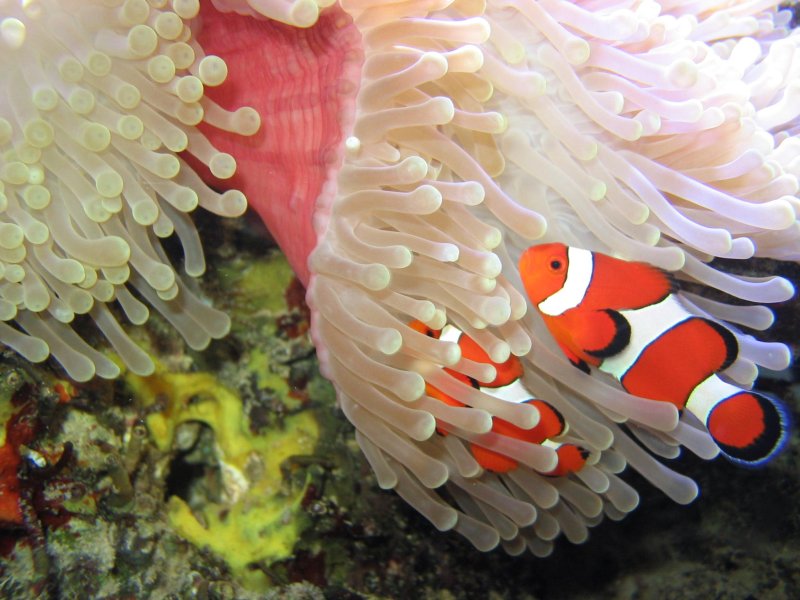
The radial stripes are often not present in LTAs. Your anemone didn't bury itself deep in the sand because it was almost dead. A magnifica wouldn't have even tried. The tentacles in your pics would be considered pointed. Mags tend to have almost a bulb at the end of their tentacles. Here is a mag pic from the anemone gallery.(its Gary's pic)
7144132_3228_1_.jpg


and this is the last you will see me on this thread.....probably.
 
I can't disagree with any of that. It seems like we could do a beter job of an anemone ID faq on this forum. See my galery for more pics of magnificas and some of BTAs for comparison.
another magnifica:
56032nem.JPG
 
Thanks both of you. And it makes sense what you said about differences in captivity and when stressed or in poor health. I think that books should spend times talking about that too!! It would really be useful!!

Maybe my nem was a LTA. That seems to fit more accurately. Do LTA's have a specific Genus and species?

It didn't really have the graduated foot until at the end when it was dying. It was all red until then. Do you think that since it was in such poor shape, that is why is it so difficult to identify?

Unfortunately, I relied on getting a quality, sturdy anemone from my LFS, so I didn't anticipate all of these problems. I never would have guessed that I would buy a misID'ed nem and go through all this. Who knew?

I'm hoping that I've learned more and am continuing to learn and will be able to possibly take pictures first and post before buying next time or something. That way I can make sure of the ID and the health!!
 
Back
Top