Help Identify, is it velvet?

What about flow for the TTM containers, should I use bubblers? Would I need to discard between transfers?

keep it simple: bare tank, heater, airpump/airtubing/airstone (just one if doing a 20g or less tank). No other flow is necessary.

have a couple size-appropriate pieces of PVC for hiding places for the fish.

i personally discard the airstones after each transfer since they are less than a dollar each. but, i suspect you could sit them out to dry for a week or two and be fine to reuse. i don't risk it anymore, although I used to (left out for a month). airtubing I do the same with.
 
I really want to make sure of what this is before I start tearing apart my tank to catch all my fish.

It really doesn't appear to be velvet and the fish don't match any of the symptoms.

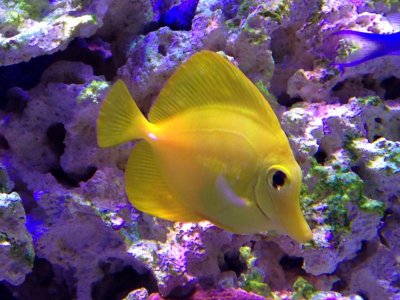
Here is a picture today of my yellow tang.
 

Attachments

  • image.jpg
    image.jpg
    77.6 KB · Views: 20
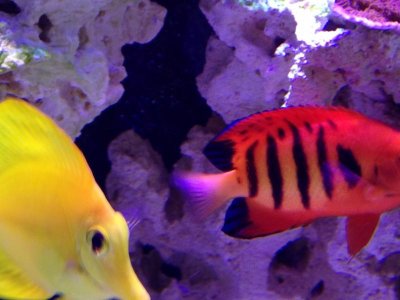
And here is my flame angel. No change in behavior except letting the cleaner shrimp pick at him.
 

Attachments

  • image.jpg
    image.jpg
    49.9 KB · Views: 16
You are "diagnosing" by visual symptoms. Very simply that is not the way it is done. Ich symptoms will come and go as the life cycle progresses and repeats itself. Some fish never exhibit "sprinkled salt" (which is actually under the skin) and many get ich initially only in their gills. I suggest you read and reread the ich stickies.
 
And here is my flame angel. No change in behavior except letting the cleaner shrimp pick at him.

First of all, cleaner shrimp have no bearing on ich eradication or "cleaning". Ich is embedded beneath the skin. Secondly fish that allow cleaning will solicit cleaning even when totally ich free. (Why they do that is beyond the scope of this thread).

However. If you do not think you have a problem. Do nothing.
 
You are "diagnosing" by visual symptoms. Very simply that is not the way it is done. Ich symptoms will come and go as the life cycle progresses and repeats itself. Some fish never exhibit "sprinkled salt" (which is actually under the skin) and many get ich initially only in their gills. I suggest you read and reread the ich stickies.

I hear ya. I just am trying to figure out whether it is ich or the worse velvet. Trying to minimize stress for my fish and myself.

If it's velvet, I understand that once the parasite can be seen on the body, it is really too late for treatment.
 
First of all, cleaner shrimp have no bearing on ich eradication or "cleaning". Ich is embedded beneath the skin. Secondly fish that allow cleaning will solicit cleaning even when totally ich free. (Why they do that is beyond the scope of this thread).

However. If you do not think you have a problem. Do nothing.

I realize that they have no bearing on ich, I just never observed this behavior before and thought it necessary to point it out.

I am going to go through the processes, just trying to educate myself as much as possible.

I am all in to this hobby at this point! No turning back now, I built my tank into my wall! :)
 
If it is velvet you have very little time (but based on the pictures, it is almost certainly not). It kills quickly.
 
If it is velvet you have very little time (but based on the pictures, it is almost certainly not). It kills quickly.

Thank you!

Just to be clear, no treatment besides TTM, then into quarantine with 2 treatments of prazipro, correct? After 12 weeks add back to display?

As far as the quarantine goes, it must be fresh everything - water filter everything ? By the time I get done with TTM and add the fish to quarantine, I won't want that QT to have the DT water and bio filtration in it, because of the parasites.

So how do I quickly get a QT up and running with bio filtration from a clean source?
 
Correct. Avoid DT water for the QTs for the entirety of the 12 weeks.

You can use Bio Spira for the bacteria. Then monitor and use Prime or AmQuel as needed. Water changes as well. This will keep ammonia at safe levels.
 
Correct. Avoid DT water for the QTs for the entirety of the 12 weeks.

You can use Bio Spira for the bacteria. Then monitor and use Prime or AmQuel as needed. Water changes as well. This will keep ammonia at safe levels.

What is the best filter for a permanent QT?

I am getting a 30 gallon QT.

So I can fill, install filter and pour Bio Spira in and then fish within 12 days ?

How is my mandarin going to survive without live pods during this process?
 
My RO DI unit is right next to my DT, if I leave the unit itself there and run the tubing out of that room to fill up elsewhere, I shouldn't have any issues right?
 
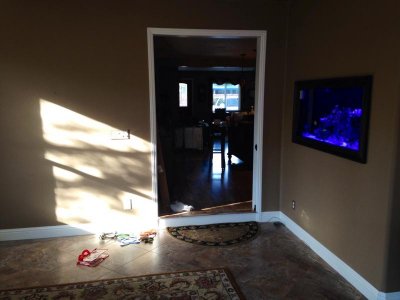
Here is my in wall tank.

I plan on putting the QT to the left in this picture (left side of entry to this room by the light switches).

Is this okay or do I need more space away from the tank?

I have a frame around the in wall tank and have a rubber gasket that lines the frame and is sandwiched between the frame and the glass of the DT.
 

Attachments

  • photo4.jpg
    photo4.jpg
    41.9 KB · Views: 15
Greetings All,
Fighting a rebout of Ich.
Basically, I am finding that Observation alone is NOT an indication of Ich. I had a Purple and a Blonde Naso in 55 Qt that were clean for 12+ weeks waiting on a Display Tank Replacement and poof... Ich! they are now in week 2 of .5 mg/L
Why bother w/ TTM? would it be better to go right into .5 Cupramine & Prazi-Pro right out of the bag?
Currently @ week 4 of fallow on 375 display/ going to replace glass next 2 weeks then fallow for another 6 weeks for a total of 12 weeks fallow. Nothing new added, all swimmers in 3 tanks @ .5 .. is there anything that I am missing to insure a Clean system??
 
Greetings All,
Fighting a rebout of Ich.
Basically, I am finding that Observation alone is NOT an indication of Ich. I had a Purple and a Blonde Naso in 55 Qt that were clean for 12+ weeks waiting on a Display Tank Replacement and poof... Ich! they are now in week 2 of .5 mg/L
Why bother w/ TTM? would it be better to go right into .5 Cupramine & Prazi-Pro right out of the bag?
Currently @ week 4 of fallow on 375 display/ going to replace glass next 2 weeks then fallow for another 6 weeks for a total of 12 weeks fallow. Nothing new added, all swimmers in 3 tanks @ .5 .. is there anything that I am missing to insure a Clean system??

You have a good plan going.

As for why TTM vs Copper:
Copper... some fish react poorly to copper, and unfortunately you don't find that out until it is too late. copper also masks other issues like velvet and brook meaning you may miss the signs and add too soon to your DT. copper takes 4 weeks at .5ppm and then you are best to monitor/observe at 0ppm copper for 4 more weeks (because of the masking of other issues like velvet), meaning 8 weeks total. copper can be difficult for some people to read the ppm levels with test kits.

TTM... although it doesn't cure velvet, brook or really anything other than Ich, it doesnt mask those things like copper does. so if you were to do TTM for the 12 days and then observe for 2-3 more weeks, it will have given you plenty of time to assess adequately. another point is that the Ich eradication period is only 12 days instead of the 28 days required with copper. TTM does not require any medication.

those are just a few things to note, but regardless both are great approaches. i choose TTM because i lost fish with copper, and have yet to lose fish in TTM... just takes a little extra elbow grease in the process.

NEVER put the fish directly into .5ppm water, that will likely kill them. you need to add them into 0ppm water and then work the copper levels up very slowly; over 4 days preferred. then start the 4 week timer. you will also want to wait a week or so first to make sure they are eating and otherwise healthy; otherwise you may think copper killed the fish while it was really something else.
 
also worth nothing in the TTM vs Copper is that with TTM you can use Prime or AmQuel to keep ammonia in check; with copper you can't. i like having that as an option personally.
 
copper also masks other issues like velvet and brook meaning you may miss the signs and add too soon to your DT

Low levels of copper can mask velvet, but proper therapeutic levels of copper can eliminate velvet. So, treating with copper at levels greater than 0.35mg/L (for Cupramine, at least) can eliminate both crypto and velvet. Copper isn't the treatment of choice fpr velvet (IMO, chloroquine phosphate is better), but it will work if administered properly.

Copper has no effect on Brooklynella, however.
 
Back
Top