Help needed! Fluke outbreak in display tank!

VJV

New member
Hi, two weeks ago I made the mistake of adding a Flame Angel to my tank without QT. It was the last fish I was going to add, the supplier was trusted and I work abroad during the week so can not properly maintain a QT routine that required constant monitoring and water changes.

Immediately after adding the Flame I noticed that a couple of other fish started scratching themselves in the sand often. Namely a Midas Blenny and a Kole Eye tang. The next week when I got home my male lyre tail Anthias was lying in the sand, breathing heavily and looking not well. Furthermore, on another day I noticed that the tang and one of my black clowns had one white spot on the cheek, like tiny piece of skin. In the meantime my male Anthias fins were severely threaded and he was looking very bad. Decided to add a couple of lysmatas i Had in another tank and as soon as they got in they were all over the male Anthias vigorously pulling stuff out of its body and open mouth! I must say that I am a newbee and during these 2-3 days I researched the web and at this point to me it was obvious that I had brought the Fluke into my tank. Decided to try and a. Least quarantine the male Anthias but unfortunately when I tried to do it it got all tangled into the net and when I managed to put him in the QT it was swimming belly up and died in the hour 😞😞😞.

I turned on a UV in the main system (where by the way, everyone continues to look alive and healthy) and am now considering the options:

1- treating in a QT: I can not remove all my fish into QT as I do not have a large enough tank to hold 10 fish.

2- treating he display tank with Prazi-Pro: I have heard that Prazi-Pro is effective and reef safe. I read several forums (including this one) people that have tried it saying that it is indeed reef safe. I am considering going this route but to be on the safe side actually move my corals to the QT tank instead, which would be much easier.

3- do nothing as remaining fish seem healthy and hope that he cleaner shrimp plus UV take care of the problem

So, would like to hear your views on the above, as well as whether Prazi Pro would precipitate into sand/rocks and remain in the system long after the treatment is done.

Help would be much appreciated!!
 
Last edited:
If you can not move the fish then treat the main. I personally have never done it but, as you say, others have successfully. #3 is not a good option. Eventually the flukes will overwhelm the fish and they will die. If you can catch one fish and do a FW dip to confirm flukes it will aid in your route of treatment. Have you ever done a FW dip? If not we can walk you through it. UV will not do anything for flukes. Also nets are rather bad for fish. Not only can their gills and operculum a get caught and cause damage but it can scrape their eyes and lead to infections. I use a small hand held colander or Tupperware container.
I'm sure by now you know to quarantine everything no matter who it comes from.
 
If you can not move the fish then treat the main. I personally have never done it but, as you say, others have successfully. #3 is not a good option. Eventually the flukes will overwhelm the fish and they will die. If you can catch one fish and do a FW dip to confirm flukes it will aid in your route of treatment. Have you ever done a FW dip? If not we can walk you through it. UV will not do anything for flukes. Also nets are rather bad for fish. Not only can their gills and operculum a get caught and cause damage but it can scrape their eyes and lead to infections. I use a small hand held colander or Tupperware container.
I'm sure by now you know to quarantine everything no matter who it comes from.


Thanks! I believe I know theoretically how to perform the Fw dip but help is always appreciated 😊. I have read and seen several videos on the subject, namely from Mark Callahan (Mr Saltwater Tank), having purchased his book on Quarantine fish diseases and treatments. So I know the theory, but that is not to say I would not mess up the practice... 😬. Like the little example with the fish net shows...
The other issue is how to catch the fish. The Anthia was relatively easy because it was lying on the bottom but in order to catch the others I believe I would need to remove all the rock work because they are much faster than I am. Any suggestions? I have read that it is easier at lights out but my fish at lights out all retreat each into his own crevice so I can not reach them. The clowns are the only exception and perhaps I could catch one of these but I am afraid to mess it up and stress them even more! These little guys have had their share with three tank moves in the past year!

On the subject of QT, I know I should do it but given that I spend 4 days per week out of the home, I am afraid that during that time without water changes there would be an Ammonia spike and I would get home to a new dead fish. Furthermore, I would not be able to daily measure and adjust copper levels if for example I were to dose Cupramine which would render a prophylactic treatment possibly ineffective...😞

By the way, yesterday the Kole tang had a large square wound on one side. Not sure if was due to heavy scratching in one rock or even an accidental scratch.
 
There is a sticky on how to catch uncatchable fish. I will usually drain some water into a large container and move rocks into the container and catch the fish. It's more stressful to die of a parasites than being caught and dipped. To do the dip just temp and pH match the dip water (RO) to the current tank they are in. Be sure to aerate the water for at least an hour. I would use a dark container so you can see if any flukes come off. Be sure to set a timer (I use my phone). Five minutes is all that is needed. The fish will most likely lie on the bottom of the container this is completely normal. If it tries to jump out then move it immediately. This is more stressful on the human than the fish. If there are any flukes they will become more opaque the longer they are in the freshwater. They will look like little contact lenses. Some say they look like sesame seeds.
Do you keep a sponge in the main to cultivate bacteria? I personally don't use copper for ich. I do TT with Prazi then it goes into a QT for 5-6 weeks. Keep an eye on the Kole tang for infection.
 
Again, thank you very much for the advice. Unfortunately I have been looking around and PraziPro is not imported in Portugal or Spain, so was looking at Seachem Paraguard instead. I am thinking that it is much easier to move the corals to a QT tank than the fish. This has the added advantages of not stressing them so much and treating the main tank as well. I have read a couple of posts on fluke (Gyrodactylus) where reefers treated the fish in quarantine for a month and a couple of months after moving them back they had another outbreak. I guess that if I treat the tank I will for sure kill any leftover as well.

On the issue of Paraguard, have you had any experience with it and flukes?
 
Do you keep a sponge in the main to cultivate bacteria? I personally don't use copper for ich. I do TT with Prazi then it goes into a QT for 5-6 weeks. Keep an eye on the Kole tang for infection.


I do have some sponge in the main display (actually in the sump) that I can move into the QT for bacterial seeding.
 
Another potential problem is that my QT is just a 30 gallon tank. I guess that if I put 10 fish in that tank without any protein skimming I would need to do large daily water changes to keep ammonia and Nitrites in check, or risk killing them all due to an ammonia spike. Problem is that I spend 4 days per week abroad. I am afraid that 30 gallons with such a high bio load would probably not last 4 days without ammonia spiking and killing all my fish.

I have never made a QT so would very much like to hear your views on the frequency of water changes that is required to keep the water quality suitable for the fish.
 
As long as the sponge has been seed for 6 weeks you can use it in the QT to control ammonia. Paraguard has not been proven to eradicate flukes. Can you get formalin or Quick Cure to do dips? They can be done every 7-10 days. I would highly suggest you do frequent water changes in the QT for 2 reasons 1. Control ammonia 2. Water quality affects the fish's' stress level.
You can just use a Rubbermaid container as a QT. I've done that in a pinch along with a power head for water movement.
Do you have any Prime on hand or something to lock the ammonia? Can you order Prazi online?
The life cycle of flukes in 78 F is typically 3 weeks so a tank left fallow for a month or so should be fluke free.
 
Thanks again! I decided that I will move the inverts to the QT and treat the main display instead. This has several advantages including:

1 - it has an established bio filter and is much larger at 80g, so the risk of killing the fish due to an ammonia spike will be much lower. A piece of filter floss will never be able to host the same number of nitrifying bacteria as 30+ kg of live rock and 30kg of sand.

2 - I will be 100% sure that I kill all parasites in the main tank

3 - it will be a lot less stressful for the fish, not only because I won't have to catch them and re locate them but also because water quality will probably be better

Now I did check with Seachem and they said that Paraguard will also kill flukes. I also saw a couple of threads where people used it with success. Having said this, I may still try and order prazipro online given it is in theory reef safe, and a lot more people seem to have used it successfully.
 
Just keep an eye out for ammonia spikes in the event micro fauna die off. Malachite green has not been proven effective against flukes.
 
Change of plans: hopefully tomorrow I will move the fish into a 30g QT. I am planning to do a fresh water dip on every one before putting them into the QT and treat with Sera Tremazol. I can not get Prazipro in Europe but Teemazol is also based on Praziquantel, so should be good. I will leave the main tank fallow for 4 weeks so in the meantime after I treat with Tremazol I may do a 2 week preventive treatment with Paraguard, just in case they had somethingg else.
 
Hi all. Just started the treatment. Unfortunately the equipment was delayed and than I went away on vacations so I could only start today. Thus far I lost two Lyretail Anithias and the Midas. Yesterday I moved the fish to a 30g QT. I was planning to do fresh water dips before placing them in the QT but unfortunately when I tried to match the PH I completely overshoot it (it went from 7.0 to 9.0+) as I believe the dosing is meant for saltwater tanks and not fresh water, so I had no choice but to move them straight into QT. I also moved a large piece of rock to help with the biological filtration given the large bio load, and added Seachem Stability to help the bacterial population. I used water from the main tank and filter floss that was in the sump for 2 weeks in a Tunze comline filter (3166.50). I also have a Tunze comline skimmer 9006 that will be on between treatment.

This morning I treated with Sera Tremazol (Praziquantel). The instructions require you to do a 80% water change after 6 hours and in one week repeat the treatment. The flame angel reacted badly, sinking to the bottom and swimming belly up. When I saw him standing still belly up I thought he was gone, but than I stated aerating the water (the skimmer was off for the treatment) and he started to come back. Even though he is laying relatively still in the bottom I hope he will make it!

After this I will treat the QT with Paraguard for 3 weeks, in case I missed any bacteria. This way the main tank will be fallow for over a month which should get rid of the parasites.
 
You can use vinegar to reduce the pH for a dip. The live rock will help with bio filtration. I've never used that kind of praziquental so I don't know why the flame angel reacted that way. Is this a powder Prazi and if so what did you use to dissolve it into the water? Are you aerating the water in the QT sufficiently? Prazi depletes the O2 so extra aeration is needed.
 
Help needed! Fluke outbreak in display tank!

uzypavaq.jpg


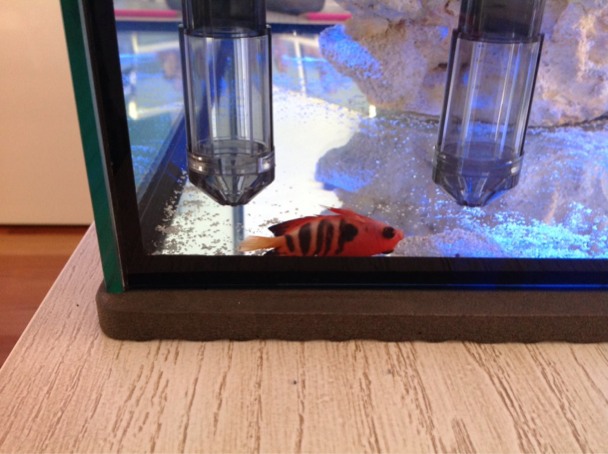
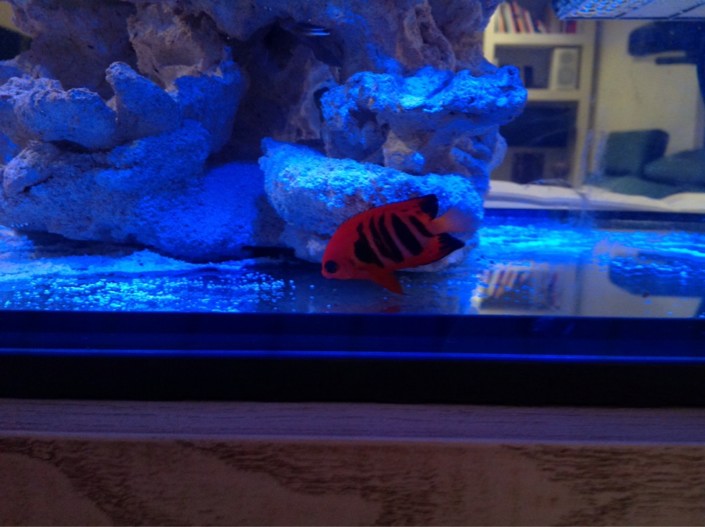
Her is the poor guy...😞😞😞

Not sue if he will make it through the night... The yellow eye kole tang is being merciless and keeps attacking the poor Angel with the tail.

When I saw the Flame acting like it did I immediately added an air stone to increase oxygen levels, even though none of the other fish was displaying signs of stress. Tremazol is liquid. You add 1ml for each 15L and 6 hours later perform a 80% water change. 7 days later repeat the treatment.

Now that I have done the water change I connects the skimmer back again, so this should help with aeration.
 
Have you seen anything floating in the water that could be flukes? Can you give the flame something to hide in to keep away from the tang? The extra stress combined with the flukes could do him in.
 
First, let me thank you for all the help! Much appreciated. I have not seen anything floating that would suggest it at this point. However, I probably would miss it anyway as I have never seen it before.

The large rocks has several caves which I hoped the angel would use, but unfortunately he did not. I have a couple of PVC pipes but I just bought them and would probably need to bleach them first for 24h as I am afraid they may have glue or other toxics that could end up killing all the fish...

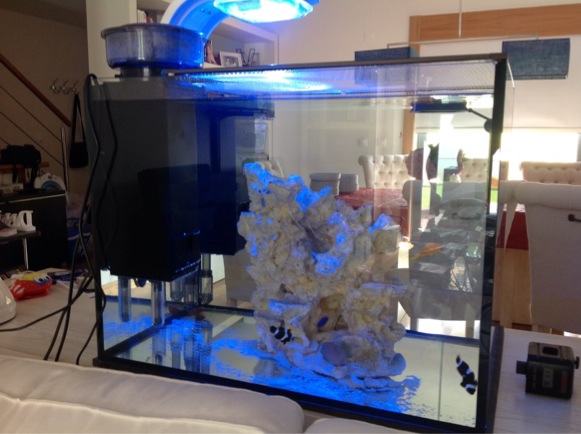
Here is a pic of the tank.

rezy5ehy.jpg


And one of the poor Angel. He is now barely breeding...

urady6eg.jpg
 
Another thing, when I took the fish out of the main tank the flame did not seem to be overly sick, even though he had been hiding for the last couple of days whenever I was near the tank, something he did not do before. That was also the same behavior of the two Anthias and the Midas in the 5-6 days prior to dying. They would seem lively but were very skittish, and would constantly seek hiding.

I do not see any white spots on the fish. Maybe gill flukes? The first Anthias that did die was significantly discolored, it's fins were severely damaged. I have seen a white "thing" (smaller than the tip of a hair pin) striking to the side of the Kole once, and in a clown as well. The fish that did die already all have exhibited the same scared behavior and increased scratching against the substract.

None of them is covered in white spots so I believe it is not ich, but honestly I am not sure...

Very sad...😞😞😞
 
You are welcome:) I ask about something in the water because once flukes come in contact with Prazi they spasm uncontrollably and dislodge from the fish. They can be seen floating around in the water. Some have described it as a snowstorm. And sometimes if a fish has a lot of flukes this mass exodus can be detrimental to the fish. It is theorized that a fish can bleed out due to all the hooks dislodging.
Flukes do not present with white spots. They are a nearly transparent flatworm so they are very hard to see with the naked eye. But if they get big enough they can be seen at certain angles. Hiding and tattered fins are indicative of flukes.
As far as the PVC you don't need to bleach them for that long. I clean mine by bleaching for 15-20 minutes and rinse very well so there is no bleach smell and they are good to go.
 
The Angel is still laying on the floor but he is breeding. I am rinsing the equipment of my smaller 14g tank in seachem Prime after having bleached them and will transfer the angel to that tank today... My wife is very understanding but the leaving room is starting to look like the back room of the LFS... Am a bit concerned that is all for nothing and the angel will not resist another re-location. However it seems like he is starting to try and move about and the Kole eye will probably kill him if he does recover...
 
Back
Top