
You are using an out of date browser. It may not display this or other websites correctly.
You should upgrade or use an alternative browser.
You should upgrade or use an alternative browser.
Heniochus diphreutes...how many?
- Thread starter bureau13
- Start date


Monkeyfish
Active member
I'd get 3-5 in a tank that size.


<a href=showthread.php?s=&postid=8066589#post8066589 target=_blank>Originally posted</a> by NexDog
I want to know too.
I have a pair and one has a streamer like in that pic and one doesn't.....
Anyone got an answer?
the differences are really subtle.
Here is a schooling bannerfish
http://www.edge-of-reef.com/Chetodontidi/CHEheniochusdiphreutes1.jpg
the bannerfish has a smaller mouth, more rounded breast
and here is a heniochus acuminatus,
http://www.wetwebmedia.com/ButterflyPIX/HeniochusPIX/Heniochus_acuminatusAND.jpg
the snout is more prominant in the acuminatus than in the shooling bannerfish and the back caudal fin is different because in the heniochus the black and white don't run together to the tip of the fin.
Here is a schooling bannerfish
http://www.edge-of-reef.com/Chetodontidi/CHEheniochusdiphreutes1.jpg
the bannerfish has a smaller mouth, more rounded breast
and here is a heniochus acuminatus,
http://www.wetwebmedia.com/ButterflyPIX/HeniochusPIX/Heniochus_acuminatusAND.jpg
the snout is more prominant in the acuminatus than in the shooling bannerfish and the back caudal fin is different because in the heniochus the black and white don't run together to the tip of the fin.
steveweast
Active member
There are three main very subtle difference between the diphreutes and the acuminatus henis. They are: a more rounded breast and shorter snout in the diphruetes and a tail/fin difference.....however, the breast and snout are not pronounced in young individuals. I use the tail/fin differences to tell them apart.
Here's a diphreutes.....notice how the rear caudal fin drops almost straight down from the base of the tail......it doesn't extend much, if at all, beyond the base of the tail.
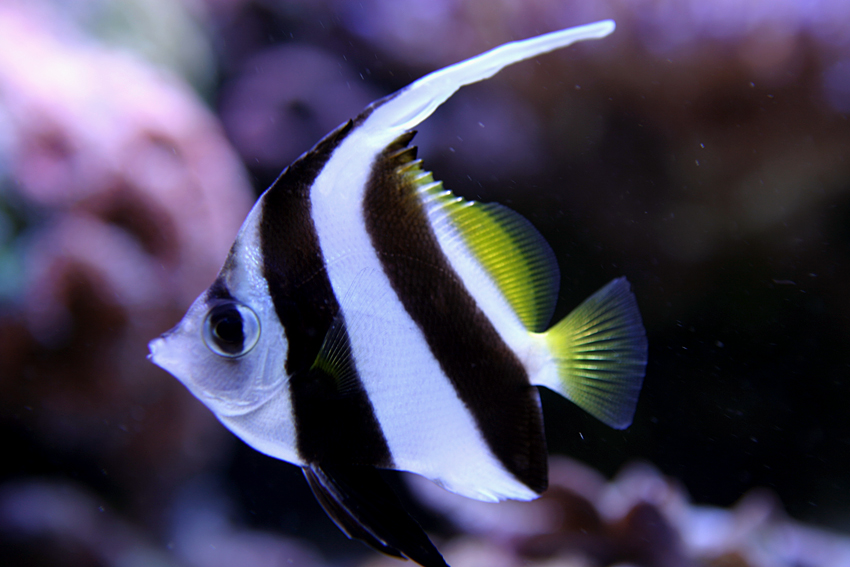
Here's an acuminatus....notice how the rear caudal fin sweeps almost parallel to the tail and ends almost at the end of the yellow tail.

You can see in these pics how the snout and breast are slightly different too....but, not as pronounced as the tail/fin relationship.
Here's a diphreutes.....notice how the rear caudal fin drops almost straight down from the base of the tail......it doesn't extend much, if at all, beyond the base of the tail.
Here's an acuminatus....notice how the rear caudal fin sweeps almost parallel to the tail and ends almost at the end of the yellow tail.
You can see in these pics how the snout and breast are slightly different too....but, not as pronounced as the tail/fin relationship.
steveweast
Active member
Diphruetes and acuminatus both have streamers....but, they frequently get broken and take a long time to grow back. I had a peppermint hog who loved to snap the streamers right at the base off my henis.....I finally had to remove him. Your bannerless henis will grow it back eventually.

Angel*Fish
cats and large squashes
<a href=showthread.php?s=&postid=8136299#post8136299 target=_blank>Originally posted</a> by steveweast
There are three main very subtle difference between the diphreutes and the acuminatus henis. They are: a more rounded breast and shorter snout in the diphruetes and a tail/fin difference.....however, the breast and snout are not pronounced in young individuals. I use the tail/fin differences to tell them apart.
Here's a diphreutes.....notice how the rear caudal fin drops almost straight down from the base of the tail......it doesn't extend much, if at all, beyond the base of the tail.
Here's an acuminatus....notice how the rear caudal fin sweeps almost parallel to the tail and ends almost at the end of the yellow tail.
You can see in these pics how the snout and breast are slightly different too....but, not as pronounced as the tail/fin relationship.
Thank you :thumbsup:
<a href=showthread.php?s=&postid=8136299#post8136299 target=_blank>Originally posted</a> by steveweast
There are three main very subtle difference between the diphreutes and the acuminatus henis. They are: a more rounded breast and shorter snout in the diphruetes and a tail/fin difference.....however, the breast and snout are not pronounced in young individuals. I use the tail/fin differences to tell them apart.
Here's a diphreutes.....notice how the rear caudal fin drops almost straight down from the base of the tail......it doesn't extend much, if at all, beyond the base of the tail.
Here's an acuminatus....notice how the rear caudal fin sweeps almost parallel to the tail and ends almost at the end of the yellow tail.
You can see in these pics how the snout and breast are slightly different too....but, not as pronounced as the tail/fin relationship.
Thanx for the explanation. This is the best one yet.
steveweast
Active member
You're welcome.....if you ever get a chance to visit some of the wholesalers in LA, you'll see tanks full of henis.....BUT.....now knowing how to distinguish between the two species, you'll easily be able to see the two species and cherry pick out the diphreutes....where as before.... all it looked like was a tank full of henis. When a bit older, the snout and rounded breasts are dead giveaways......but, adults are rarely imported of either species since they do get big.
<a href=showthread.php?s=&postid=8137044#post8137044 target=_blank>Originally posted</a> by steveweast
Diphruetes and acuminatus both have streamers....but, they frequently get broken and take a long time to grow back. I had a peppermint hog who loved to snap the streamers right at the base off my henis.....I finally had to remove him. Your bannerless henis will grow it back eventually.
Steve, how long does it take to grow the streamer if broken from the base? Do they always grow back to their full glory?
steveweast
Active member
It depends whether the "missing" section includes bone. Most of the pennant has a bone.....then a flesh streamer continues on from there. If the bone gets clipped, it will take many, many months to regenerate.
I was thinking about getting a diphreutes. They’re available as ‘Heniochus’ at some LFSs, but no-one in the stores could tell me (or wanted to bother finding out) whether they were acuminatus or diphreutes.
So, I spent a lot of time looking into the issue of how to differentiate the two species. I made trips to a couple different LFSs, studied every picture I could find on the net, and emailed picts to a supplier based in Hawaii for him to identify.
My conclusion is that there are plenty of exceptions to all the supposed rules for differentiating the two species. The most reliable way of getting a diphreutes is to make sure the fish was netted in Hawaii.
So, I spent a lot of time looking into the issue of how to differentiate the two species. I made trips to a couple different LFSs, studied every picture I could find on the net, and emailed picts to a supplier based in Hawaii for him to identify.
My conclusion is that there are plenty of exceptions to all the supposed rules for differentiating the two species. The most reliable way of getting a diphreutes is to make sure the fish was netted in Hawaii.
<a href=showthread.php?s=&postid=8139386#post8139386 target=_blank>Originally posted</a> by steveweast
It depends whether the "missing" section includes bone. Most of the pennant has a bone.....then a flesh streamer continues on from there. If the bone gets clipped, it will take many, many months to regenerate.
Thanks Steve, as long as not in years I can wait.
BTW after reading your descriptions and the pictures, I quickly made out my two heniochus, one is acuminatus the other diphreutes, the differences are in fact quite apparent if you know what to look for.
I was wondering why one constantly picked at the rocks and the other only ate food in the water column, now it seems to make some sense.
One other interesting observation. I just added a yellow tang to the tank, my resident heniochus ganged up on him for a day, now the yellow tang has gained his status but he began to beg heniochus for help because he was constipated after eating some long cheato weed blown into the tank from the sump and had a hard time squeezing the undigested cheato out from his behind.
Last edited:

Triggerfish
Active member
Re: Heniochus diphreutes...how many?
unlike acuminatus that appear in pairs. diphreutes appear in small schools.. so taking into account the longevity issues that i believe many folks have experienced with this species, i would probably go with no less than five.
i think the biggest challenge is going to be trying to find five diphreutes guaranteed net caught healthy looking specimens at once.
it seems locally acuminatus is more available.
<a href=showthread.php?s=&postid=8034013#post8034013 target=_blank>Originally posted</a> by bureau13
do they really do better in groups? And if so, how big should the groups be?
unlike acuminatus that appear in pairs. diphreutes appear in small schools.. so taking into account the longevity issues that i believe many folks have experienced with this species, i would probably go with no less than five.
i think the biggest challenge is going to be trying to find five diphreutes guaranteed net caught healthy looking specimens at once.
it seems locally acuminatus is more available.
Similar threads

- Replies
- 0
- Views
- 228
- Replies
- 6
- Views
- 3K


- Replies
- 1
- Views
- 311
