monicaswizzle
Premium Member
Well, having killed two previous anemones (BTA and LTA), you would think I would know better, but no, I am now hosting a Heteractis malu. I post this tale for two reasons: 1) I welcome any helpful tips or suggestions that people with more experience may have to offer, 2) Although "not smart", I suspect many of my mistakes are pretty typical and maybe a cautionary tale will help save an anemone or two and the frustration for the fish keeper that goes with it.
1) Mistake #1--Not enough research. Last Wednesday I received very short notice that I would be in Rhinelander, WI on business. Since I really like the Divers Den items offered by LiveAquaria (DFS), I took a quick check of their website to see if they had anything I might "need". They had a pair of tank bred Tomato Clowns (A frenatus), which is something I have been sort of on the lookout for. I have a 45 gallon tank with 30 gallon sump already set up and running with a DSB, liverock and lots of calupera, but no fishes. So, I did a quick web search to see which anemones are natural hosts for tomatoes. Emphasis on quick, as in, not very good. The first website I found that listed clowns and their native hosts listed both LTA and H. malu as natural hosts for tomatoes. (Since then I have spent more time and learned that actually neither are believed to host tomatoes in nature. Damn the web!) So, armed with great misinformation, I checked out the DFS, LiveAquaria, Divers Den website for invertebrates and they had a very nice 4" H. malu for sale. I called and ordered both for pickup on Thursday evening.
2) Mistake #2--Rushing it. So, rushing it already got me into buying a pair of clowns and an anemone that they don't normally use. I may get lucky and they may adopt it anyway (some do), or since they are captive bred clowns, they might not have accepted a "natural" one either, but it might have improved my chances. But the rushing it didn't stop there:
a) My DSB varied from a max of 4" to a high of 3", which is a bit marginal for the H. malu. So, on Wednesday night I picked up 20# of "live sand" and carefully added it to the tank. I am pretty sure that the additional sand wasn't deep enough to kill the existing DSB to any significant extent (can happen), but between stirring up the DSB and moving around all the LR, I got a nitrate spike. It had been running too low to measure for 6 or more months, but it jumped up to about 20 to 30. Not at all ideal for adding an anemone. I changed about 50% of the water and it dropped down to 10-15, but that still is not good for acclimation of a very sensitive species.
b) I think wise council would indicate that a 4" (max when inflated) anemone is a bit small for hosting a mature pair of tomatoes. It could very likely work out fine, but if they are "rough with it", it might not have the staying power to get them settled in.
So, I added the anemone (and clowns) to the tank on Thursday night. The lighting (newly purchased) for the tank is 250w, 10k metal halide, which is what they were using at DFS. I put the anemone in the tank with the lights out in the center of a nice open area of sand surrounded by LR that gets very good light by day. Since I didn't want the anemone to move around and/or the clowns to sail into it right away, I put it under a 6" mesh plastic planting pot and left it that way overnight. The next day I left the basket on while the lights were on, just to give it a more gradual adjustment to full light. Saturday I removed the basket and the anemone was still "upright", but not inflated and not appearing to have "dug in" at all.
Late Saturday it rolled over to a corner of the tank and was laying upside down with the foot in the air and the mouth and tentacles on the sand. Taking the theory that less disturbance is best, I left it that way and tested all my water parameters. That is when I discovered the nitrates were high and did a 50% water change, which brought them down around 10+.
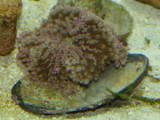
Today the anemone was still laying in the corner, no longer upside down, but "on its side" with the foot touching the glass and the mouth facing some LF and calupera. I decided it was a good idea to try and redirect it to the open area of the tank, so I gently moved it back into the circle of sand and into a little depression I had made to help it settle in. I did this during the mid-day, lights out phase of my tank. It remained there for about an hour, but shortly after the lights came on it returned to the same corner that it was in before. Now the foot is resting in a bunch of calupera and the oral disc and tentacles are sort of at a 45-degree angle to the sand. The "good news" is that it is partially inflated and looks the best it has since I brought it home.
So, what to do?
I am considering another 50% water change to drop the nitrates below 10, but I am not sure if that is best. I expect the DSB and the LR to rapidly drop the nitrates anyway, and large water changes always involve some changes in temp, pH, and chemical balances, so it might be best to let things get back to low nitrates the "slow" way. Opinions?
With or without water changes, I am inclined to leave the anemone where it "wants to be" and not move it unless it starts spending a lot of time upside down or obviously distressed.
The clowns are ignoring the anemone for now, which is probably best. In the long run I hope that it thrives and they adopt it, but unless they settled in very gently, it would probably add to the stress for the anemone. Though I have read some theories that an interested clown can help an anemone acclimate.
Well, that is it. Wish me better luck than my sloppy preparation may deserve.
1) Mistake #1--Not enough research. Last Wednesday I received very short notice that I would be in Rhinelander, WI on business. Since I really like the Divers Den items offered by LiveAquaria (DFS), I took a quick check of their website to see if they had anything I might "need". They had a pair of tank bred Tomato Clowns (A frenatus), which is something I have been sort of on the lookout for. I have a 45 gallon tank with 30 gallon sump already set up and running with a DSB, liverock and lots of calupera, but no fishes. So, I did a quick web search to see which anemones are natural hosts for tomatoes. Emphasis on quick, as in, not very good. The first website I found that listed clowns and their native hosts listed both LTA and H. malu as natural hosts for tomatoes. (Since then I have spent more time and learned that actually neither are believed to host tomatoes in nature. Damn the web!) So, armed with great misinformation, I checked out the DFS, LiveAquaria, Divers Den website for invertebrates and they had a very nice 4" H. malu for sale. I called and ordered both for pickup on Thursday evening.
2) Mistake #2--Rushing it. So, rushing it already got me into buying a pair of clowns and an anemone that they don't normally use. I may get lucky and they may adopt it anyway (some do), or since they are captive bred clowns, they might not have accepted a "natural" one either, but it might have improved my chances. But the rushing it didn't stop there:
a) My DSB varied from a max of 4" to a high of 3", which is a bit marginal for the H. malu. So, on Wednesday night I picked up 20# of "live sand" and carefully added it to the tank. I am pretty sure that the additional sand wasn't deep enough to kill the existing DSB to any significant extent (can happen), but between stirring up the DSB and moving around all the LR, I got a nitrate spike. It had been running too low to measure for 6 or more months, but it jumped up to about 20 to 30. Not at all ideal for adding an anemone. I changed about 50% of the water and it dropped down to 10-15, but that still is not good for acclimation of a very sensitive species.
b) I think wise council would indicate that a 4" (max when inflated) anemone is a bit small for hosting a mature pair of tomatoes. It could very likely work out fine, but if they are "rough with it", it might not have the staying power to get them settled in.
So, I added the anemone (and clowns) to the tank on Thursday night. The lighting (newly purchased) for the tank is 250w, 10k metal halide, which is what they were using at DFS. I put the anemone in the tank with the lights out in the center of a nice open area of sand surrounded by LR that gets very good light by day. Since I didn't want the anemone to move around and/or the clowns to sail into it right away, I put it under a 6" mesh plastic planting pot and left it that way overnight. The next day I left the basket on while the lights were on, just to give it a more gradual adjustment to full light. Saturday I removed the basket and the anemone was still "upright", but not inflated and not appearing to have "dug in" at all.
Late Saturday it rolled over to a corner of the tank and was laying upside down with the foot in the air and the mouth and tentacles on the sand. Taking the theory that less disturbance is best, I left it that way and tested all my water parameters. That is when I discovered the nitrates were high and did a 50% water change, which brought them down around 10+.
Today the anemone was still laying in the corner, no longer upside down, but "on its side" with the foot touching the glass and the mouth facing some LF and calupera. I decided it was a good idea to try and redirect it to the open area of the tank, so I gently moved it back into the circle of sand and into a little depression I had made to help it settle in. I did this during the mid-day, lights out phase of my tank. It remained there for about an hour, but shortly after the lights came on it returned to the same corner that it was in before. Now the foot is resting in a bunch of calupera and the oral disc and tentacles are sort of at a 45-degree angle to the sand. The "good news" is that it is partially inflated and looks the best it has since I brought it home.
So, what to do?
I am considering another 50% water change to drop the nitrates below 10, but I am not sure if that is best. I expect the DSB and the LR to rapidly drop the nitrates anyway, and large water changes always involve some changes in temp, pH, and chemical balances, so it might be best to let things get back to low nitrates the "slow" way. Opinions?
With or without water changes, I am inclined to leave the anemone where it "wants to be" and not move it unless it starts spending a lot of time upside down or obviously distressed.
The clowns are ignoring the anemone for now, which is probably best. In the long run I hope that it thrives and they adopt it, but unless they settled in very gently, it would probably add to the stress for the anemone. Though I have read some theories that an interested clown can help an anemone acclimate.
Well, that is it. Wish me better luck than my sloppy preparation may deserve.