Hole size

?????? I am not sure I understand.....reef ready....obsolete? Every lfs you go into sells reef ready. My understanding is that reef ready just means that it has built in overflows. I thought it was the other way around and that the hang on back style of setups was the old method. If I went with a non reef ready tank then I would have to come up with some other way of getting water from the DT to the sump, in other words make a non reef ready tank....reef ready. I am not sure if the tank leaks or not, I have just been told that anytime you buy a used tank it is a good idea to replace the seals.

Exactly! The manufacturer says this is how we make money. Obsolete yes. RR means small overflows, small useless holes (in most cases.) These tanks are inefficient in surface skimming/surface renewal, and make implementing better drain systems and return systems more complicated than necessary. Even with siphon systems dual overflows are problematic and don't balance out.

They are in the stores, because the manufacturers won't change something that sells, and the stores have them because they "sell." Folks buy them, because they think they should. So until folks stop buying them, they will stick around. That does not make them any less obsolete. They are made obsolete by C2C overflows (toothless) and siphon drain systems. This is something that some manufacturers/builders will do, at additonal $$, but the cost—is the same as doing it "their way." The motivation here is profit margin, not what is really known to be better for the system overall.

True, if you buy a non-reef ready tank, you have to build the system yourself, however the system you build (if you do selective reading) will be more efficient, and provide a better environment for your critters.

Never buy a tank, unless you know it does not leak. There are generally reasons folks dump tanks, and among them are they leak or they don't work as expected. Used tanks are like used cars: Lemons are more prevalent than anything else.

A used tank, does not necessarily need to be resealed. It is a lot of work, when done right, and can do more harm than good, if not done right. As I said, if the tank is leaking (and you should have found that out before you hauled away someone else's garbage, in which case they should have paid YOU!!) it needs to be completely rebuilt.
 
The dual overflows are tricky and the small teeth on the reef ready overflows are very inefficient. It was a good concept back in the day, but there are much better ways to run a reef. Considering you already bought the 120 I'm going to assume you intend to keep it.
Issue number one, with only two holes in each overflow it is difficult to get good flow you can run the 1" pipes as durso's and the 3/4" as returns. The challenge is you can't get more than 600 GPH or the pipes will gurgle like crazy (loud enough to make your wife hostile to the hobby) While 600 is good enough for an ok reef, it just isn't enough flow for me. I like to keep my water clean which requires lots of water going to the skimmer. I prefer the 10x turnover.

So your options with two overflows, ripping them out and rebuilding, or implementing a herbie system with your return behind the tank. My preferred approach for reef ready tanks. One complete herbie in each return works well. use the 3/4 as the siphon line and 1" as a durso. Bit complicated to get dialed in but works well. There are a few other options like a single siphon but I'll save that unless you really want to know. The herbie really helps get enough flow so when you blow off the detrius in your rocks it get's sucked into the overflow. Powerheads keep it suspended but without good flow it just settles somewhere else and breaks down into nitrates and phosphates. With a dual herbie you can easily run ~1500 GPH, at which time the overflow teeth will be under water. (which is why the non reef ready tanks are much better coast to coast C2C without teeth)

Issue number two is the location of the two overflows add the challenge for a good sump. A single overflow like C2C is great at having an effective sump and plumbing system. (but that is a discussion for a different tank)

Issue number three is the overflow teeth themselves. Originally they were intended to keep fish and snails out, but they significantly increase the display tank water height and only pull a small fraction of water directly from the surface (due to the increased water height caused by the teeth). the proteins that become ammonia/phosphate float, the teeth added a sticky film on the water surface that is a challenge to get out with no teeth and good surface flow that surface skim is a thing of the past which significantly improves water quality.

P.S. your overflow teeth appear much wider than the standard reef ready tanks which is a good thing.
 
Last edited:
The dual overflows are tricky and the small teeth on the reef ready overflows are very inefficient. It was a good concept back in the day, but there are much better ways to run a reef. Considering you already bought the 120 I'm going to assume you intend to keep it.
Issue number one, with only two holes in each overflow it is difficult to get good flow you can run the 1" pipes as durso's and the 3/4" as returns. The challenge is you can't get more than 600 GPH or the pipes will gurgle like crazy (loud enough to make your wife hostile to the hobby) While 600 is good enough for an ok reef, it just isn't enough flow for me. I like to keep my water clean which requires lots of water going to the skimmer. I prefer the 10x turnover.

So your options with two overflows, ripping them out and rebuilding, or implementing a herbie system with your return behind the tank. My preferred approach for reef ready tanks. One complete herbie in each return works well. use the 3/4 as the siphon line and 1" as a durso. Bit complicated to get dialed in but works well. There are a few other options like a single siphon but I'll save that unless you really want to know. The herbie really helps get enough flow so when you blow off the detrius in your rocks it get's sucked into the overflow. Powerheads keep it suspended but without good flow it just settles somewhere else and breaks down into nitrates and phosphates. With a dual herbie you can easily run ~1500 GPH, at which time the overflow teeth will be under water. (which is why the non reef ready tanks are much better coast to coast C2C without teeth)

Issue number two is the location of the two overflows add the challenge for a good sump. A single overflow like C2C is great at having an effective sump and plumbing system. (but that is a discussion for a different tank)

Issue number three is the overflow teeth themselves. Originally they were intended to keep fish and snails out, but they significantly increase the display tank water height and only pull a small fraction of water directly from the surface (due to the increased water height caused by the teeth). the proteins that become ammonia/phosphate float, the teeth added a sticky film on the water surface that is a challenge to get out with no teeth and good surface flow that surface skim is a thing of the past which significantly improves water quality.

P.S. your overflow teeth appear much wider than the standard reef ready tanks which is a good thing.

The Herbie modification does not use a Durso style standpipe. It does not matter how many folks try to do it that way, it is not safe. The herbie has a single siphon, and a DRY emergency. That is the only safe way. This applies to dual herbies as well, (practically my brainchild, a few years ago,) but they are NOT STABLE, and are impossible to balance without doing more things (creating a single point of failure) that are unsafe.

As far as RR tanks go, I can't see a good reason NOT to rip out the overflows, plug existing "tiny" holes, and put in a C2C, and use a stable drain system, which the herbie is not. RR tanks are obsolete as they come from the manufacturer.

A 120 is a great tank, dimensionally and visually, it is a crying shame to run it with the RR handicap.
 
So your saying ("The herbie has a single siphon, and a DRY emergency. That is the only safe way.") a single not double herbie is the only safe way?
 
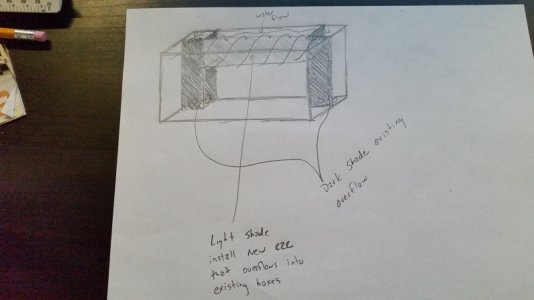
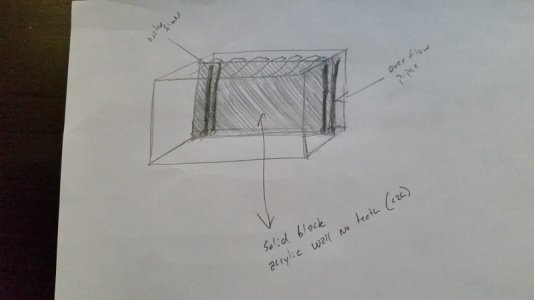
would this work (pic 1) or would I have to remove the 2 origional boxes and go wall to wall (pic 2) would have to put bracing in the overflow box for the c2c.
 

Attachments

  • pic 1.jpg
    pic 1.jpg
    83.5 KB · Views: 6
  • pic 2.jpg
    pic 2.jpg
    71.4 KB · Views: 4
Uncle's comments are based on the durso stand remaining dry is the only safe way, no issue with doing a dual herbie just running a durso vs dry is his main point, if you can't tell we have had this discussion several times.

The argument is based on the possibility of the durso getting blocked, which does happen, so you can either run it dry as Uncle suggests to everyone (which is good advice) I tend to think of the herbie with Durso as a safer option than a plain durso, and prefer the stability of the trickle, to mitigate the risk I use other factors for safety, such as a dark lid over the overflow and strainers on each pipe opening. The major risk factors are snails, siphon lines are like magnets for snails. So you need something for sure. A typical durso the snails just get flushed to the bottom with a rare occasion that a snail can fit through the pipe but get stopped at the bulkhead. A siphon is far more prone because the snails get stucks at the gate valve (which is much smaller than the bulkhead)

I've had four snails stuck in a bulkhead and only one ever stuck in the durso with my off and on tanks for the last 10 years (only five with a dual or joint herbie). By far the best method was the solid lid, it keeps fish and snails out of the overflow and the dark color prevents algae buildup. Never had an issue since I added the lid. So my risky behavior is acceptable to me based on my usage of a lid rather than a dry durso. And certainly safer than the traditional single durso and return in the overflow old concept.

With your pictures in the above post adding a C2C is a great idea, I'd go with the 1st one just so you aren't loosing all that space in your display.
 
Thanks for the insight. I was thinking I like the 1st one also. I then thought maybe if I ran the front piece of the c2c addition to lap over the front of both corner overflows so as to cover the teeth on the front of the old overflows and leave the teeth on the sides of the old overflows so the water can travel from the center addition to the corner boxes and then to the sump.I would also cap the overflow with a lid as you did. Then I could use two of the 1" and one of the 3/4" bulkheads for drain and the remaining 3/4" plumed to the center of the addition c2c for return. Or am I going to have issues no matter what with the current tank
 
I think I have found a solution to my plumbing. I found a guy on youtube that instead of using a emergency pipe he is using a float switch controlled pressure regulator and as a last resort a float switch to shut off the pump. All controlled with a Apex.(https://www.youtube.com/watch?v=K1sUURZiXfY) This would allow me to avoid the stagnant water in one of the two overflows and also allow me to still utilize both of my returns. Has anyone tried this? What do you all think?
 
Just my 2 cents. I ran the exact tank with 1800 gph through the stock corner overflows using dursos. It was quiet and easy. Build your own durso, build it taller so the down facing elbow is higher. Creating less of s cascade into the overflow box. Use a strainer on the intake of the durso. Do not drill a hole in the top of the cap, instead a larger hole through the side, now you can twist the cap to regulate incoming air. Fabricate a cover for the overflow box to keep snails out. Simple cheap, no removing and rebuilding. I ran both returns using them more for surface agitation.
 
So your saying ("The herbie has a single siphon, and a DRY emergency. That is the only safe way.") a single not double herbie is the only safe way?

The herbie with a DRY emergency is the only safe way. Absolutely. Folks do it other ways, but that does not make those ways safe, or even advisable in anyway. Again, it just means folks do it.

Dual herbies is not a safety risk, it is a balance problem, and it does not work as advertised. The "single" means a 1 to 1 ratio, not 2 to 1, or any other machination, although the 1 to 1 ratio can be achieved in a couple different ways. Depends on what you have to work with. I believe I coined the concept several years ago, as an alternative to attempting a BA system with dual overflows; yes I am knocking the concept...
 
Just my 2 cents. I ran the exact tank with 1800 gph through the stock corner overflows using dursos. It was quiet and easy. Build your own durso, build it taller so the down facing elbow is higher. Creating less of s cascade into the overflow box. Use a strainer on the intake of the durso. Do not drill a hole in the top of the cap, instead a larger hole through the side, now you can twist the cap to regulate incoming air. Fabricate a cover for the overflow box to keep snails out. Simple cheap, no removing and rebuilding. I ran both returns using them more for surface agitation.

Physics says that a durso (open channel) will start making noise and become unstable when the pipe is 1/4 full of water. How your system is actually performing is based on the size of your dursos. If they are 1.5", this occurs around 350gph, making a total of 700 gph for two.

It does not matter where the air hole is, or how the air enters the standpipe, it will not change the dynamics of the standpipe style. You cannot beat the physics. It is possible to tweek dursos much higher, close to siphon, by reducing the amount of air in the line. However, the higher they are tweeked, the more unstable they become, and they will never be silent. Also, the higher they are tweeked, the more unsafe the system becomes.

If one is going to tweek them high enough to handle 1800gph overall, the only sensible thing to to is convert to a siphon system. Using a durso system is counter intuitive, and it doesn't matter what you do, you cannot beat the physics.

Which brings us to the "corner overflows" which more than likely will not handle 900 gph each, quitely, and doing weir calcs on them would be rather complicated considering the teeth. I suspect a flow meter is needed on the pump outlet to find out what that particular tank is/was actually flowing.
 
I think I have found a solution to my plumbing. I found a guy on youtube that instead of using a emergency pipe he is using a float switch controlled pressure regulator and as a last resort a float switch to shut off the pump. All controlled with a Apex.(https://www.youtube.com/watch?v=K1sUURZiXfY) This would allow me to avoid the stagnant water in one of the two overflows and also allow me to still utilize both of my returns. Has anyone tried this? What do you all think?

The only reasonable failsafe, is a passive fail safe, or a single mode of failure which results in the system being safer, not more of a flood risk. Any mechanical or electrical device used as a fail safe, needs an addtional passive failsafe, or it is just a waste of time. Youtube is entertaining to watch, but the value, and often the validity, of the information you get from youtube is not very high. It is an example of "striving for 15 minutes of fame..." Examples of passive failsafe: sump volume for power out drain down: no failure mode. Air vent line on the open channel of a BA system: One failure mode-- plugged air vent line, makes the system safer by tripping to siphon. Or a DRY emergency, that can only fail if water is flowing in it... common sense says that it will be obvious when the dry emergency kicks in, it will suck air and make noise. Intervention will most likely occur before the now flowing emergency has the opportunity to become occluded. BA's system mitagates that risk however, with air vent line failsafe.

The bottom line is do it right, don't hunt up shortcuts that may be more convenient, but won't be what they seem to be.
 
I concur electronic failsafes are a fine third barrier, but by themselves they will fail (as will everything else). You want a system that when it fails you know about it and there is a backup to prevent disaster (called defense in depth). With this one you will only know it failed when either your living room is wet or your return pump is destroyed. The Herbie or BA are better options. A split or joint herbie is a marked improvement over the electronic system. BA is best of all.
 
Back
Top