I want your dinoflagellates

Pants

Member
I'm new to marine aquariums so I was excited when I saw people were having blooms of dinoflagellates in their tanks (though sad that they are so hard to get rid of). I am a graduate student doing my PhD on dinoflagellates. The descriptions of these blooms sound an awful lot like one of the groups of dinoflagellates I work on (Prorocentrum sps.). If anyone currently has some dinos I'd really like a look at them. Your pest might actually be something interesting to me.

I'd also be happy to answer any dino questions you guys may have.
 
As luck would have it, I have an outbreak of some type of algae or bacteria just before getting ready to set up the new tank. I was planning on using about 30% of my current water to lessen any cycle but I don't want to transfer any large problems over

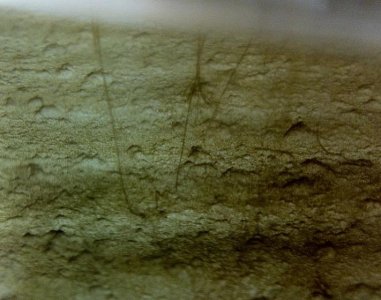
I'm not sure what this is and the cord for my good camera is broken so I had to take this picture with the phone. It's more like snot in places rather than a covering like my last cyano breakout. Can you tell. through this sorry picture, what I'm dealing with. I've held off on this week's water change in case this is something that will thrive on new nutrients being added-

 
Tough to tell what that is.


But, for the future, moving water to a new tank will not lessen a cycle. Only moving established liverock can do that.
 
Tough to tell what that is.


But, for the future, moving water to a new tank will not lessen a cycle. Only moving established liverock can do that.

I have about 177# of liverock in my current tank, half of which will be going into the new tank immediately. I will take about one cup of my current sand bed but the rest will stay right where it is

I know the water won't have much affect on the cycling and I phrased that incorrectly. The main purpose of the water transfers will be to equalize the tanks' parameters as much as possible so the move will go smoothly. I was even considering crossing the drain and return lines after 2 weeks or so to make them an exact match. Don't think I'm going to go that route, however
 
I'm new to marine aquariums so I was excited when I saw people were having blooms of dinoflagellates in their tanks (though sad that they are so hard to get rid of). I am a graduate student doing my PhD on dinoflagellates. The descriptions of these blooms sound an awful lot like one of the groups of dinoflagellates I work on (Prorocentrum sps.). If anyone currently has some dinos I'd really like a look at them. Your pest might actually be something interesting to me.

I'd also be happy to answer any dino questions you guys may have.

You got any miraculous insight on how to kill the stinking things? I'm getting ready to go through hell to try to get rid of them.
 
I have about 177# of liverock in my current tank, half of which will be going into the new tank immediately. I will take about one cup of my current sand bed but the rest will stay right where it is

I know the water won't have much affect on the cycling and I phrased that incorrectly. The main purpose of the water transfers will be to equalize the tanks' parameters as much as possible so the move will go smoothly. I was even considering crossing the drain and return lines after 2 weeks or so to make them an exact match. Don't think I'm going to go that route, however

That makes a whole lot more sense. Good luck with the transfer.
 
I had a huge dino problem several weeks ago. I'm sure you know it already, but just in case...lessen the photo period, try a 3 or 4 day lights out period first, cut feeding in half, filter sock in sump changed daily, and raise alk. The biggest factor was manually removing as much as possible every day, too. That alone may have ultimately got rid of it all, but in conjunction with the other points I mention I'd find it hard to imagine that dinos will ultimately survive. Good luck.

Bob
 
I'm new to marine aquariums so I was excited when I saw people were having blooms of dinoflagellates in their tanks (though sad that they are so hard to get rid of). I am a graduate student doing my PhD on dinoflagellates. The descriptions of these blooms sound an awful lot like one of the groups of dinoflagellates I work on (Prorocentrum sps.). If anyone currently has some dinos I'd really like a look at them. Your pest might actually be something interesting to me.

I'd also be happy to answer any dino questions you guys may have.

I think I'm going to nominate you as a moderator in a new "Slime, Sludge and other Reef Sewage" forum. :idea:
 
Too bad you're so far away! I have plenty to go around... :/

I'd prefer alive but mailing some in lugols wouldn't be bad. If you could send me some photos I could figure out if it would be worth the effort to mail you some tubes and lugols.

As luck would have it... Can you tell.

Its pretty hard to tell anything from that photo, but snot rather than filaments is right. If you see little tendrils floating up that is a very good sign of dino.

You got any miraculous insight on how to kill the stinking things? I'm getting ready to go through hell to try to get rid of them.

I'm usually trying to keep them alive. The big trouble you have is that most things that will kill them will kill other things n your tank. Your tank is teeming with dinoflagellates, nearly all good. Getting rid of the bad one that is blooming is tough. The algae that live in the cells of your coral and do photosynthesis for them are dinoflagellates. The algae that produces the most omega-3 fatty acids in your tank are dinoflagellates.

That said dinos, and the in particular the ones I study that I think might be your pest like low light and low turbulence. Increasing flow and increasing the light intensity will bother them. Many of mine I have to put under shade cloth under the T5s to get them growing nicely. They will also swim up into the water column at times so a UV sterilizer will nuke some of them.

Many are mixotrophic so without a species ID turning off your lights may not help. They'll just stop doing photosynthesis and start eating (though it may slow them down enough that they aren't a problem anymore).

Many are toxic, but even the non-toxic ones can use up a lot of oxygen if you have a bad bloom so make sure you keep things oxygenated for your fish.

I think I'm going to nominate you as a moderator in a new "Slime, Sludge and other Reef Sewage" forum. :idea:

My first act would be to insist that everyone get at least an cheap microscope. So many of these algae IDs would be dead simple even for a novice if you had a cheap microscope. So far every sample someone has told me is a dino bloom in their tank has ended up being diatoms or cyano - neither of which look anything like a dinoflagellate under the scope. They sell cheap ones for your phone and most universities have places where they sell old lab equipment where you can get a $1000 student scope for like $100.
 
I like this guy!! I learned more about dino's just in reading his last post than I have in reading a bunch of threads.

Curious about transporting in Lugol's. Do dinos require a high amount of iodine to thrive?
Thanks!!
 
Attached you'll find a dinoflagellate (Prorocentrum hoffmannianum) who grows a lot like the descriptions of dino outbreaks I have read in forums like these.

The Lugols wouldn't be to provide iodine but to preserve the specimen. The dinos would be dead. About 2ml/100ml will preserve the DNA well. They would be easier to identify alive though. One could ship some in a tube and hope they live but many dinos will die very fast in cold water.
 

Attachments

  • Phoff.jpg
    Phoff.jpg
    59.9 KB · Views: 19
Pants, would this cheap microscope work :
found this on amazon for $13.46
Lightweight and portable, the Carson MM-200 MicroMax pocket microscope is ideal for on-the-go science. The MicroMax offers a powerful 60 to 100x magnification range, making it easy to examine blood samples, bugs, and anything else that's worthy of a closer look.
 
Pants, would this cheap microscope work :
found this on amazon for $13.46
Lightweight and portable, the Carson MM-200 MicroMax pocket microscope is ideal for on-the-go science. The MicroMax offers a powerful 60 to 100x magnification range, making it easy to examine blood samples, bugs, and anything else that's worthy of a closer look.

These toy scopes can be a hard call. 100X with some glass will be sufficient. Ideally I'd want you to be able to get to 200-400. For the price I'd almost wonder if the little jewelers loop might be the better buy. It would have less magnification but the quality of the lens will be better and it will be cheaper.

What you will be looking for at these scales is:
1) Cyano - small compressed cells organized in filaments. Filaments might be ribbon-like (they come in other shapes but these are the ones I've seen in aquariums; genus Oscillatoria).
2) Diatoms - Angular cells (lots of shapes possible) look a bit like living crystals, slow moving.
3) Prorocentroid Dinoflagellates - Compressed swimming cells. the filaments visible at a macro level are actually cells in mucus not touching each other just all suspended in a column of mucus. The swimming motion is a whirling (dinos means to whirl in greek). The whirling motion is characteristic of all dinoflagellates.

So you will basically be asking yourself: Is it a filament? Is it crystal-like? Does it whirl around when it swims (like its drunk)?

I think you could answer those questions with a toy scope.

If you have a University near by you should check out their used equipment though. But you'd be paying like 10X as much as these toy scopes. These scopes will get you up to 400X with good glass. You'd need to be prepared to take it apart and clean it though.
 
I teach microbiology in a secondary school. I am spoiled with equipment. I have a nice scope at home for my viewing pleasure.

We are patiently awaiting our dino bloom in our classroom tanks. :)
 
If I mailed some of you tubes and a self addressed padded envelop would you be able to put some of your dinos in the tube and mail it back?
 
I'll spend some time this afternoon putting together some envelopes to send. If you have dinos that you could send and want to help please PM me and address. I'll probably include a tube for preserved cells with lugols already in it and another tube that I will hope could carry live cells (not sure how realistic that is).

I'll definitely send you some microscope images of your algae and if it turns out to be a dino I could even send some electron microscope images, maybe some fluorescent images, and some DNA analysis. But your dino might end up being something new and interesting. If I can get them alive I should be able to have colleagues at the FDA test for toxins too.
 
I get some thick red slime once in a while in my tank and it just happens on my sandbed. Not sure what it may be but it if helps I can send you some.
 
Back
Top