
You are using an out of date browser. It may not display this or other websites correctly.
You should upgrade or use an alternative browser.
You should upgrade or use an alternative browser.
Id sources for flatworms
- Thread starter maxima k2
- Start date

melev
Well-known member
Goby1kanobe
Premium Member
I clearly have a flat worm problem. I have a 180 gallon and a nano tank. They are in both. Any suggestions? I have a mandarin goby in my 180, and have heard they are a help in ridding tanks of these pests, but mine doesn't seem to be solving the problem.
Thanks!
Thanks!
melev
Well-known member
<i>From my site:</i>
<b>Flatworms (Red Planaria): How to eliminate them from your reef</b> ââ"šÂ¬Ã¢â‚¬Å“ by Marc Levenson
Small reddish-rust colored creatures may already be in your tank. Or you may buy a coral and they'll appear as hitchhikers later. They may appear on the glass/acrylic, on the substrate, or on live rock. Due to their extremely thin bodies, they are called flatworms correctly. They appear almost two-dimensional, barely a flap of skin or perhaps a 'dangling chad'. They can move through the tank, elongating the front part of their body like a sail filling with wind, latch on to the nearby surface and pull the rest of it's body forward.

Red Planaria
They feed on small foods like rotifers, phytoplankton and such, and will grow out of control unchecked. Creating a mat with their bodies, they can smother corals or parts of the substrate. If they get to the point of overpopulating the tank, there is the possibility that they may die suddenly all at once, and the toxin they release at death can cause further deaths and even wipe out a tank entirely. Some predators exist, but results vary. Six Line Wrasses, Leopard Wrasses, Target Mandarins and even Blue Damsels reportedly eat these flatworms, as does one Nudibranch (Chelidonura varians), but some have opted for a different approach when these methods prove ineffective.

Benign flatworm - nothing to worry about.
Salifert came out with a product over a year ago called Flatworm eXit, a poison that only affects flatworms and is reef-safe. Let me add the qualifier that if your tank is heavily infested, Flatworm eXit will not be the cause if you lose livestock. The issue is that if many flatworms die at once, their toxins reach lethal levels quickly and this, not the product, can lead to deaths in your tank. Feel free to ask others about their results before using this product. When I used it, the only item in my tank that appeared distressed was my Hawaiian Featherduster. Its feathers were shriveled up and wilted and it looked very badly during the treatment, but afterwards it opened up completely. SPS, LPS, soft corals and fish were completely unaffected, as were snails, starfish, crabs and pods. My infestation was low because I regularly siphoned out all I could see each week, before I ever dosed my tank.
What I recommend is that you remove as a many as you can before you treat the tank. This is what I used:
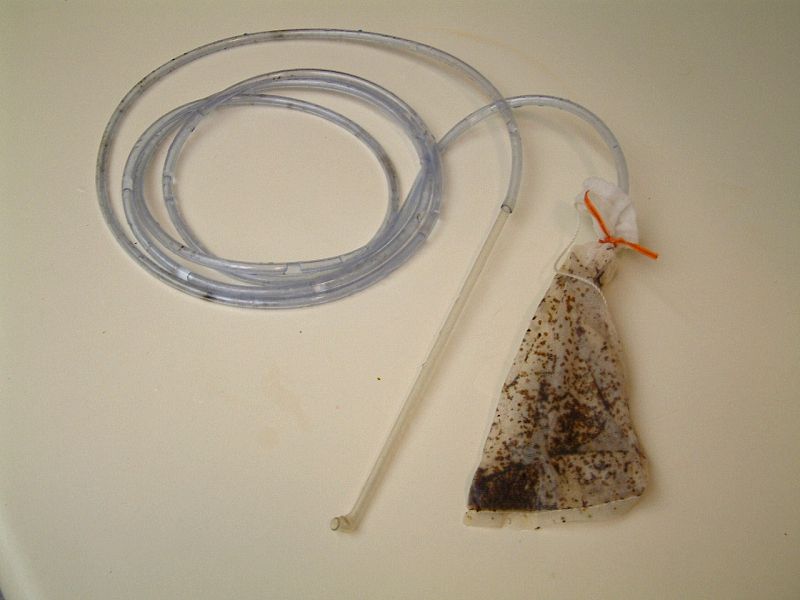
I put the bag in my sump, and sucked out all the flatworms I could reach and see. Starting the siphon was easy by putting the end of the rigid tubing in the flow of a powerhead. I siphoned out as many as I could find every day until virtually none were in sight. The less you have, the less toxins will be released when you treat. If you don't use a sump, you can put the bag in a bucket in front of the tank, and after the procedure, you might decide to pour the water back in your tank. If the water looks cloudy or reddish, it would be better to dispose of it and replace lost tank water with new saltwater.
The day I was ready to treat my tank with Flatworm eXit, I made up 20g of new saltwater for a water change. I also hooked up a canister filter filled with GAC (granulaed activated carbon), and tested it to make sure it was ready to run.
I dosed the tank with approx 60 drops of the chemical (1 drop per gallon), and the flatworms started to come out into the open, and died. They would die on a string, and similar to webbing, multiples would die on that thread. I used my vacuum system to suck out all that I could see. After the first hour, I added 30 more drops and continued to observe the tank and siphon any dead or dying flatworms. My skimmer was always on, but the bubbles were depressed due the treatment, and it took a couple of hourse before it began skimming again.
After 1 hour 20 minutes, I turned on the canister filter filled with carbon to pull out impurities and toxins.
The skimmer did work later, and pulled out some stuff, but nothing like some of the horror stories detailed on ReefCentral.com. I did a 20g water change (55g reef plus sump), and they were gone.
It is recommended to repeat the procedure one week later, but forgot and never did treat the tank again.
About a month later I saw a few in my tank, but I've not seen one in a long time now. I do have two Mandarins, a Six Line Wrasse, and a Blue Damsel to work on any possible flatworms if they do reappear.
Some people take precautions when adding new livestock to their tank, always doing a Flatworm eXit dip for 15 minutes prior to adding the coral to their display to prevent spreading these creatures.
<u>A suggestion by Salifert:</u> To determine the proper dosage of Flatworm eXit, take one gallon of tank water, and add a few flatworms to it. Add one drop of F.E., and stir. Wait and watch to see if it affects the flatworms. If not, add another drop, stir and wait & watch. If necessary, add another drop and stir. Wait 15 minutes each time, until you see the flatworms are obviously distressed. At that point, you'll know exactly how many drops per gallon it will take to kill the flatworms in your system. What a great idea!
<b>Flatworms (Red Planaria): How to eliminate them from your reef</b> ââ"šÂ¬Ã¢â‚¬Å“ by Marc Levenson
Small reddish-rust colored creatures may already be in your tank. Or you may buy a coral and they'll appear as hitchhikers later. They may appear on the glass/acrylic, on the substrate, or on live rock. Due to their extremely thin bodies, they are called flatworms correctly. They appear almost two-dimensional, barely a flap of skin or perhaps a 'dangling chad'. They can move through the tank, elongating the front part of their body like a sail filling with wind, latch on to the nearby surface and pull the rest of it's body forward.
Red Planaria
They feed on small foods like rotifers, phytoplankton and such, and will grow out of control unchecked. Creating a mat with their bodies, they can smother corals or parts of the substrate. If they get to the point of overpopulating the tank, there is the possibility that they may die suddenly all at once, and the toxin they release at death can cause further deaths and even wipe out a tank entirely. Some predators exist, but results vary. Six Line Wrasses, Leopard Wrasses, Target Mandarins and even Blue Damsels reportedly eat these flatworms, as does one Nudibranch (Chelidonura varians), but some have opted for a different approach when these methods prove ineffective.
Benign flatworm - nothing to worry about.
Salifert came out with a product over a year ago called Flatworm eXit, a poison that only affects flatworms and is reef-safe. Let me add the qualifier that if your tank is heavily infested, Flatworm eXit will not be the cause if you lose livestock. The issue is that if many flatworms die at once, their toxins reach lethal levels quickly and this, not the product, can lead to deaths in your tank. Feel free to ask others about their results before using this product. When I used it, the only item in my tank that appeared distressed was my Hawaiian Featherduster. Its feathers were shriveled up and wilted and it looked very badly during the treatment, but afterwards it opened up completely. SPS, LPS, soft corals and fish were completely unaffected, as were snails, starfish, crabs and pods. My infestation was low because I regularly siphoned out all I could see each week, before I ever dosed my tank.
What I recommend is that you remove as a many as you can before you treat the tank. This is what I used:
I put the bag in my sump, and sucked out all the flatworms I could reach and see. Starting the siphon was easy by putting the end of the rigid tubing in the flow of a powerhead. I siphoned out as many as I could find every day until virtually none were in sight. The less you have, the less toxins will be released when you treat. If you don't use a sump, you can put the bag in a bucket in front of the tank, and after the procedure, you might decide to pour the water back in your tank. If the water looks cloudy or reddish, it would be better to dispose of it and replace lost tank water with new saltwater.
The day I was ready to treat my tank with Flatworm eXit, I made up 20g of new saltwater for a water change. I also hooked up a canister filter filled with GAC (granulaed activated carbon), and tested it to make sure it was ready to run.
I dosed the tank with approx 60 drops of the chemical (1 drop per gallon), and the flatworms started to come out into the open, and died. They would die on a string, and similar to webbing, multiples would die on that thread. I used my vacuum system to suck out all that I could see. After the first hour, I added 30 more drops and continued to observe the tank and siphon any dead or dying flatworms. My skimmer was always on, but the bubbles were depressed due the treatment, and it took a couple of hourse before it began skimming again.
After 1 hour 20 minutes, I turned on the canister filter filled with carbon to pull out impurities and toxins.
The skimmer did work later, and pulled out some stuff, but nothing like some of the horror stories detailed on ReefCentral.com. I did a 20g water change (55g reef plus sump), and they were gone.
It is recommended to repeat the procedure one week later, but forgot and never did treat the tank again.
About a month later I saw a few in my tank, but I've not seen one in a long time now. I do have two Mandarins, a Six Line Wrasse, and a Blue Damsel to work on any possible flatworms if they do reappear.
Some people take precautions when adding new livestock to their tank, always doing a Flatworm eXit dip for 15 minutes prior to adding the coral to their display to prevent spreading these creatures.
<u>A suggestion by Salifert:</u> To determine the proper dosage of Flatworm eXit, take one gallon of tank water, and add a few flatworms to it. Add one drop of F.E., and stir. Wait and watch to see if it affects the flatworms. If not, add another drop, stir and wait & watch. If necessary, add another drop and stir. Wait 15 minutes each time, until you see the flatworms are obviously distressed. At that point, you'll know exactly how many drops per gallon it will take to kill the flatworms in your system. What a great idea!

A suggestion by Salifert: To determine the proper dosage of Flatworm eXit, take one gallon of tank water, and add a few flatworms to it. Add one drop of F.E., and stir. Wait and watch to see if it affects the flatworms. If not, add another drop, stir and wait & watch. If necessary, add another drop and stir. Wait 15 minutes each time, until you see the flatworms are obviously distressed. At that point, you'll know exactly how many drops per gallon it will take to kill the flatworms in your system. What a great idea!
This is NOT to determine the proper dosage.
The right dosage is as described in the instructions. However some people do a slightly higher dosage.
The above "experiment" can show, if one or more treatments were not successful, at what dosage they do respond or can show that they are (temporarily) resistant to FWE.

This is NOT to determine the proper dosage.
The right dosage is as described in the instructions. However some people do a slightly higher dosage.
The above "experiment" can show, if one or more treatments were not successful, at what dosage they do respond or can show that they are (temporarily) resistant to FWE.
melev
Well-known member
Thanks for chiming in Habib. So while this would be the right drops per gallon to kill the flatworms, there's a risk it might be too strong for the livestock in the reef perhaps?
I know some people have tripled the dosage in their tanks in the past. Some with perfect results, some with serious losses. I'd always attributed that to the fact the toxins coming out of the flatworms were too abundant.
I'll update my page on my site. If you have an alternate text you'd suggest, I'll be happy to use it. What I posted was something I'd read in your forum about 4 to 6 weeks ago.
I know some people have tripled the dosage in their tanks in the past. Some with perfect results, some with serious losses. I'd always attributed that to the fact the toxins coming out of the flatworms were too abundant.
I'll update my page on my site. If you have an alternate text you'd suggest, I'll be happy to use it. What I posted was something I'd read in your forum about 4 to 6 weeks ago.

maxima k2
New member
Melev, I emailed the pic. to you. This worm is about an inch and a half long and half an inch wide when it is undisturbed. I have only seen one and it is in my curing tank. I do not have the main tank up yet. I am trying to figure out if it will be a problem before I put this rock in the tank, I dont want to be chasing anything around a 230.
melev
Well-known member
Okay, this is not one you want in your tank. I've seen them before. If you'll notice, the pattern is similar to the mantle of a clam, so they can blend in while they eat away at its prey.
If you find flatworms of this size in your tank, typically it is a good idea to get rid of them, unless you know someone that wants them, like a biologist perhaps.
If you find flatworms of this size in your tank, typically it is a good idea to get rid of them, unless you know someone that wants them, like a biologist perhaps.

Goby1kanobe
Premium Member
Thanks for the sugestions guys! That'sa big help

Similar threads


- Replies
- 0
- Views
- 155
