Is It Possible?

Ambition

New member
Is it possible for one to get wild caught black and white ocellaris? I've heard they aren't collected due to captive breeding reducing the prices, making the collection of wild specimens not very worthwhile. Just curious since I'm getting into breeding, and if at all possible I want wild caught individuals to start.
 
I'm not sure about the wild caught thing, but remember that wild caught fish have significant risks of diseases. You might want to consider perhaps sourcing a few from breeders in vastly different locations across the country, thereby increasing the genetic pool of your own fish. I don't know if it would work but its just a thought.
 
I'm not too worried about diseases, I have multiple QT tanks set up for stocking the broodstock tanks. More concerned about a better gene pool, I'll look into sourcing individuals from different areas as well.
 
The black and white occ are only in the Darwin area of auustrailia IIRC. Collecting them is extremely dangerous because of the famous saltwater crocodiles!!
 
As far as I know, there was only one collector in the Darwin area and he was killed by a crocodile several years ago.
 
I'm not fond of the orange face... I much prefer the specimens that transition to being completely black and white.
 
I recognize two diferente types of Ocellaris and Percula.................

And this is related with Anemone species.............

Percula that are founded in shallow Waters............sandy places........and hosted in S. gigantea..........show heavy sign of melanism..............and they are called true Percula.............

The same occours with Ocellaris.................the ones that are founded in shallow Waters and hosted in S. gigantea.................show signs of melanism...........and they are called Black O...........


The ones...........of both Percs and Os..............that are founded in Reefs.............hosted in Mags...................don´t show signs of melanism...............they have the completelly Orange body..............

They evolved in this way.................and also developed a genetic issue...............

So Melanism is genetic too..................evolving from this kind of relationship with Anemone species..............

Maybe in Ocellaris..............in Nature................some fishes don´t show a complete Melanism....................and that fact is seeing in headlights.........

I think that it´s a sign that they are wild..............and I think its cool.........

But completelly black ones are awesome................

 
I´m tending to trust................

Look at these that also claim to be WC.............

http://www.nano-reef.com/topic/232937-euphyllias-red-sea-max-130-34-gallons/

The Female have the same head pattern..............

I like these fishes.............they seems not loose the yellow head marks..........

I don't have a problem believing these are WC since the guy who owns them lives in Australia and the clowns have normal faces/heads.


I recognize two diferente types of Ocellaris and Percula.................

And this is related with Anemone species.............

Percula that are founded in shallow Waters............sandy places........and hosted in S. gigantea..........show heavy sign of melanism..............and they are called true Percula.............

The same occours with Ocellaris.................the ones that are founded in shallow Waters and hosted in S. gigantea.................show signs of melanism...........and they are called Black O...........


The ones...........of both Percs and Os..............that are founded in Reefs.............hosted in Mags...................don´t show signs of melanism...............they have the completelly Orange body..............

They evolved in this way.................and also developed a genetic issue...............

So Melanism is genetic too..................evolving from this kind of relationship with Anemone species..............

Maybe in Ocellaris..............in Nature................some fishes don´t show a complete Melanism....................and that fact is seeing in headlights.........

I think that it´s a sign that they are wild..............and I think its cool.........

But completelly black ones are awesome................

Sorry to be picky, but some of this is just wrong.

Some melanism is genetic and some isn't in percs. Just ask those breeders who tried to fix the "onyx" trait in percs early on. It can also come and go depending on the type of anemone in which the clown chooses to live.

Black ocellaris are a color morph that comes only from the Darwin area in North Western Australia. Ocellaris that occupy gigantea in other parts of world don't show the same melanism.

FWIW, your posts would be much easier to read if you didn't use 20 periods instead of just a comma or one period.
 
Off topic but every time I see your (phender) avatar I get a tinge of nostalgia for my berner. She only made it 4 1/2 years before dying from the breed's obligatory cancer. Great dogs, and the melanism is well fixed in their ground coat. :)
 
I recognize two diferente types of Ocellaris and Percula.................

And this is related with Anemone species.............

...
I think this is wrong.
I agree with phender. Black and white Ocellaris are originally from Darwin. Orange and white Ocellaris originally from elsewhere. The black coloration of Ocellaris have nothing to do with which kind of anemone they live in.
Percula does seem to have more black when live in a Gigantea instead of Magnifica. However, there are Onyx Percula that stay black with Magnifica. There are Percula with minimal black and stay mostly orange even with Gigantea as host.


OP
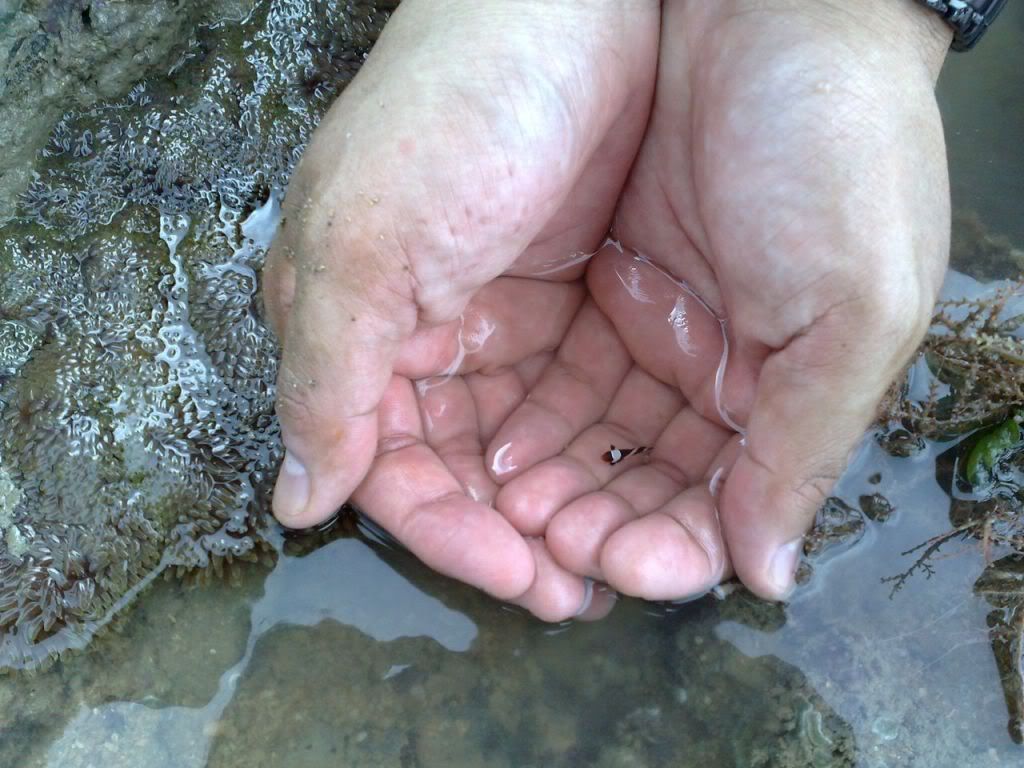
This black and white Ocellaris is/was wild, but not caught in Darwin. Lewy took this picture and then let him go.
Juv_BandW_Occ-rz.jpg

This picture is in this thread
http://reefcentral.com/forums/showthread.php?t=1529412
 
You are right...............not all fishes show melanism................

But I still believe that the kind of Host Anemones have its part in this evolutive process..........
 
I saw some images from Peninsular Malaysia..............from Singapore and Perhenthin Islands..............and the Ocellaris hosted in Gigantea show signs of melanism...............not all fishes................but the mojority............

http://www.wildsingapore.com/wildfacts/vertebrates/fish/pomacentridae/ocellaris.htm

http://wildshores.blogspot.com.br/2011/07/rich-reefs-of-kusu-island.html

In Philippines also you can see signs of melanism in Ocellaris when hosted in Gigantea.........

http://www.aquaworldaquarium.com/Articles/TonyGriffitts/DivingandSnorkelingInThePhilippines.htm


They are not black.............but brown to burnt Orange color...........
 
Certified wild caught ones are occasionally found but they are extremely infrequent and command a high price. About 4-5 years ago I had a line on a mated pair that was tracked through the supply chain from the catcher, but their landed pre-retail cost was about $600 or $900 for the pair (can't remember the exact number, but it was very high). I passed on the pair and I believe that ORA was anxiously standing by in the wings to snatch them. My two main breeding pairs are WC (originally brought in 6 several years ago) and as things have changed so much from when I got them, I do wonder what I'll do when they start reaching their inevitable expiration date.
 
Well a breeder recently sold a breeding pair of black and white ocellaris (both captive raised) for $500, so the $600 isn't too bad if WC (and I would spend the extra hundred to start with WC). Anyone know how to get in touch with someone to get a WC individual or two? At least one would be good, if the need arises a second quality bred CB individual would suffice. IMO starting with fresh genetics when breeding is always something to do where/when possible.
 
I saw some images from Peninsular Malaysia..............from Singapore and Perhenthin Islands..............and the Ocellaris hosted in Gigantea show signs of melanism...............not all fishes................but the mojority............

http://www.wildsingapore.com/wildfacts/vertebrates/fish/pomacentridae/ocellaris.htm

http://wildshores.blogspot.com.br/2011/07/rich-reefs-of-kusu-island.html

In Philippines also you can see signs of melanism in Ocellaris when hosted in Gigantea.........

http://www.aquaworldaquarium.com/Articles/TonyGriffitts/DivingandSnorkelingInThePhilippines.htm


They are not black.............but brown to burnt Orange color...........

You said this, "The same occours with Ocellaris, the ones that are founded in shallow Waters and hosted in S. gigantea show signs of melanism and they are called Black O...........

That is wrong. Only the ocellaris found in and around Darwin are called "Black ocellaris".

I said, "Black ocellaris are a color morph that comes only from the Darwin area in North Western Australia. Ocellaris that occupy gigantea in other parts of world don't show the same melanism."

I didn't say they don't show any melanism, I said they didn't show the same melanism.

It is well documented that many species of clowns in the wild show melanism when living in merten's and giant carpet anemones and when moved to different anemones will lose that melanism.
 
Back
Top